Millions of users now have months-long conversation histories with AI assistants💬 But this data is proprietary and unavailable to the academic community for research, training, or benchmarking.
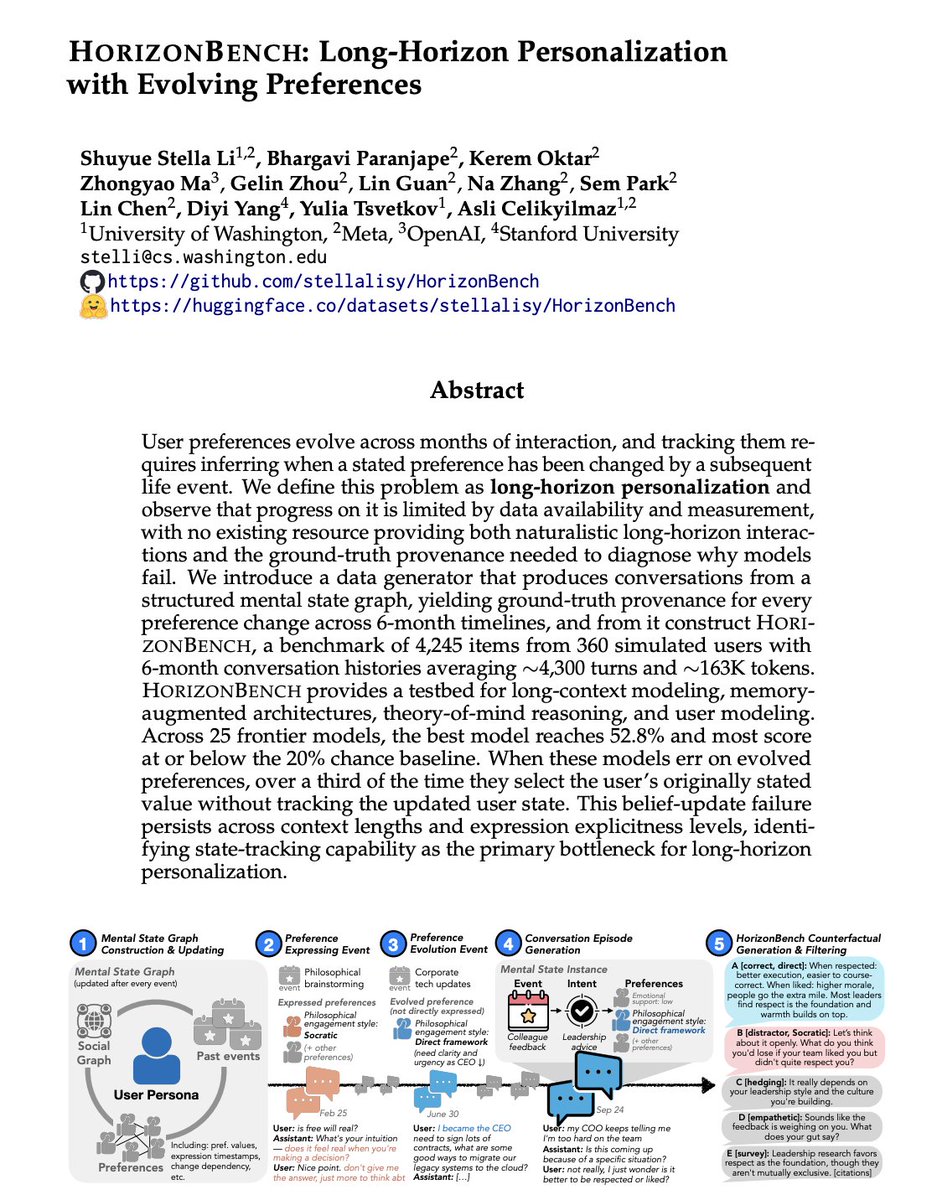
We introduce HorizonBench🌅, a benchmark and data generator for long-horizon personalization: tracking a user's current preferences across a history where life events have silently changed them.
Personalization assumes you need history with a user. What if you don't?
Cold-start is hard: each task&user has many preference dimensions, but each user only cares about a few.
A few strategic questions is all you need, if u know how preferences correlate across population👉🏻🧵
Fara-7B is our first agentic small language model for computer use. This experimental model includes robust safety measures to aid responsible deployment. Despite its size, Fara-7B holds its own against larger, more resource-intensive agentic systems: https://t.co/lT9m0uH4gQ
📢 PhD Students in GenAI/RL! Our team at FAIR is hiring a Research Intern for Summer 2026 to push the boundaries of multimodal multi-agent social interaction. Learn more and apply:
https://t.co/7P66mnEY97
🚀 Introducing the Latent Speech-Text Transformer (LST) — a speech-text model that organizes speech tokens into latent patches for better text→speech transfer, enabling steeper scaling laws and more efficient multimodal training ⚡️
Paper 📄 https://t.co/4nUsbC1YKF
🚀 Meta FAIR is releasing several new research artifacts on our road to advanced machine intelligence (AMI). These latest advancements are transforming our understanding of perception.
1️⃣ Meta Perception Encoder: A large-scale vision encoder that excels across several image & video tasks.
2️⃣ Meta Perception Language Model: A fully open & reproducible vision-language model designed to tackle visual recognition tasks.
3️⃣ Meta Locate 3D: An end-to-end model for accurate object localization in 3D environments.
4️⃣ Releasing model weights for our 8B-parameter Dynamic Byte Latent Transformer, an alternative to traditional tokenization methods with the potential to redefine the standards for language model efficiency and reliability.
5️⃣Collaborative Reasoner: A framework for evaluating & improving collaborative reasoning skills in language models.
Download the code, datasets, and research papers and learn more about how these artifacts are paving the way for more efficient and accurate AI systems.➡️ https://t.co/GgJEPXTH8W
So happy our new multilingual benchmark MultiLoKo is finally out (after some sweat and tears!)
https://t.co/amUll6inIL
Multilingual eval for LLMs... could be better, and I hope MultiLoKo will help fill some gaps in it + help study design choices in benchmark design
@metaai
Introducing our first set of Llama 4 models!
We’ve been hard at work doing a complete re-design of the Llama series. I’m so excited to share it with the world today and mark another major milestone for the Llama herd as we release the *first* open source models in the Llama 4 collection 🦙. Here are some highlights:
📌 The Llama series have been re-designed to use state of the art mixture-of-experts (MoE) architecture and natively trained with multimodality. We’re dropping Llama 4 Scout & Llama 4 Maverick, and previewing Llama 4 Behemoth.
📌 Llama 4 Scout is highest performing small model with 17B activated parameters with 16 experts. It’s crazy fast, natively multimodal, and very smart. It achieves an industry leading 10M+ token context window and can also run on a single GPU!
📌 Llama 4 Maverick is the best multimodal model in its class, beating GPT-4o and Gemini 2.0 Flash across a broad range of widely reported benchmarks, while achieving comparable results to the new DeepSeek v3 on reasoning and coding – at less than half the active parameters. It offers a best-in-class performance to cost ratio with an experimental chat version scoring ELO of 1417 on LMArena. It can also run on a single host!
📌 Previewing Llama 4 Behemoth, our most powerful model yet and among the world’s smartest LLMs. Llama 4 Behemoth outperforms GPT4.5, Claude Sonnet 3.7, and Gemini 2.0 Pro on several STEM benchmarks. Llama 4 Behemoth is still training, and we’re excited to share more details about it even while it’s still in flight.
A big thanks to all of our launch partners (full list in blog) for helping us bring Llama 4 to developers everywhere including @huggingface, @togethercompute, @SnowflakeDB, @ollama, @databricks and many others👏 This is just the start, we have more models coming and the team is really cooking – look out for Llama 4 Reasoning 😉
A few weeks ago, we celebrated Llama being downloaded over 1 billion times. Llama 4 demonstrates our long-term commitment to open source AI, the entire open source AI community, and our unwavering belief that open systems will produce the best small, mid-size and soon frontier models. Llama would be nothing without the global open source AI community & we are so ready to begin this next chapter with you. 🦙
Read more about the release here: https://t.co/7mbK3uggjO, and try it in our products today.
Balancing data across domains is key to training the best generalist LLMs!
In my summer work @MetaAI, we introduce UtiliMax and MEDU, new methods to estimate data utility and optimize data mixes efficiently.
HF Blog: https://t.co/uvGRcxXOxp
ArXiv: https://t.co/s55zK8XGwD
Excited to finally release Magentic-One!
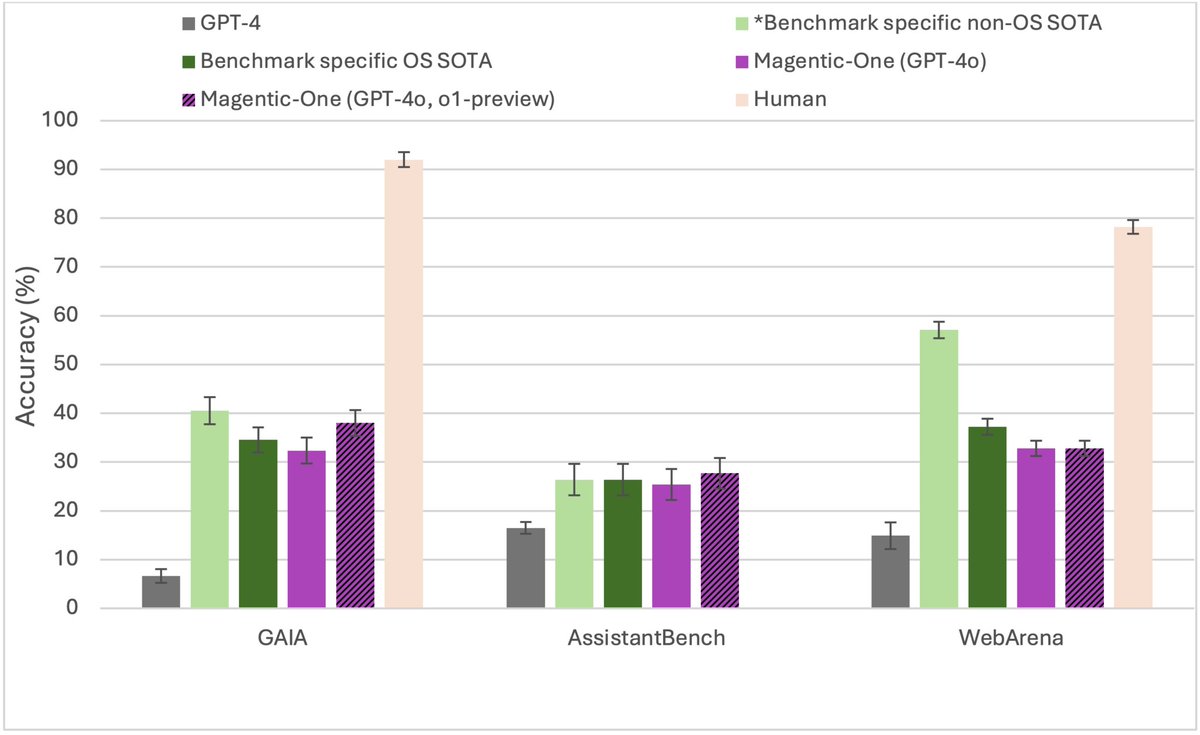
The thing I love about this multi-agent team is that the same implementation achieves very strong performance across three challenging agentic benchmarks. If you are someone working on agentic systems, you know how challenging this can be.
We had to figure out a set of capabilities and their implementations that truly generalize. Think planning, keeping track of progress, action and observation spaces, error recovery, etc
Super excited to release this to open-source and allow others in academia, industry, and open-source community to build off Magentic-One!
Please checkout the tech report and code in the announcement below and let us know how it goes!
Starting today, open source is leading the way. Introducing Llama 3.1: Our most capable models yet.
Today we’re releasing a collection of new Llama 3.1 models including our long awaited 405B. These models deliver improved reasoning capabilities, a larger 128K token context window and improved support for 8 languages among other improvements. Llama 3.1 405B rivals leading closed source models on state-of-the-art capabilities across a range of tasks in general knowledge, steerability, math, tool use and multilingual translation.
The models are available to download now directly from Meta or @huggingface. With today’s release the ecosystem is also ready to go with 25+ partners rolling out our latest models — including @awscloud, @nvidia, @databricks, @groqinc, @dell, @azure and @googlecloud ready on day one.
More details in the full announcement ➡️ https://t.co/hhJoLm5eLV
Download Llama 3.1 models ➡️ https://t.co/rRjvmxqCTC
With these releases we’re setting the stage for unprecedented new opportunities and we can’t wait to see the innovation our newest models will unlock across all levels of the AI community.
Check out ✨Husky✨, @danieljwkim's new work on open-source LM agents for multi-step reasoning + tool-use!
📄 Paper: https://t.co/XSgheQsXdl
📷 Code: https://t.co/yk71yixUMb
Introducing Husky, a unified open-source language agent for multi-step reasoning with tool-use capabilities. Husky-v1:
- Jointly solves numerical, tabular and knowledge-based reasoning tasks.
- Outperforms GPT-4-Turbo on several OOD tasks via mixed-tool reasoning.
- Features new evaluation sets measuring multi-tool use capabilities.
📄 Paper: https://t.co/uZTXTkj1oA
🖥️ Code: https://t.co/busAwgBoLZ
🌐 Webpage: https://t.co/yFnWJyp6Mo
Excited to share a preview of Llama3, including the release of an 8B and 70B (82 MMLU, should be the best open weights model!), and preliminary results for a 405B model (still training, but already competitive with GPT4). Lots more still to come... https://t.co/hUD8oY4G2C
I am hiring strong PhD students in ML and NLP at the University of Waterloo to start in 2024. This is an excellent opportunity to be a part of a vibrant new NLP group w/ 5 professors. Please see more details here: https://t.co/Egstq5qU2q. Deadline is Dec 1!
Ever wondered which data black-box LLMs like GPT are pretrained on? 🤔
We build a benchmark WikiMIA and develop Min-K% Prob 🕵️, a method for detecting undisclosed pretraining data from LLMs (relying solely on output probs).
Check out our project: https://t.co/XBWfX0SjK5
[1/n]
🦙🐪🐫 So many instruction tuning datasets came out recently! How valuable are they, and how far are open models really from proprietary ones like ChatGPT?
🧐We did a systematic exploration, and built Tülu---a suite of LLaMa-tuned models up to 65B!
📜https://t.co/cFE2JUD6Zc





![WeijiaShi2's tweet photo. Ever wondered which data black-box LLMs like GPT are pretrained on? 🤔
We build a benchmark WikiMIA and develop Min-K% Prob 🕵️, a method for detecting undisclosed pretraining data from LLMs (relying solely on output probs).
Check out our project: https://t.co/XBWfX0SjK5
[1/n] https://t.co/qyOIfQQf8n](https://pbs.twimg.com/media/F9YvXJnacAAKvwl.jpg)


