@asteraex Because there is no Caucasus input, Agarak has absorbed the Caucasus input. I am seriously going to take this disgraceful system out of the hands of this guy called Davidski.
@EzKordem Kurmanji and Zazaki mainly use roj (from the light root), so they appear only marginally in the diagram. Both languages are still Iranian, and the preserved form xor keeps a direct link to the older sun root.
@EzKordem The word roj comes from a different root. It goes back to Proto-Iranian ráwčah, meaning “light” or “day,” which itself comes from the Proto-Indo-European root leuk- “to shine.” This is why it is not part of the main sun branch in the diagram.
@Tom_Rowsell There isn't much of a difference; previously, Aknashen was being considered, whereas now the BP group is being considered. The only difference is that Aknashen is a site with high CHG admixture, while BP has CHG-EHG admixture.
@LStano1@realillyrian668 Contrary to what is thought, the exact opposite happened; the autosomal ancestry passed down by CHG was mediated through Y-DNA, which is entirely due to the founder effect.
@Celtiberoca The thing you call Yamnaya was roughly 50% CHG and ZNF. There is nothing more ridiculous than people with a superficial knowledge of genetics commenting on this even your definition of "white" is wrong.
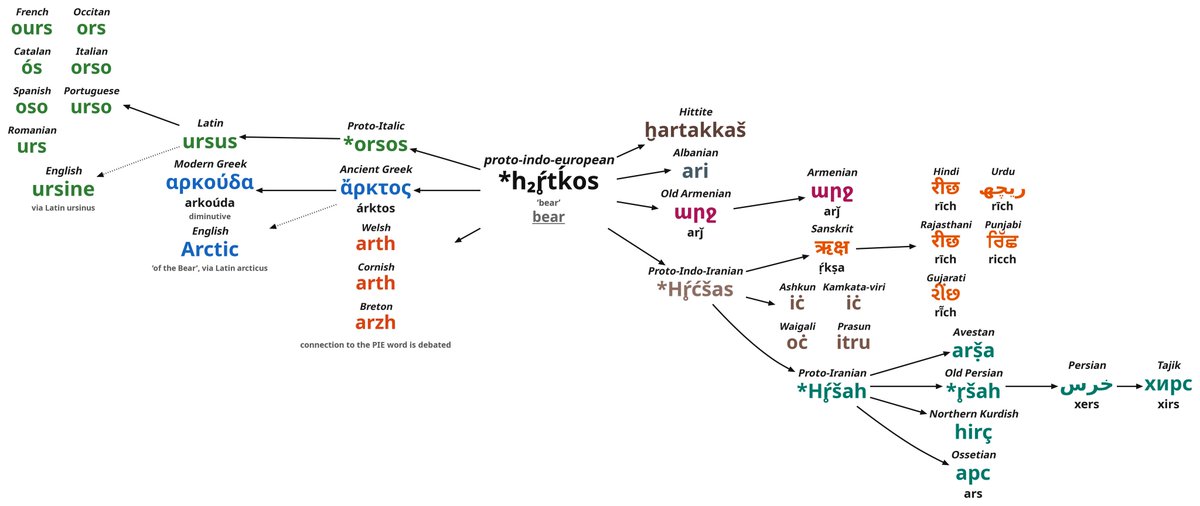
@Akjarati Dashed arrow = tatsama / learned borrowing. The fact that they appear in historical or literary contexts (and some still do) doesn't invalidate the chart; that's literally why the arrows are dashed instead of solid.
@EzKordem Italic goes as gʷ > v (Latin vīta > vida), Hellenic goes as gʷ> b (Greek bíos > bio), and Indo-Iranian goes as gʷ > j (Sanskrit jīvá > Persian cân).