One thing a PhD teaches you, often painfully late, is that effort is not the scarce resource. Knowing where to spend it is.
In coursework, someone has already decided which problems are worth solving. In research, you can spend two years becoming incredibly good at answering a question nobody really cares about.
That's why I think one of the most underrated skills in a PhD is developing research taste.
Knowing which questions are fundamental, which problems are becoming tractable, and which ideas are worth being wrong about for a while.
And perhaps the hardest part is learning to distinguish being productive from actually making progress.
A PhD isn't just about learning how to solve hard problems. It's about learning which problems deserve your time.
🌟 Peer review is the foundation of #CoRL2026. Huge thanks to all our reviewers and ACs, and congratulations to our 5 Outstanding Area Chairs and 99 Outstanding Reviewers! 👏
🔗 https://t.co/pN9sE8PELO
Heading to #CoRL2026 to present SERF!
Spotlight: Tue 11/10 · 2:30–3:00 PM · Hilton Austin
Poster: Tue 11/10 · 5:00–6:30 PM · JW Marriott (2F) · #173
If you’re into robot perception and SLAM, scene representation, mobile manipulation, or honestly anything robots, come say hi!
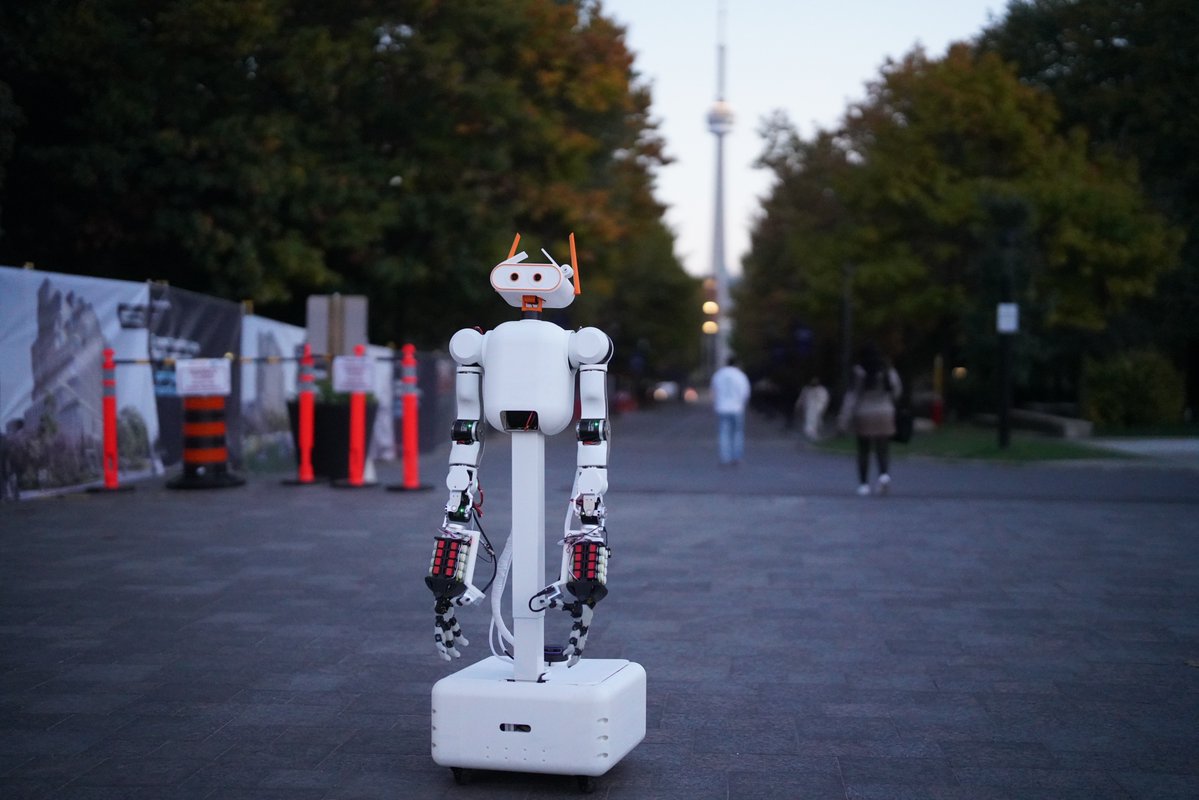
Today, I'm excited to finally introduce MABEL — our fully open-source, mobile bimanual robot! 🤖🦾
$8K in parts. Just 2 weeks from parts to a fully tested robot.
And we're open-sourcing EVERYTHING: hardware, firmware, teleop pipeline, controllers, learning pipelines, and digital twin simulation.
Built by us at @nyuniversity and @UofTRobotics in 3 months, started in a tiny NYC studio apartment 🗽🍕
Our goal is simple: make capable, full-stack robotics accessible to everyone. 🚀
🧵👇
(1/7)
We taught a robot to play!
Introducing Dexterity from Supervised Play (DSP): turning minutes of human play into a world model and dexterous manipulation policy. No task demonstrations or sim2real!
https://t.co/jrQrWRiCHu
Coding agents write code for robot arms. We gave them a flying one 🚁
Can they handle manipulation tasks on a coaxial quad-tiltrotor (8 rotors, 4 tilting arms) with an arm and gripper?
Meet Fly-by-Code: built in simulation, the code runs on the real drone 🧵
DINOv2 has never seen a caption, and Qwen3 has never seen an image. We still aligned their embedding spaces without a single image-caption pair.
It even works when the images and the captions come from different datasets.
Project page: https://t.co/2YHSkXVz1D
⬇️
Can a robot hand learn a task from ONE human video, and still do it when the objects are somewhere else?
Meet Dex-One2Many 🖐️
Trained only in simulation from one video, it runs on a real robot hand, even from setups the video never showed 🧵
Want to just drop in a raw video and automatically extract moving objects, 3D traces, depth, AND event-chunked task descriptions? 🤯
Say less 🎉 TraceExtract, the data engine powering our μ₀ world model, does all the heavy lifting for you.
✅ Depth + camera intrinsics/extrinsics
✅ DINOv2-based semantic keypoints (tracks what ACTUALLY moves)
✅ Global-local 3D reconstruction for long videos without OOM
✅ Event-centric VLM task labels
Try it now 👇
https://t.co/jOamHPI72E
What if every robot failure became a reusable digital experiment?
Today at #ECCV2026, I’ll discuss this question in my talk on evaluating world models for embodied intelligence. I’ve also written a new post: From Atoms to Bits: Building the Digital Development Loop for Physical Intelligence. https://t.co/uoesREnEZh
A robot places a mug in a dishwasher. The gripper opens, and the mug slips. Changing the controller takes seconds. Finding out whether the change helps still requires resetting the scene and running another physical trial.
That gap is the motivation.
Training already happens on computers. But when every meaningful comparison requires another robot experiment, the pace of development remains tied to physical interaction. Reliable digital evaluation could let us test many more ideas between physical checks.
The opportunity is to move more of the development loop into computation: change a model, test it, diagnose the failure, and decide what to try next.
Four works from our collaborations provide foundations:
• IVE: Acquire new experience through exploration guided by semantic reasoning and memory, complementing what we can learn from existing video.
• DynaFLIP: Learn visual representations that preserve information needed for control, using image transitions, language, and 3D motion as supervision.
• μ₀: Learn inspectable 3D interaction traces from video, providing reusable motion knowledge that can support different robot embodiments.
• Guava: Connect reasoning models to embodied tools and feedback, including a 4B agent post-trained on simulation experience.
Integrating these capabilities into a reliable development system remains a research goal. The next step is to build digital environments that improve with physical evidence, and give agents tools to run experiments, compare models, and investigate failures.
Those agents would have two responsibilities: evaluate the candidate policy, and establish whether the digital environment supports that evaluation.
Can digital experiments select policies that perform better on real robots? Does that agreement survive repeated optimization? When should the system request another physical trial?
These are the questions that should define progress. We should measure the development process itself: better physical performance under a fixed robot-interaction budget, while also counting compute and human effort.
The next robot should inherit more than weights. It should inherit failure cases, reproducible experiments, and evidence about where its tests can be trusted.
Every physical trial should improve both the robot and the process that develops the next one.
📍 Today, September 9, 4:30–5:15 PM Malmö time
ECCV tutorial: Evaluating Visual Foundation and World Models https://t.co/YRsOfDf3kM
📖 From Atoms to Bits https://t.co/uoesREnEZh
Thanks the tutorial team @gowthami_s@RawalRuchit@ziqi__ma@kamalgupta09 for bringing this discussion together!
#ECCV2026 #PhysicalAI #EmbodiedAI #WorldModels #Robotics #AIEvaluation
i gave astra a robot, a paint brush, and a camera then asked it to paint the golden gate bridge in real life!
it figured out how to control the robot, and progressively got better throughout its attempts. the timelapse is sick
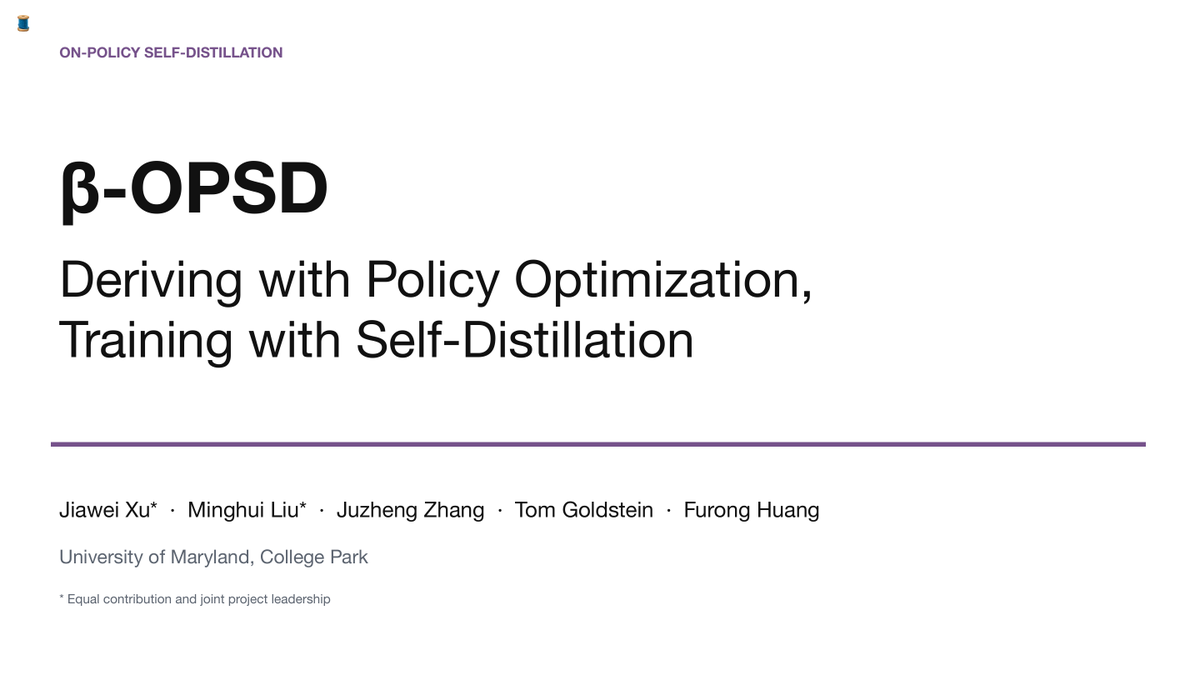
RL vs. distillation may be a false dichotomy.
A post-training abstraction:
RL as a compiler for supervision.
Use policy optimization to derive where the model should go. Compile the solution into dense targets. Let distillation do the training.
Introducing β-OPSD 🧵
The Real-to-Sim part of R2S2R transforms physical robots, sensors, environments, objects, and interactions into simulations that preserve task-relevant observations and dynamics - not only how the world looks, but how it acts when the robot interacts with it. These results set a new bar for sim-real alignment in robot manipulation.
We found a general recipe for Solves: scale pretraining, then hill-climb with minimal in-house data.
For the first time, one fine-tuning example can teach a new behavior that generalizes. Below: 4 folding strategies, learned from one example each and tested on held-out setups.
Today, we give robots a /skills library that self-evolves and compounds indefinitely! Introducing ASPIRE: a robot solving its 100th task is no longer as clueless as solving its first. Coding agents observe multimodal sensory traces from simulation and real robots, launch an evolutionary search over control programs, and distill the best know-how into an ever-expanding library.
ASPIRE is a new type of continual learning: "training" is skill refinement instead of gradient descent.
"Trained model" is a repo of sensorimotor skills instead of floating weights.
“Distributed training” is a panel of agents each practicing a different skill instead of sharded minibatches.
Here's the beauty: ASPIRE gives the tired terms "sim2real transfer" and "cross-embodiment transfer" a whole new meaning. Bridging the sim-to-real gap is notoriously brutal. An end-to-end policy has to swallow both the visual shift (sim looks toyish next to a real camera) and the subtle contact physics it never quite gets right. ASPIRE sidesteps the mess, because it doesn't ship pixels or weights across the gap, but ships the know-how. The robot still has to practice in the real world, not zero-shot, but it gets there way faster because it isn't rediscovering the strategy from scratch. Same for going single-arm to bimanual hardware, which usually requires new data and retraining from zero. ASPIRE achieves up to ~10x cut in "transfer learning” tokens (yes, tokens are the new unit of *training* compute ;)
Check out our gallery of 150+ tasks and 90+ skills the robots taught themselves, all on the website! Kind of wild that we can ship the "learned weights" as an HTML page rather than a GGUF. We'll open-source the full stack so your own robot library starts compounding from ours!
Deep dive in thread:
Introducing SERF: a spatiotemporal environment and robot feature map for long-horizon mobile manipulation.
We demonstrate that conditioning a mobile manipulation policy on a SERF map enables long-horizon reasoning.
New work with @nvidia: evaluating robot policies entirely inside a world model. The policy acts, the model imagines the consequences, and the imagined evals predict real-world results. 🧵
real vs world-model rollout side by side📷
Hot take: robots should not dream in pixels.
Pixels are too low-level.
Latents are too opaque.
μ₀ predicts a third thing:
3D motion traces.
On real robots, it beats π₀.₅ — with ~1/100 the data scale and no action labels for world-model pretraining. 🧵
https://t.co/UfmrqNlBtw
(this video features voiceover narration)