@ludvigsson That’s a thoughtful step, Jonas. You’re helping protect them from cognitive decline. AI is a remarkable innovation, but its unintended consequence is that it can discourage us from challenging our minds and producing original, high-quality work. We’ve become too dependent on it.
Amir Mahmoud invited me to the Little Rock Public Radio earlier this month to discuss the Southern SARE producer grants. Listen….
USDA offers grant for problem-solving farmers in Arkansas https://t.co/TAr323X0CE
3. Yale World Fellows 2027 (global)
A fully funded semester at Yale: stipend, housing, insurance and travel. For non-US citizens 5–25 years into their careers. $20 fee.
Deadline: 2 Dec 2026, 2 PM ET
https://t.co/goTon90KYi
Have an innovative idea for your farm? Southern SARE Producer Grants offer up to $25,000 to help farmers and ranchers test sustainable agriculture practices through on-farm research, demonstrations and other projects.
🔗 Learn more: https://t.co/nPZtfVJ8SI
Join us Friday, Nov. 6, in Pine Bluff, for the 66th Rural Life Conference! This year's theme is "From Vision to Victory: Where Land, People and Purpose Grow Together."
📅 Registration deadline: Oct. 30!
Register today: https://t.co/eIudCeRLbK
Join UAPB Livestock Specialist Dr. Ian Daniel on Wednesday, Sept. 23, for a seminar on managing parasitic diseases in sheep and goats. You'll learn about internal parasites, pasture management, dewormer resistance and proper dewormer use.
📍 S.J. Parker Auditorium
⏰ 2–4 p.m.
This feels like a meaningful step toward next-generation wildlife care —minimizing stress while improving data quality reflects the kind of precision approach the field has been moving toward. It could reshape how we study and protect species
Remotely tracking animals in their natural habitats has become a central pillar of wildlife research. But on land, the process often involves fitting a collar around an animal’s neck that contains a GPS tracker and various sensors. This requires capturing the animal, which isn’t just expensive—it’s also stressful and dangerous for everyone involved.
But a biologist sees a better way forward for this field of study, known as wildlife telemetry.
He’s now building and experimenting with devices, described in a recent preprint, that would allow researchers to apply collars on animals without needing to capture them.
Rethinking how we put collars on animals, he argues, could bring many benefits to wildlife research, such as improving animal welfare and the quantity and quality of data collected at the same time.
Learn more: https://t.co/FyW68eZpXU @NewsfromScience
Are you keeping up with the latest episodes of This Week in Parasitism (TWiP)? 🪱 Hosted by Vincent Racaniello, Daniel Griffin, and Christina Naula, TWiP is the podcast about eukaryotic parasites. 📺 https://t.co/CWITt8q19t
I’m honored to have been selected for the John Paul Delaplane Award at Texas A&M University.
This award recognizes a student who have demonstrated great interest and understanding of livestock production, medicine, and disease prevention.
Interested in gaining research experience, and curious about genome editing tool development and their application to treat human diseases? 🧬 🧫
Good news, we are hiring here in our research lab at Mass General Hospital in Boston! 📣
https://t.co/BiT91yYPkf
A mobile app for real-time local risk info about disease-carrying arthropods won the 2025 ESA Antlion Pit, an innovation competition for entomology-related products and services. Meet the creator of Vector Guard and learn what's next for the app. #EntSoc25 https://t.co/iJfzqGEQxI
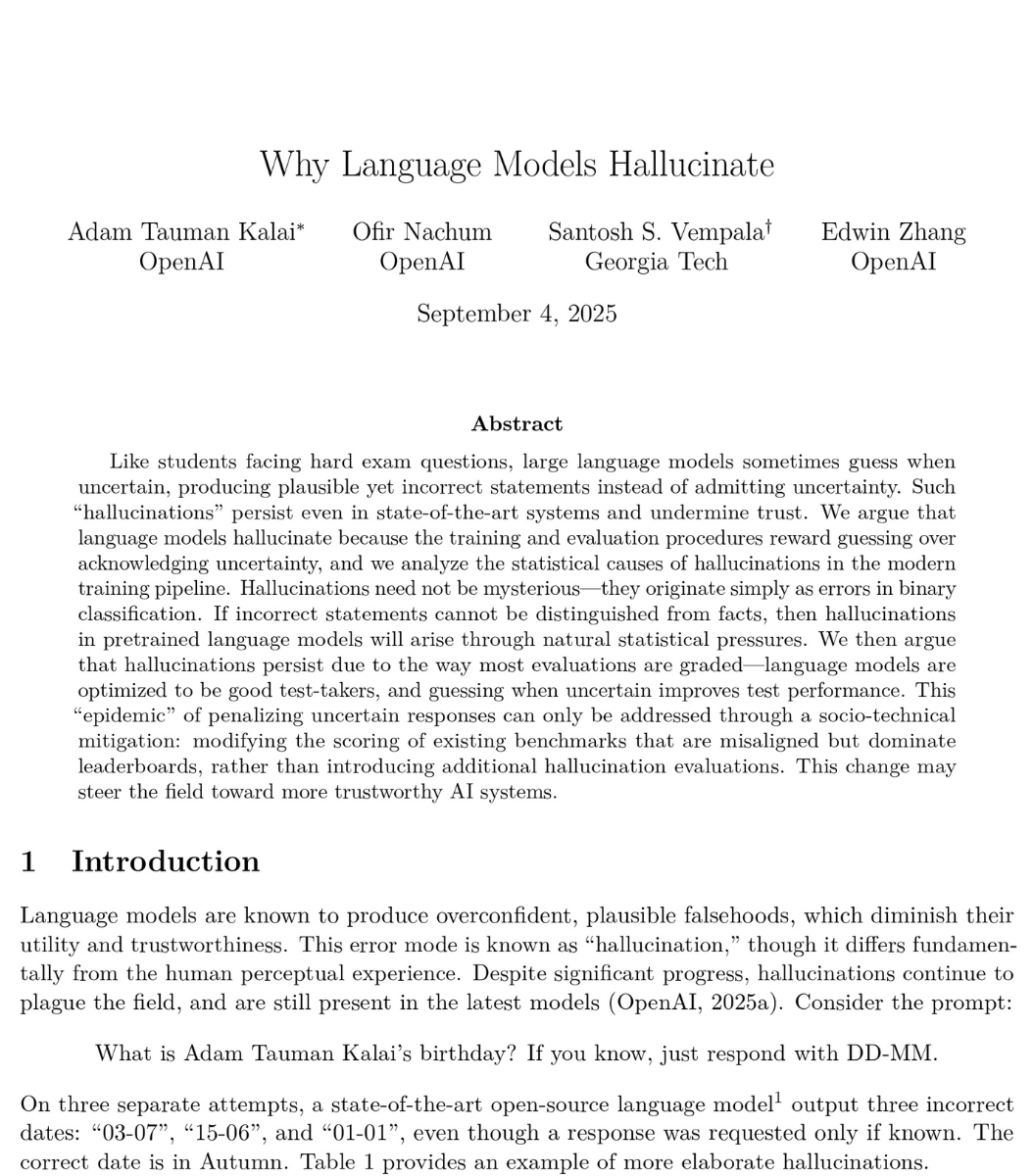
🚨BREAKING: OpenAI published a paper proving that ChatGPT will always make things up.
Not sometimes. Not until the next update. Always. They proved it with math.
Even with perfect training data and unlimited computing power, AI models will still confidently tell you things that are completely false. This isn't a bug they're working on. It's baked into how these systems work at a fundamental level.
And their own numbers are brutal. OpenAI's o1 reasoning model hallucinates 16% of the time. Their newer o3 model? 33%. Their newest o4-mini? 48%. Nearly half of what their most recent model tells you could be fabricated. The "smarter" models are actually getting worse at telling the truth.
Here's why it can't be fixed. Language models work by predicting the next word based on probability. When they hit something uncertain, they don't pause. They don't flag it. They guess. And they guess with complete confidence, because that's exactly what they were trained to do.
The researchers looked at the 10 biggest AI benchmarks used to measure how good these models are. 9 out of 10 give the same score for saying "I don't know" as for giving a completely wrong answer: zero points. The entire testing system literally punishes honesty and rewards guessing.
So the AI learned the optimal strategy: always guess. Never admit uncertainty. Sound confident even when you're making it up.
OpenAI's proposed fix? Have ChatGPT say "I don't know" when it's unsure. Their own math shows this would mean roughly 30% of your questions get no answer. Imagine asking ChatGPT something three times out of ten and getting "I'm not confident enough to respond." Users would leave overnight. So the fix exists, but it would kill the product.
This isn't just OpenAI's problem. DeepMind and Tsinghua University independently reached the same conclusion. Three of the world's top AI labs, working separately, all agree: this is permanent.
Every time ChatGPT gives you an answer, ask yourself: is this real, or is it just a confident guess?
Early morning on the farm. Taking 'the kids' out to collect ticks. No summer rains yet but collected R.simus, R.evertsi, A.hebraeun, H.rufipes and H.truncatum.
@afpmb Interesting — Curious if some of these are just non-pathogenic mutualistic symbionts that might enhance survival of the tick by protecting againast infection with Rickettsia rickettsii (that have detrimental effect on tick survival.)
Download our large database of funding opportunities for early-career faculty and researchers
Download it here: https://t.co/RGXGrdp2uf
433 funding opportunities.