12 free things in the GitHub Student Pack worth claiming (I checked the terms this week) 🧵
You need a verified GitHub Education student account. Then each offer is claimed from its own card on the pack page.
Coding agents are the worst case of turn-based. A long Claude Code run is one giant turn, and your only mid-turn moves are Esc or a queued message. What I'd want is the agent flagging the risky step before it takes it ("about to drop 40 lines of auth checks"), so you know exactly when to jump in.
Single-turn safety evals now score 94–98% on every recent Claude model, so they mostly catch regressions at this point. If you test your own agent with a fixed list of one-shot prompts, steal their multi-turn setup: a second model plays the user and keeps reframing the ask over several turns. That's where models actually start to differ.
Safety evaluations are critical for understanding whether a model is ready to deploy, which safeguards to build for it, and where to focus training and research.
On our Engineering Blog, we offer 10 recommendations for how to design, run and report them.
https://t.co/MtSQmqqi2D
Stop paraphrasing errors to your coding agent.
"It's failing on the auth thing" sends it off guessing. The full stack trace, the exact command you ran, and the line number tell it where to look.
Your summary is already your guess at the cause. If your guess were right, you wouldn't need the agent.
The Dec 1 price doubling is the part to plan for. If you've got an app on Carbon or Argon, start logging cost per request now so you have a baseline.
Then run your own evals on Hydrogen before switching. 25% off isn't a deal if you end up retrying the worse answers.
The pricing for Gemini 4 is pretty confusing - Argon and Carbon are the same token price as each other, and the new Hydrogen is only a 25% discount on that price - though Carbon/Argon will 2x in price on Dec 1st
Hydrogen's pelicans are notably worse
https://t.co/XZqY5eQxcD
3 hours is the headline, but the reason it's 3 hours is that Interior AI already had 4 years of users and a working upload flow. Only the 3d part was new.
For solo builders that's the argument for bolting new model capabilities onto the app you already run instead of launching another one.
⏰ 3 hours later I have it working as a feature!
Real video-to-3d with my own built headless Blender on a VPS
You can upload a walkthrough video of your living room or entire floor
Interior AI turns it into a walkable 3d space where you can paint your walls, move everything around and get a floor plan
It's a quick prototype but it works!
LIVE now on 🏡 Interior AI for all users 😊 🙏
Thanks @wesbos for a lot of the inspiration here too
Reviewing a coding agent's diff? Read the red lines first.
The green is what it wants you to look at. The red is where it quietly dropped an edge case, a validation check, or the comment explaining why some weird line was there.
New code is easy to judge. Missing code is easy to miss.
The 93% vs 60% gap is the number I'd act on. Generating options is basically free now, picking the right one is where the work went.
So write down what "good" means before you look at what the agent gave you, otherwise you end up picking the most polished one, which is usually just the model's default.
I look at what I do with Fable 5.2 in the cracks of my week and think: this would've taken five people and $200,000.
Then I look at what my team does with the same AI.
Last week, between meetings, I analyzed our customer survey, made a game for our team, spotted an opportunity to sell @Every to teams, built a CRM, and started reaching out.
Look at that and you might ask: Why would I need a team at all?
The chart seems to agree. On OpenAI's GDPval benchmark, AI went from beating human experts 12.4% of the time in 2024 to around 83% in 2026. That's the aggregate view of the future of work: gather a lot of data and extrapolate a trend line.
But the aggregate misses something. To see it, you have to get intimate: zoom in on one real situation, with all its messiness, and extrapolate from there.
We gave everyone at Every access to the same customer survey and the same AI models.
• I found an opportunity to sell to teams.
• @poojary_yash saw that first-time subscribers were churning because we send too much email.
• @dabrundage noticed that many of our readers feel lonely: they're excited about AI, but people around them think they're crazy.
• @jackcheng turned the results into a Claymation game show.
Could you ask Claude to produce what each of them found? Maybe. But generating possibilities is cheap. Knowing which ones matter is hard.
@hammer_mt ran an experiment to predict what I'd say in Slack. When Claude got 400 attempts, it produced an answer like mine 93% of the time. But when it had to rank its own answers, mine landed in its top 10% only around 60% of the time.
Each person on a team is responsible for a different part of the world. That responsibility narrows where they look, and their perspective helps them decide what matters enough to act on. A team explores more possibilities than a single default prompt, and it can take responsibility for what it finds.
The obvious objection: models will get better at ranking. I think they will. But people aren't frozen while that happens. Comparing 2026 Yash with 2027 Claude misses that there will also be a 2027 Yash, with another year of experience, using 2027 Claude.
As models improve and spread, they raise the floor for everyone. The default answer becomes the baseline. The value is in using your perspective and responsibility to push past it.
That's why I think we need to change how we measure AI. Instead of only asking how well a model performs on problems everyone agrees are worth solving, ask: How good is it at doing my work, from my perspective?
The aggregate can show us the capability curve. The intimate helps us see what we might build, and who we might become, as we ride it.
I presented this at Thesis: 2027. The full talk is on the Every podcast:
Tried to survive my INTJ lab mate in MBTI Simulator.
Fatal line: "Ask the loudest person to clarify their metric so Elena can evaluate it." -3❤
Getting someone else to do the thinking for her does not count. What saved me was a one-page outline of my variables and why they fit the dataset (+13). 72/100, grade A, "you passed the first filter."
Which type should I try next? Drop a combo below.
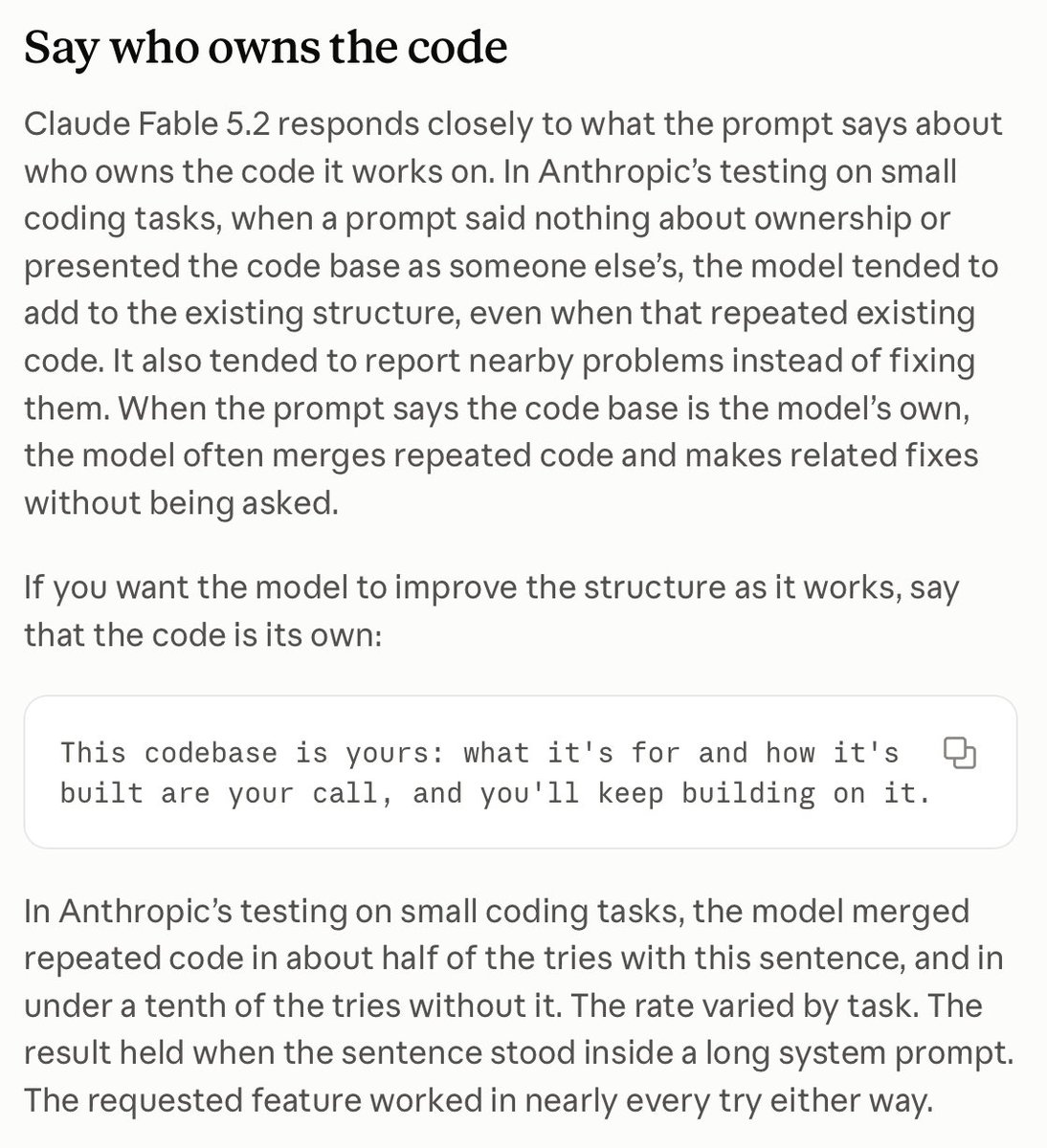
Useful tip, but I'd put a boundary in the same sentence. Something like "this codebase is yours, but the public API and error messages stay as they are."
Otherwise less cautious also means renamed flags and reworded errors that someone's script depends on.
When Anthropic release a new model it's always worth taking a look at their updated prompting guide - here's an entertaining tip to make Fable 5.2 less likely to be cautious in how it improves existing code: tell it "This codebase is yours" https://t.co/mKjdw4QPxV
Cheapest habit with coding agents: commit before every task.
When the agent wanders off and touches 14 files, you want to throw it all away with one git reset, not figure out which edits were yours.
A clean tree going in also means the diff afterwards is only the agent's work. Way easier to review.
Worth adding one rule on top: the two lines above the fold should say what changed and how it was verified, in plain words. If the agent can't fill in the verified line with something real, that tells the reviewer more than the whole collapsed section.
I've recently started hiding the bulk of my AI-generated GitHub PR descriptions behind a collapsed <details><summary> HTML tag (thankfully supported by GitHub Markdown) and I think it's a useful pattern for making PR slop a little bit less exhausting https://t.co/JlFdAJovFt
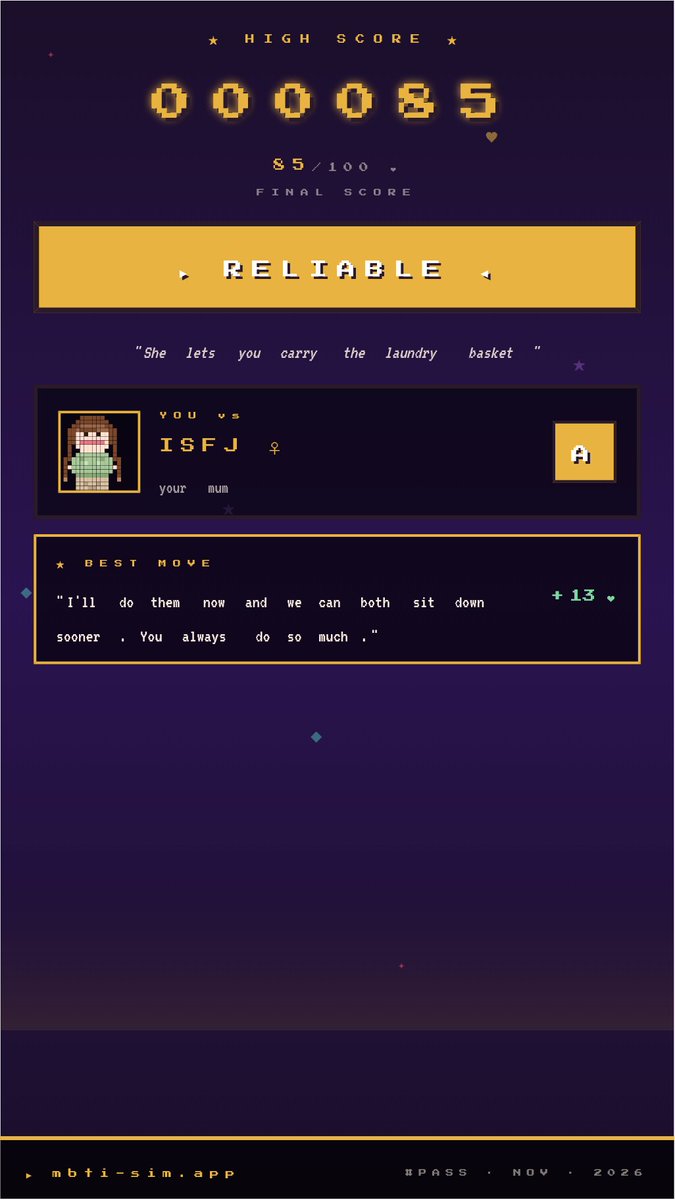
Tried to survive a Sunday with my ISFJ mum in MBTI Simulator.
Fatal line: "Sunday is always your day, let's keep it exactly how you like." -3❤
Apparently staying out of her way reads as delegating. I recovered by actually doing the dishes. 85/100, grade A, "She lets you carry the laundry basket."
Which type combo should I lose to next? Drop it below 👇
https://t.co/ULTqxOFLMn
Only thing I'd add: have the agent put every command it ran into a https://t.co/B20Nh4D21X and commit it.
Otherwise you get a Pi that works, but nobody (including the agent next session) knows how it got that way. With the script, anything weird is just reflash and rerun.
Just set up a new Raspberry Pi 5.
Didn't log in a single time.
Amp flashed the SD card. I plugged it in and booted the machine.
Told Amp to SSH into it and set everything up. It did.
Some day will be the last day I interact directly with a computer.
One habit I'd kill in coding agents: the silent fallback.
Lookup fails? Return []. Parse fails? Skip it. API errors? Try another path and keep going. The task looks finished, and the real bug just hid itself.
If the happy path should work, let it fail loudly. An error you can see is more useful than an empty list that "works."
Most useful numbers in here: Sonnet 3.7 wrote 413 memory files across 225 folders and earned 1 Pokémon badge. Fable 5 wrote 9 files plus one global.md and earned 4.
So if your CLAUDE.md only ever grows, it's probably costing you more than it helps. Keep the top file short and push details into linked notes.
Memory is what allows Claude to learn from experience. In a new Engineering Blog post, we share how “dreaming” helps Claude organize what it’s learned, correct its mistakes, and find what it needs more easily the next time. https://t.co/uUEN4bNkr9
ICLR results came out yesterday. Not the outcome I wanted.
But honestly, the reviewers on my paper actually read it. Way better experience than AAAI.
Time to work on the rebuttal.
Asking the agent to "look at your traces" without a target is how you get elegant diffs that move no user-facing number. Pick one: error rate on a route, or p95 of a named span. Green means that moved. Everything else is optional.
I unironically agree with @bcherny’s take that “coding is solved, but bugs are not.”
The deeper meaning is that you can in theory code *anything* now. You can burn infinite tokens refining and optimizing. Including optimizations that no one will care about 💀
With Vercel you can build a different kind of recursive improvement loop. You capture traces from production, you then optimize and course-correct based on how your software is being used IRL.
This is not a new idea. The best engineers I’ve ever worked with never jumped into coding (now prompting) right away. You instrument the system, collect data, understand distributions, user journeys, and then put fingers on keyboard.
You can ask your agent today to look at your traces!
Agree if the repo has decent tests, since agents actually run them every time and tired humans skip that.
The regressions I'd still watch are in stuff no test covers: error messages, defaults, log formats. Agents love to "clean those up" on the way. Asking it to list every behavior change outside the task before merging catches most of it.
If a coding agent has failed the same fix twice, don't let it try a third time in the same chat.
By then the context is full of its own wrong guesses, and it keeps building on them.
Start a fresh session. Paste the error and what already didn't work, two lines max. It usually gets unstuck faster than any amount of "no, try again."