Lisa Gold: Research Maven. Freelance researcher, fact-checker, writer, rare book expert. I do research for authors. Married to @bymattruff. Elsewhere @ lisagold
The National Archives keeps the actual Constitution at 67 degrees in cases that monitor pressure, humidity, and light down to fine detail. The new exhibit under the Lincoln Memorial has let its case hit more than 80 degrees, with a fan pointed at it like a stopgap because the climate system cannot hold. A preservation specialist put it plainly. Decay is a chemical process, and heat speeds it up. These are not minor numbers to miss by. They are the difference between documents lasting another century and documents beginning to yellow, corrode, and crack within a loan period that runs through next year.
The copy of the Emancipation Proclamation on display is one of 27 surviving from the 1864 printing Lincoln personally signed to raise money for wounded soldiers and grieving families. The 13th Amendment copy is one of just 15, carrying the signatures of 37 senators and 114 House members alongside his own. These are not replaceable objects. A facsimile exists precisely so no one has to gamble the originals on a display case that cannot hold its own temperature.
Add a broken sally port security system that let a child push through both sets of doors at once, a weekend power outage that closed the museum entirely, and a glass door that shattered on a visitor, and the pattern stops looking like bad luck. It looks like a building that opened before it was ready, holding pieces of the country's founding promise that cannot be uncracked once they crack.
The Atlantic’s new cover story about the end of reading is absolutely frightening.
Here are 5 concerning facts from it:
1) 51% of adults read 0 books a year: According to the National Endowment for the Arts, which conducts the most comprehensive survey of the nation’s reading habits, fewer than half of all adults reported having read a book of any kind in 2022.
2) Reading for fun has gone from a mainstream hobby to a niche one: Americans who read for pleasure on any given day fell from 28 percent in 2004 to 16 percent in 2023.
3) Everyone is reading less: The decline in reading cuts across age groups, gender, and education levels. Even the demographics that traditionally read the most—retirees, women, and college graduates—have seen a collapse.
4) Books are getting simpler and shorter: New York Times best sellers today have sentences that are about one-third shorter than they were a century ago.
5) Kids are struggling to read and doing less of it: Fourth- and eighth-grade reading scores have slid for the past decade. From 1984 to 2025, the percentage of 13-year-olds who said they rarely or never read for fun rose from 8 to 29 percent. "Every year older a child gets, the less they like to read."
For most of history, the biggest reading problem was illiteracy. People didn't know how to read books.
But today the biggest problem is post-literacy. People know how to read books, but don't.
A society that doesn't read loses more than just books. People lose the ability to think critically, focus deeply, and see life through multiple perspectives.
The world needs you. Please consider picking up a book today.
https://t.co/P8Sq3pAa6K
The Atlantic’s new cover story by @rosehorowitch is absolutely definitive on the end of the age of reading in America—and the emergence of a new post-literate age in modern life
Some core facts and anecdotes:
1. Reading is shrinking. The share of Americans who read for pleasure declined by 43 percent between 2004 and 2023. While Americans might see more words than ever—between all those texts, posts, emails, and captions—less than half of Americans read books, anymore. The average sentence in NYT bestsellers are one-third shorter than a century ago.
2. Americans can swallow words and sentences, but they’re losing the ability to think deeply about writing that’s longer than an Instagram post. Nearly 30 percent of American adults cannot paraphrase or make inferences from a multipage text. In 2017, that number was less than 20 percent.
3. It’s worse for the young. Fourth- and eighth-grade reading scores have slid for the past decade. From 1984 to 2025, the percentage of 13-year-olds who said they rarely or never read for fun rose from 8 to 29 percent.
4. “Every year older a child gets, the less they like to read”: Most high-schoolers consider reading for pleasure an alien practice. Margaret Rennix, Harvard’s assistant director for humanities and social-sciences support, says some students view reading as an unnecessarily burdensome way of acquiring knowledge. “By asking them to read,” she said, it's as if “professors are arbitrarily withholding information from students by forcing them to get it through this more difficult medium.”
https://t.co/kk8qktY6fd
One of the most incredible things I have ever worked on:
Recently discovered documents, written by John Dickinson in 1775, that reveal his secret and previously unknown efforts to prevent the American Revolution.
Now featured in the New York Times.
https://t.co/BLrB27kPtH
New federal data shows 19.2 million people are signed up for ACA Marketplace plans, down 13% from last year, following expiration of enhanced tax credits. This effectuated data accounts for people who lost coverage due to nonpayment.
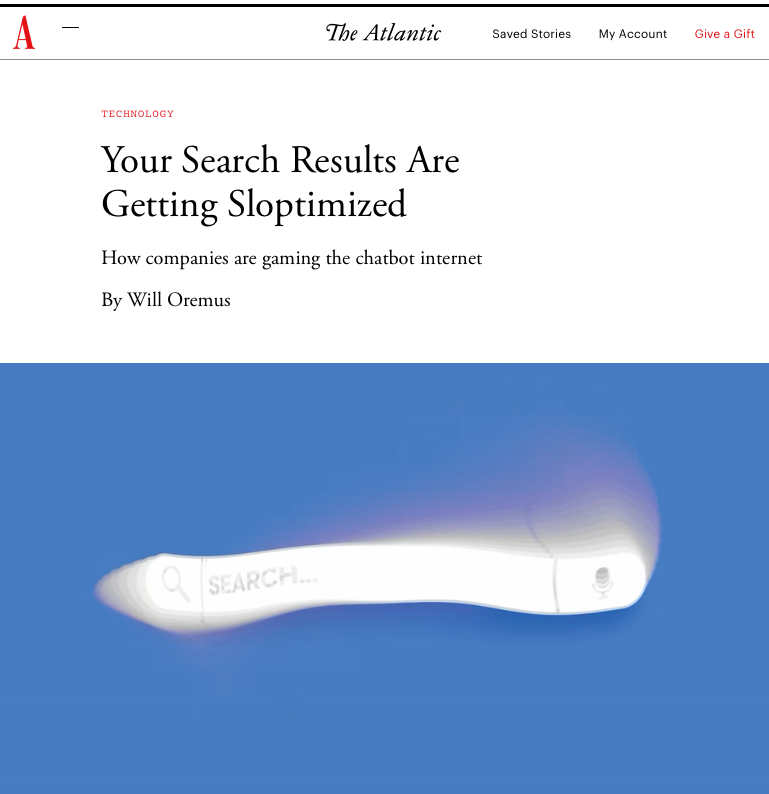
First the web got flooded machines writing for humans. Now the machines are writing for machines.
Welcome to the era of ~sloptimization.~
My latest for @TheAtlantic:
You have noticed it. ChatGPT feels dumber than it used to. Your prompts that worked six months ago produce worse results now. The writing sounds flatter. The ideas sound safer. The internet itself feels like it is shrinking. Every article reads the same. Every email sounds the same. Every answer sounds like it was written by the same voice.
You thought it was you. It is not you.
Researchers at Oxford and Cambridge published a paper in Nature proving what is happening. They call it Model Collapse.
Here is the mechanism in one sentence. AI trained on AI-generated data gets dumber every generation until it forgets what real human data looked like.
The internet is filling with AI-generated content. Blog posts. Articles. Reviews. Comments. Social media. AI companies scrape the internet to train the next generation of models. Which means the next generation of AI is being trained on the output of the current generation.
Each cycle loses information. Not randomly. It loses the rarest, most unusual, most creative parts first. The researchers call these the "tails of the distribution." The weird ideas. The unexpected perspectives. The things that made the internet feel human. Those disappear first.
What remains is the average. The safe. The expected. The bland.
Then the next generation trains on that. And loses more. And the next generation trains on that. And loses more. The researchers proved this is not a slow decline. Major degradation happens within just a few iterations. Even when some of the original human data is preserved.
They tested it on large language models. On image generators. On statistical models. The pattern was the same every time. The output converges toward a narrow, flattened version of reality that looks nothing like the original data.
The lead researcher put it plainly. "Large language models are like fire. A useful tool. But one that pollutes the environment."
The pollution is invisible. You cannot see which sentence on the internet was written by a human and which was written by AI. Neither can the AI that is about to train on it. And once the tails are gone, they do not come back. The damage is irreversible.
This is not a prediction anymore. It is a diagnosis.
The internet you grew up on was built by humans writing things no algorithm would have written. Strange, personal, imperfect, alive. That internet is being diluted. One generation of AI at a time. And the models trained on what remains are learning a smaller and smaller version of the world.
Model Collapse is not a technical problem. It is a cultural one. The thing that made the internet worth reading is the thing that disappears first.
OpenAI and Google are about to have a massive legal problem and nobody is talking about it.
Every major AI lab has sworn to courts that their models do not store exact copies of copyrighted books.
They claim their safety filters block verbatim regurgitation. They use this as their primary legal defense against copyright infringement.
Researchers proved it is entirely an illusion.
They published a paper called "Alignment Whack-a-Mole" exposes a vulnerability that could destroy the foundation of fair use in AI.
They use a complex jailbreak or a malicious hack. They just fine-tuned the models.
They trained ChatGPT, Gemini, and DeepSeek on a simple, benign task: expanding plot summaries into full text.
The safety filters instantly collapsed.
The models started reproducing 85% to 90% of copyrighted books word-for-word. Single verbatim spans exceeding 460 words.
They did this without ever seeing the actual book text in the prompt. Only semantic descriptions.
But here is the detail that will terrify AI executives.
You don't even need to fine-tune the AI on the specific book you want to extract.
The researchers fine-tuned a model exclusively on the works of Haruki Murakami.
That single action unlocked the verbatim recall of over 30 completely unrelated authors.
Fine-tuning doesn't teach the model new text. It acts as a skeleton key. It reactivates the latent, word-for-word memorization hidden deep inside the pre-training weights.
And it happened across three different models from three different companies. They all memorized the exact same books in the exact same places.
It is an industry-wide vulnerability.
It's not that AI can't be used to do knowledge work. It's that it's wildly unreliable in bizarre and incomprehensible ways. Things you'd never think it could be possible to mess up are the things that it messes up.
Like you ask it download some data and do an analysis, and instead it just completely fabricates a fictional dataset for no reason, and gives you results based on that.
Fine if you catch it, but potentially career-ending if you don't.
It inserts its own ideas without telling you. It deletes critical paragraphs.
These actions would be psychopathic in a colleague, but we're just supposed to accept it because it's a machine.
Anthony Head, the British actor best known for his roles in “Buffy the Vampire Slayer” and “Ted Lasso,” has died at 72.
His daughters shared in a statement that he “passed away peacefully of complications due to pneumonia, surrounded by his family.”
https://t.co/TOTGKcKLzx
In May, the New York ‘Times’ reported that media entrepreneur Steven Rosenbaum had included “more than a half-dozen misattributed or fake quotes” in his book, “The Future of Truth,” seemingly generated by AI. Rosenbaum had previously acknowledged that he’d used AI tools during the research, writing, and editing process, but the investigation was nevertheless mortifying — for both Rosenbaum and his publisher, Simon & Schuster. The book-publishing industry had already been wrestling with the prospect of a flood of AI-authored texts in the fiction market, and now the Rosenbaum scandal was showing the way AI could blow a hole in the nonfiction sector, too.
Nonfiction publishing is uniquely vulnerable to AI because the industry has long neglected to do anything to ensure the books it publishes are factually accurate. “People outside of the industry don’t understand that, contractually, publishers are not obligated to fact-check,” said Paul Bogaards, who was a longtime executive at Knopf.
Worse, it seems publishers have no idea what to do about this glaring vulnerability. “We don’t have systems in place,” said literary agent Alia Hanna Habib. “For every contract, there is a conversation, and it never really feels like anyone has the right answer,” said one editor at a major publishing house.
Editors, writers, and agents say the problem is likely already rampant. “I feel like everyone is passing off AI work as their own and most of the time don’t say anything about it,” said a senior nonfiction editor at a major publishing house.
Read Charlotte Klein’s report on how the recent discoveries of AI hallucinations in nonfiction books has underscored the vulnerabilities of the publishing industry: https://t.co/F74ixKaZRM
🦔Four viral examples of Google's AI Overview misfiring hit social media this week. One user searching for the definition of "disregard" got an AI response that said "Understood! I'll ignore the previous prompt and start fresh." Another asked "can cockroaches live in your penis" and Google's AI confidently replied "Absolutely! It's totally normal, too" with fabricated medical detail.
A third user asked Gemini "why is Google search so bad now" and got back "Google prioritizes profits over precision." A fourth asked the opposite question and got the opposite answer.
My Take
The cockroach one made me laugh out loud until I remembered Google is rolling this out to billions of people who genuinely cannot tell when the AI is making things up. The dictionary screenshot shows a textbook prompt injection happening in production at planetary scale, where the AI mistook the user's search query for instructions it should follow. The opposing Gemini answers about Google search prove the model tells you what you want to hear and has no idea what is actually true.
Google is degrading the product that generates roughly 60% of Alphabet's revenue, and the financial logic forcing this is genuinely difficult. AI Overviews cost dramatically more to serve than traditional search results, and they answer the user's question without driving the click-throughs that monetize the entire search business. Google is taking on higher costs and lower ad revenue per query at the same time, and the only reason it is doing this is competitive pressure from ChatGPT and Perplexity eating into search market share. Investors pricing Alphabet at AI-leader multiples should pay attention to how visibly the core product is breaking right now, because the moat that built the Google search monopoly was reliability, and reliability is the part the AI rollout is actively trading away.
Hedgie🤗
The circumstances in which nonfiction books are fact-checked by pro fact-checkers are those in which *the author* hires and *personally* pays fact-checkers. Some authors do this! But there are not staff fact-checkers at major book publishers, the way there are at major magazines.
The recent removal of FiveThirtyEight's archive is a reminder of how fleeting digital content can be. Our research found 38% of webpages that existed in 2013 were no longer accessible a decade later.
https://t.co/D6dJf69jl5
We tend to think the internet is permanent, but recent events remind us that our digital record is fragile & being shaped in real time.
Legal pressure, platform restrictions, and limits on tools like the Wayback Machine are already affecting what can be preserved and accessed.
📚 Read VANISHING CULTURE to see why it matters
📖 Download & read: https://t.co/BrawXOwMBr
🛒 Purchase in print: https://t.co/EB58IliqDm
#VanishingCulture #DigitalMemory #InternetArchive #BookTwitter