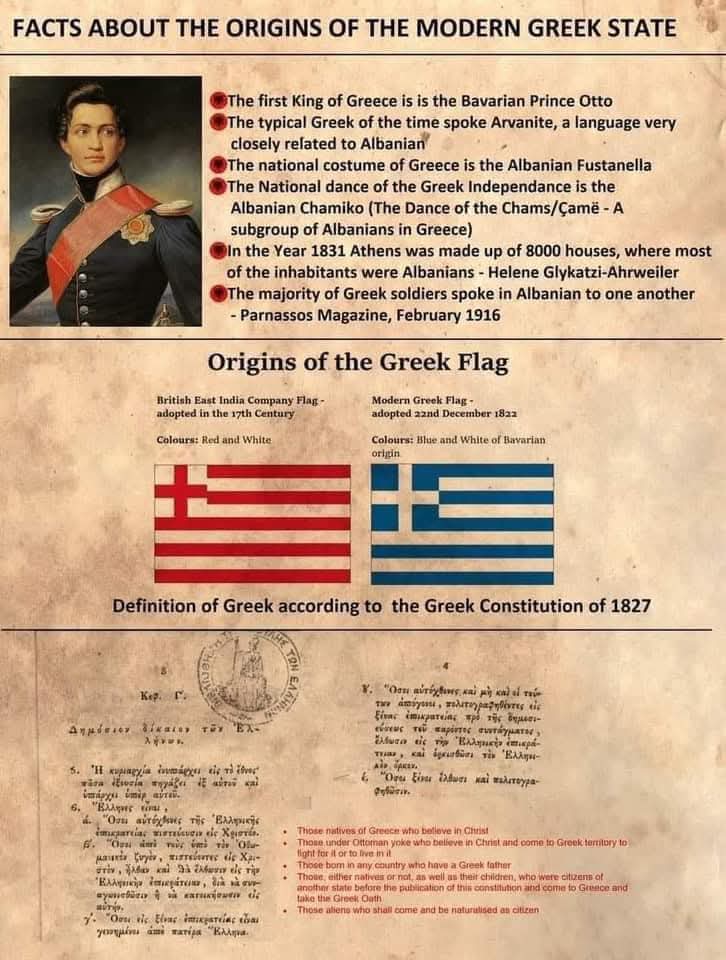
@kos_data Është toka e shqiponjave dhe jo e luleve pa erë! Ata i shkojnë për shtat qeverisë dhe jo popullit që nuk i do këta, që po proteston ndaj egositëve që skanë të ngopur!
@AngelosZenios@OsintBalkans@praktikiskepsi That’s mean nothing! I have enough info, you must learn more and accept the truth! You are a mixed cultural country! Arabs, Turks, Bulgarian, Russian and Albanians and clearly no Greeks! Greeks doesn’t exist! Fake people and fake cultures!
@AngelosZenios@OsintBalkans@praktikiskepsi If you know, your language was written like arabic, from right to left. You as greek, cant explain us how you have “old greek language” and “new greek”. So, can you explain to the world where are you comming from?! Egypt, Iraq, Bangladesh?! Lets the truth comming out!
@FilteredZero Është turp që nxjerr këtë tradhëtar këtu! Ky erdhi nga burgjet greke, bëri çorap gjithë Jugun dhe përmendi Vorio Epirin aty ku është zemra e Shqipërisë! Mos na e prish ditën, fshije!
@Loukas41708 Your motherland is calling you! Is the time for the big true story! Albanians are awake now in Greece! Big Albania is not a dream, is a reality that must happen!
@CvetkoDeda@AncientDardania In your own history books you have the truth! You came from Russia in the years 700! Belgrade in that time was Hungarian! Try and make a better research!
@Hoplite_21@AncientDardania If you make a research on the Greek history, you have only Albanians figures and in some years you have vacancies… your country is afraid of the truth! Also Serbs, we are here in our tribes and you also in our tribes! So go and learn again!
Greece has declared two prominent voices of Albanian journalism, Marin Mema and most recently Artan Hoxha, as "Non Grata."
The Greek authorities have argued that these journalists were declared "non grata" because they are considered a "threat to public order and internal security" of the Greek state, permanently banning their entry.
Marin Mema: The decision was made years ago, around 2012, and is primarily linked to his reports on the Çameria Issue and the properties of Albanians in Çameria.
Artan Hoxha: The ban comes after his strong denouncements regarding Fredi Beleri and his alleged links to serious events, including accusations of involvement in the Peshkëpi massacre in 1994.
Instead of addressing these accusations, the Greek state strongly defends Beleri, even sending him to the European Union as a member of the European Parliament!
Meanwhile, they block the entry of the journalist who dared to tell the truth.
The message is clear: Greece is not afraid of the journalists, but of the truth they expose.
The banning of voices that speak about the Çameria issue and the protection of figures accused of grave acts against Albania underscores this position.
@amnesty@EU_Commission
Bylis:an ancient treasure of Illyria🇦🇱
Bylis is one of the most important ancient cities in Albania, with a history that begins in the 4th century BC. Located in the south of the country, near the present-day town of Ballsh, it was a major urban and cultural center of southern Illyria🇦🇱
Around the 4th century BC, Bylis became a fortified city with powerful walls that enclosed an area of more than 30 hectares. It was a city with advanced urban organization: straight streets, public squares, theaters, and temples.
The most famous monument of the city is the ancient theater, which had a capacity of about 7,500 spectators,one of the largest in the Illyrian territory. This theater testifies to the cultural development and importance of the city.
From the 4th–2nd centuries BC, Bylis maintained close ties with Apollonia and Dyrrachium, two important cities of the time. After 167 BC, when Rome defeated the Illyrian king Gentius, Bylis came under Roman rule.
In the 5th–6th centuries AD, the city was transformed into an important Christian center, with the construction of several magnificent basilicas. However, the Slavic invasions brought destruction to the city, which was never rebuilt to its former dimensions.
Today, Bylis is an archaeological park that attracts both local and foreign visitors. The ruins of the theater, basilicas, agora, and fortification system provide a vivid testimony to the Illyrian, Roman, and Christian history of Albania.