I’m excited to be at NeurIPS 2025, presenting our latest work “Preventing Shortcuts in Adapter Training via Providing the Shortcuts”
📅 Wed, Dec 3, 2025
⏰ 11:00 AM – 2:00 PM PST
📍 Exhibit Hall C, D, E — Poster #4406
📄 arXiv: https://t.co/At21XrLGmb
Interested in rendering a 360° light-field in real-time? On a cellphone? Look no further! Join us at our #NeurIPS2023 poster #315 for ⚡LightSpeed, a joint work b/w @CMU_Robotics & @Snap, spearheded by
@c414driu5.
🗓️ Wed, 13 Dec | ⏰ 5 p.m. CST
https://t.co/CmcGdor6xL
Our method obtains ~55 FPS on an iPhone 14. For more details and benchmarks, check out the project page: https://t.co/ceOIj7TkKV. Code and demo coming soon!
(n/n)
LightSpeed: Light and Fast Neural Light Fields on Mobile Devices
paper page: https://t.co/8vqSzLVARQ
Real-time novel-view image synthesis on mobile devices is prohibitive due to the limited computational power and storage. Using volumetric rendering methods, such as NeRF and its derivatives, on mobile devices is not suitable due to the high computational cost of volumetric rendering. On the other hand, recent advances in neural light field representations have shown promising real-time view synthesis results on mobile devices. Neural light field methods learn a direct mapping from a ray representation to the pixel color. The current choice of ray representation is either stratified ray sampling or Pl\"{u}cker coordinates, overlooking the classic light slab (two-plane) representation, the preferred representation to interpolate between light field views. In this work, we find that using the light slab representation is an efficient representation for learning a neural light field. More importantly, it is a lower-dimensional ray representation enabling us to learn the 4D ray space using feature grids which are significantly faster to train and render. Although mostly designed for frontal views, we show that the light-slab representation can be further extended to non-frontal scenes using a divide-and-conquer strategy. Our method offers superior rendering quality compared to previous light field methods and achieves a significantly improved trade-off between rendering quality and speed.
The light-slab representation was originally designed for frontal-view scenes, but we demonstrate that it can be extended to represent non-frontal scenes using a divide-and-conquer strategy.
(4/n)
(1/2) We are excited to announce the “MitoEM Challenge: Large-scale 3D Mitochondria Instance Segmentation” with 3,600x larger EM image volumes than previous benchmarks covering one human and one rat tissue. More than 150 ppl have already registered! https://t.co/T8bQvRmTjd
We are proud to be a part of the coveted list of #Tech30 startups by @YourStoryCo spotlighting the 30 most promising tech startups of 2020. Join the waitlist here to experience the new way of video creation at https://t.co/jr4FlqKwsP
@MohapatraHemant@Baris@SharmaShradha
To learn how to design machine learning systems, I find it really helpful to read case studies to see how great teams deal with different deployment requirements and constraints. Here are some of my favorite case studies.
At #GoogleForIndia today, we announced Google Research India - a new AI research team in Bangalore that will focus on advancing computer science & applying AI research to solve big problems in healthcare, agriculture, education, and more. #GoogleAI
https://t.co/hNlwhhxhVx
Hinton’s advice for new researchers: question the basic assumptions. Think of radically new ideas and follow your intuition about what people are doing wrong. Cast a wider net, since the way we are currently doing things are probably far from the best way. https://t.co/0l8U0gmbSL
A high school student made a deep learning library to help him understand how neural networks work. He implemented vanilla fully connected, conv, pooling layers, GRU cells, various gradient descent optimizers & other cool stuff like a Keras-like interface. https://t.co/8ITrgRoxc4
Slides for most talks at Good Citizen at CVPR workshop are up https://t.co/9I5vErbqQR Lots of useful advice and experience for writing and reviewing papers, how to do good research and evaluation, talks, how to organise your time #CVPR2018
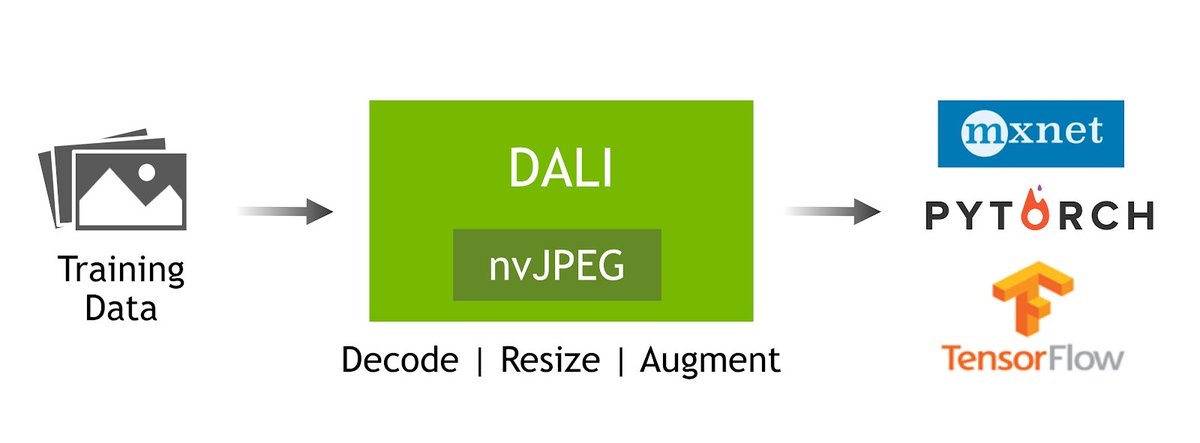
Today at #CVPR2018 we introduce @NVIDIA DALI & nvJPEG, new #deeplearning libraries for data augmentation and image decoding. https://t.co/nndrnQBG1a