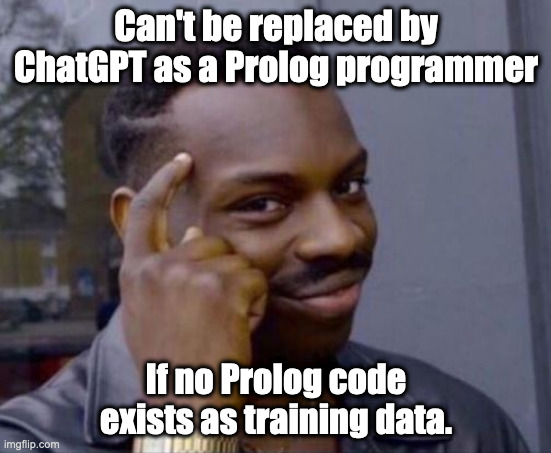
@MarkusTriska It does seem to be challenged by generating working Prolog beyond classic textbook examples. I wonder if it is just lack of training data, or that Prolog syntax flexibility and recursive relational structure is makes it difficult predict using autoregressive models?
The take-home message from the debate on Bing AI is not how easily AI now passes the Turing Test.
It is how easily *we* fail it: Falsely perceiving AI as human conscious intelligence.
The reason is a well-established psychological effect: Hyperactive agency detection.
🧵 1/5
@ole_b_peters The succes of ensemble methods in machine learning is indirect evidence of why democracy is capable of better decisions. Though still biased, biases may be cancelled out or amplified. In democracy, we also have communication as an error correcting (or propagating 😬) mechanism.
@yoavgo Yes, very little understanding is necessary to operate (or build!) models. Deeper understanding is necessary to identify and avoid unbearable errors and biases. “Useful” usually implies risk, because it matters to us.
@CristianBodnar Counterintuitive advice, but I agree that it makes sense to attack a problem with an unbiased mind and when either stuck or done, examine what others did. When I have done this (even if my approach is hopeless), I think it prepared me well for reading/understanding those papers.
@ovelarsen @kjaerulv Jeg tror ikke på at forsikring vil være billigere end præventiv risikohåndtering. På meget kort sigt måske. Virksomheder med forsikring og nedprioriteret sikkerhed vil få en målskive på ryggen, fordi hackerne ved at de er villige til at betale. Så vil forsikring blive dyrere..
Mike Wooldridge @wooldridgemike puts his finger squarely on the big reason why #AI researchers should take "informing public about #AI" seriously. #AAAI2021
(Certainly resonates with my own reasons for my modest involvement.. https://t.co/wWXLHOOGNF https://t.co/MAcZIpLjXF )
@iamtrask It seems way easier to scrutinize and reason about an algorithm, but the accountability/ownership of bias may be weakened/obscured severely. OTH converting a human decision process to an algorithm often merits and paves way for renewed focus on bias/fairness.
My impression is that some folks use machine learning to try to "solve" problems of artificial scarcity. Eg: we won't give everyone the healthcare they need, so let's use ML to decide who to deny.
Question: What have you read about this? What examples have you seen?
@ThomasBerntH@pelledragsted@DSTdk Kender ikke antagelserne, men uanset dem kan i ikke konkludere som i gør: "inddragelsen af af de dynamiske effekter betyder således ikke meget for den samlede finansiering". Hvis usikkerheden er stor som i nævner, så betyder udelukkende det at i ikke kan vide det. #fejlslutning