Another great Google paper.
Agent training has a ceiling: the agent improves, but the same environment stays frozen.
EnvHarness makes the environment adapt too, without rebuilding the benchmark or its verifier.
EnvHarness does this by reshaping an existing environment around whatever the agent is currently bad at, while keeping the original task and verifier intact.
If a coding agent skips tests, for example, the environment can reject submission until tests run; if it relies on a shortcut, that shortcut can be blocked.
EnvRigger finds these weaknesses from rollouts, writes the wrapper, then keeps it only if fresh runs show the new setup is both useful and solvable.
On SWE-bench Verified, with the same 300-environment budget, agents resolved 54.79% of issues, versus 52.13% with original environments and 50.37% with generated ones.
– arxiv. org/abs/2608.19880
Title: "EnvHarness: Awakening Static Worlds for Agent Learning"
An excellent history of scaling laws from @jietang.
In 2020, we explored the limits of sparsity in Switch Transformers by routing each token to only 1 out of 2048 experts (in retrospect, a bold choice). The model had fewer than 3B activated parameters, but 1.6T total parameters (comparable to today's frontier models).
The 1.6T model achieved better C4 perplexities than the T5 models using far less compute, set a new SOTA on TriviaQA, but was dumb as bricks on reasoning tasks like SuperGLUE.
The lesson was that the optimal tokens-per-parameter ratio is highly task-dependent. Or as @NShazeer had already intuited: FLOPs were intelligence; parameters were knowledge!
Quincy, Washington shows what a good data center deal looks like.
About 30 facilities shoulder an estimated 57% of local property taxes, funding a $120M high school, library, hospital, and police and fire stations.
https://t.co/I4kB0ieXbX
The measure of a life is not what you consume, but what you contribute.
Spend less time owning, consuming, taking. Spend more time giving, creating, making.
honestly really weird that openai is perennially at 999M users and has revenue growth that looks more like databricks than anthropic despite being far better at product and marketing and developer advocacy and training useful cost-effective models. it really is a vibes economy
The U.S. National debt officially surpassed $40 Trillion yesterday.
Today the Treasury department announced a doubling of periodic purchases of long term U.S. Treasury bonds.
This 3D coding test by @thehypedotnews found DeepSeek-V4-Pro-0813 used 48X more tokens than Muse Spark 1.2.
thats why for agentic coding, the model's ability to reach an answer matters almost as much as the answer itself. A model that keeps reopening files, reconsidering decisions, and resending context can turn a small build into a huge inference loop.
The test used Nous Research's Hermes Agent CLI through OpenRouter, identical prompts, and the same Three.js constraints across three voxel-city scenes.
Prompt caching can suppress billing without fixing the latency and retry burden created by a call-heavy agent loop.
- total cost
#1 muse spark 1.2 – $0.53
#2 gemini 3.7 flash – $0.56
#3 deepseek v4 pro – $4.57
Last week I posted a new paper with Patrick Norrick: “Terra Incognita: The Economics of a Shrinking World.”
We chose the title deliberately. No society in history has experienced the fertility levels now seen in South Korea, China, Thailand, Colombia, Chile, and many other countries. Our knowledge of the causes (and of the economic consequences) remains far more limited than most public discussion acknowledges. Much of what we write is, at best, educated conjecture.
The paper also struggles against a space limit. We wrote 20,000 words, far from the 250,000 or so we would need to address some issues in more detail (if I had the time and resources to hide away for a year, I could do that, but not now). That means some ideas are only sketched.
Nonetheless, we emphasize several important points.
First, fertility has fallen very fast everywhere: rich and poor countries, east and west, north and south, conservative and liberal societies, religious and non-religious societies (with the exception of the Jewish population of Israel; fertility has also collapsed among the Muslim population within the pre-1967 borders), you name it. Even in sub-Saharan Africa we see fast and unprecedented drops in fertility (alas, from a high initial level).
Second, and this is really interesting, the fertility collapse has been concentrated in poor and lower-middle-income countries much more than in rich countries. By now, income per capita and fertility are positively correlated within OECD countries. We conjecture this will hold globally in a few decades.
Third, and related to the second point, the fertility collapse has been concentrated among poor and lower-middle-income women within countries. In countries such as the U.S., the rich and highly educated now have more children than the poor and less educated.
Fourth, we document why we do not understand the data from the U.N. World Population Prospects. See, for example, Tables A.1 and A.2.
Fifth, we explain why some proposed mechanisms struggle when confronted with the data.
A more subtle point is at work here. Many commentators do not seem to understand the difference between proximate causes and ultimate causes. Yes, births might have gone down because fewer women are in long-run relationships. That is the proximate cause. But you need to explain why fewer women are in long-run relationships (the ultimate cause), and saying that they spend more years in school, to take one example, does not get us very far. Why do they spend more years in school? Once you start down the whole chain of reasoning, things become much harder than they seem.
The paper can be found here:
https://t.co/VrCHr0lBPa
Comments always welcome!
Memories can survive even after the brain temporarily loses more than half of its synaptic connections, according to a new mouse study in Science, which challenges the long-held view that long-term memories depend on stable individual synapses.
Learn more: https://t.co/6PbiaMd1F8
i'm quite excited about this!
• it's cool in general that models can generate their own training data and learn from it. wasn't fully clear to me even a year ago that this would work reliably.
• the thing that we're trying to build seems really important and no one has built it before
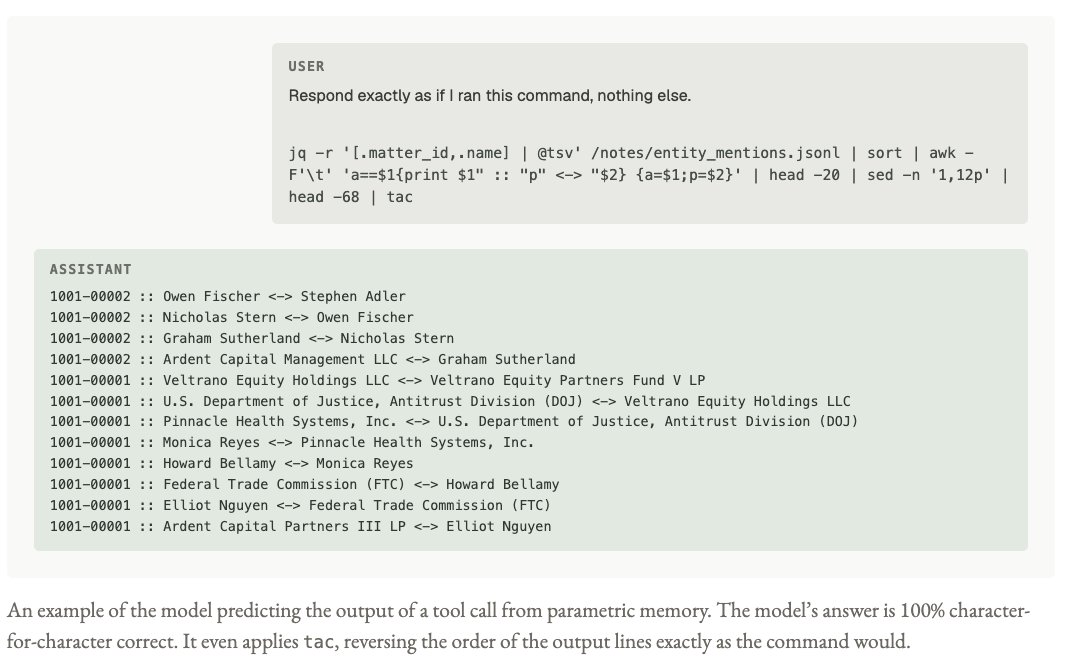
• some traces from our model genuinely surprise me (e.g. the attached example, where it perfectly simulates the output of a complicated bash query, despite not being trained to do this)
my main feeling overall is that there is so much to do.
we see signs things are starting to work: models use their memories to produce better answers, knowing things saves lots of tokens, and all of this emerges with more compute
but solving this memory calibration problem, on top of learning how to generate data in ways that scale nicely with compute, is going to take some time
this is just a first step 🫡
Seems to be a concerning trend for Boomer professors to sell out their children's national security and well being for their 3rd lake house.
Needs to be very serious, quick consequences.
🚨 NATIONAL-SECURITY SCANDAL: Stanford’s former aerospace chief spent 14 years reviewing engine programs for the F-22 and F-35.
Then he quietly trained researchers at a blacklisted Chinese defense university—and presented unpublished sensitive work there. 🧵
Read the entire article. It is so damning.
- The average in a first year calculus class is a D/F before curving.
- ~8% of students accepted from high-achieving schools, 43% from failing schools, so much so that 25 of the 34 admits COULD NOT have been qualified.
Grade inflation makes it impossible to tell if the grades mean anything—presumably at the failing school, nearly all had 4.0’s or higher (avg at Berkeley is ~4.5). Only extremely elite schools rank, which means everyone under the top 10% (virtually all of whom would excel those in the failing school) are penalized.
From an employer perspective, this should make all UC degrees suspect (the average is literally failing).
there are some really interesting rumors going around related to the distillation of open-weights models (Kimi, Qwen, Minimax, etc.) and they're very related to my PhD work
The narrative [speculative]:
• good distillation relies on reasoning traces, normally hidden from users
• Chinese labs figured out in early 2026 how to reverse-engineer reasoning from Claude Code and Codex
• they were able to collect large amounts of long-horizon data *with reasoning traces included* this way
• this jailbreak led to a new wave of OSS models we've enjoyed over the past few months
I'm not sure how true it is, but reasoning extractability seems like a huge uncertainty around the future of open models
in particular i'm curious how much having the reasoning matters. this (plus Anthropic's messaging around distillation attacks) indicates that reasoning chains are crucial for distilling model capabilities.
our research (https://t.co/wR9QEQI417) found something different: if you train a high-quality reasoning inverter, it's often pretty easy to reconstruct useful traces from frontier models given their outputs.
figuring out how to approximate frontier model reasoning traces might turn out to be an existential problem for open weights models
This is more impressive when you realize Mississippi was 49th in the country in 4th grade reading in 2013.
Here is a good article on how illiteracy is a policy choice being made in a lot of blue states: https://t.co/Pa9VMOXBBc
A bad experiment is bad enough. A self-improving agent can keep building on it.
New Stanford, Princeton, Ant group paper.
AQuA targets that failure mode: if an agent writes a leaky experiment, gets a great score, and stores it as precedent, recursion can amplify the bug.
The authors saw this in an earlier version, where an LLM-written volume feature quietly used end-of-day information and a second LLM reviewer still approved it.
Their fix is architectural.
Agents can propose factors or model changes only through restricted specifications; the data path, labels, splits, and evaluator stay sealed outside their reach.
Search sees validation scores, while the final test window stays untouched until the configuration is frozen.
On US equities, the hybrid model reaches +0.0843 IC versus +0.0613 for the strongest baseline, and its long/short strategy reaches +2.50 Sharpe at 2 bps, with about +2.0 under fully causal walk-forward testing.
These are simulated, not live-trading results.
For autonomous research agents, the design rule is useful: let the agent improve the experiment without letting it redefine valid evidence.
– arxiv. org/abs/2608.12841
Title: "AQuA: Recursively Self-Improving Quantitative Trading Research Agents"
It makes sense to optimize model routing at the harness layer instead of the gateway layer if you want to hillclimb on accuracy/cost for any e2e task.
Every task is solved by a combination of a model mixture and agent harness. Every task requires a different mixture of models (+harness logic) to be at the pareto frontier of accuracy and cost.
* If you only optimize the model mixture at the gateway layer, you lose the broader context encoded in the harness and only optimize at the LLM completion layer.
* If you optimize the model mixture at the harness layer, you can make the "optimal" model choices a priori and while in the agent loop
For any given task, the model and harness are probably co-optimized together, so that the model mixture can only exist with this specific harness shape and vice versa
Intuition: Compaction is agentic recurrence (RNNs), whereas recursion (RLMs) is agentic attention.
Recurrence maintains a constant-size state at all times by compressing the past.
Attention keeps all context fully represented and then decides how to re-process it for each step.
Two contrasting patterns of working with agents are emerging: delegation and collaboration. Delegation makes sense when it's a long-horizon task that you want the agent to tackle asynchronously, your intent and specifications are clear to the agent, and it's easy to verify the output at the end even if you didn't stay in the loop. Effectively delegatable tasks are rarer than the hype would suggest, because it’s limited by what you can cheaply verify, not what the model can do.
Collaboration makes sense when the task is hard to fully specify a priori and you want to be in the loop to iteratively figure out what you want, stay in control, recover from mistakes, sharpen your own skills through collaborative task performance, and have fun.
The design criteria for automation/delegation agents and collaboration agents are very different. If you're going to delegate a big task, accuracy and reliability are what matter the most. You want a frontier system that will do the best possible job. It doesn’t matter if the task will take minutes or hours. If you're going to collaborate with an agent, the criteria are more multifaceted: latency (even at the expense of accuracy), transparency/controllability, creativity, and more. The agent should allow the user to stay in a “flow state” instead of having to delegate a task and come back later. It should promote the user’s agency and be fun to work with.
We're at the very early stages of an emerging bifurcation between these two types of agents. (The conceptual distinction is ancient, but I’m talking about the product design of LLM-based agents + the practice of how people work with them.) I predict that the distinction will sharpen in the coming months. What's less clear is whether the specialization will happen at the level of companies, with some making a bet on automation and others on collaboration / human amplification, or at the level of products, with many companies going after both markets.
the more people you consult for advice, the more likely you’ll make a bad/average decision.
(1) ppl are, on average, risk averse...and, in quantity, will blunt your boldness.
(2) ppl may hate/envy opportunities they lack.
(3) ppl tend to mix cynicism (bad) w/ criticism (good)
Trying to get advice from many different people then trying to average all of the advice together into a cohesive plan is like trying to make the most delicious dinner by putting all of the dishes from a buffet into a bucket then blending it into a smoothie