Today a READER,
Tomorrow a LEADER.
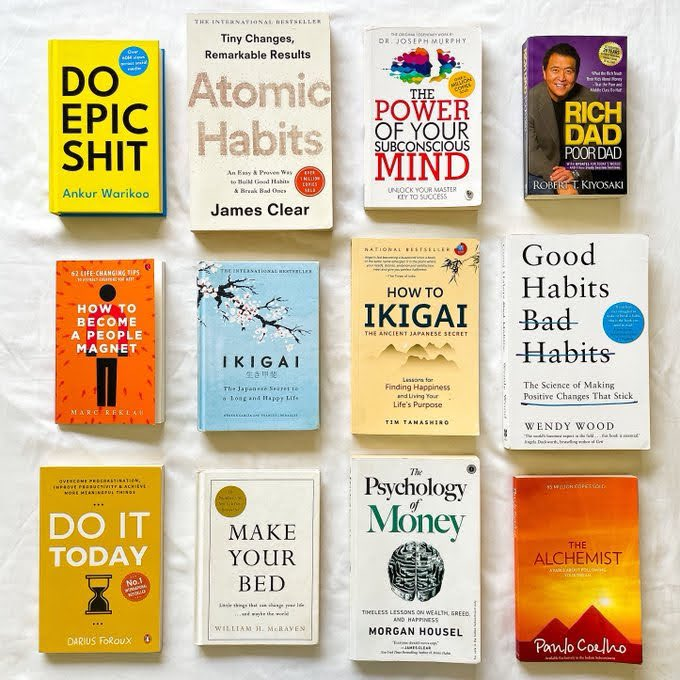
Here’s 10 books everyone interested in self development should read!
“Reading is essential for those who seek to rise above the ordinary.”
-Jim Rohn
If you're in your 20s,
Learn these Financial Rules to become a millionaire in your 30s:
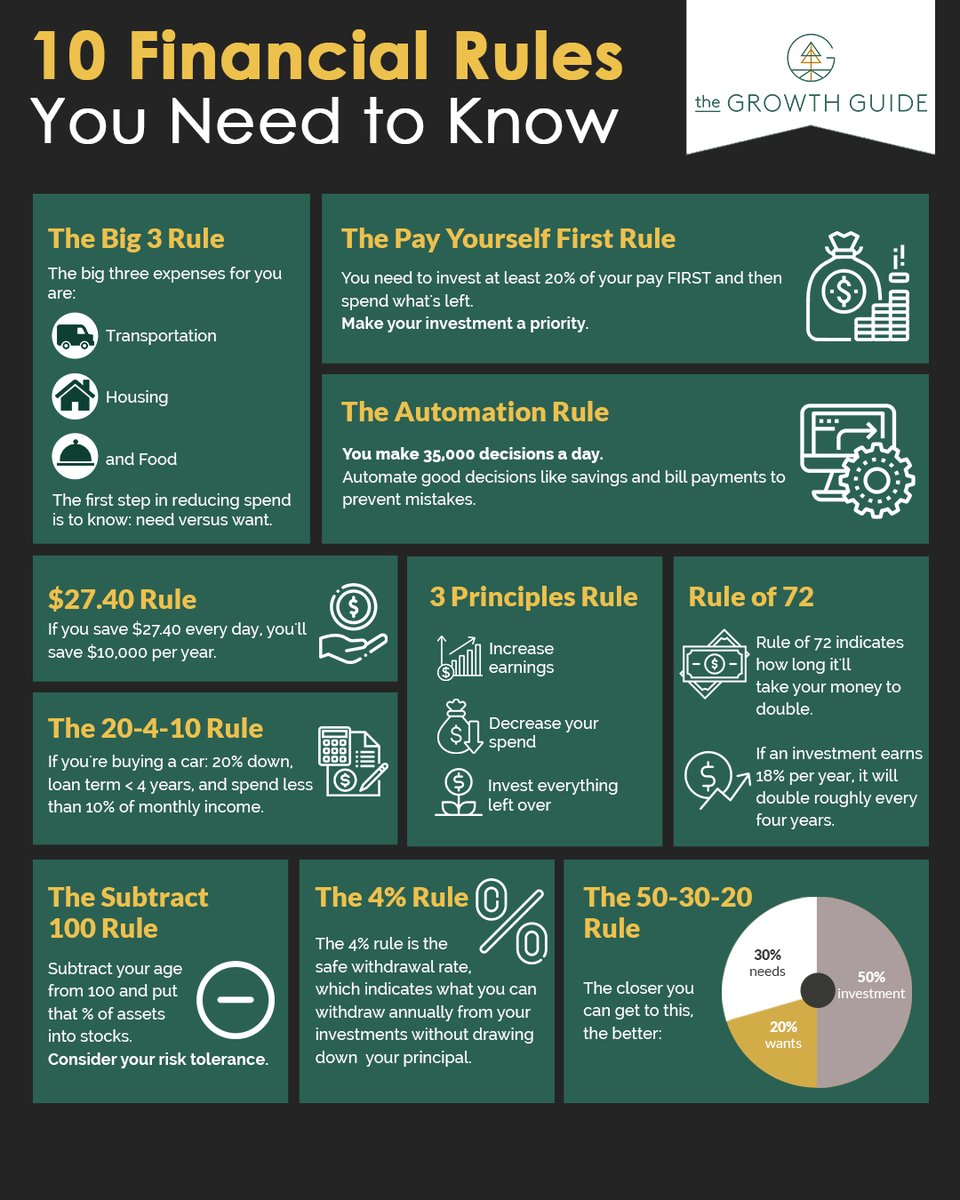
3 Principles Rule
This is the foundation of it all:
1. Increase earnings
2. Decrease your spend
3. Invest everything left over
Ensure your investments include an emergency fund and you're prepared for the unexpected.
The Pay Yourself First Rule
Too many people get paid, spend on their lifestyle, and then invest.
You need to invest at least 20% of your pay FIRST and then spend what's left.
Make your investment a priority.
Do it first, and live off the rest.
The Automation Rule
You make 35,000 decisions a day.
This leads to decision fatigue and bad decisions.
Automate good decisions to prevent mistakes:
• get paid
• auto-transfer to savings
• auto-transfer to investments
• set up auto-bill pay for your bills
The 50-30-20 Rule
The average American household saves 10%.
Some have proposed the following:
50% - needs
30% - wants
20% - investing
To be a millionaire, flip the script:
50% - investment
30% - needs
20% - wants
The closer you can get to this, the better.
The Big 3 Rule
The big three expenses for you are:
• transportation
• housing
• food
A certain amount of each expense is a need, the bare necessity.
The remaining portion you can control, the want.
The first step in reducing spend is to know: need versus want.
The 20-40-10 Rule
If you're buying a car, use the 20 - 40 - 10 Rule.
• 20% down payment
• loan term no more than 4 years
• Spend less than 10% of monthly income
This keeps your car expenses reasonable.
$27.40 Rule
If you save $27.40 daily, you'll save $10,000 annually.
If you start investing $10,000 per year at 8% at 20, you'll have $2 million at 55.
I wish I'd started investing $10,000 per year sooner - don't make this mistake.
Rule of 72
Compounding is the 8th wonder of the world and has the power to make or break you.
The Rule of 72 indicates how long it'll take your money to double taking compounding into account.
An investment earning 18% per year will double roughly every four years.
Rule of 114
The Rule of 114 is comparable to the Rule of 72, but it tells you how long it will take for your money to triple.
I only learned this one in the last year and am fascinated by it.
I'm looking forward to some triples.
The Subtract 100 Rule
Subtract your age from 100 and put that percentage of assets into stocks.
If you're 20, you should have 80% stocks and 20% bonds.
Some argue that given longevity and retirement horizons, you should put more into stocks.
Consider your risk tolerance.
The 4% Rule
The 4% rule is the safe withdrawal rate and indicates what you can withdraw from your investments without drawing down your principal.
Said differently:
1. Calculate monthly expenses
2. Multiply by 12 to annualize it
3. Multiply by 25 (4% safe withdrawal rate)
TL;DR:
To be a millionaire in your 30s,
Live these rules in your 20s:
• Rule of 72
• Rule of 114
• The 4% Rule
• The Big 3 Rule
• The $27.40 Rule
• The 50-30-20 Rule
• The 20-40-10 Rule
• The 3 Principles Rule
• The Automation Rule
• The Subtract 100 Rule
• The Pay Yourself First Rule
I used to have one crippling addiction:
Planning.
My brain loved the cheap dopamine of gathering books to read, tasks to complete, and videos to watch.
But when it came to taking action, the euphoric rush faded.
What ended my addiction?
This story of two men learning to fish
--
The first fisherman was a planner.
He heads straight to the marina to buy the best fishing boat money can buy.
Then, he specs out an expensive, custom, carbon-fiber fishing rod.
And from there, he spends hundreds of hours reading up and watching videos on everything there is to know about fishing.
• Casting angles
• Weather patterns
• Baiting techniques
You name it, he's bought the book on it.
And of course, he's watching the fishing channel every night for hours, learning from the best of the best.
A few months later—after months of diligent preparation—he *finally* feels ready to fish.
So the next day, he heads out on the lake in his new boat with his fancy rod and wealth of fishing "experience" built up over the last few months.
But six hours in, nothing. Not even a nibble.
He fiddled with his tangled rod which was much more difficult to cast than it looked on TV.
Still nothing.
He moved to a spot upstream, just like his favorite guru would suggest.
Still nothing.
So—what happened?
Turns out, the second fisherman had already sucked the lake dry.
On day one, the second fisherman grabbed a shitty rod, sliced up a hot dog, and went to the lake.
The first day, nothing.
So he moved to a new spot.
Second day, nothing.
So then he moved again.
And on the third day? His first nibble.
From there it was time to iterate.
And every day after, he honed his technique.
He found a baiting technique that worked a bit better.
Or a new lake with a few more fish.
And after three weeks of iteration, he found the winning combination.
Before long, he was hauling in hundreds of fish every day.
To keep up with his daily haul, he hired a small team to help him.
And from there, he opened a restaurant with fat margins to sell his fresh fish.
And after that, he opened a fishing school to teach others his craft.
He did all of this while the first fisherman sat around gathering gear.
Sure, the first fisherman felt productive during those months of preparation, right?
He was "learning" after all, right?
But there was one difference: feedback.
Every day the second fisherman had an idea of something that might work better.
And he went right to the market to validate his assumption.
If it worked, his strategy improved.
And if it failed, he learned something new.
The moral of this story?
Get to action as quickly as possible.
When you find yourself gathering gear, stop.
Instead, grab a shitty rod and start fishing.
My boys are only two & three.
But here’s a list of movies I can’t wait to watch with them!
•Rudy
•Rocky
•Rambo
•Sandlot
•Gladiator
•Fight Club
•The Matrix
•Braveheart
•Field of Dreams
•It’s a Wonderful Life
•Shawshank Redemption
•The Pursuit of Happiness
What else are great father/son movies?
Want to set your kids up for success?
Demonstrate these 5 characteristics daily.
Bookmark this to periodically check in on yourself.
1. Integrity
Why it's important: Integrity is the foundation of trust.
Children often look to their fathers as role models, and a dad who demonstrates integrity shows his children the importance of being honest, doing what's right even when it's difficult, and maintaining consistency in one's beliefs and actions.
As children grow and face their own moral dilemmas, the integrity they've witnessed in their father will guide their decisions.
How dads can demonstrate it: Dads can showcase integrity by being truthful in their conversations, following through on promises, and admitting their mistakes.
They should emphasize the value of honesty in daily actions, making choices based on principles rather than convenience or short-term gains.
When faced with a challenging situation, they can share their thought process with their children, explaining why they chose a particular path rooted in integrity.
2. Selflessness
Why it's important: Demonstrating selflessness teaches children the value of putting others' needs and feelings above one's own.
It fosters a sense of community, compassion, and care, ensuring that kids grow up understanding the importance of relationships and social responsibility.
How dads can demonstrate it: Dads can show selflessness by volunteering in their community, putting family needs above their own desires, and consistently being there for their children.
Listening to their kids, spending quality time with them, and making sacrifices, big or small, to ensure their well-being are tangible acts of selflessness.
3. Assertiveness
Why it's important: Assertiveness is about standing up for oneself and expressing feelings, beliefs, and desires in a respectful manner.
By displaying assertiveness, dads teach their children to communicate their needs without being aggressive or passive, ensuring they're treated fairly and with respect.
How dads can demonstrate it: Fathers can demonstrate assertiveness by setting boundaries and expressing their feelings in calm and confident ways.
Engaging in healthy discussions where they stand up for their beliefs while also being open to listening can show assertiveness.
Role-playing with kids about scenarios where they need to be assertive can also be beneficial.
4. Determination
Why it's important: Determination instills a mindset of perseverance.
It teaches children that challenges are a part of life and that with effort and resilience, they can overcome obstacles.
When children see their father's determination, they learn the value of hard work, persistence, and dedication.
How dads can demonstrate it: Fathers can set personal goals and share them with their children, showing them the steps they're taking to achieve them.
Whether it's training for a marathon, taking on a new project, or learning a new skill, the journey and commitment will speak volumes.
They can also share stories of past challenges and how determination played a role in overcoming them.
5. Critical Thinking
Why it's important: In a world filled with information and differing viewpoints, critical thinking enables children to assess, analyze, and make informed decisions.
Dads who emphasize critical thinking equip their kids with the ability to differentiate between fact and opinion, helping them navigate complex situations.
How dads can demonstrate it: Fathers can encourage open dialogues at home, asking open-ended questions and promoting a questioning attitude.
They can engage in debates, provide books or resources that challenge perspectives, and work on puzzles or games that require strategy and thought.
Celebrating curiosity and rewarding the search for answers will foster a love for critical thinking.
Thanks for reading!
Anything you would change? Leave a comment below. 👇
Enjoyed this post? Like and repost to share far and wide across X!
Fatherhood is the greatest journey any man can take.
Here's a few reasons why:
1. Unconditional Love: Fatherhood introduces a profound love that is deep and unconditional for one's child.
2. Life Perspective: Becoming a father changes one's outlook on life, priorities, and what truly matters.
3. Personal Growth: Fatherhood challenges a man to be better, more patient, understanding, and selfless.
4. Bond Creation: The bond between a father and his child is unique and irreplaceable, fostering deep connections.
5. Legacy: Through their children, fathers can pass on values, traditions, and life lessons.
6. Learning: Kids have a wonderful way of teaching adults about the world, joy, curiosity, and the simple pleasures in life.
7. Resilience: Fatherhood comes with challenges that build resilience, determination, and strength in a man.
8. Joy in Small Moments: The simple moments, like hearing a child's laughter or watching them take their first steps, become monumental.
9. Shared Adventures: Whether it's teaching a child to ride a bike or traveling together, these shared experiences become cherished memories.
10. Protector Role: Being a guardian and protector for another human being gives a sense of purpose and responsibility.
11. Teaching: The role of a teacher becomes evident as fathers pass on skills, wisdom, and knowledge to their children.
12. Empathy Development: Fatherhood often deepens a man's ability to empathize and understand emotions on a deeper level.
13. Creating a Legacy: Through fatherhood, men can set examples of love, kindness, and respect for future generations.
14. Time Value: The fleeting nature of childhood makes every moment valuable, teaching fathers to cherish and be present in the now.
15. Lifelong Connection: Unlike many relationships, the bond with a child is lifelong, continually evolving and deepening over time.
While these are just a few reasons, the journey of fatherhood is unique for every man, filled with its own set of challenges and joys.
Thanks for reading. If you enjoyed please like, comment, and repost to share this message across X.
Life lessons from my father that I want to teach to my son:
1. You can tell everything you need to know about a person by observing how they treat service workers.
2. Hard work will never be overrated. You have to work hard if you want to get ahead.
3. You don't need to have an opinion on everything. It's perfectly reasonable to have no opinion on something that you haven't researched or don't understand.
4. You can get pretty damn far in life by just saying what you're going to do and then doing it.
5. Showing up early costs very little and pays off handsomely in the long run.
6. Waking up early is the easiest way to improve your odds of success. You don't have to wake up early to be successful, but you rarely find an early riser that isn't winning.
7. Having good posture is a physical and mental unlock for life.
8. Being kind to people is the only real life hack. Kindness remains severely underrated.
9. Consistency is everything. You should never bet against a person who just keeps showing up.
10. Most of us need fewer friends and more intellectual sparring partners. Friends are pleasant and easy to come by, but intellectual sparring partners question our assumptions and force us to level up.
Those are 10 life lessons I learned from my father that I want to teach to my son.
If you enjoyed this, follow me @SahilBloom for more in future.
"Dad, I'm bored!"
Here's 50 things you can plan to do when you inevitably hear these words this coming weekend.
1. Go camping in the backyard or a nearby campsite.
2. Have a picnic in the park.
3. Visit a local museum or zoo.
4. Plan a treasure hunt with clues.
5. Start a DIY project at home, such as a birdhouse.
6. Have a movie night with popcorn and favorite films.
7. Visit a local beach or swimming pool.
8. Learn a new sport together.
9. Set up a lemonade stand.
10. Bake cookies or make homemade ice cream.
11. Go on a bike ride.
12. Visit a local farm or petting zoo.
13. Make it a homemade pizza night.
14. Do some gardening and plant some seeds.
15. Go fishing at a local pond or lake.
16. Have a water balloon fight.
17. Visit a local science center.
18. Build a fort with cardboard boxes.
19. Make a scrapbook of family memories.
20. Go for a hike in a local nature reserve.
21. Take a day trip to a nearby city.
22. Volunteer at a local charity together.
23. Paint or draw pictures outdoors.
24. Have a barbecue and let the kids help.
25. Set up a backyard obstacle course.
26. Learn magic tricks and put on a magic show.
27. Visit a local amusement or water park.
28. Have a family game night with board games.
29. Take a family yoga or fitness class.
30. Make homemade bird feeders.
31. Have a stargazing night and learn about constellations.
32. Start a book club together.
33. Make tie-dye shirts.
34. Learn a new musical instrument together.
35. Take a cooking or baking class.
36. Visit a local art exhibition.
37. Start a worm composting bin for gardening.
38. Go to a farmers market and cook with the fresh produce.
39. Do a puzzle together.
40. Visit a fire or police station.
41. Attend a local sports game.
42. Go bowling or play mini-golf.
43. Have a DIY photo shoot in a park.
44. Build a model rocket and launch it.
45. Have a karaoke night at home.
46. Visit a local historic site.
47. Start a nature journal and sketch wildlife.
48. Make a time capsule.
49. Try bird watching.
50. Go on a scenic drive or train ride.
Which of these were your favorite? What other ideas do you have?
Comment, like, and retweet this to give Dad Twitter some fun ideas for the weekend.
Your 3-year old asks to play trucks with him. You say you can't because you are watching a football game
Two years later, your 5-year old asks if you will read him a book. You say, I wish but you have to answer an "urgent" work email
Three years later, your 8-year old asks if you could teach him how to play catch. You say, I want to but I am too tired and out of shape
Your kid is now 10 and they don't ask you anymore because he knows the answer
Stop thinking you are too busy or there are more important things to do then playing or teaching your kids
When your kid asks you to do something, you won't always be able to say yes
But if you always say no then they will stop asking
Teaching children about money should be part of parenting because most schools won't do it.
Here are 10 things everyone should know about investing & personal finance (before they turn 18):
Strong core muscles are essential for maintaining good balance, preventing back injuries, and living a long and healthy life.
7 exercises to build core strength and stability from home:
Anthony Bourdain said: "Eat at a local restaurant tonight. Get the cream sauce. Have a cold pint at 4 o’clock in a mostly empty bar. Go somewhere you’ve never been. Listen to someone you think may have nothing in common with you. Order the steak rare. Eat an oyster. Have a negroni. Have two. Be open to a world where you may not understand or agree with the person next to you, but have a drink with them anyways. Eat slowly. Tip your server. Check in on your friends. Check in on yourself. Enjoy the ride." (Ht Jamieson Faulcon)
More protein, less sugar.
More reading, less scrolling.
More investing, less spending.
More business talks, less gossip.
More working out, less video games.
10 investing lessons & visuals every investor needs to memorize:
1/10: Warren Buffett is worth ~$100 Billion and recommends investing in the S&P 500. S&P 500 returns over the last 40 years: