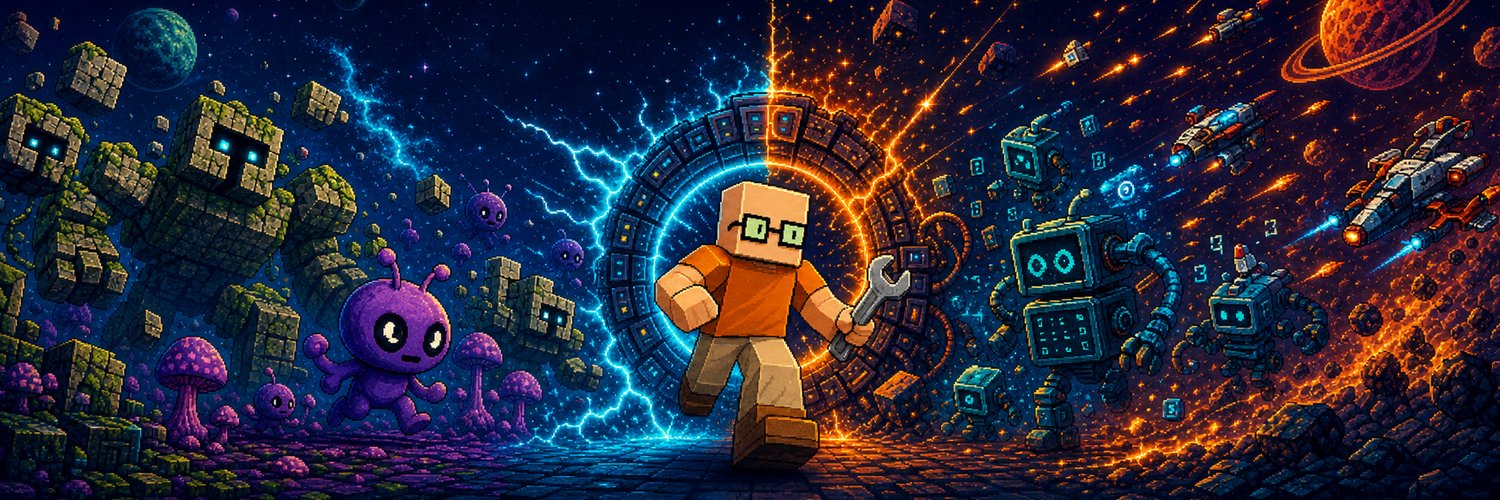
Building NovaShift: Universe solo. Each universe plays by its own rule — this is the last 30 seconds of a wave, when it turns into a panic wave.
Out now in Early Access on Steam:
https://t.co/Dbxl8I5cB8
#indiedev#gamedev#roguelite
@devoriahub Happy Screenshot Saturday! NovaShift: Universe — a survivor-like where each of the 4 universes plays by different rules. Steam: https://t.co/Dbxl8I5cB8
@devoriahub Solo-developed. Each universe plays by different rules — Retro turns off auto-fire, Number's boss throws digits that fuse mid-flight. Out now: https://t.co/Dbxl8I5cB8
@WhoElsButMe NovaShift: Universe — survivor-like where you jump between 4 universes and each one changes the core rules. Steam: https://t.co/Dbxl8I5cB8
@NOENDSTUDIO1 I am also a new dev on gaming but I got confused without market boost a good game can waste or a bad game can be hyped how we can overcome this?
@Voxlessa Prep carries over too: clear a universe and you bank one weapon + one passive from it before the final fight, plus a few secrets hidden along the way. Launched with 4 universes, more planned.
Building NovaShift: Universe solo. Each universe plays by its own rule — this is the last 30 seconds of a wave, when it turns into a panic wave.
Out now in Early Access on Steam:
https://t.co/Dbxl8I5cB8
#indiedev#gamedev#roguelite
@Voxlessa Yeah, it changes a lot. In Retro your combo (+dmg per kill) breaks if you stand still for a second, so you can't turtle. In Number the final boss cycles through +/−/×/÷, so a build built for addition can struggle at ×.
Bu rüzgar türbini sessiz ve etkili bir şekilde çalışarak bir evin enerji ihtiyacını karşılamak için yeterli olan 2.000 Watt kadar elektrik gücü üretir.
IBM MQ -> RabbitMQ -> Kafka ->Pulsar, How do message queue architectures evolve?
🔹 IBM MQ
IBM MQ was launched in 1993. It was originally called MQSeries and was renamed WebSphere MQ in 2002. It was renamed to IBM MQ in 2014. IBM MQ is a very successful product widely used in the financial sector. Its revenue still reached 1 billion dollars in 2020.
🔹 RabbitMQ
RabbitMQ architecture differs from IBM MQ and is more similar to Kafka concepts. The producer publishes a message to an exchange with a specified exchange type. It can be direct, topic, or fanout. The exchange then routes the message into the queues based on different message attributes and the exchange type. The consumers pick up the message accordingly.
🔹 Kafka
In early 2011, LinkedIn open sourced Kafka, which is a distributed event streaming platform. It was named after Franz Kafka. As the name suggested, Kafka is optimized for writing. It offers a high-throughput, low-latency platform for handling real-time data feeds. It provides a unified event log to enable event streaming and is widely used in internet companies.
Kafka defines producer, broker, topic, partition, and consumer. Its simplicity and fault tolerance allow it to replace previous products like AMQP-based message queues.
🔹 Pulsar
Pulsar, developed originally by Yahoo, is an all-in-one messaging and streaming platform. Compared with Kafka, Pulsar incorporates many useful features from other products and supports a wide range of capabilities. Also, Pulsar architecture is more cloud-native, providing better support for cluster scaling and partition migration, etc.
There are two layers in Pulsar architecture: the serving layer and the persistent layer. Pulsar natively supports tiered storage, where we can leverage cheaper object storage like AWS S3 to persist messages for a longer term.
Over to you: which message queues have you used?
–
Subscribe to our weekly newsletter to get a Free System Design PDF (158 pages): https://t.co/uc5M7CdXXC
Explaining 8 Popular Network Protocols in 1 Diagram. The method to download the high-resolution PDF is available at the end.
Network protocols are standard methods of transferring data between two computers in a network.
1. HTTP (HyperText Transfer Protocol)
HTTP is a protocol for fetching resources such as HTML documents. It is the foundation of any data exchange on the Web and it is a client-server protocol.
2. HTTP/3
HTTP/3 is the next major revision of the HTTP. It runs on QUIC, a new transport protocol designed for mobile-heavy internet usage. It relies on UDP instead of TCP, which enables faster web page responsiveness. VR applications demand more bandwidth to render intricate details of a virtual scene and will likely benefit from migrating to HTTP/3 powered by QUIC.
3. HTTPS (HyperText Transfer Protocol Secure)
HTTPS extends HTTP and uses encryption for secure communications.
4. WebSocket
WebSocket is a protocol that provides full-duplex communications over TCP. Clients establish WebSockets to receive real-time updates from the back-end services. Unlike REST, which always “pulls” data, WebSocket enables data to be “pushed”. Applications, like online gaming, stock trading, and messaging apps leverage WebSocket for real-time communication.
5. TCP (Transmission Control Protocol)
TCP is is designed to send packets across the internet and ensure the successful delivery of data and messages over networks. Many application-layer protocols build on top of TCP.
6. UDP (User Datagram Protocol)
UDP sends packets directly to a target computer, without establishing a connection first. UDP is commonly used in time-sensitive communications where occasionally dropping packets is better than waiting. Voice and video traffic are often sent using this protocol.
7. SMTP (Simple Mail Transfer Protocol)
SMTP is a standard protocol to transfer electronic mail from one user to another.
8. FTP (File Transfer Protocol)
FTP is used to transfer computer files between client and server. It has separate connections for the control channel and data channel.
–
Subscribe to our newsletter to download the high-resolution PDF. After signing up, find the download link on the success page: https://t.co/keu1P0hhKI