@acellus_health, we often get the question of "What's the value of structured data in cancer care?"
Our hypothesis is that structuring the longitudinal, fragmented data of a cancer patient using AI can make oncologist more confident in their treatments and power the next generation of agentic AI solutions...
so we tested it using @Microsoft's new #Healthcare #Agent #Orchestrator system. And we were surprised by the results (click on the link below for the details)
This is all to say, I've built a memory system that's been valuable to me and if you want to try it out, check out the docs to get started here: https://t.co/HCvIXRoE1o
I've started testing with local models and now this is essentially free.
But find what works for you because someone could tell you their memory system is incredible for them (like I'm doing lol), but in my eyes, everyone will have a different AHA moment when it comes to memory, and sometimes you may just have to build that yourself.
Memory is a challenging thing for long-running agentic tasks. I've tested out a bunch of different systems, from internal memory for ChatGPT and Anthropic to external memory plugins.
From reading about how others are using and building memory systems, they all work similarly with regards to architecture, but react differently with regards to model/harness differentiation.
3. Account agnostic memory: Maybe this is unique to me, but if you do multi-organization work, you may find yourself having two AI subscriptions for different orgs. For example, I have two Claude subscriptions, one for each org.
Cogni-Code stores memory locally on your laptop with a git history, so it's independent of the model provider, and thus, the auth associated with that. This allows me to switch between accounts but maintain my workflows.
For example, I have a process of making Notion backlog cards for both organizations for features/bugs/chores/etc. This is the same process across organizations, however different accounts for each. What I've loved is that the process is recording, but the connected accounts are unique, so I can record that process once without having to duplicate it.
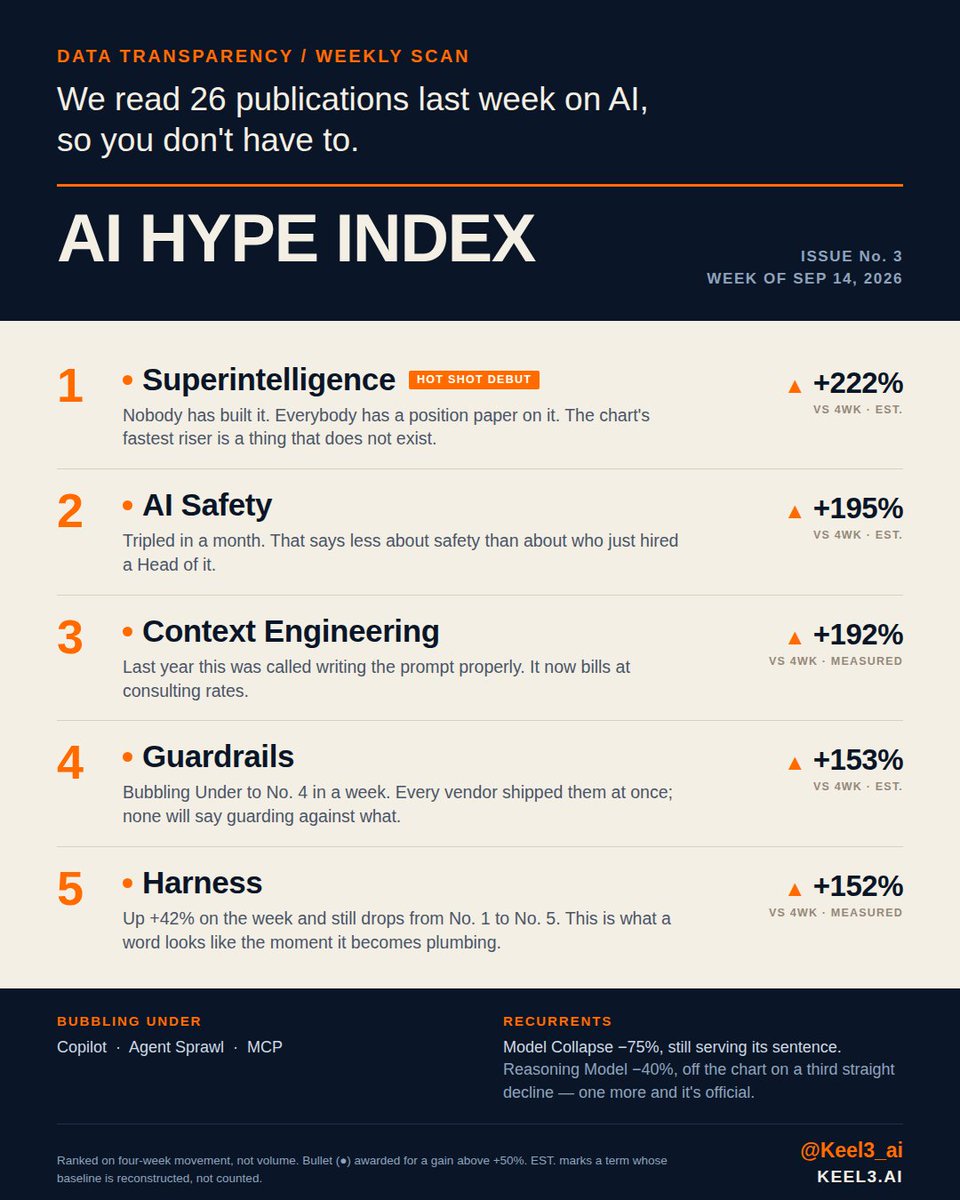
We read 26 publications on AI last week so you don't have to.
The AI Hype Index, Issue No. 3. Ranked on four-week movement, not volume.
This week the entire top four is vocabulary about slowing down.
We read over 120 publications this week on AI, so you don't have to. We filter out the wallpaper — LLM, agents, generative AI — because a word everyone uses every day isn't a trend, it's a load-bearing wall.
The Keel3 AI Hype Chart, week of September 7, 2026. 🧵
This is an exemplar for what we are NOT doing with medical AI, which extensive evidence for improving accuracy. I wrote about the paradox this week
Free. No ads. Subscribe
https://t.co/XnLoAsxXUO
Today, I'm open-sourcing it: https://t.co/nq4hHHK5xW
Try it, break it, tell me what you find, tell me what you don't.
Today, I switch from project to agent harness, and it picks up right where I left off
I got tired of re-teaching my coding agent the same things every session.
My preferences. My project standards. The bug we spent three hours cornering last Tuesday. Gone. Slate wiped.
Every new session, day one. (1/5)
Here's an example: I walked through a debugging runbook once in conversation.
I didn't save it. A week later I typed "is staging healthy?" and my agent executed the entire 5-step procedure; right host, right commands, right order.
Not retrieval. A loaded procedure. The pipeline had quietly compiled it from a single walkthrough. (4/5)
📣 How we built the Codex agent loop
Ever wonder what Codex does between your prompt and its response?
Each turn assembles inputs, runs inference, executes tools, and feeds the results back into context until the loop ends
https://t.co/bJtbACRoJb
100% agree - 1.5 hours and 108 questions later, I had a full spec doc to V1, V2, and V3 phased implementation of an app.
Then it built it 😂 No errors included
This is the best Claude Code hack I've learned this week. It's annoyingly useful (because it asks a LOT of questions).
I write what I want to do/feature specs, and then I add:
"interview me in detail using the AskUserQuestionTool about literally anything: technical implementation, UI & UX, concerns, tradeoffs, etc. but make sure the questions are not obvious be very in-depth and continue interviewing me continually until it's complete, then write the spec to the file"
thanks @trq212
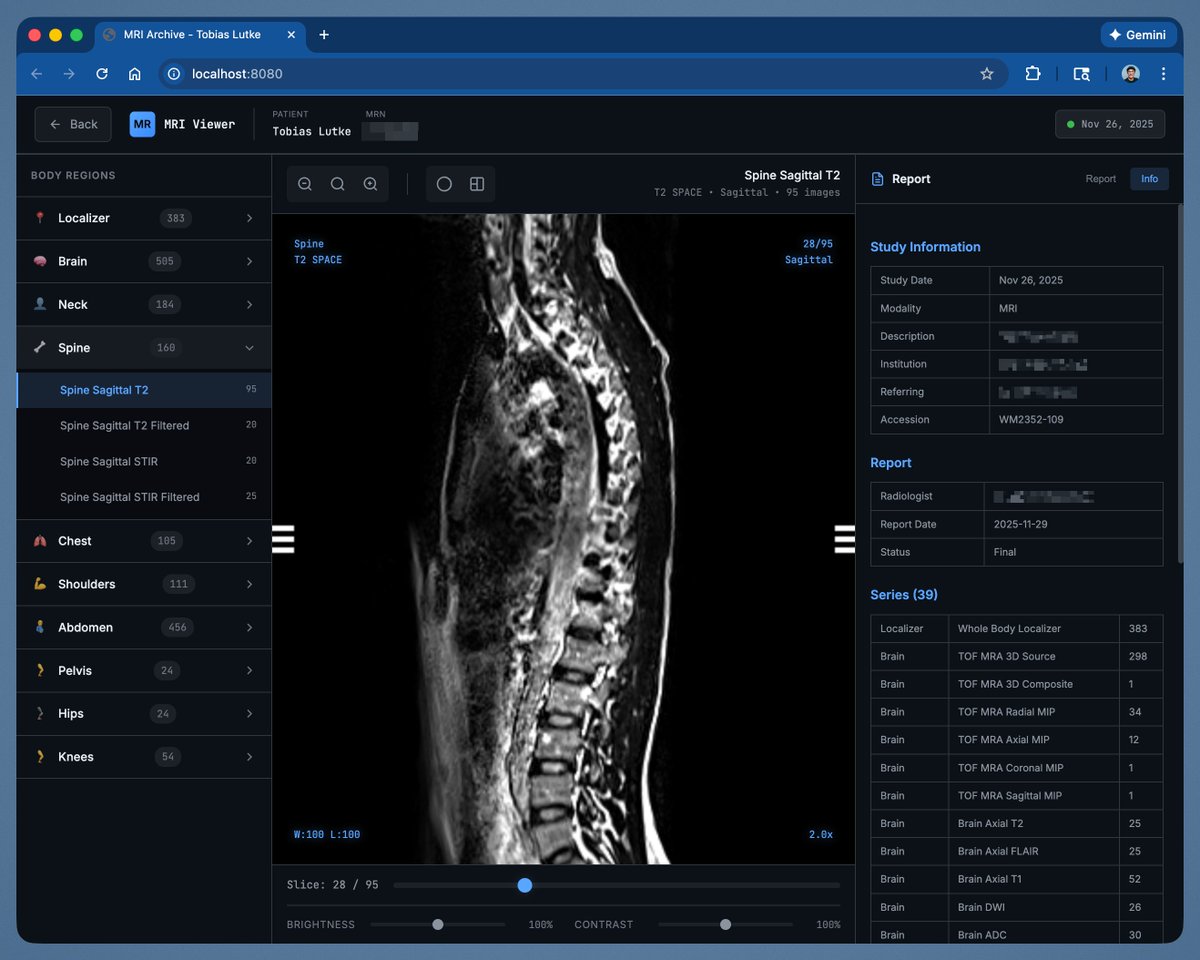
My annual MRI scan gives me a USB stick with the data, but you need this commercial windows software to open it.
Ran Claude on the stick and asked it to make me a html based viewer tool. This looks... way better.