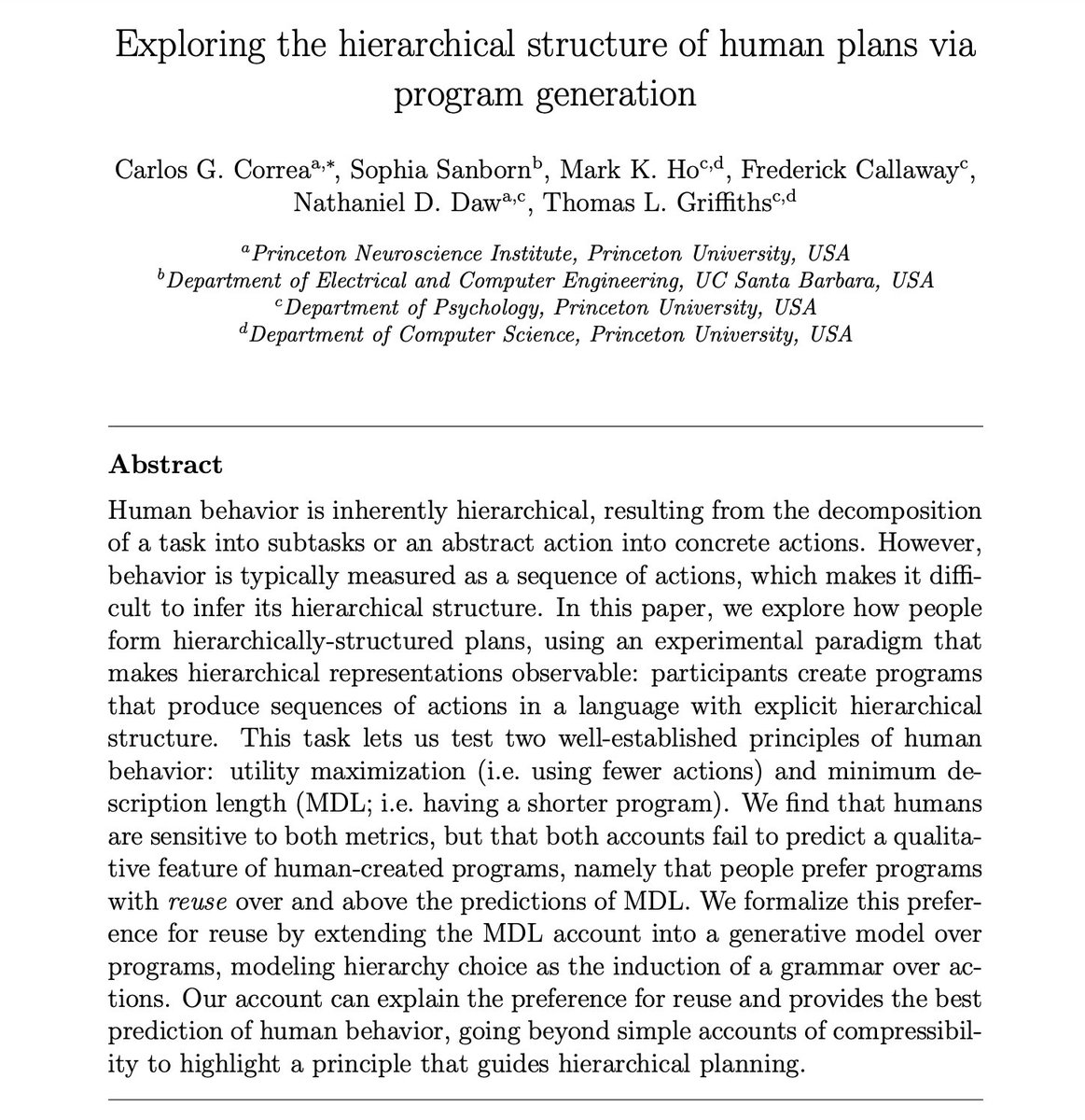
My paper on hierarchical plans is out in Cognition!🎉
tldr: We ask participants to generate hierarchical plans in a programming game. People prefer to reuse beyond what standard accounts predict, which we formalize as induction of a grammar over actions.
https://t.co/3nJ2Ei8LtB
Just walked out of a set at @ComedyCellarUSA (nyc) where the comic (Lenny Marcus) was doing a long bit mocking homeless people. Most of the audience was laughing. Pretty hard to be hopeful about the future right now...
According to X’s AI Grok, the top story on Twitter right now is that @elonmusk’s actions are being “widely condemned as an act of election interference” for suspending #WhiteDudesForHarris after raising $4 million for Kamala Harris
Our new preprint (collaboration with Claire Gillan @celinefox_ and @samgilbert1) explores the complex relationship between metacognition, compulsivity and the utilization of external reminders. (1/7)
Institutions should reflect on this wisdom:
https://t.co/2OaR0x8SIK
Institutions have an incentive to make their contribution externally legible by proliferating centrally organized programs. I believe this paradoxically reduces the quality of research it's meant to support.
I'm looking for a postdoc interested in computational cognitive modeling and deep reinforcement learning!
Submit a CV and references here: https://t.co/BFNjvqx7Pt
Please share with anyone who might be interested!
In this paper, we show how people reuse hierarchical structure while solving problems, using a program-writing task (lightbot) and a grammar induction model (adaptor grammar).
Human behavior is hierarchically structured. But what determines *which* hierarchies people use? In a preprint, we run an experiment where people create programs that correspond to hierarchies, finding that people prefer structures with more reuse.
https://t.co/5a9YdhK04U
1/7
Our paper on optimal nudging is out in Psych Review! We use resource-rational analysis to formalize nudges and predict their effects.
We also show how to use this approach to automatically construct *optimal* nudges that best improve choice.
With @callfredaway and @cocosci_lab
You know that feeling when you're trying to make a rational decision but all those pesky heuristics and biases make you do something silly? Wouldn't it be great if those biases helped us make ~better~ decisions instead?
(https://t.co/5AN6EfWmqt 🧵)
While it’s *deeply* unfashionable to be publishing in @eLife right now - do humour us for advertising a study that was several years in the making (submitted way back when it was still possible for reviewers to reject us!). We’re rather proud of it.🧵👇🧵https://t.co/iX3vHSbdgv
Really excited to share our new paper where we use a reinforcement learning model to demonstrate that rational adaptation to an unpredictable early life environment can produce key characteristics of anhedonia. (1/10) https://t.co/XNOPtUjRvN
I’m recruiting PhD students to help launch the Exploration, Learning, and Mind Lab at @UofNH Psych in Fall 2024!
Check out our lab website at https://t.co/PsMimneBpa for more info, and feel free to get in touch if you’re interested in applying!
Our article, "Identifying Resource-Rational Heuristics For Risky Choice" just got accepted in Psychological Review thanks to the hard work of @callfredaway & Paul Krueger, who did most of the work, and Tom Griffiths, who co-supervised the project with me. https://t.co/qkk7EVsRhk
You know that feeling when you can't remember a citation, but you can feel it hiding in your brain somewhere, taunting you? In this paper, we propose a computational model of how these "feelings of knowing" help us rationally allocate memory resources. https://t.co/cnjlTLY8pp
The notion that goals are central to human cognition is intuitive, yet learning and decision-making researchers have often overlooked the topic. In this @TrendsCognSci article, @Anne_On_Tw and I propose it’s time to start studying goals in their own right https://t.co/6S5VyaaJ1d
Registration for general attendance now open for this year's mathematics of neuroscience conference:
https://t.co/pJDtURWsZM
We've got a full schedule of great talks, and would love to have you join us!
Also accepting physical/virtual poster submissions until Sept 20th.
New preprint with @cjahn_neuro on how the brain learns to control attention in a changing environment! We find attention is learned incrementally from reward feedback, and it maps stimuli into a generalized space that can guide decisions in many settings. https://t.co/UVoGrLEUBd
Cumulative culture must withstand environmental change🌍How? One possibility: people have many learning strategies at their disposal🧠
Imitation is optimal in stable environments. When circumstances change, causal models can help🌟
Work with @fierycushman! https://t.co/ONkBLTNHZd