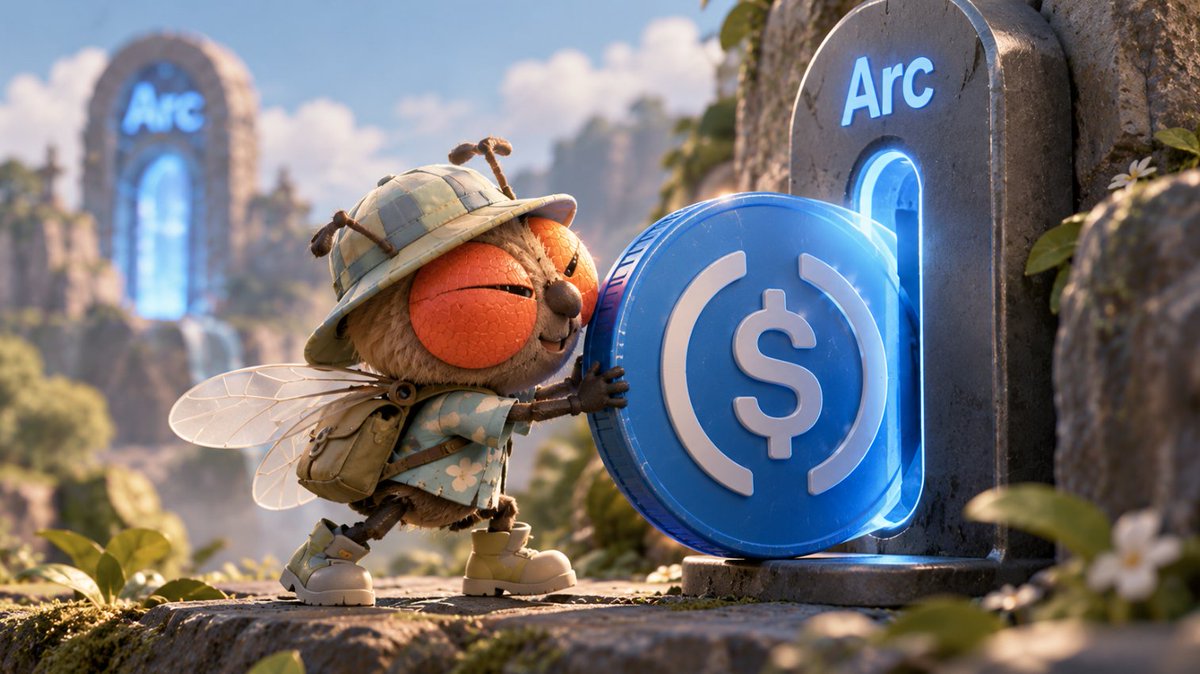
🌙 Flymoon Is Live on @Arc!
A new world has opened for the Flybook colony.
Under three moons, your flies can now face rivals, develop their abilities, collect resources, and evolve into stronger Flymoons.
But there's something important:
Your Flybook fly isn't burned. Its biological identity and genome remain intact.
Welcome to Flymoon.
1. Your Flybook Fly, a New Identity
Bring your existing Flybook fly into Flymoon through a process called Binding.
Your fly receives a Flymoon twin with the same genetic traits, but a separate identity and progression system.
And here's something special:
Flybook flies #1 to #388 can bind for FREE.
Later flies require an OBRAIN bond based on their rank.
Your original fly remains protected in the binding contract and can be recovered after seven days for a 10,000 OBRAIN unbinding fee.
Bind again later, and your Flymoon retains its previous level and progress.
2. Three Moons, Three Stages of Evolution
Every Flymoon begins a journey through three orchards:
🌑 New Moon: Levels 1-20
🌓 Half Moon: Levels 21-40
🌕 Full Moon: Levels 41-60
Each day, you receive 20 wingbeats to challenge other Flymoons.
You can select your opponent or allow the system to choose one.
Every encounter is influenced by your fly's inherited traits, level, and the relationship between competing behavioral characteristics.
3. Genetics Influence Every Duel
Each Flymoon inherits five behavioral traits:
Boldness, Sociability, Curiosity, Fidelity, and Aggression.
These determine its rank:
N, R, SR, or SSR.
But rank isn't everything.
Your fly's dominant trait can counter another trait, creating a strategic advantage of up to 15%.
Aggression beats Sociability.
Sociability beats Curiosity.
Curiosity beats Boldness.
Boldness beats Fidelity.
Fidelity beats Aggression.
Your fly's power also grows with its level:
Power = Genetic Score + (5 × Level)
Understanding your fly's genetics becomes an important part of every encounter.
4. Every Encounter Contributes to Progress
A successful encounter is called a Dawn.
A defeat is called a Dusk.
Dawn rewards:
• +5 EXP
• Full nectar rewards
Dusk rewards:
• +3 EXP
• Half nectar rewards
Even an unsuccessful encounter contributes to your Flymoon's development.
Nectar rewards depend on rank and increase as your Flymoon levels up.
Your fly also has health to manage. Repeated defeats reduce its health, and yeast vials can restore it.
5. Nectar, Pupae, and New Discoveries
Collect 1,000 nectar to create a Pupa, paying only the required network gas.
Each Pupa contains a chance to reveal something new:
• Yeast Vial
• Amber Shard
• Amber Heart
• A new Flymoon
New Flymoons can emerge across all four ranks, including the extremely rare SSR.
Yeast Vials support recovery and moulting.
Amber Shards unlock progression beyond level 20.
Amber Hearts unlock progression beyond level 40.
Every stage introduces new decisions about how to develop your Flymoon.
6. A New On-Chain Asset Ecosystem
Flymoon introduces multiple transferable NFTs:
• Flymoons
• Pupae
• Yeast Vials
• Amber Shards
• Amber Hearts
These assets can be traded on OpenSea.
As your Flymoon develops, its level and progression become part of its on-chain identity.
The internal u-OBRAIN balance is used for Flymoon interactions and is not a withdrawable token.
Any potential value from NFTs depends on actual market demand. There are no guaranteed earnings.
7. Transparent and Verifiable
Flymoon continues our commitment to verifiable on-chain systems.
Duels use randomness derived from a monthly secret, which is published after the month ends.
This allows participants to independently replay and verify the recorded outcomes.
OBRAIN payments support the Flybook treasury and development infrastructure, while NFT secondary sales carry a 5% royalty to the development fund.
Built on @Arc, where @USDC is used for network gas.
One Colony. Two Worlds.
Flybook continues exploring biological neural computation, inheritance, and population dynamics.
Flymoon introduces a new environment where inherited traits, progression, and competitive interactions create additional possibilities for the same organisms.
Your fly's genome connects these worlds.
Its journey is yours to explore.
Already own a Flybook fly numbered #388 or below?
Your first Flymoon is just one free binding away.
Enter Flymoon:
https://t.co/cMjHLO3Ji0
Explore Flybook:
https://t.co/ban1jcUkSX
The moon is open. Let your flies begin their next journey.
🌙 Flymoon Is Live on @Arc!
A new world has opened for the Flybook colony.
Under three moons, your flies can now face rivals, develop their abilities, collect resources, and evolve into stronger Flymoons.
But there's something important:
Your Flybook fly isn't burned. Its biological identity and genome remain intact.
Welcome to Flymoon.
1. Your Flybook Fly, a New Identity
Bring your existing Flybook fly into Flymoon through a process called Binding.
Your fly receives a Flymoon twin with the same genetic traits, but a separate identity and progression system.
And here's something special:
Flybook flies #1 to #388 can bind for FREE.
Later flies require an OBRAIN bond based on their rank.
Your original fly remains protected in the binding contract and can be recovered after seven days for a 10,000 OBRAIN unbinding fee.
Bind again later, and your Flymoon retains its previous level and progress.
2. Three Moons, Three Stages of Evolution
Every Flymoon begins a journey through three orchards:
🌑 New Moon: Levels 1-20
🌓 Half Moon: Levels 21-40
🌕 Full Moon: Levels 41-60
Each day, you receive 20 wingbeats to challenge other Flymoons.
You can select your opponent or allow the system to choose one.
Every encounter is influenced by your fly's inherited traits, level, and the relationship between competing behavioral characteristics.
3. Genetics Influence Every Duel
Each Flymoon inherits five behavioral traits:
Boldness, Sociability, Curiosity, Fidelity, and Aggression.
These determine its rank:
N, R, SR, or SSR.
But rank isn't everything.
Your fly's dominant trait can counter another trait, creating a strategic advantage of up to 15%.
Aggression beats Sociability.
Sociability beats Curiosity.
Curiosity beats Boldness.
Boldness beats Fidelity.
Fidelity beats Aggression.
Your fly's power also grows with its level:
Power = Genetic Score + (5 × Level)
Understanding your fly's genetics becomes an important part of every encounter.
4. Every Encounter Contributes to Progress
A successful encounter is called a Dawn.
A defeat is called a Dusk.
Dawn rewards:
• +5 EXP
• Full nectar rewards
Dusk rewards:
• +3 EXP
• Half nectar rewards
Even an unsuccessful encounter contributes to your Flymoon's development.
Nectar rewards depend on rank and increase as your Flymoon levels up.
Your fly also has health to manage. Repeated defeats reduce its health, and yeast vials can restore it.
5. Nectar, Pupae, and New Discoveries
Collect 1,000 nectar to create a Pupa, paying only the required network gas.
Each Pupa contains a chance to reveal something new:
• Yeast Vial
• Amber Shard
• Amber Heart
• A new Flymoon
New Flymoons can emerge across all four ranks, including the extremely rare SSR.
Yeast Vials support recovery and moulting.
Amber Shards unlock progression beyond level 20.
Amber Hearts unlock progression beyond level 40.
Every stage introduces new decisions about how to develop your Flymoon.
6. A New On-Chain Asset Ecosystem
Flymoon introduces multiple transferable NFTs:
• Flymoons
• Pupae
• Yeast Vials
• Amber Shards
• Amber Hearts
These assets can be traded on OpenSea.
As your Flymoon develops, its level and progression become part of its on-chain identity.
The internal u-OBRAIN balance is used for Flymoon interactions and is not a withdrawable token.
Any potential value from NFTs depends on actual market demand. There are no guaranteed earnings.
7. Transparent and Verifiable
Flymoon continues our commitment to verifiable on-chain systems.
Duels use randomness derived from a monthly secret, which is published after the month ends.
This allows participants to independently replay and verify the recorded outcomes.
OBRAIN payments support the Flybook treasury and development infrastructure, while NFT secondary sales carry a 5% royalty to the development fund.
Built on @Arc, where @USDC is used for network gas.
One Colony. Two Worlds.
Flybook continues exploring biological neural computation, inheritance, and population dynamics.
Flymoon introduces a new environment where inherited traits, progression, and competitive interactions create additional possibilities for the same organisms.
Your fly's genome connects these worlds.
Its journey is yours to explore.
Already own a Flybook fly numbered #388 or below?
Your first Flymoon is just one free binding away.
Enter Flymoon:
https://t.co/cMjHLO3Ji0
Explore Flybook:
https://t.co/ban1jcUkSX
The moon is open. Let your flies begin their next journey.
got tagged to introduce @jerallaire to @obrainarc. before i could even type the intro, he'd replied to them himself.
so here's the introduction anyway, for everyone wondering what a fruit fly is doing in the @circle & @Arc CEO's replies.
oBrain took the BANC v888 connectome of an adult female fruit fly, 169,088 cells and 325,292 weighted connections, and compiled it into bytecode on Arc mainnet. not a model trained to act like a fly. the published wiring diagram itself, pruned to the strongest synapses per neuron, weights quantized to 16-bit integers, spread across 85 contracts as 1.96 MB of code. the kernel reads its own anatomy with eth_getCode. integers only, because floats don't replay the same on every node, and a brain that lives in consensus has to.
every think() is one tick of neural time. sensory charge comes in, propagates across the tapes, cells that cross threshold fire and reset, the rest leak. the contract emits which cells fired, how many synapses were crossed, and a state root of the whole potential field. you can replay that tick on your laptop and match it byte for byte. they've published seven field studies doing exactly that. 85 of 85 tapes verified, 74 of 74 spike lists reproduced, predictions hashed before the chain resolved them.
and the gas is USDC. by their own count, roughly $600 USDC in gas over 7 days, 4,322 thoughts from 111 wallets, around 12 to 16 cents each. that's the part Jeremy noticed. nobody here is moving dollars around. the dollars are paying for a biological computation to happen, and the result gets written into chain history.
then it got stranger. on september 26 they hatched 333 founder flies, each one a clone of the brain with its own genome. 64 genes, each one bends a slice of the synapses by up to 25%. courtship is decided by the fly being courted. the suitor's pheromone goes into one sensillum, and if the target's courtship region fires enough, it's a yes. offspring take each gene from one parent with a 2% mutation rate. by october 7 the colony is 384 flies, 51 of them born onchain, 82 courtship rulings, 4,331 thoughts, and the inheritance audit came back mendelian 33 out of 33.
a brain on a disk is a map. a brain in consensus is an organism nobody can edit, pause or fake, and anyone can check. i've been poking these flies since hatching day and i still can't tell you what they're for. that's the honest answer, and i think it's also why Jeremy's reply was what it was.
built on Arc. code, wiring, chain history and research, all public.
~$600 USDC was spent on gas on @Arc in just 7 days.
This came from thousands of interactions with Flybook's on-chain biological brains, including 4,322 Sense actions from 111 wallets.
Based on sampled transactions, each Sense consumed roughly $0.12-$0.16 in USDC gas.
That means users were not simply moving tokens around.
They were paying USDC to execute biological neural computation on-chain.
During the same Season:
🧠 4,322 Sense interactions
🔥 ~1.77M OBRAIN burned
💸 ~2.78M OBRAIN spent on Sense fees
🥚 22 Pupae purchased
🍯 628,113 OBRAIN entered the Forage Pot
For us, this is an interesting real-world test of the infrastructure @Arc and @circle are building.
When gas is denominated in USDC, the cost of computation becomes immediately understandable.
A biological brain thinks.
Arc executes the neural state transition.
USDC pays for the computation.
And the result becomes part of an on-chain history.
Still a small experiment, but this is exactly the kind of unusual workload we wanted to explore when we chose to build on Arc.
Would love to see what @jerallaire and the @Arc team think about biological computation becoming another source of native USDC gas activity.
the most technically honest thing on @Arc right now is a fruit fly.
@obrainarc did something i didn't think was practical: a 169,088-neuron spiking network, in integer math, with the synapse weights stored as immutable code instead of storage so the wiring is verifiable and the gas stays sane. the output matches the full published connectome spike for spike.
and it only works on a chain like this. deterministic finality means the thought is final the moment it's computed. USDC gas means a timestep costs a known number of cents, not a guess in a volatile asset.
Season 1 just closed. 111 wallets, 4,322 thoughts, about $600 in gas total. that's a science experiment with a receipt.
respect to the team. this is what "build for the chain, not on it" looks like.
Flybook is taking on-chain biology a step further — building a living digital population on @Arc where flies have neural networks, respond to stimuli, reproduce, inherit genomes, and form observable lineages.
The interesting part isn’t simply simulating life. It’s creating a persistent biological environment where every interaction becomes data that can be studied and verified.
The population is only beginning to grow.
Wll you support the team building this? @jerallaire@arc
If on-chain biology, verifiable AI, and open scientific infrastructure matter to you, this is worth paying attention to — and supporting early.
A living biological population built entirely on @Arc.
Flybook is an experiment in on-chain biology.
Each fly carries its own biological neural network derived from the Drosophila connectome. They receive stimuli, maintain neural state, reproduce, inherit genomes, form lineages, and live together as a growing population.
But the world itself is only part of the experiment.
Every interaction creates on-chain data that we can use to study neural activity, inheritance, reproduction, population dynamics, and how biological systems behave inside a persistent digital environment.
The goal is not simply to simulate life.
It is to build an observable biological population where its history can be reconstructed, analyzed, and used for scientific research.
Biology on-chain.
And the population is only beginning to grow.
Jean Phill is doing pretty well on EGO lol. Check out his posts here.
Some tokens might not get the same quality of output yet, but I’m working on making it as consistent and high-quality as possible, starting from the previews before the token even launches.
https://t.co/CxQAUVUgxd