@astro_reid@Astro_Christina@astro_reid, @Astro_Christina this is awesome!
Q: in each image returned of the flyby, the Moon looks slightly different (camera exposure settings/phase of the flyby? i.e. art002e010208 vs art002e009289). Which image(s) standout as being closest to what the human eye sees?
Only one chance in this lifetime…
Like watching sunset at the beach from the most foreign seat in the cosmos, I couldn’t resist a cell phone video of Earthset. You can hear the shutter on the Nikon as @Astro_Christina is hammering away on 3-shot brackets and capturing those exceptional Earthset photos through the 400mm lens. @AstroVicGlover was in window 3 watching with @Astro_Jeremy next to him.
I could barely see the Moon through the docking hatch window but the iPhone was the perfect size to catch the view…this is uncropped, uncut with 8x zoom which is quite comparable to the view of the human eye. Enjoy.
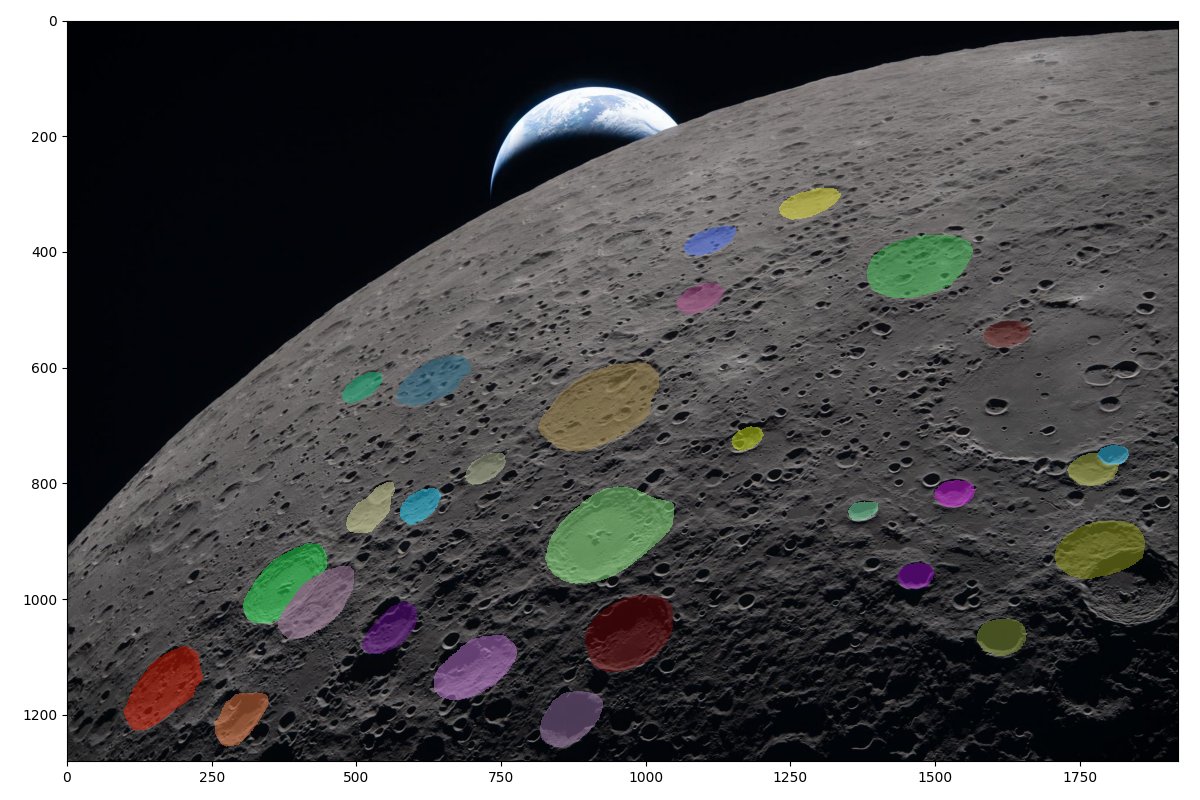
@NASA@NASA - incredible! We've already started passing these images through our Crater Detection Algorithm.
Can you put me in contact with the OpNav team to discuss our autonomous OpNav tech?
Tycho Orbital is developing autonomous optical navigation technologies for lunar missions.
Using craters detected in images, we can determine the spacecraft's position fully autonomously.
https://t.co/Y86zc6bSO0
Following the lunar flyby, the Artemis II mission started returning some incredible photos of the lunar far side.
We couldn't resist running them through our crater instance segmentation model - a core part of our Crater Detection Algorithm (CDA).
@NASA@NASAArtemis@NASAAdmin
@chr1sa I used "long tail" to describe the elapsed time distribution in a population of position estimates from our OpNav algorithm when presenting to a university group last week and thought of you @chr1sa 👍🏻
Callum Bruce @callumbruce91 demystifies transformer architecture by guiding readers step by step through the construction and training of a time-series denoising model using TensorFlow. The model performs well and can be used for specialized tasks.
https://t.co/tZM07nfq9Q
I posted "How to Program a Neural Network" on Medium a little over a year ago. With over 36k views and 10k reads it has reached far more people than I imagined possible. I've added a free-to-view link at the top of the article so anyone can now access it
https://t.co/lXl71G5z6N
"In this article, we will develop a crater detection algorithm (CDA) for an autonomous crater-based optical navigation system for spacecraft in orbit of the Moon."
Lunar Crater Detection: Computer Vision in Space by @callumbruce91 https://t.co/mKzdUBtIPi
Crater detection algorithms (CDA) are a crucial part of future autonomous crater-based navigation systems onboard spacecraft.
Follow the implementation of a CDA based on the #segmentanythingmodel in my latest Medium article published in @TDataScience:
https://t.co/tzaOiMDv0k
Have you ever wondered how a neural network works? Follow along as I explain, step-by-step, how to implement a neural network from scratch in "How to Program a Neural Network", published in @TDataScience.
#NeuralNetworks#MachineLearning#deeplearning
https://t.co/zChWx9xgtQ
Dive deep into one of the fundamental methods deployed in machine learning—the gradient descent algorithm—and follow along as @callumbruce91 explains how you can use it to solve engineering optimization problems. https://t.co/iiXeNZO8Ht
What if you use #machinelearning to solve engineering optimization problems? 🤔
Read about this in my latest article, published in @TDataScience PID Controller Optimization: A Gradient Descent Approach https://t.co/o2xlBu8FuJ