I was having trouble figuring out how to explain a math concept to a friend yesterday, so I decided I'd try to animate a sequence using @figmadesign's Smart Animate feature to create a @3blue1brown-esque clip.
Pretty happy with how it turned out, and no code required!
@benhylak Was really excited to try Workshop this morning but seems like installer might be broken? “No stable release is published yet”
Sent you a DM w/ verbose logs
Software is going to melt into everything and nothing all at once
Asked Claude-3.5 to implement an example patient application using the Good Faith Estimates provided by the Patient Cost Transparency Guide (nitty gritty healthIT interop spec)
And it one-shotted a React app
Just two and a half years ago it was extremely rare for 14-18 year olds to be building startups and applying to YC; now I've lost count of how many ambitious young people I see trying to solve the world's hardest problems
Etiquette is seems like the wrong choice of word. “Best practices” however, are common for almost every tool.
At a 10,000 person company, your actual working group is going to be a small percent of that total. In my experience, it’s typically best left to the small team to figure out what works for them. Best practices are helpful starting points.
Slack offers lots of capabilities to integrate with all the other “surfaces” that information lives. IMO, this is where it is the responsibility of the company to provide enhanced tooling specific to your org.
@phuctm97 This is my go-to chart for comparing the tradeoffs to each “major” commercial OS strategy. The extension model on top of open-core is how we sell at https://t.co/qkBjBKfNdH - still, no option is going to be as lucrative as it could be closed source.
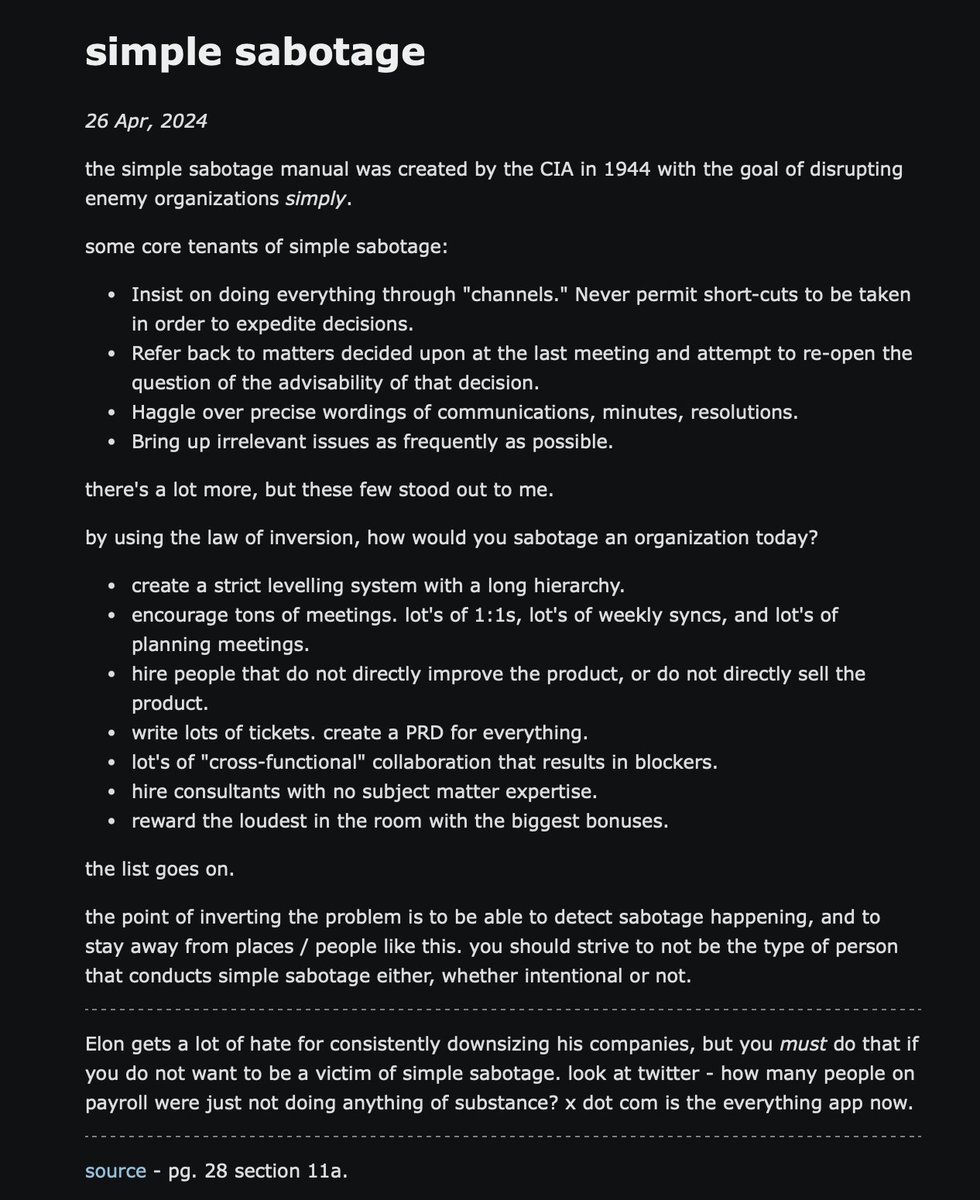
in 1944, the CIA released a manual called simple sabotage to aid their espionage efforts. the goal of simple sabotage was to disrupt the functioning of enemy operations from within, without the need to train someone.
the first time I read this, I realized that a lot of processes & politicking within organizations is just a form of simple sabotage - whether it's done intentionally or not.
stay away from places that employ simple sabotage, and get rid of it if you run an organization.
I love how joyful the interactions in the editor look, almost like someone physically redlined your writing with ink. So fun, kudos!
I am confused however on what the best use case for this is. Initially it reminded me of Calca. I've been dying for a more modern version of that tool for ages. https://t.co/BtnJyBm9ck
It seems like some of the underlying technology (recognizing equations) could lend itself nicely to this kind of use case.
By assuming that technical talent is fungible and interchangeable, a previously-successful engineering company will be run into the ground...
...along with a few of its own products and everyone on board.
It's astonishing how certain types of managers will prefer less-talented-but-more-controlable scientists and engineers over more brilliant and creative ones who may be more difficult to control, somewhat unpredictable, and sometimes annoying.
Here is the thing: scientific and technical breakthroughs are unpredictable by management, and progress often comes from folks with unconventional personalities and backgrounds.
As I was told by my management at Bell Labs: "You don't have to be crazy to work here, but it helps" 😄
@finereli How do you initially prompt these long-term interactions?
I find myself defaulting to just instructing for task-work, but can see obvious value in the “talking it out” discovery method.