Forget generalities about the Deuterocanon and the early Church - what is the evidence that the Corinthians saw Judith as canonical Scripture? Read my blog at https://t.co/nvMlh9tK2g
Many skeptical claims against the Bible are based on bigotry towards laborers. Stereotypes are passed off as scholarship, beginning with claims that a fisherman “couldn’t” know how to read or write Greek (and therefore New Testament writings are fakes, etc.).
Frederick Douglass was a slave whose violent masters actively worked to stop him from learning how to read and write, including hiding every scrap of writing from him. He learned it anyway. When you are presented with the alleged writings of an alleged slave, is the correct conclusion that the writing can only be a later fake by a non-slave? Or is it that the prejudice against slaves was wrong?
Frederick Douglass is just one obvious more recent example far more extreme than the Evangelists. Peter was not a slave, not a peasant, not even “only” a laborer: he owned the boat.
Others like John were never simple fishermen: John is the son of a man who owned a fishing business (Mark 1:19-20). James and John (and presumably their father) were partners with Simon Peter (Luke 5:10), and presumably Andrew; they also employ servants (Mark 1:20). Boats needed 5 to 16 men, and sometimes two boats were needed to handle the nets. This was not a small operation, even if it was only a few boats (and we do not know that; it could have been many). John is also known unto the high priest (John 18:15-16), including the damsel that kept the door, presumably because he was the one who supplied them with fish—a lucrative gig. The Bible also notes that he was a spoiled momma’s boy—momma literally begged in order to advance John’s career (Matthew 20:20-21: Then came to him the mother of Zebedee’s children with her sons, worshipping him, and desiring a certain thing of him…). The idea that such a family arranged for John to learn Greek is not nearly as “inconceivable” as skeptics contend.
Even more, Andrew the “fisherman” had time to follow John the Baptist, before Christ; just as Paul’s tent-making is a side job. A job is not all of someone’s life, even in ancient times.
It is bigotry when people use someone’s résumé as a weapon to claim they “couldn’t” do something. And “fisherman” is not even a résumé, it is a vague one word description of one thing a person did, with no information as to what else he may have done (be it previously, afterwards, or during).
To be blunt, “fisherman” does not describe the limits of anyone’s potential.
The evidence for the early Church’s acceptance of Baruch as canonical Scripture, compares shockingly well to the evidence for Matthew – the single most important book of the Bible to early Christians, called the “Christian Pentateuch.” Read the blog at https://t.co/JCEUL7NYU0.
I know multiple people IRL who have told me they almost self deleted.
As a last cry for help they decided to flip to a random Bible verse and each one of them found
THIS EXACT VERSE.
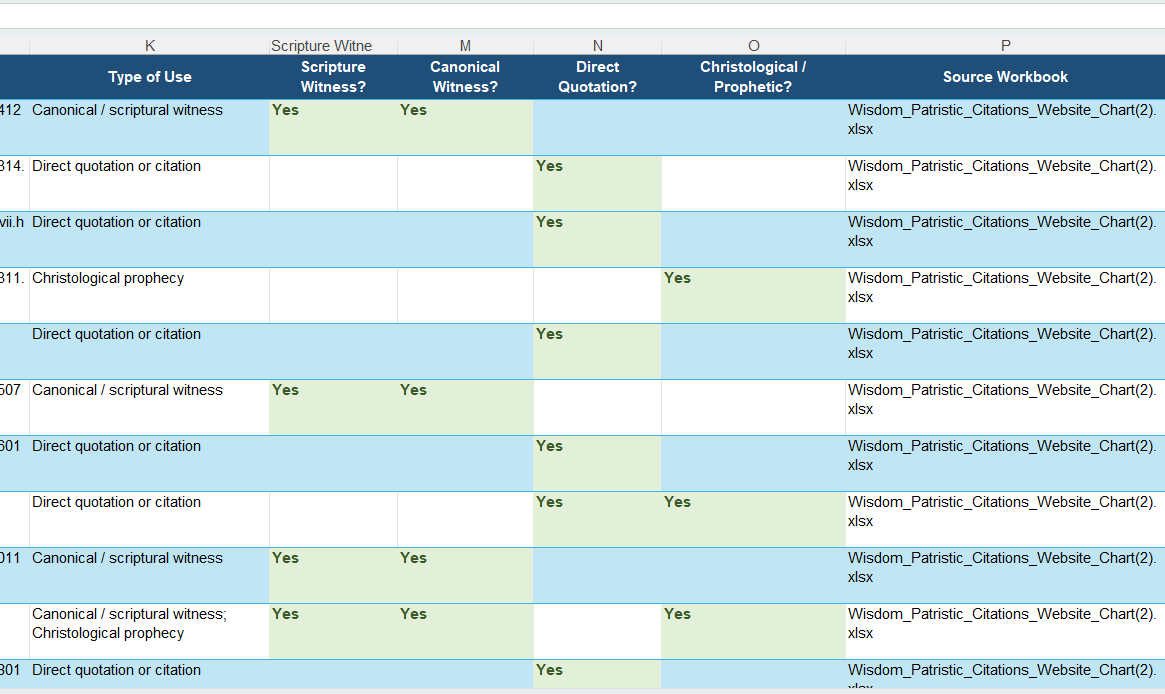
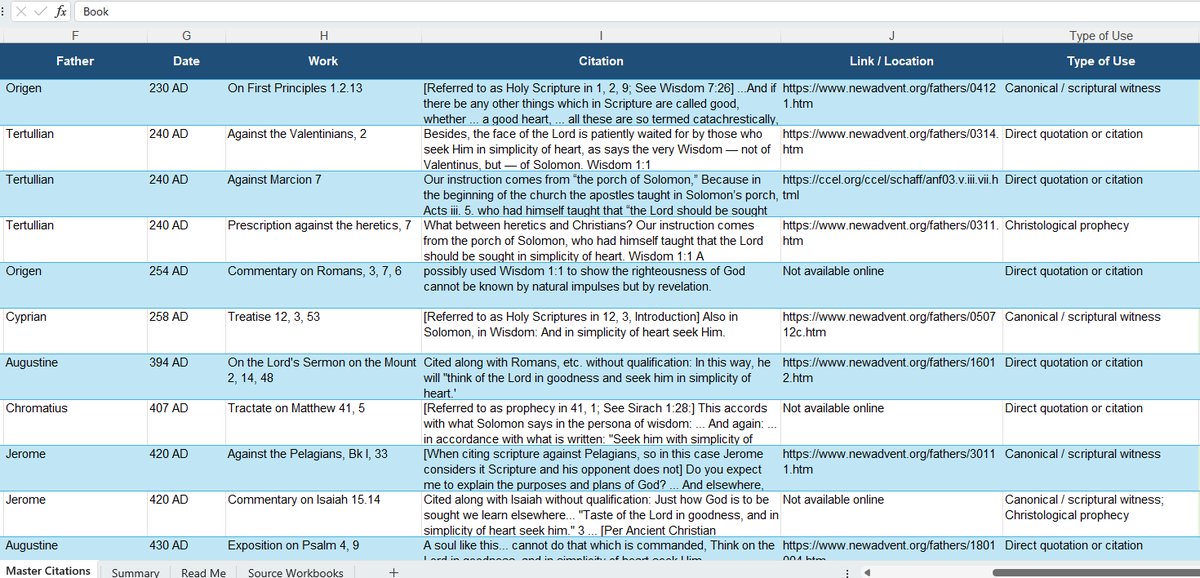
Anyone can now use the searchable spreadsheet/database of everything the earliest Christians ever said about the Deuterocanon, available at https://t.co/jaUIBdEksn.
It's a work in progress... at this point my research has been uploaded but i have not read through the online changes to make sure that what the A.I. and cheap foreign labor say about the individual references (i.e., the categorizations noted in columns K, L, M, N, and O) is all accurate, so "buyer beware". I will be working my way through that piece for a long time to come.
Still, it is already a tremendous resource for those interested. It is vastly more comprehensive than anything else i could find when trying to see the evidence for myself.
There is a massive gender gap in Christianity and blue-collar is the answer. There are 7% fewer men in Church and the ones that are there are 7% less engaged. Let’s look at the numbers and see how focusing your messaging on blue-collar men can close that gap and shed light on the blue-collar blindspot.
Protestants say Josephus “proves” the Old Testament matched their canon before Christ. But he didn’t name the books. Why trust his allusion more than allusions made by the Evangelists to the Deuterocanon?
Read more at https://t.co/lfDsr7nosb
A great book, and part of the inspiration for my own book Canon Crossfire (available entirely online for free, at my website). But for Kruger’s model to work the way he wants it to, the early Church had to reject the “Apocrypha” – as he notes in a footnote: Ch. 6, note 11. The problem, tho, is that the Church did no such thing in the case of certain specific books like Susanna, Baruch, and the long form of Esther – you just have to focus on these specific books (forget generalizations about the “Apocrypha”): read what the father creating a canon list said about them, and it is clear that the father considered Susanna part of his Daniel (etc.), to any reasonable standard of proof. E.g., Jerome says anyone claiming he rejected Susanna as part of Daniel was slandering him.
I doubt Kruger denies that (I don’t know of any scholar who does), but my guess is that he forgot it as “trivia.” No doubt that in the canon debate, he would claim Hebraica Veritas as grounds for rejecting these books– but this is not the canon debate, it is the foundation of his case for the New Testament. For his NT model to work, the early Church had to reject the “Apocrypha” (he knows that, and says so in his footnote) and that is not really what happened on those specific books.
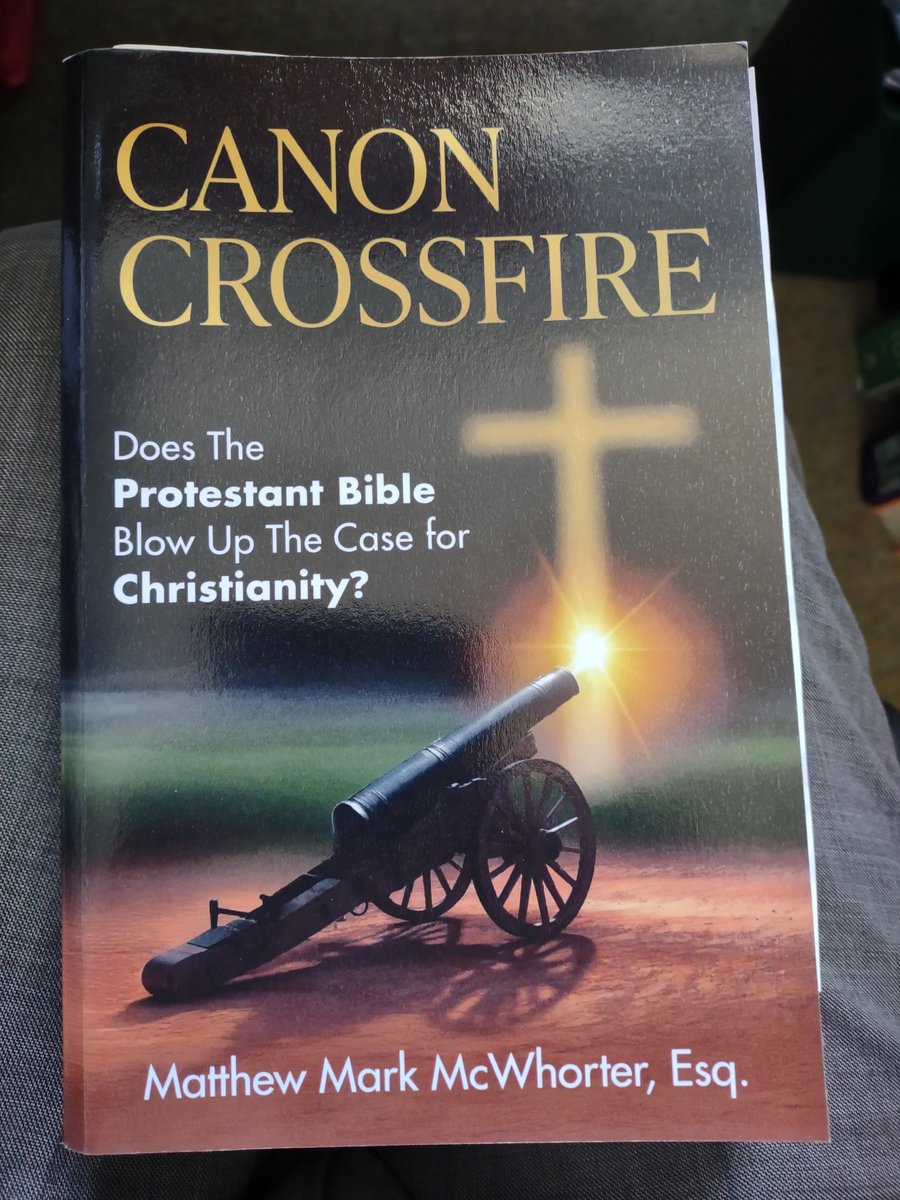
Whether Kruger or any Protestant could win “round two” (once they recognize this problem and try to fix it) is the real subject of my book. I personally don’t think so, but I leave it to the reader to decide. Anyway, you sound like the book might interest you… A year into this and it still has nothing but five star reviews from everyone, including Protestants. I was a skeptical lawyer at the time I read Kruger’s book and noticed this problem; my book is just a lawyer walking through the evidence on the Old Testament canon and explaining how a skeptical opponent would use it against a Protestant who is trying to prove the New Testament. (This is not really a “Catholic” argument, and the book has not bothered anyone who read it.) As mentioned it is all available online, but I also still have free print or ebook copies available for seminarians - DM or email me if you want one of those.
Canon Crossfire is now available in its entirety for free online! It includes hyperlinks to all the original source documents. Check it out! PDF downloads of the entire book are also available on the canon crossfire home page.
https://t.co/v1tPTpUbal
Personally, this marks a transition from promoting the book itself to promoting the research the book is based on. Book promotion involves a lot of live interviews just explaining the premise of the book - over an eight month period I did about 100 of those (I have links to them at the main website). Starting in May, I worked to get the research itself online, and now I will focus more on in depth discussions of the subject of the book. Looking forward to it!
So if you are a host looking for such content, reach out to me! Even if you disagree with the premise, I don't bite, and there is much to discuss.
Which canon list first names Baruch in its third category? Was it ever done in the Middle Ages, or not until after the Reformation?
From my book Canon Crossfire: “Something else is also clear, when we look solely at Baruch and not at the Apocrypha as a group [meaning the Catholic Deuterocanon]: with respect to Baruch (and, in fact, Susanna, as briefly mentioned above) there is no third category (the three categories being Scripture, not Scripture, and something in between = Apocrypha), no Ecclesiastical, no “only to be read and not to be used to confirm doctrine,” nothing like that at all. Baruch is either full canonical Scripture or it is not, and it is that way for every single Father, including Athanasius, Rufinus, and Jerome (the three Fathers most often cited as support for a “third category” of Books), and also including Epiphanius, Cyril of Jerusalem, Gregory of Nazianzus, Amphilochius of Iconium, and the Apostolic Canons (additional Fathers occasionally cited as support for a third category).”
@drjohnmeade@michaeljkruger@TextandCanon@pjgurry
In your charity would you please pray for a private intention of a loved one and RT this far and wide. It's an important and urgent one and I'd love your help in storming heaven with the incense of the saints!
@bradwritesscifi@blucollarbible The Bible IS the combination/collection. The United Nations was not created in 1776, a piece of what will eventually come together as the UN was.







![CanonCrossfire's tweet photo. Which canon list first names Baruch in its third category? Was it ever done in the Middle Ages, or not until after the Reformation?
From my book Canon Crossfire: “Something else is also clear, when we look solely at Baruch and not at the Apocrypha as a group [meaning the Catholic Deuterocanon]: with respect to Baruch (and, in fact, Susanna, as briefly mentioned above) there is no third category (the three categories being Scripture, not Scripture, and something in between = Apocrypha), no Ecclesiastical, no “only to be read and not to be used to confirm doctrine,” nothing like that at all. Baruch is either full canonical Scripture or it is not, and it is that way for every single Father, including Athanasius, Rufinus, and Jerome (the three Fathers most often cited as support for a “third category” of Books), and also including Epiphanius, Cyril of Jerusalem, Gregory of Nazianzus, Amphilochius of Iconium, and the Apostolic Canons (additional Fathers occasionally cited as support for a third category).”
@drjohnmeade
@michaeljkruger
@TextandCanon
@pjgurry](https://pbs.twimg.com/media/HLReK-7WoAEkZe2.png)


