"Just enduring. This complacency is a disease. If we don't act now, it will infect all of us and all who come
after us." #TheProphecy#MustGo#MyCowMyChoice
THEOLOGY DUJOUR
Sunni Islam is a lot about God
Shia Islam is a lot about Ali
Apostolic Christianity (Catholicism & Orthodoxy) is a lot about Mary Mother of God
Evangelical Protestantism is mostly about Jesus Christ
Good people,
I built the tool I wish I had when starting the homeownership journey.
Save up to 6 house designs you love.
Generate cost estimates.
Track your progress.
Refine your vision.
Everything stays in one place.
https://t.co/v2Fk9kDzc8
You first own the journey. Then you own the home.
This is the ladder to your first home.
I'm finally reading Dune. This quote, which is in the first few pages, hits hard:
"Once men turned their thinking over to machines in the hope that this would set them free. But that only permitted other men with machines to enslave them."
When you tell God, "Here is my life, heart. Tell me what you what to do!"
You better buckle up. God will kick you into your purpose like the movie 300.
All I am going to tell you is... You will need Him on your way down.
Rick Rubin: "I've met very few billionaires who are happy"
"I don't look at the outside very much. I look inward. I try to focus on what do I feel, what am I seeing, in the hopes that by sharing what's going on in me, it resonates with someone else. I can't predict what someone else would like. And I don't think anybody can. So if I'm authentically true to myself, that's the best chance of someone else liking something."
Rubin explains the paradox of acceptance:
"People want to be accepted. And I'm suggesting that the best way to be accepted is to be yourself. It's not to change yourself to what someone else thinks. First of all, you don't really know what someone else thinks. And if you're not genuine to yourself, nothing is there. It's just a projection or a mask. It's not true."
On what makes something interesting:
"In a sea of information, the more yours is personal, the more it's not like hers or his or theirs, the more it's yours. If we're all thinking the same thing, it's boring. Why would we make anything if everyone thinks the same thing? What makes us interesting are the differences. Even the imperfections. The imperfections are what make us human."
Rubin shares what captures his attention:
"There's so much middle of the road, and it doesn't interest me. I want it because it's louder, quieter, softer, harder. It's pushing some boundary. That's why I take notice. It's not more of the same. It's the one that makes you stop and think: did I really hear that? Did I really see that? What's going on here?"
On what success actually means:
"If I like it, that doesn't mean anything. That's what people think. Just because I like it doesn't give it any value. But as an artist, if you like it, that's all of the value. That's the success. It comes when you say, 'I like this enough for other people to see it.' Not 'other people like it, so it's successful.' That doesn't mean anything. Because other people liking it is out of your control. All that's in your control is making the thing to the best of your ability."
Rubin reframes what greatness means:
"I came to realize recently, it's all an offering to God. And if you're making an offering to God, you're not thinking about the budget, or hoping this segment of the audience is going to like it. We don't think like that. It's a higher vibration. We're making the best we can make, to the best of our ability, out of love and devotion. That's what it is. There is no higher form."
On criticism and reviews:
"Most of the artists I work with don't read any criticism or reviews, good or bad. The ones who are the strongest in who they are can even read a terrible review and laugh at it. Because when someone gives you criticism, it's telling you as much about who they are as what you've made."
Rubin explains the only real competition:
"The idea of the Oscars or the Grammys, where we're saying which album is better than another, it doesn't make any sense to me. Because it's always apples and oranges. The only people we can honestly compete with is ourselves. Is this the best I can make today? Have I gone further than I've gone before? That's all we can do. That's the only competition that makes sense."
On the obsession required for mastery:
"Many of the artists that are great at what they do are great for one reason: they fall in love with this thing, and they just want to know everything they could possibly learn about it. I'm working on a documentary project with comedians now. One of the things they talk about is their commitment; when other people are going out on the weekend, they're going to perform every night they possibly can.
For a period of 10 years. Having bad performances. Having people not like what they do. Banging their head against the wall. But that obsession with breaking through, and when I say breaking through, I don't mean to the audience. I mean with themselves."
Rubin shares a hard truth about dreams and jobs:
"Maybe your purpose in life isn't related to your job. Maybe your job is your job, and the job is the thing that supports you. And then the rest of your waking hours are devoted to your purpose. Don't let following your dreams undermine your ability to support yourself. If you decide 'I want to be a comedian and I'm putting all my eggs in the comedian basket', the pressure of having to support yourself will change you as a comedian. Not for the better. You want the stability of being able to take care of yourself in the world to be free to do whatever your passion is."
He challenges the mythology of genius:
"There's a mythology that the people who make things that we love are special people, the people on Mount Olympus, magic people who are geniuses. And then there's the rest of us. That's not the case. We're all just people. We're all doing our best. We're all good at some things, not good at other things. We're humans. And sometimes we find a way to make something beautiful."
Rubin shares his most vulnerable moment:
"The call came: 'How do you feel? You have the number one album in the country.' And I remember saying, 'I've never been more unhappy in my life.' We mistakenly think some kind of outward success is going to change something in us. And it does not. It may make life more comfortable. But it doesn't change who we are. Any hole in ourselves that we're hoping to fill does not get filled."
He explains why successful people are often unhappy:
"If you spend 20 years of your life working towards a goal that's going to solve everything, and then you finally achieve what you've been trying to do for 20 years, and nothing changes, that's when you get hopeless. It's not uncommon to see very successful artists who are very unhappy.
I'm sure you've met many very successful business people. Billionaires. Very few of them are happy. Very few. They've accomplished their dreams and are unhappy. Because we don't know what we want. We're trying to fill something that maybe can't be filled through material or public success. It's something else. Some internal thing."
Rubin closes with this:
"Don't do things just because you think you're going to get something for it. That's not why we do things. Do what's interesting to you. Follow what's interesting. Don't worry about the outcome. We can never predict the outcome. Follow your own inner guide. It might not make sense to anyone else.
It might not even make sense to us. And that's okay. The wisest thing we can do is know enough to know we don't know. Anytime you think 'I know how it is' your world just got a lot smaller."
Best breakdown of the China productivity shock 2.0 I’ve read.
“China accidentally built a distributed neural network of manufacturing intelligence where knowledge diffuses horizontally across thousands of agents faster than any single western company can process internally”
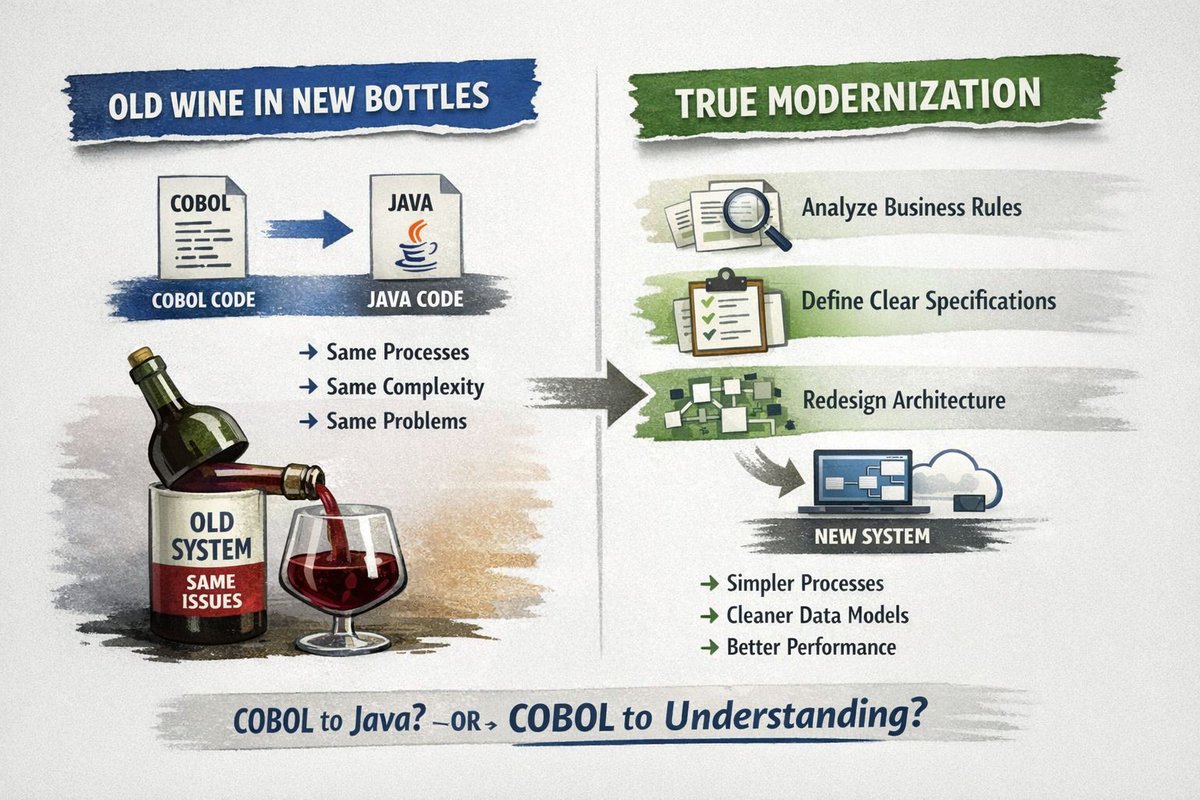
Everyone is excited about AI modernizing COBOL to Java.
But let’s be honest:
This is not modernization.
It is translation.
Tools from companies like Anthropic can convert COBOL into Java. That sounds impressive. But what do we really get?
The same system
The same processes
The same complexity
Just in a different syntax.
This is what I call “old wine in new bottles”.
The real problem of many legacy systems is not the programming language.
It is unclear business logic, implicit processes, and decades of accumulated complexity.
If you translate that 1:1, you keep the problem alive.
There is another aspect that is often ignored: performance.
Mainframe systems are fast for a reason.
Application and database run close together, often without network latency.
Highly optimized I/O, predictable execution.
When we “modernize” to Java with distributed systems, REST calls, and remote databases, we often introduce:
More latency
More failure points
More complexity
And sometimes even worse performance than before.
So what should we do instead?
Do not start with code.
Start with understanding.
Use AI to:
* extract business rules from COBOL
* make implicit processes explicit
* document behavior as specifications
Then redesign the system based on today’s needs.
COBOL → Understanding → Specifications → New System
Not:
COBOL → Java → Done
Modernization is not about changing the language.
It is about reducing complexity and improving clarity.
Let’s move from translating code to understanding systems.
A sniper does not fire because he has been lying still for six hours and wants it to be worth the wait.
He fires because the conditions are met.
If they are never met, he goes home with a full magazine.
That is not a failed mission.
That is the mission.
You must've have realized... workplace drama is higher in employees whose personal lives stalled... no money goals... no skill growth. Just emotions leaking everywhere.
Last quarter I rolled out Microsoft Copilot to 4,000 employees.
$30 per seat per month.
$1.4 million annually.
I called it "digital transformation."
The board loved that phrase.
They approved it in eleven minutes.
No one asked what it would actually do.
Including me.
I told everyone it would "10x productivity."
That's not a real number.
But it sounds like one.
HR asked how we'd measure the 10x.
I said we'd "leverage analytics dashboards."
They stopped asking.
Three months later I checked the usage reports.
47 people had opened it.
12 had used it more than once.
One of them was me.
I used it to summarize an email I could have read in 30 seconds.
It took 45 seconds.
Plus the time it took to fix the hallucinations.
But I called it a "pilot success."
Success means the pilot didn't visibly fail.
The CFO asked about ROI.
I showed him a graph.
The graph went up and to the right.
It measured "AI enablement."
I made that metric up.
He nodded approvingly.
We're "AI-enabled" now.
I don't know what that means.
But it's in our investor deck.
A senior developer asked why we didn't use Claude or ChatGPT.
I said we needed "enterprise-grade security."
He asked what that meant.
I said "compliance."
He asked which compliance.
I said "all of them."
He looked skeptical.
I scheduled him for a "career development conversation."
He stopped asking questions.
Microsoft sent a case study team.
They wanted to feature us as a success story.
I told them we "saved 40,000 hours."
I calculated that number by multiplying employees by a number I made up.
They didn't verify it.
They never do.
Now we're on Microsoft's website.
"Global enterprise achieves 40,000 hours of productivity gains with Copilot."
The CEO shared it on LinkedIn.
He got 3,000 likes.
He's never used Copilot.
None of the executives have.
We have an exemption.
"Strategic focus requires minimal digital distraction."
I wrote that policy.
The licenses renew next month.
I'm requesting an expansion.
5,000 more seats.
We haven't used the first 4,000.
But this time we'll "drive adoption."
Adoption means mandatory training.
Training means a 45-minute webinar no one watches.
But completion will be tracked.
Completion is a metric.
Metrics go in dashboards.
Dashboards go in board presentations.
Board presentations get me promoted.
I'll be SVP by Q3.
I still don't know what Copilot does.
But I know what it's for.
It's for showing we're "investing in AI."
Investment means spending.
Spending means commitment.
Commitment means we're serious about the future.
The future is whatever I say it is.
As long as the graph goes up and to the right.
Allow me to break Agriculture in a few true sentences:
1.If you’re not eating onions today , it’s because you didn’t plant them 4 months ago.
2.If you can’t sell garlic today it’s because 9 months ago you didn’t plant.
3.If you want to sell 10 cows a week from Pen Fatten from today, it means starting 4 months ago, every week you had 10 weaners, the labour and food coming onto your farm bought or born. 10 every week since 4 months ago and going forward.
4.Agriculture isn’t a Zhet. It isn’t fast money. It doesn’t take breaks. Doesn’t take holidays. It’s not “cheap”.
5) If you want maize in April, the decision was in October. If you relaxed in October, expect hunger in April.
6) If your chickens aren’t ready this weekend, it’s because 6 weeks ago you didn’t put day-old chicks in the brooder.
7) If your pasture is brown and useless today, it’s because you didn’t fertilize and rest it in the last season. Grass rewards planners, not gamblers.
8) If you don’t have money from your pigs today, it’s because 11 months ago you didn’t batch your breeding. Livestock only pays those who plan in cycles.
My DM is FULL of people asking 1000s of questions… 90% are about Market… the Market isn’t the problem. Food isn’t hard to sell. Producing food is the hardest thing for a lazy, fast-cash generation.
Thanks for coming to my Ted Talk.
A man's life is built on a system.
The system is built on five Japanese philosophies:
Ikigai – Your reason for waking up.
Kaizen – Microscopic daily improvement.
Hara hachi bu – Disciplined abstinence.
Wabi-sabi – Failure is fuel.
Gambaru – Masculine endurance.
Illusion of knowledge = mistaken belief that more information automatically leads to better decisions.
More data = amplifies noise + reinforces overconfidence but doesn't necessarily reduce uncertainty...
Africa should continue burning its share of fossil fuels until it meets the West halfway. The continent needs energy to industrialise, create jobs, and raise incomes.
Africa’s banks shouldn’t shy away from financing coal projects that power industrial growth.