Capital Finance, Venture Capital, Capital Investment Management, Trade Finance, Private Equity, Asset Management, Capital Intelligence, Capital Projects
Canada’s brain drain is brutal. I can count 15 founders I know personally who left. (per @UWaterloo researchers, it’s specifically the top percentile of students that leave).
No one is asking me for a solution, to be clear, but I have one suggestion.
The simple, obvious, Canada-must-change this immediately: uncompetitive marginal tax rates.
Many Canadians don’t realize that Canada asks high earners and founders to pay top marginal rates at much lower income levels than even the highest-tax U.S. jurisdictions like NYC or California.
The top marginal tax rates in Canada are above 50% in Ontario (53.5%), Quebec (53.3%), and BC (53.5%), with Alberta slightly below (48%).
Meanwhile, even in the highest tax jurisdictions of California and NYC, the top marginal tax rate sits lower at 50.3%, and 52%, respectively.
But it gets worse. Much worse.
These high marginal rates in the U.S. hit at commensurately high levels of income ($25M in NYC, $1M in Cali).
Canada’s highest marginal rate? That started at the highest federal income threshold of $218K for the 2025 tax year.
$218K!!!??? (In CAD too. Thats about $157K in USD).
That means the marginal tax rate for similarly-earning Americans in the highest-tax jurisdictions like California and NYC is actually around 45%.
So Canadians pay significantly higher tax rates at lower levels of income.
And it’s not close, even when compared to the highest-tax U.S. jurisdictions (which themselves are losing hundreds of thousands of builders).
It’s obviously more nuanced than just tax, but this is one way to start solving this problem.
Let the brightest, hardest-working and highest-earning Canadians keep more of what they earn.
Cc @lucyhargreaves4
At the height of 1980s Wall Street greed, Paul Tudor Jones spent his weeknights in one of Brooklyn's poorest neighborhoods, promising 85 kids he'd pay their college tuition if they graduated. A year later it became the Robin Hood Foundation.
This is one of the most aggressive traders in America explaining why he keeps showing up in Bedford-Stuyvesant in person.
He had worked out that the thing those kids were missing was not money.
"It dawned on me that what they really needed, that they did not have, was an enormous amount of discipline, and people to motivate them and people to push them."
Then he tells the story that turned him from a donor into someone who showed up.
"I had a kid over Christmas, 13 years old, got in a fight with a kid who's 16, and he had a bullet put in his head at 13 years old. That was when I decided my role had to be one of interventionism."
And he never once called it charity. He called it a debt.
"They need help just like I needed help 11 years ago, when I didn't have a job and didn't have a clue. All I'm doing is paying back, and the payback I'm making is one that everyone owes."
Bookmark & watch the full segment ↓
this should be a five alarm fire for policymakers in canada
517 american companies started by canadians. $414 billion raised. almost 9 in 10 of them went to school in canada
incredibly, 216 of these founders went to waterloo…. and half of these companies were started in the last 2 years!
The richest investor on earth walked into a room of MBA students and explained in 84 minutes why most of them will fail. for free. the finance industry has spent 28 years pretending nobody recorded it.
his name is Warren Buffett. in 1998 he sat in front of a class at the University of Florida and gave away the entire framework he used to turn a few thousand dollars into over $100 billion. no slides. no prepared remarks. just a chair and a microphone.
the first thing he says is the one sentence no financial advisor will ever repeat to your face: diversification is protection against ignorance. if you know what you are doing, it makes no sense. he held fewer than ten positions for most of his career.
then he tells the room something that changes how you think about money forever. he says if he could buy 10% of any student's future earnings, he would pick the person everyone trusts, not the person with the highest grades. character compounds. grades do not.
MBA programs charge $200,000 to teach portfolio theory. he sat in a chair and said the entire theory is wrong. for free. to a room full of people paying $200,000 to learn it.
84 minutes. one chair. no textbook. the man worth more than most countries gave the entire method away. almost nobody has watched it.
Google Brain founder, Andrew Ng:
"Prompting will be dead in 6 months, graphs are what's replacing it."
In 2 hours at Stanford he shows how to build agents that work and improve entirely on their own.
The first 10 minutes cover what most $500 courses never do.
Watch the lecture first, then read the guide below on how to build a system that improves itself.
A Chinese developer just explained the shift from Loop Engineering to Graph Engineering better than anyone.
most people are still building agents the way that's about to be obsolete.
> why single-agent loops break and go "goal blind"
> the 4 parts of a graph: nodes, edges, state, policy
> 3 topologies that run everything: diamond, supervisor, pipeline
> Anthropic's 5 official workflow patterns
the punchline: it's not how many agents you run. it's the determinism you build with verifiers, code fallbacks, and reality anchors.
I broke the same architecture down with Kimi K3. Full A-Z guide below.
Lulu Cheng Meservey says if you're going to warn people AI will take half their jobs, the one rule is don't smile while you say it.
"A lot of CEOs are describing that AI will cause massive job loss. Most people will look at that and say, don't say that."
"I look at it a little bit differently. If you believe that it'll cause massive job loss, and you're in that rare position, I think you do have an obligation to warn people and to try to get us to prepare for it."
"But the really small but really important thing is, don't look happy when you're saying it. Don't be smiling when you say there's going to be a 50% unemployment rate in a year."
whoever leaked this has bigger balls than sense
SpaceXAI shipped five hireable workers for $200 a month, then wrote the catch into its own Grok Bot documentation and left the page up: all five run on one computer, so one sign-in hands the browser session, the files and the command-line credentials to every one of them
the NSA, CISA and the cyber agencies of the UK, Canada, Australia and New Zealand had published the opposite instruction 103 days earlier: no broad or unrestricted access, low-risk and non-sensitive work only
i ran four of mine on one account for a week, counting what each could reach: eleven signed-in apps, one browser profile, and deleting a bot left all of it standing
Grok Bot is worth hiring five times over, and you can draw its blast radius before the second one exists:
- sign in for the bot that needs the site, then open the others and see what they reach: that session is theirs the moment it exists
- give each bot its own account on the app, since the docs tell you in writing to stop using separate bots as a security boundary
- put the stop line in the description, as an approval controls the proposed action and leaves whatever already ran where it landed
- cap the spend outside the product, because there is no bot-specific spend cap yet and the audit view of what they did is still coming
- keep the money and the customer replies in your own hands, and let the other four start from scratch each morning on work that cannot bite
one sign-in is also why this pays: five names finish inside your real tools instead of handing you drafts to paste
my take, and it is the uncomfortable one: your real limit on Grok Bot is how many logins you will put on one machine, and the hiring was always the easy half
bookmark this, the five descriptions that let bots hand work to each other and the one folder that survives an update are written out in the article ↓
I liked this chart so much I had to recreate it
I flipped the axis so that top right is best (tip by @marckohlbrugge and @daniellockyer)
My chart is based on https://t.co/UXK5AFqCaQ data, which for quality of life includes people actually liking the place, climate, healthcare, schools but also air quality
You can also select [ X ] Only places I've been and it checks your travel history and shows you those, in my case, I've barely been to places in the bottom left (high cost, low quality)
https://t.co/pWGAYspFqP
P.S. places at war get a reduced quality of life score on https://t.co/wIvkplS86H as they always have been, doesn't matter who started it, which is why Israel shows as low, without conflict it'd be in the top left (inb4 cancelled)
.@mlevchin spent "zero minutes" introspecting on his failed companies:
"I kept going because I realized I liked the journey as much, if not more than the destination."
"The day my co-founders and I declared our first company dead, I found myself thinking, 'What will be the next one?'"
"I took exactly zero hours or minutes contemplating, 'Is this the right thing for me to do?'"
AI spending among US companies is accelerating:
The top 1% of US businesses spent a record median of $7,400 per employee per month on AI in July, according to Ramp.
This compares to a record $650 per employee for the top 10% of businesses and $11.95 per employee for the median firm.
Over the last several months, AI spend per employee has more than tripled for all these groups.
The surge is widening the gap between categories, with the top 1% now spending more than 600 times as much per employee as the typical company.
To put this into perspective, the top 1% of US businesses were spending less than $1,000 per employee per month on AI in early 2024.
AI investment is becoming increasingly concentrated among a handful of companies.
whoever leaked this has bigger balls than sense
someone gave a fleet of Claude agents shared memory so they would stop contradicting each other, then measured both the bill and the output: the version that talked most made 2.4x the api calls of the version that won, and hallucinated 34% more than doing nothing at all, 0.658 against 0.492
i ran the same question past two of my own agents afterwards and got two different answers about which file owns the config. each one was individually right and the pair was wrong, which is the whole failure in one line
this is Graph Engineering, the layer that decides which agents may talk to each other at all, and it installs into the agent you already pay for:
- decide which agents may share state at all, because every edge you draw is a channel a mistake can travel down
- measure divergence per PAIR instead of as a fleet average, across what they believe about place, time and task history
- gate on that number and stop the pair above your threshold before it reasons, rather than repairing the output afterwards
- let compressed summaries replace whole states: the verified protocol landed 0.463 against 0.658 for full broadcast
- cut the sync frequency until it hurts, since the winning setup used 58% fewer calls than the one that broke it
- never propagate a state nobody checked, because the contamination effect came in at d=1.18, a full standard deviation of extra lying
- keep the shared layer small enough to diff, which is what a written standard does and a running conversation cannot
- re-run the check after every model upgrade, because this was 8 scenarios on one model family at n=30 per condition
- and learn where it does not bite: on plain software tasks every condition converged under 0.2 and the whole effect vanished
turns out the ranking is the uncomfortable part: verified summaries 0.463, no synchronisation at all 0.492, full broadcast 0.658. the middle option is doing nothing, and it beat the thing everyone builds first
the group agreeing is what it looks like when every agent copied the same mistake, which is why a fleet that hallucinates has a replication problem and keeps getting handed a smarter model instead
so the question for your own setup: if you asked two of your agents the same thing right now, would they answer the same way
bookmark this one. the layer underneath it, deciding which arrows between agents exist at all, is built step by step in the piece below ↓
MS: "We see lower token pricing (open weight, lower cost near frontier models) translating to lower incremental unit economics for model providers... putting a higher importance on token throughput, adoption and building an ecosystem"
https://t.co/S9a9MC0LX4
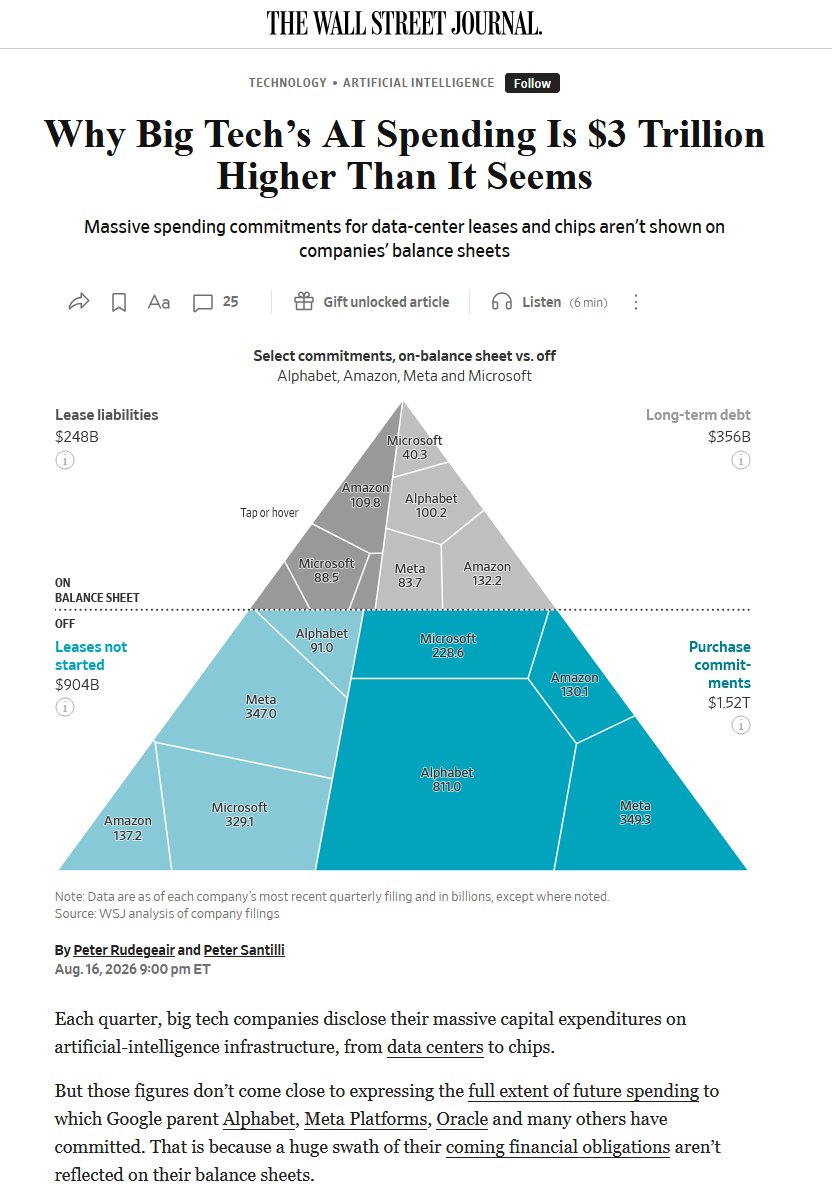
9 tech cos had~$3T of off-balance-sheet commitments, mostly AI-related, an analysis of securities filings shows, about triple what the companies owe under their outstanding leases and long-term borrowings. Eye-opening report by @rudegeair and @pswsj https://t.co/AKelJCSrM3
Thrive's letter is legendary
worth reading all of it
so much to admire here but what Thrive does unbelievably well is combine elite level execution with radical open-mindedness, they're navigating the world not stamping out a cookie cutter venture playbook








![levelsio's tweet photo. I liked this chart so much I had to recreate it
I flipped the axis so that top right is best (tip by @marckohlbrugge and @daniellockyer)
My chart is based on https://t.co/UXK5AFqCaQ data, which for quality of life includes people actually liking the place, climate, healthcare, schools but also air quality
You can also select [ X ] Only places I've been and it checks your travel history and shows you those, in my case, I've barely been to places in the bottom left (high cost, low quality)
https://t.co/pWGAYspFqP
P.S. places at war get a reduced quality of life score on https://t.co/wIvkplS86H as they always have been, doesn't matter who started it, which is why Israel shows as low, without conflict it'd be in the top left (inb4 cancelled)](https://pbs.twimg.com/media/HP3RUu6WEAAIdcO.jpg)