Two market corrections can produce nearly identical price patterns while having completely different breadth, leadership + sector participation.
March vs. November is a fascinating example of this... for ex. March 30, 2026, was a deeper, broader, more washed out bottom than the November pullback so far.
Here are the breadth differences I'm seeing...
1) March was a broad, persistent internal breakdown:
Percentage of S&P 500 stocks above their 50day moving average fell to extreme levels (~18% around mid to late March). Longer-term participation was also weak (low to mid 30s-40s % above the 200day at times). Monthly advancing stocks were extremely low (~16-18% in some readings). Daily sessions near the low showed very one sided breadth (e.g., ~20% advancing / ~78% declining on key days). New lows expanded sharply. This was multi-week, multi-timeframe weakness... not just a one day flush.
2) November has been weaker on the big down day but far less washed out overall:
Nov 5 saw ugly daily breadth (one source: 73 advancers vs. 430 decliners in the S&P 500, advancing volume ~9%). Percentage of stocks above the 50day dropped (reports in the mid 30s to low 60s depending on the universe), and the percentage above the 200day fell into the mid 50s. However, it did not approach March’s extreme lows, and participation recovered more quickly on subsequent sessions. Equal weight and non tech areas held up relatively better in the lead up and aftermath. Broader market readings (all US stocks) have stayed in weaker but not capitulation territory.
Leadership + sector differences...
March... broad selling across most sectors (tech, industrials, financials, consumer discretionary, etc.). Energy was a clear relative winner amid the oil spike. Leadership broke widely rather than just rotating.
Nov... heavily concentrated in AI/tech/semiconductors and related infrastructure. Chipmakers (SOX index down ~12% on Nov 5, Nvidia −9%+) and mega-cap AI names drove the bulk of the damage. The catalyst was post-midterm election fears of tighter AI/data-center regulation. Non-tech areas, equal-weight S&P, and some cyclicals/defensives were more resilient. Reports noted rotation already underway (e.g., equal-weight making relative or absolute highs while mega-cap tech lagged). Rebounds so far have been more selective and tech-dependent, with breadth lagging on some recovery days.
...but what can I take away from this data?
The March 30 low was a more classic, broad, washed out correction low with wide internal damage. The recent November action is a shallower, more concentrated tech/AI-led pullback with better underlying participation outside of that leadership group.
That makes the recent low look less “strong” or climactic by comparison. Whether the November lows hold will depend on whether tech stabilizes and breadth broadens on the recovery, something that was more forcefully resolved after March.
I'm just sharing what the data says, but at the end of the day, price is the only thing I care about.
My 2 cents.
THE FED FLAGS AI AS A MAJOR FINANCIAL STABILITY RISK
In its latest report, the Fed says elevated stock valuations are partly driven by enthusiasm for "super intelligence" and warns that AI investment could soon surpass the 1990s telecom boom.
87% of surveyed market contacts cited AI as a financial stability risk, up from 50% in the spring, pointing to earnings disappointments, cyberattacks and complex financing.
Advanced-computing debt issuance hit $680B through October, 5x the amount in 2023, and now accounts for 31% of nonfinancial investment-grade debt issuance, up from under 6%. More than $1.1T is outstanding.
But the Fed says other obligations are growing even faster, including over $1T in future lease commitments and over $2T in take-or-pay contracts and residual value guarantees.
Hedge fund leverage is also at its highest recorded level since 2013.
The report's data cuts off on October 28, before Nvidia's latest selloff.
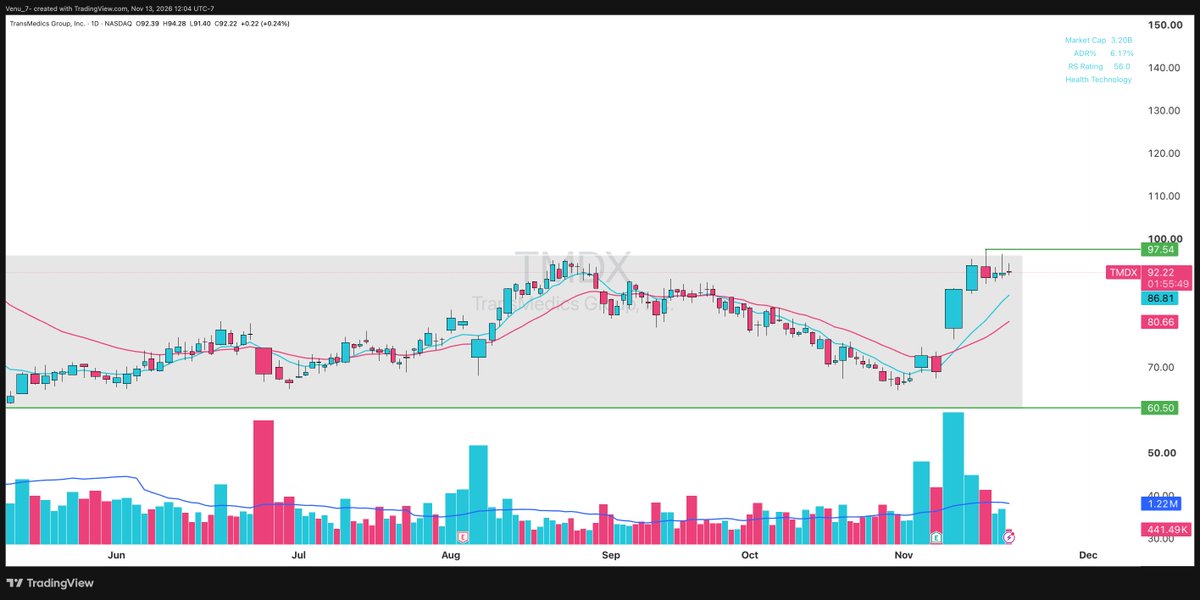
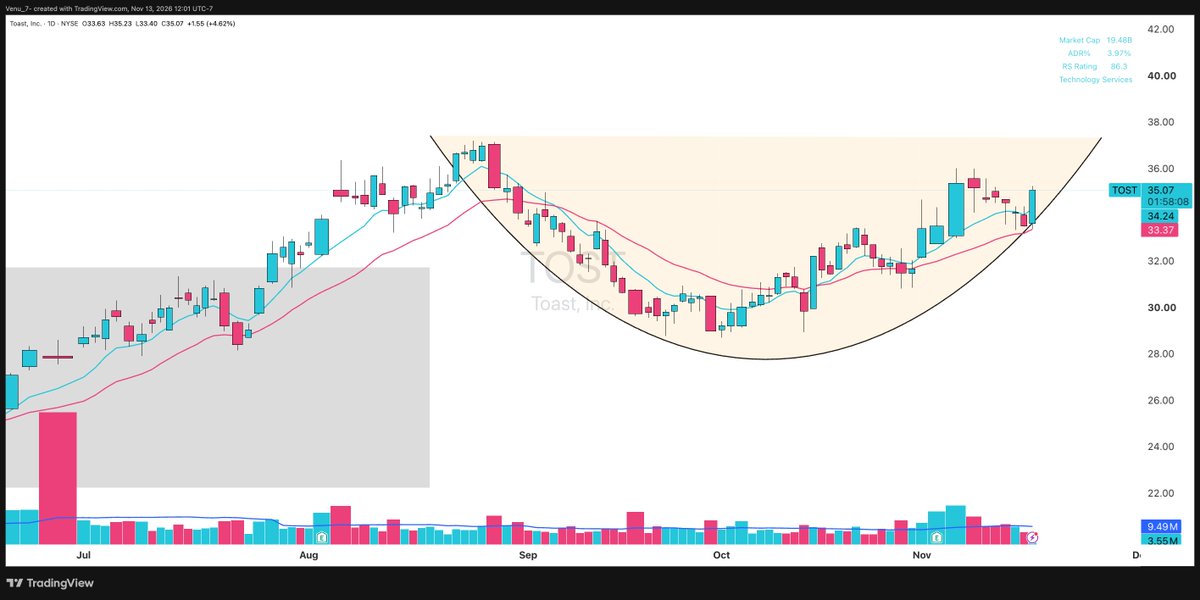
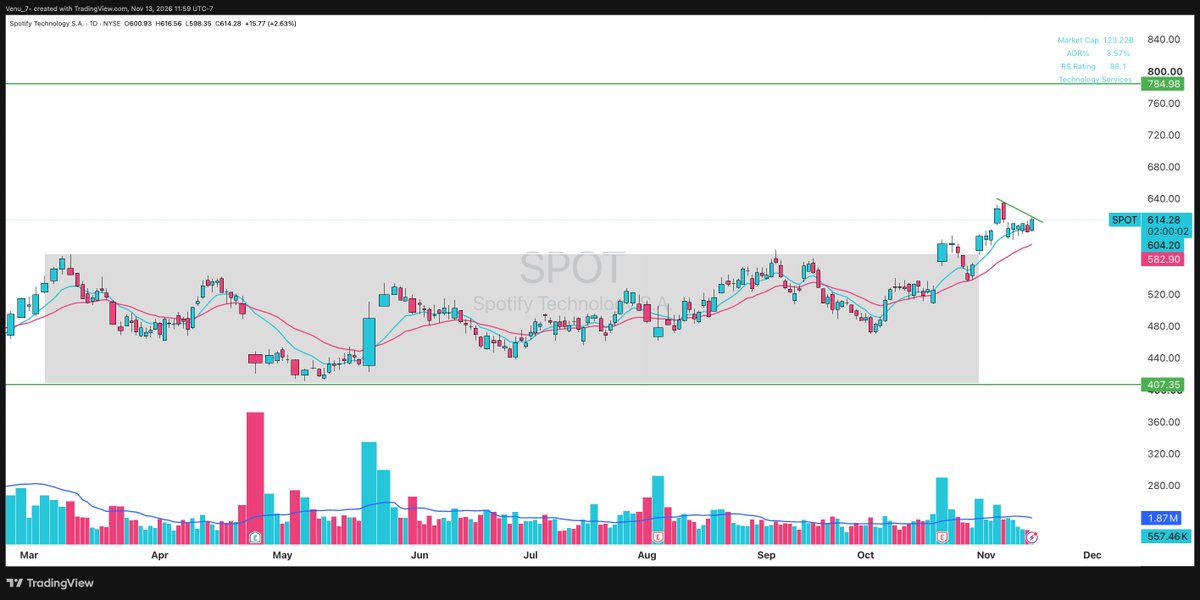
As the market opens lower this AM, my eyes go straight to the names refusing to go down with it...
do you see how they're behaving while the indexes sell off? that's the RS I want to watch.
track strength during weakness, trade it on the turn.
Chart: $ABNB, $TOST, $U, $CVNA.
최근 하트넷을 많이 참고함. 원래 대단한 분이지만, 이번 하락/조정에 독보적이었던 듯.
사람은 기존 가지고 있는 휴리스틱과 스키마에서 벗어나기 굉장히 힘들기 때문에(어쩌면 유전자 단에서부터 정해진...) 상황에 따른 패턴 인식 능력이 다르고 바꾸기가 힘든 편.
그래서 상황이 바뀌었을 때, 그 상황을 잘 해석하는 사람을 따라가면 되는 듯.
X에서는 @dons_korea@PForever0000@BTC_WyckoffLab 이분들 도움을 많이 받은 듯.
BOFA'S HARTNETT: STAY RISK-OFF UNTIL TREASURY YIELDS FALL BELOW 4.5%
Bank of America's Michael Hartnett warns investors to remain risk-off until financial conditions ease.
His key conditions for turning bullish:
🔸 10-year Treasury yield below 4.5% — potentially December or January.
🔸 Oil below $70 per barrel — already moving in that direction.
🔸 Weaker US dollar — expected to peak in February or March.
BofA sees the S&P 500 above 8,000 in its bull case, but below 7,000 in its bear case.
Despite the caution, global equity funds attracted $98.3 billion last week, the largest inflow since June.
Hartnett sees a market still supported by aggressive dip-buying, but vulnerable to higher rates and tighter liquidity.
US margin debt is surging.
In just the past 6 years, margin debt has surged by ~50%.
This is why hedge funds are blowing up left and right over a mere 6% correction.
Investors are all in on stocks while we're still in the biggest supply crisis in history.
This will end in tears...
Nvidia chips are still scarce, even now.
But to maximize that premium, Nvidia has to support the neoclouds.
If the new Nvidia CEO turns even slightly skeptical about supporting the neoclouds, spot prices will take a hit. That will hurt neocloud margins. To avoid this, the neoclouds will have no choice but to reach out elsewhere. AMD, or the TPU camp.
In other words, the neoclouds break free of Nvidia's grip, and Nvidia's dominance and influence both take a hit. That in turn means a hit to the massive order volume that underpins Nvidia's only moat, its control of the supply chain, and it means Nvidia's flywheel breaks.
Jensen worked tirelessly to protect this flywheel. He pushed on many fronts to get a blind eye turned to neoclouds leasing capacity to Chinese hyperscalers, and he encouraged chip exports to China so that China would never forget the taste of the Nvidia sauce, working relentlessly to have China's AI ecosystem built on top of Nvidia. That way, even if the latest GPUs become hard to get inside China, there is still a reason to rent the same chips from overseas neoclouds. Keeping Chinese developers inside the Nvidia ecosystem was also a way of protecting neocloud utilization.
Still, all of this was playing with fire along the edges of the gray zone, something deeply improper and dangerous in the eyes of Washington.
Even so, Jensen did what was best for Nvidia. That cannot be denied.
Jensen meant to wait until the neoclouds could order the next generation of GPUs on their own. He probably saw sharing risk with customers until then as being in Nvidia's interest too. What I want to know now is whether the next CEO can wait that long.
According to the WSJ article... the current CEO does not seem to be that patient.
I worry about an Nvidia without Jensen.