We have a mission: To empower creators with tech & platform.
Sounds simple right? It is if you have the right pieces.
SHER is #P2P live streaming and it's a game changer for creators.
With #P2P we are potentially able to provide the best payouts in the market, above 80%.
🧵
If you are publishing from CI, it is absolutely imperative that you start using staged publishing and then push live with a human in the loop, rather than just yolo that junk into production without an MFA token.
https://t.co/eH4tl6WAgV
what if you find out you've been infected with the Shai Hulud worm? watch here: https://t.co/Zttltnhx79
Brian Clark goes through the TanStack supply chain attack, details, recap, and follow through for secure development
Are PWAs cooked? I'm seeing more web-folks building native apps through Codex/Claude and I wanted to think about what this means for PWAs.
When is the point where the value provided by native apps + time to create beats the more limited capabilities of the web + reach?
https://t.co/MgffIkA3N7
Are PWAs cooked? I'm seeing more web-folks building native apps through Codex/Claude and I wanted to think about what this means for PWAs.
When is the point where the value provided by native apps + time to create beats the more limited capabilities of the web + reach?
https://t.co/MgffIkA3N7
Introducing Flue — The First Agent Harness Framework
Flue is a TypeScript framework for building the next generation of agents, designed around a built-in agent harness.
Flue is like Claude Code, but 100% headless and programmable. There's no baked in assumption like requiring a human operator to function. No TUI. No GUI. Just TypeScript.
But using Flue feels like using Claude Code. The agents you build act autonomously to solve problems and complete tasks. They require very little code to run. Most of the "logic" lives in Markdown: skills and context and AGENTS.md.
Flue is like Astro or Next.js for agents (not surprising, given my background 🙃). It's not another AI SDK. It's a proper runtime-agnostic framework. Write once, build, and deploy your agents anywhere (Node.js, Cloudflare, GitHub Actions, GitLab CI/CD, etc).
We originally built Flue to power AI workflows inside of the Astro GitHub repo. But then @_bgiori got his hands on it, and we realized that every agent needs a framework like Flue, not just us.
Check it out! It's early, but I'm curious to hear what people think. Are agents ready for their library -> framework moment?
the new programming with agents, this is what i feel like, my brain power goes more and more to finding the creative ways to close the loop
only way to get these things to do exactly what you want
El 22 de julio de 1985, Borges concurrió a presenciar una de las jornadas del Juicio a las Juntas Militares.
Al día siguiente entregó este texto a la Agencia EFE que lo difundió a todo el mundo:
https://t.co/WEIlJdioTp
the base thesis is that since wr e can shit out huge amounts of code now, therr's no way to review it all via human brains. sure.
but nobody seems to ask why we want shit out huge amounts of code in the first place.
mythical man month of the AI age.
It's time to bring Haptics to the web 🫨
Create custom tactile patterns with strengths + durations for your web interactions.
Make your app feel as good as it looks ✨
→ https://t.co/DGz9Eu6nto
Even after the steep progress of the past 3 months, it remains that AI performance is tied to task familiarity. In domains that can be densely sampled (via programmatic generation + verification), performance is effectively unbounded, and will keep increasing from current levels. In novel, unfamiliar domains, performance remains low and further progress still requires new ideas, not just more data and compute.
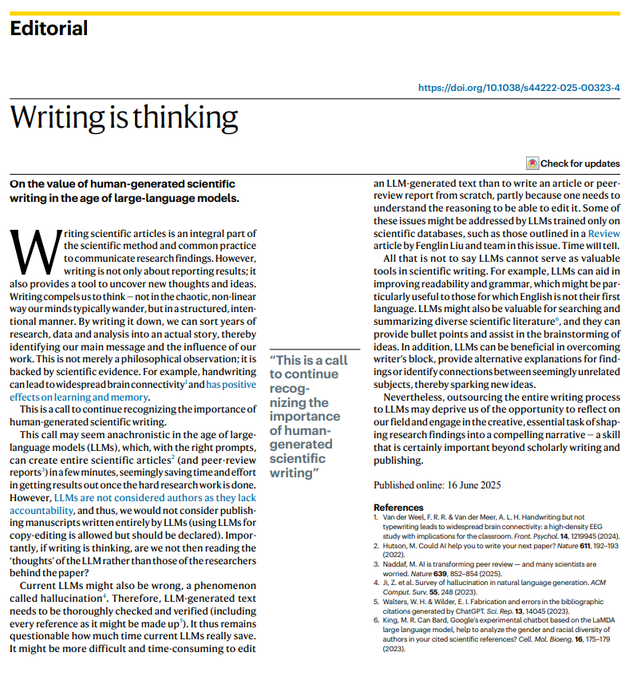
Writing forces your brain to coordinate memory, reasoning, and meaning-making simultaneously.
Every time you write, you rewire toward clearer thinking. Every time you let an LLM do it, you rewire toward consumption.
Electrobun is a new cross-platform runtime for desktop apps ✨
Electron mostly uses C++ to embed Node.js & Chromium.
Electrobun uses Zig to embed Bun and - like Tauri - relies on the OS default web renderer.
🔷 Write apps in TypeScript
🧱 Process isolation
⚖️ 12MB base install
“There is no cloud, just someone else’s computer.”
This isn’t a joke; it’s a reminder.
When you upload a file to “the cloud,” it doesn’t magically float into the sky. Instead, it lands on a physical server within a data center, equipped with real CPUs, disks, RAM, and cables. This server is owned and controlled by someone else.
Your data is essentially stored on their machines, running on their operating system, and governed by their policies.
The “cloud” is essentially a collection of massive server racks, virtualization (VMs and containers), networking abstraction, and billing dashboards that create the illusion of magic. However, beneath the user interface and APIs, it’s still computers housed in a building.
This is why cloud providers can shut down accounts, outages can disrupt half the internet, law enforcement can subpoena providers, and misconfigurations can leak millions of records.
In the cloud, you don’t lose responsibility; you simply share it.
When engineers use this phrase, they’re essentially saying:
“Don’t forget who controls the hardware.”
The cloud offers convenience, scalability, and power. However, it’s not yours.
Finding myself going back to RSS/Atom feeds a lot more recently. There's a lot more higher quality longform and a lot less slop intended to provoke. Any product that happens to look a bit different today but that has fundamentally the same incentive structures will eventually converge to the same black hole at the center of gravity well.
We should bring back RSS - it's open, pervasive, hackable.
Download a client, e.g. NetNewsWire (or vibe code one)
Cold start: example of getting off the ground, here is a list of 92 RSS feeds of blogs that were most popular on HN in 2025:
https://t.co/dwAiIjlXet
Works great and you will lose a lot fewer brain cells.
I don't know, something has to change.