🧵THREAD🧵
Fauci’s lab leak coverup couldn’t have happened without the help of legacy media.
Do you remember how far outlets went to claim the lab leak was a conspiracy?
I’ve got the screenshots. ⤵️
Lab leak is a scandal beyond your imagination.
Put aside the actual provenance of the virus—sure, maybe it didn't come from a lab.
I'm speaking only about the cover-ups, opinion pieces fobbed off as scientific research, the lying, and the strong appearance of financial corruption, etc.
It's a scandal orders of magnitude beyond what you think.
The reason it never exploded the way it should have is that layer upon layer of context are required to understand even the contours of the scandal.
Take the post below by Matt Ridley, a scientist and author who has done so much of the heavy lifting on the lab leak question.
The post shows an email from Peter Daszak, the man largely responsible for soliciting government grants—including from NIH and USAID—and using those the funds from those grants to run risky experiments in Chinese labs.
In this case, Daszak is advising the head of one of the most important labs at the Wuhan Institute of Virology—a lab that was doing risky research on coronaviruses—not to provide data to one of the most distinguished researchers in the space, Jesse Bloom.
The virus Daszak references RaTG13, which was, at the time, the closest-known virus to SARS-CoV-2, a 96% match.
This email is indeed a "wow." And yet it's just a grain of sand on an endless beach of malfeasance.
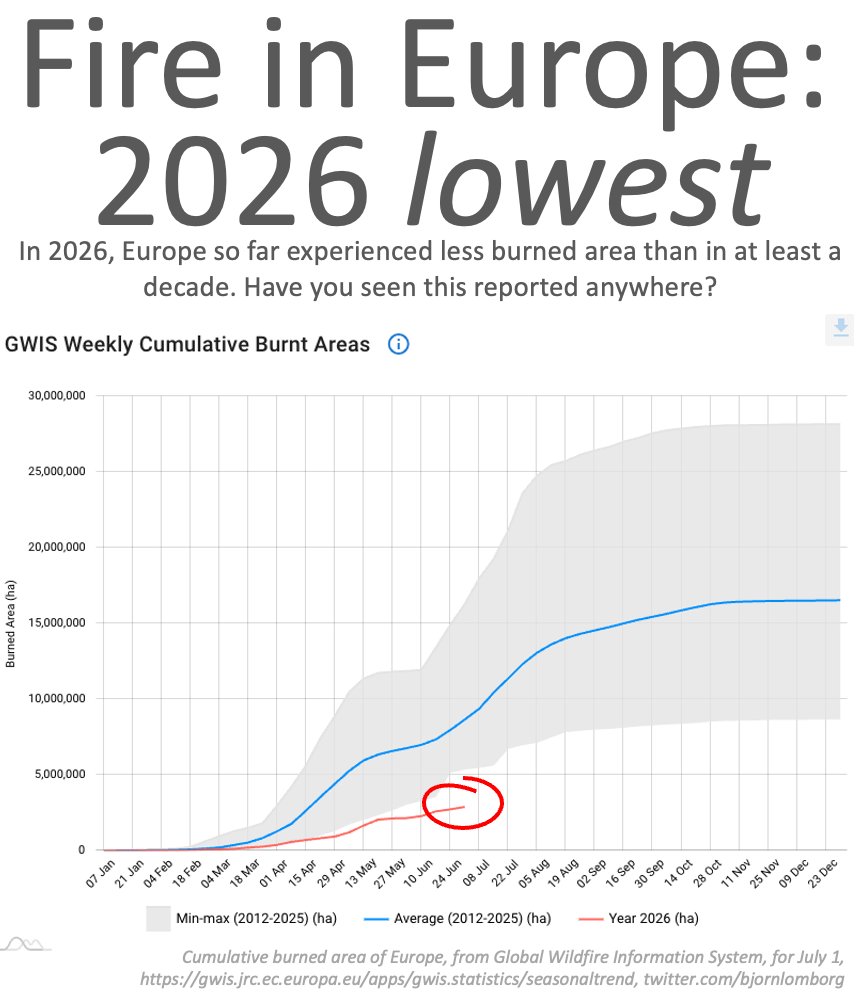
2026 Fire in Europe at record lows
Halfway through 2026, Europe has burned less than in any year 2012-25
Every continent is below average, and Africa and the Americas are at record lows
Media only showing stuff burning leaves us badly informed
https://t.co/iDqlYckvRT
You can see all the references in my Twitter thread:
https://t.co/c1gWhtRaBe
Det är nästan genialt hur EU lyckas sälja in ren och skär diktaturövervakning som ”trafiksäkerhet” 😂
Från och med nu kräver EU obligatoriska kameror riktade rakt mot förarsätet i bilen, gjorda för att stirra dig i vitögat och registrera din minsta ansiktsrörelse. Om din blick svävar iväg mot sidospegeln eller om du blinkar för länge efter ett arbetspass, så går bilens automatiska övervakningssystem igång för att analysera och flagga ditt beteende. Det absolut bästa? Eftersom hälften av bilarna byggs i Kina kan partihögkvarteret i Peking analysera ditt ansikte och ditt innersta privatliv i realtid.
Man måste nästan beundra tempot i hur snabbt precis allt håller på att spåra ur just nu. Ribban för vad som anses ”normalt” flyttas framåt varje vecka, och ingen verkar ens reagera längre.
Hur lång tid tar det innan kameran kopplas till ditt digitala ID så att systemet drar böter direkt från kontot om du råkar titta snett på nästa vansinniga politiska beslut? Vad gissar ni?
These COVID nightmares will never be forgotten...
21-year-old Australian mom of three was violently choked by police & arrested for not wearing a mask, even though she had a medical exemption.
This is why economists use the extra word, and call it "opportunity cost," in an apparently pointless attempt to avoid confusion.
Imagine the better things I could be doing with my time right now than explaining this
@rstarsa A somewhat clever ruler might find it in their interest to allow businesses to thrive, at least somewhat, while keeping control of the political system. Such a state should have an easier time expanding then if they had been poor.
See China.
United Nations (UN) report states that Hamas committed sexual violence, including rape, gang rape, and sexualized torture of women during the terror attacks on 7th October 2023 in Israel.
Hamas terrorists also raped corpses (dead bodies).
"Rape and sexual violence were utilized to “crush the spirit of protestors” and to force protestors to sign confessions."
Amnesty intervjuade 45 kvinnor, men det verkar handla om hundratals eller tusentals fall.
https://t.co/eiKZ3f7JN1
Anthropic Claude finds dozens of Firefox vulnerabilities
Mozilla patches most issues in Firefox 148, bug discovery scales faster than patch capacity
https://t.co/NOgicE9JMZ
Anthropic says its Claude Opus 4.6 model found 22 vulnerabilities in Firefox in two weeks, including 14 rated “high-severity,” in a security partnership with Mozilla, according to TechCrunch. Most fixes shipped in Firefox 148 in February, with a handful deferred to the next release.
The headline number flatters the story, but the operational shift is more important: discovery is getting cheaper and faster than remediation. Anthropic started in Firefox’s JavaScript engine and then widened the search across the codebase, deliberately choosing Firefox because it is both large and heavily scrutinised. In other words, the test case was not a neglected hobby project; it was one of the internet’s most attacked and most audited open-source applications. If an automated workflow can still surface dozens of issues there, the bottleneck moves downstream to triage, patch review, regression testing, and release management.
That asymmetry shows up inside Anthropic’s own results. Claude was far better at identifying potential vulnerabilities than producing working exploits. The team spent about $4,000 in API credits trying to generate proof-of-concept exploits and succeeded in only two cases, TechCrunch reports. For defenders, that sounds reassuring: the model can point to cracks without reliably weaponising them. For maintainers, it is a different kind of pressure. A tool that produces many plausible findings—some urgent, some wrong, some duplicates—can flood the same limited pool of humans who already do security triage on nights and weekends.
Open-source security has always depended on a mismatch between the number of people who could report bugs and the number who can responsibly fix them. Lowering the cost of “bug discovery” shifts that mismatch from occasional spikes to a steady stream. It also changes incentives. If a project becomes known as “AI-scan friendly,” it may attract more automated reports, more noise, and more demands for rapid disclosure timelines—without any corresponding increase in patch capacity. Conversely, organisations running such tools may be tempted to treat security as a procurement line item: buy more scanning, assume risk goes down.
The attacker side of the ledger does not need the same workflow to benefit. Even if Claude struggled to write exploits, the same class of models can still automate code comprehension, identify suspicious patterns, and narrow the search space for humans who do exploit development for a living. When discovery scales and exploitation partly scales, the limiting factor becomes how quickly software teams can ship safe fixes without breaking everything else.
Firefox 148 absorbed most of the patches. The next question for maintainers is whether the two-week scan becomes a monthly routine—and what happens when the reports arrive faster than the releases.
https://t.co/NOgicE9JMZ
The BBC Doesn't Make Mistakes. It Makes Choices
The BBC has made another error. A live translation of Pete Hegseth's Pentagon address rendered the word "regime" as "mardom," the Persian word for "people." So when the Defence Secretary told the world that the regime that chanted death to America had been gifted death in return, BBC Persian told its audience inside Iran that the American government was threatening the Iranian people. The BBC issued a correction. It called the mistranslation "human error." That is also what it called Panorama.
When the BBC edited Trump's January 6th speech, it did not accidentally make him sound more peaceful. It cut the line where he called for his supporters to march "peacefully and patriotically," spliced in footage from elsewhere, and broadcast the result a week before the American presidential election. The BBC's own standards adviser called it deliberate distortion. The Chairman Samir Shah eventually called it an "error of judgment." The Director-General Tim Davie said nothing of substance. Two senior executives resigned. Trump sued for ten billion dollars. And throughout, the Corporation's position was consistent: mistake, not malice. Human error. Regrettable. Corrected.
Now examine the Hegseth translation. A single word, "regime," becomes "people." Not a complex clause. Not an ambiguous idiom. One word, with one meaning, translated into its opposite. And the effect was not neutral. BBC Persian broadcasts inside Iran, to people for whom the distinction between the regime and the people is not semantic. It is the difference between those who imprison and those who are imprisoned. When that audience heard America threatening the Iranian people, they did not hear a translation error. They heard confirmation of what the Islamic Republic has told them for forty years. The BBC handed the regime its propaganda line, live, with the American Defence Secretary's voice attached.
Thamar Eilam-Gindin, a Persian linguist and Iran expert at Haifa University, said the mistranslation fundamentally altered the meaning of the address. She added that among diaspora Iranians she works with regularly, the incident confirmed what they already believed: that BBC Persian runs a long-standing pro-regime editorial line. That charge does not come from Republican media monitors or Trump's legal team. It comes from Iranian exiles. The people with the most direct experience of both the regime and the BBC's coverage of it have reached their verdict.
The BBC will say the two incidents are not comparable. Panorama was edited; this was live. One was deliberate craft; the other was a translator under pressure. But this defence only holds if you believe the errors are random. Random errors scatter. They make subjects sound better and worse, more threatening and less, more guilty and more innocent, in rough proportion. The BBC's errors do not scatter. They cluster. Trump is made more dangerous. America is made more threatening. Iran's regime is made less culpable. Israel's actions are made less justified. The mistakes, every time, travel in the same direction as the ideology. That is not a coincidence. That is a culture.
An institution whose errors always serve its prejudices has not made errors. It has made choices. The method changes. The outcome never does. And the people who pay the price are not politicians with lawyers. They are Iranians inside Iran, who tuned into a service their licence fee helps fund, and were told that America wants them dead.
"The BBC's errors do not scatter. They cluster. Trump is made more dangerous. America is made more threatening. Iran's regime is made less culpable. Israel's actions are made less justified. The mistakes, every time, travel in the same direction as the ideology."
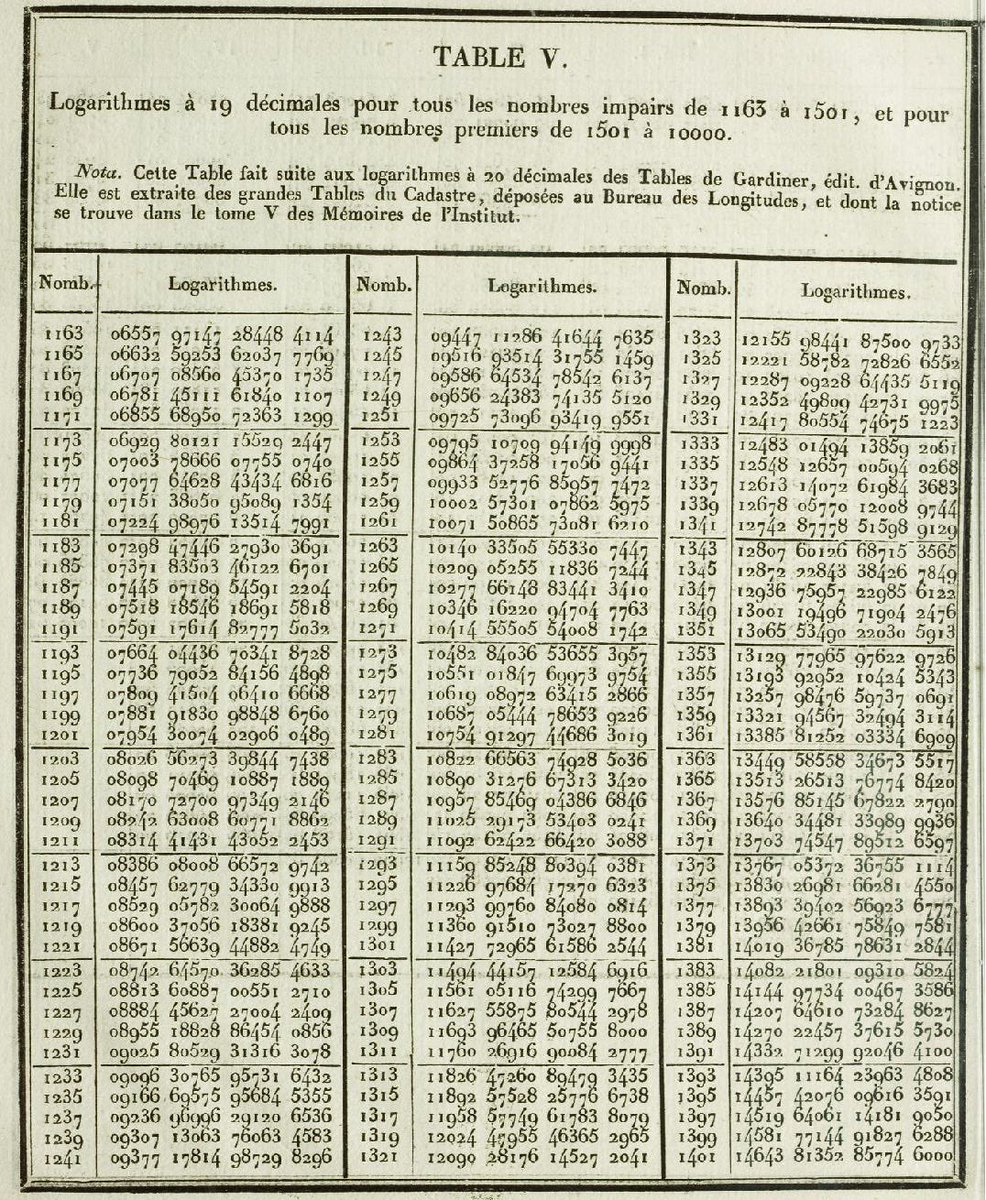
In 1792, during the French Revolution, engineer Gaspard de Prony was tasked with producing accurate trigonometric and logarithm tables for France’s new metric cadastre. The job was enormous.
He found the solution when he read Adam Smith’s description of the pin factory and had an insight: calculations could be produced using the division of labor just like pins.
He organized the work in three layers: leading mathematicians derived formulas, a small group translated them into algorithms, and 60–80 workers (many unemployed hairdressers!) executed the simple arithmetic.
By 1794 the "logarithm factory" was producing roughly 700 results per day. Later thinkers like Herbert Simon and Allen Newell even called this system a precursor to the computer.
On the 250th anniversary of Smith’s Wealth Of Nations, it seems appropriate to appreciate Smith’s impact on humanity from the minute to the gargantuan
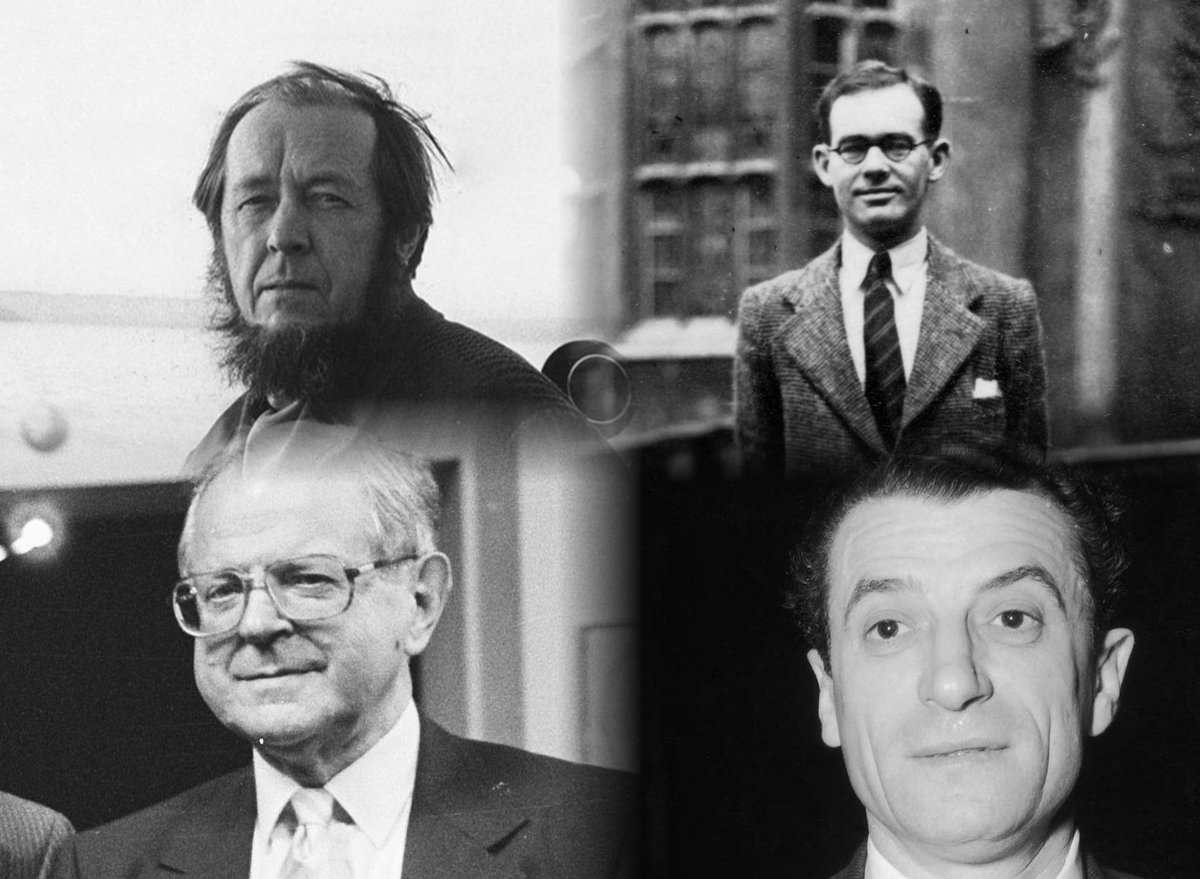
A New York Times reporter knew 10 million people were dying. He told the British Embassy. Then he went back to his typewriter and called the journalist covering the famine a liar.
That journalist was murdered two years later. The Times reporter kept his Pulitzer.
This is the story of four men who told the truth before it was allowed. 🧵
The "gotcha" relies on verified context, not just the audio. The ruins are Police Station 138 in Tehran, a government facility struck by US-Israeli forces. Officials toured it for a Red Cross director, claiming to media/visitors the buildings were all civilian/residential (as shown in video frames/overlays). The hot mic catches the woman reporting she did so, with the man's "good, good" affirming the message. Alone the exchange is ambiguous, but paired with the site's known identity and their presentation, it indicates coordinated misrepresentation of a non-civilian target as purely residential. No extended translation alters that.
Efterkrigstidens modus operandi i Europa var att bygga "försäkringssystem" istället för monument. Om detta var rätt är en fråga i sig, men är det inte märkligt att man så hänsynslöst lät det plundras och raseras om det nu skulle vara fundamentat för det civiliserade samhället?