@Codeforged_One@MissPookems Sorry to hear that. But I think those activities we used to share with our loved ones help us keep their memories more alive. I hope you find a way to go back to this community. Much love to you!
Si se encuentran a un gringo en México, háblenle en español, nunca en inglés. Ya es hora de que aprendan nuestro idioma si pretenden quedarse a vivir aquí.
@Elara_Raven Batman Arkham City.
Middle Earth: Shadow of War.
Tom Clancy's The Division.
Banishers, Ghosts of New Eden.
AC Origins and Odyssey.
Vampyr.
Beast of Reincarnation.
I am the Vice President of Portfolio Lifecycle at Electronic Arts, and on Wednesday I closed BioWare.
It had been open for thirty-one years in Edmonton, ever since two practising physicians founded it in 1995 and gave it a name that still sounds faintly like a clinic. It made Baldur’s Gate, Knights of the Old Republic, Dragon Age and Mass Effect, and the next Mass Effect, the one we teased at The Game Awards in December 2020 with a scrap of N7 armor half-buried in the snow, went with it. You may not have heard. We announced it in about a hundred and fifty words on a company blog on a Wednesday afternoon, which is how you announce something you would prefer people learn later, from a friend.
I have played every Mass Effect game twice, Paragon and then Renegade. I romanced Garrus. I cried on Virmire like everyone else. I mention it only because people assume the men who do this have never held a controller, and the truth is worse: we know exactly what we’re closing, down to the side quests.
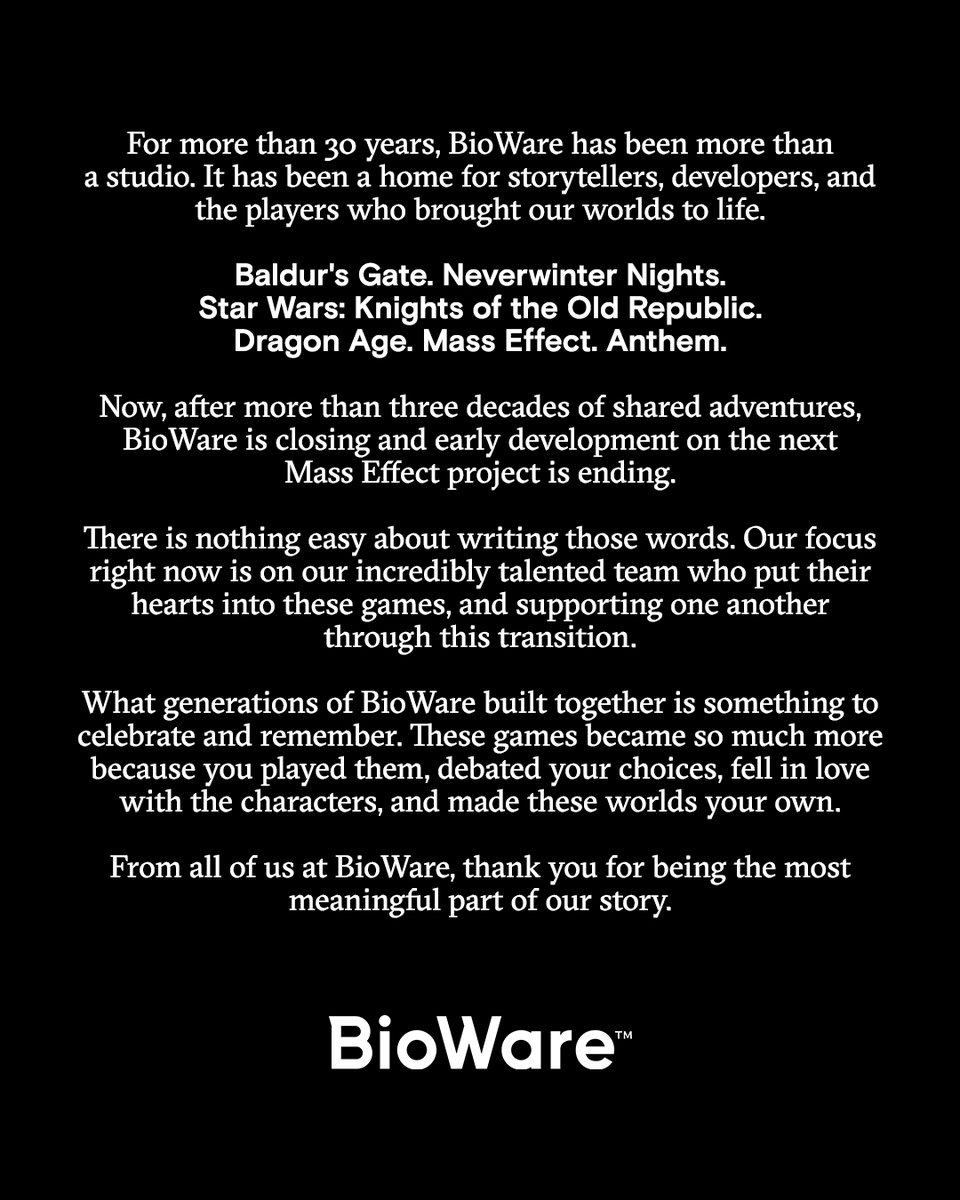
The obituary itself was very good. It opens, “For more than 30 years, BioWare has been more than a studio,” and then lists the dead in italics, the way a village lists its sons on a war memorial: Baldur’s Gate, Neverwinter Nights, Star Wars: Knights of the Old Republic, Dragon Age, Mass Effect. And then, last, in the same italics and with the same reverence: Anthem.
Someone at BioWare typed that. Someone who was there in 2019, when we asked a studio of storytellers to build a live-service shooter and later switched off its servers, sat down this week and placed Anthem on the memorial beside Knights of the Old Republic, as though the studio had chosen it. In twenty years in this business I have not seen a cleaner piece of corporate grief. You take the wound you inflicted and carve it into the headstone as one of the deceased’s achievements.
The news arrives halfway through a sentence, “BioWare is closing and early development on the next Mass Effectproject is ending,” where the eye slides past “closing” on its way to something about Mass Effect. It gives no number, no reason and no owner. EA isn’t mentioned anywhere in the text; our name appears once, at the foot of the page, in small grey type beside the copyright symbol. We don’t sign obituaries. We own them. The final line thanks the players “for being the most meaningful part of our story,” while the staff are supported “through this transition.” The players get the thanks. The staff get a noun.
The menu above it hasn’t been touched in years. If you scroll up you can still click Careers and apply for a job at a studio that closed on Wednesday. It still lists an office in Austin. It still links to Origin, a store we shut down long ago, and to a merchandise shop that is, as I write, still taking orders, so that you can buy an N7 hoodie from a company that no longer exists through a menu that still offers you a future there. “I’m Commander Shepard, and this is my favorite store on the Citadel.” The store is open. The Citadel is not.
We hope the closure gives players a sense of pride and accomplishment. The phrase is ours, from 2017, when an EA account on Reddit explained that Darth Vader was locked behind dozens of hours of grinding, or a credit card, because “the intent is to provide players with a sense of pride and accomplishment for unlocking different heroes.” It became the most downvoted comment in the history of Reddit, by roughly two-thirds of a million votes, and we have never stopped finding uses for it.
Everyone wants a villain for Wednesday: a bad game, a bad boss, a culture war. The real explanation is in Mass Effect, and BioWare wrote it themselves nineteen years ago. In the lore, ancient machines called Reapers come out of dark space every fifty thousand years and harvest every advanced civilization in the galaxy, not the primitive ones but the ones that have reached their height. On Virmire, the Reaper called Sovereign explains this to Shepard in a speech I can still recite: “We impose order on the chaos of organic evolution. You exist because we allow it, and you will end because we demand it.”
My job is often described as destroying studios, which flatters the people who destroy things. Anyone can destroy a studio. I harvest the ones that have peaked, on a cycle a good deal shorter than fifty thousand years but nearly as regular: Westwood, which made Command & Conquer; Origin, which made Ultima; Bullfrog; Pandemic; Maxis in its original Emeryville home; Visceral, closed in the middle of a Star Wars game. Each was loved, each reached its height, and each ended with a dark space opening and, shortly afterward, a blog post. The players like to say EA is where studios go to die. Death wastes things. We keep them.
The public noticed long ago. In 2012 the readers of the Consumerist voted us the Worst Company in America, and in the final round we beat Bank of America, a bank fresh from the foreclosure crisis that lost a public vote to a video-game publisher largely over the color of an ending. The plaque is in my office. Bank of America has since paid a billion-dollar fine for failing to report money laundering, and we have since closed BioWare, so I suspect a rematch would go our way.
We understood the Reapers better than BioWare ever did. Mass Effect 3 launched that same year with a piece of day-one content called From Ashes, which contained Javik, the last living Prothean, sole survivor of a civilization the Reapers had harvested fifty thousand years before. On launch day we sold him separately, for ten dollars. The fans were furious, and they bought him anyway, and that was when I understood the cycle could be monetized.
What casual players miss is that the Reapers don’t simply kill a civilization. They process it, turning what it was into a new Reaper, a shell that carries the old name and serves the cycle. While BioWare was being closed this month, Amazon’s Mass Effect television series was in active development. The galaxy survives, and the armor, with N7 stencilled on the chest. Only the people who made them are gone. We keep the shells.
Before long we may not need the people at all. The Financial Times reported that the investors who bought us are making “a huge bet that artificial intelligence can significantly cut EA’s operating costs,” and somewhere, eventually, a model will be trained on thirty years of Garrus. It won’t need a salary or a dental plan, and it won’t know what Virmire means, which the analysts regard as a feature.
Then there are the mass relays. Every civilization in Mass Effect builds its future on them, and on the Citadel, marvels left behind by an older race, and nobody asks who built them until it’s too late: they are the Reapers’ own infrastructure, laid down so that each civilization develops along a predictable path and is easier to harvest when the time comes. Every studio we buy is moved onto our engine, Frostbite, which was built for shooters and handed to people who made role-playing games. Every BioWare game of the last decade ran on our relays, and reporters spent years documenting how the engine fought the developers at every step. We knew. You don’t have to destroy a civilization that builds everything on your technology. You only have to wait.
The lore is the poetry, though. The reason is arithmetic, and it arrived on August 4, the day Electronic Arts stopped being a public company. A consortium bought us for fifty-five billion dollars: Saudi Arabia’s sovereign wealth fund, which now owns about ninety-three percent of the company, the private-equity firm Silver Lake, and Affinity Partners, the investment firm founded by Jared Kushner. It was the largest leveraged buyout the technology industry has ever seen, and leveraged means borrowed. The buyers didn’t pay for EA. EA paid for itself, and now carries about eighteen billion dollars of debt taken on to finance its own purchase, with interest expected to run near one point eight billion dollars a year.
I worked it out late one night with Mass Effect 2 paused on my other monitor. One point eight billion a year is about five million dollars a day. By the end BioWare was fewer than a hundred people, down from more than two hundred two years earlier, and even at generous Canadian salaries a studio that size costs perhaps fifteen million dollars a year. The figure is my estimate rather than a published one, but the division isn’t hard.
BioWare cost about three days of interest.
The studio that gave the world Shepard and Garrus and Morrigan and the Illusive Man cost less than a long weekend of servicing the debt the company borrowed to buy itself. The interest accrued on Friday, and on Saturday, and by Sunday evening BioWare had been paid for, and on Monday it began again, as it will every day, with no interest of its own in Virmire.
The Reapers have a voice, Harbinger, and whenever it seizes one of the creatures it controls it announces itself with three words the players long ago turned into a meme. I keep them on a sticky note on my monitor: “Assuming direct control.” The debt never has to say them. It assumed direct control on August 4, and every decision since has been made in its voice.
About seven hundred million dollars a year in cuts were planned before anyone opened a spreadsheet, and we had already cut staff three times this year, in February, March and June, before the deal had even closed. The bankers call it rationalizing. In the lore it would be indoctrination, which works not by conquering a civilization but by getting inside it and whispering until one day it realizes it has been agreeing with you for months. When the staff asked how many of them would be affected, I said I’d get back to them, because I was in the middle of some calibrations. They came to seven hundred million dollars.
In 2017 the faces in Mass Effect: Andromeda famously couldn’t show emotion, and the internet laughed for a year. On Wednesday the people who used to work at BioWare found they couldn’t either.
The studio saw it coming, in its own vocabulary. In 2023, when we cut about fifty jobs, its general manager wrote that BioWare “must shift towards a more agile and more focused studio.” In January 2025, after Dragon Age: The Veilguard, which EA said “did not resonate with a sufficiently broad audience,” it became a “core team” devoted to the next Mass Effect. Each round of cuts made it more focused, with fewer people and fewer projects, until there was a single game, and the most focused studio in the world, it turns out, is the one with nobody in it. On Wednesday BioWare reached perfect focus.
According to the reporting on Anthem, the developers had a name for the faith that carried them through: BioWare magic, the belief that however bad things looked, it would all come together at the end. This week we asked BioWare magic to make five million dollars of daily interest disappear, and it couldn’t. Nobody’s magic is that good, not even an asari’s. The game itself had been in early development for six years when the post announced that early development was “ending.” In the lore that would be a stillbirth on a dead world. In our filings it is a non-cash impairment.
For twenty years BioWare made you one promise, on every box and in every trailer: your choices mattered. Save this species or sacrifice it, spare this man or shoot him. They mattered right up until August 4, when someone with eighteen billion dollars of debt made one for you.
The fans will see it slowly over the next few weeks, but BioWare’s ending is the ending of Mass Effect 3. In 2012, players finished a trilogy they had spent five years and hundreds of hours shaping, and discovered that every path and every carefully kept save file led to the same room and the same three choices, which were, famously, one scene in three colors: red, blue, green. They were furious. They organized a campaign called Retake Mass Effect and raised money for charity in protest, and BioWare, under our ownership, did something publishers almost never do. It listened, and released a free Extended Cut that gave the ending more meaning. That was the last time the players won.
For thirty years the studio made its choices, great ones and bad ones, Paragon and Renegade: Knights of the Old Republic and Anthem, a beautiful Mass Effect and a buggy one, a Dragon Age that soared and a Dragon Age that did not resonate. None of it altered the destination, because every path led to the same room, a balance sheet carrying eighteen billion dollars of debt, and the color of the ending was chosen in August by people who have never loaded a save file. There will be no Extended Cut.
If it were left to me, and I’m told it partly is, we would at least have sold the closure properly, in three editions. The Standard Edition, in which BioWare closes. The Deluxe Edition, in which BioWare closes and the Mass Effect television series is announced at another company. And the Ultimate Edition, which adds an exclusive pre-order N7 hoodie, shipping November 7 from the merchandise store still linked on the obituary page. Supplies are limited, as were the employees.
People ask how I could sign it, and the honest answer is the line from Mass Effect I’d least like you to hear in my mouth. When Mordin Solus walks into the fire to cure the plague his own people engineered, he says the most beloved last words in the trilogy: “Had to be me. Someone else might have gotten it wrong.” I said it to myself when I signed, and I meant it as he did.
BioWare romanced you for thirty years, and every playthrough ended with someone who loved you aboard the Normandy. We are what comes after the credits, when the companion leaves the ship and doesn’t come back.
Its first great hit, in 1998, was Baldur’s Gate. In 2023 an independent, privately owned studio in Belgium called Larian made Baldur’s Gate 3, which won everything, sold to millions, and was by common consent the game of the decade, exactly the kind of game BioWare used to make before we asked it to make Anthem. The Gate came home. It just came home without them.
The blog is still up, and you should look at it while it lasts. Down the right-hand side runs an archive of months, each with a number showing how many posts appeared. In April 2012 there were thirty, written by developers about patches and art and cosplay, and then the numbers begin to fall, year by year: five, two, one. January 2025 has a single post, the one announcing the core team. November 2025 has one, for N7 Day. October 2026 has one. Nobody wrote the harvest down on purpose, but it’s there in the archive, which is simply what a dying thing’s calendar looks like.
N7 Day is the fans’ own holiday, November 7, named for Shepard’s special-forces program. Every year they put on their hoodies and their armor and post their Shepards and their screenshots and their tattoos, and BioWare would post something in return. The last post before the obituary was “N7 DAY 2025.” This year’s N7 Day falls seventeen days after the closure, and they’ll celebrate it anyway: thousands of people in red and white saluting a studio that no longer exists, for a game cancelled in early development, in a franchise whose television rights are being developed somewhere else. Some will tag the official accounts, and someone at EA will decide whether to reply.
I already know what the reply will say, because I’ll be the one approving it. It will thank them for being the most meaningful part of our story, and hope the day brings them a sense of pride and accomplishment. It won’t say how many people were in the building, and it won’t mention three days of interest.
When Shepard wanted to leave a conversation in the first game, he had a line that turned up in almost every dialogue tree, a polite way out of a talk that was going nowhere good, and the fans have quoted it ever since. I’ve always liked it.
I should go.
This clip shows David Bowie’s famous 1979 Saturday Night Live performance of “The Man Who Sold the World.” Bowie was joined onstage by the theatrical performers Klaus Nomi and Joey Arias, creating one of the most visually striking television appearances of his career.
Unable to move freely because he was encased in an oversized plastic tuxedo designed by Mark Ravitz, Bowie relied on Nomi and Arias to carry and guide him across the stage. The surreal, avant-garde staging reflected Bowie's fascination with performance art and the emerging New York underground scene, and the appearance introduced many American viewers to Klaus Nomi, who would later become a cult icon in his own right.
I saw a post on Reddit that said, “When you walk through a museum, you’re not just looking at art. You’re moving through centuries of people trying to explain love, grief, power, beauty, and belonging.” I don’t think I’ve ever seen a museum described so beautifully.
40 anos atrás o anime de Saint Seiya estreou no Japão! Adaptando o mangá, que já fazia sucesso, o anime de Saint Seiya estrou em um sábado, no dia 11 de Outubro, exatamente às 19:00 na TV Asahi.
Posteriormente, o anime foi exibido em mais de dezenas de países (algumas fontes dizem que mais de 90), e alcançou os lares e corações de milhões ao redor do mundo.
Em 1987, foi premiado como o anime do ano pela Revista Grand Prix, ficando em segundo lugar no ano seguinte, perdendo apenas para "Meu Amigo Totoro" do estúdio Ghibli. Personagens como Seiya, Shun e Shiryu, eram amplamente populares, além é claro dos outros Cavaleiros de Bronze e dos Cavaleiros de Ouro.
A popularidade do anime foi tão avassaladora, que a linha de bonecos chegou a vender a incrível marca de 8 milhões de unidades apenas no Japão!
E essas, cavaleiros e amazonas, são as provas indubitáveis do sucesso de Saint Seiya. 40 anos depois, seguimos aqui, mesmo que muitos estejam descontentes. 40 anos depois, seguimos tendo esperança. 40 anos depois, seguimos aguardando por mais das aventuras e lutas de Seiya e seus companheiros, amigos e irmãos.
Um viva ao anime clássico! Que jamais se despreze a história do que engrandeceu Saint Seiya, e do que abriu as portas para muitos outros no nosso país.
When you stop reading books, you lose your sharpness of speech, critical thinking, and imagination. A closed book is a closed mind. DON'T EVER STOP READING.
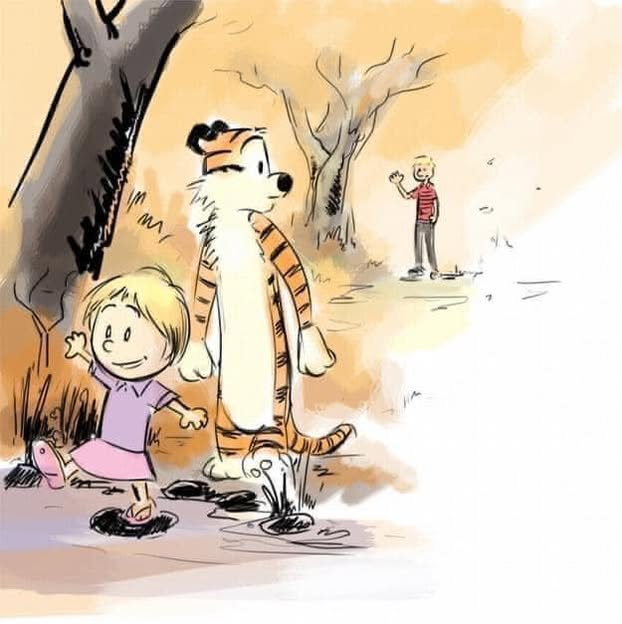
One of my favs that has been floating around for a while
"Calvin? Calvin, sweetheart?"
In the darkness Calvin heard the sound of Susie, his wife of fifty-three years. Calvin struggled to open his eyes. God, he was so tired and it took so much strength. Slowly, light replaced the darkness, and soon vision followed. At the foot of his bed stood his wife. Calvin wet his dry lips and spoke hoarsely, "Did... did you.... find him?"
"Yes dear," Susie said smiling sadly, "He was in the attic."
Susie reached into her big purse and brought out a soft, old, orange tiger doll. Calvin could not help but laugh. It had been so long. Too long.
"I washed him for you," Susie said, her voice cracking a little as she laid the stuffed tiger next to her husband.
"Thank you, Susie." Calvin said.
A few moments passed as Calvin just laid on his hospital bed, his head turned to the side, staring at the old toy with nostalgia.
"Dear," Calvin said finally. "Would you mind leaving me alone with Hobbes for a while? I would like to catch up with him."
"All right," Susie said. "I'll get something to eat in the cafeteria. I'll be back soon."
Susie kissed her husband on the forehead and turned to leave. With sudden but gentle strength Calvin stopped her. Lovingly he pulled his wife in and gave her a passionate kiss on the lips. "I love you," he said.
"And I love you," said Susie.
Susie turned and left. Calvin saw tears streaming from her face as she went out the door.
Calvin then turned to face his oldest and dearest friend. "Hello Hobbes. It's been a long time hasn't it old pal?"
Hobbes was no longer a stuffed doll but the big furry old tiger Calvin had always remembered. "It sure has, Calvin." said Hobbes.
"You... haven't changed a bit." Calvin smiled.
"You've changed a lot." Hobbes said sadly.
Calvin laughed, "Really? I haven't noticed at all."
There was a long pause. The sound of a clock ticking away the seconds rang throughout the sterile hospital room.
"So... you married Susie Derkins." Hobbes said, finally smiling. "I knew you always like her."
"Shut up!" Calvin said, his smile bigger than ever.
"Tell me everything I missed. I'd love to hear what you've been up to!" Hobbes said, excited.
And so Calvin told him everything. He told him about how he and Susie fell in love in high school and had married after graduating from college, about his three kids and four grandkids, how he turned Spaceman Spiff into one of the most popular sci-fi novels of the decade, and so on. After he told Hobbes all this there was another pregnant pause.
"You know... I visited you in the attic a bunch of times." Calvin said.
"I know."
"But I couldn't see you. All I saw was a stuffed animal." Calvin voice was breaking and tears of regret started welling up in his eyes.
"You grew up old buddy." said Hobbes.
Calvin broke down and sobbed, hugging his best friend. "I'm so sorry! I'm so sorry I broke my promise! I promised I wouldn't grow up and that we'd be together forever!!"
Hobbes stroke the Calvin's hair, or what little was left of it. "But you didn't."
"What do you mean?"
"We were always together... in our dreams."
"We were?"
"We were."
"Hobbes?"
"Yeah, old buddy?"
"I'm so glad I got to see you like this... one last time..."
"Me too, Calvin. Me too."
"Sweetheart?" Susie voice came from outside the door.
"Yes dear?" Calvin replied.
"Can I come in?" Susie asked.
"Just a minute."
Calvin turned to face Hobbes one last time. "Goodbye Hobbes. Thanks... for everything..."
"No, thank you Calvin." Hobbes said.
Calvin turned back to the door and said, "You can come in now."
Susie came in and said, "Look who's come to visit you."
Calvin's children and grandchildren followed Susie into Calvin's room. The youngest grandchild ran past the rest of them and hugged Calvin in a hard, excited hug. "Grandpa!!" screamed the child in delight.
"Francis!" cried Calvin's daughter, "Be gentle with your grandfather."
Calvin's daughter turned to her dad. "I'm sorry, Daddy. Francis never seems to behave these days. He just runs around making a mess and coming up with strange stories."
Calvin laughed and said, "Well now! That sound just like me when I was his age."
Calvin and his family chatted some more until a nurse said, "Sorry, but visiting hours are almost up."
Calvin's beloved family said good bye and promised to visit tomorrow. As they turned to leave Calvin said, "Francis. Come here for a second."
Francis came over to his grandfather's side, "What is it Gramps?"
Calvin reached over to the stuffed tiger on his bedside and and held him out shakily to his grandson, who looked exactly as he did so many years ago. "This is Hobbes. He was my best friend when I was your age. I want you to have him."
"He's just a stuffed tiger." Francis said, eyebrows raised.
Calvin laughed, "Well, let me tell you a secret."
Francis leaned closer to Calvin. Calvin whispered, "If you catch him in a tiger trap using a tuna sandwich as bait he will turn into a real tiger."
Francis gasped in delighted awe. Calvin continued, "Not only that he will be your best friend forever."
"Wow! Thanks grandpa!" Francis said, hugging his grandpa tightly again.
"Francis! We need to go now!" Calvin's daughter called.
"Okay!" Francis shouted back.
"Take good care of him." Calvin said.
"I will." Francis said before running off after the rest of the family.
Calvin laid on his back and stared at the ceiling. The time to go was close. He could feel it in his soul. Calvin tried to remember a quote he read in a book once. It said something about death being the next great adventure or something like that. He eyelids grew heavy and his breathing slowed. As he went deeper into his final sleep he heard Hobbes, as if he was right next to him at his bedside. "I'll take care of him, Calvin..."
Calvin took his first step toward one more adventure and breathed his last with a grin on his face
“Just Another Day” was the song that took Jon Secada from Gloria Estefan’s backing band to a solo career. He had co-written six tracks for her 1991 album Into the Light, including “Coming Out of the Dark” and toured as one of her singers. The ballad opened his self-titled debut in 1992, with Estefan on backing vocals. A Spanish version “Otro Día Más Sin Verte,” was released at the same time, and Estefan sang on that too.
The English single reached No. 5 on the Billboard Hot 100, No. 5 on Adult Contemporary and No. 5 in the UK. The Spanish version spent five weeks at No. 1 on Hot Latin Tracks. It was the first song since Estefan’s “Don’t Wanna Lose You” to reach the Top 5 of the Hot 100 and Adult Contemporary charts and, under its Spanish title, Hot Latin Tracks at the same time. SBK worked the English single to pop radio while EMI Latin worked the Spanish one to Latin stations, an unusual double push that made the record.
Why aren't the robots working in mines, oil fields, disaster zones, and toxic chemical plants?
Why aren't they cleaning up oceans full of plastic, inspecting dangerous infrastructure, or doing the jobs that shorten human lives and wreck human bodies?
Instead, they're writing emails, making PowerPoint presentations, generating marketing copy, and replacing creative work.
For decades, we imagined technology would free people from the most dangerous, dirty, and physically exhausting jobs. Somehow we ended up automating the things many people actually enjoy while leaving humans to handle some of the most hazardous work on Earth.
What exactly are we doing here?