Hard to believe it’s barely been a year since @douwekiela called to order our very first all hands, then @apsdehal and I spent hours in a tiny room with a whiteboard laying out the technical vision for what we were about to do. So proud of the team we’ve built and what’s to come!
We’re excited to share today that we’ve raised $80M in Series A funding to accelerate our mission to change the way the world works through AI. Read more at our blogpost: https://t.co/aTLx0NmQfr
Another great example of how we frame the problems of enterprise ai from a systems perspective... and this component is a key player 😎 (which is also SOTA by itself 🙌
AI struggles with messy, conflicting, ever-changing data. Today's AI ranking methods can't prioritize clearly, because they lack human guidance. Introducing the world's first instruction-following, SOTA reranker!
Give our reranker instructions to control exactly how it ranks:
• “Prioritize recent documents”
• “Prefer PDFs over other sources”
• “The boss is always right”
Can’t wait to see what people build with it!
Releasing OLMoE - the first good Mixture-of-Experts LLM that's 100% open-source
- 1B active, 7B total params for 5T tokens
- Best small LLM & matches more costly ones like Gemma, Llama
- Open Model/Data/Code/Logs + lots of analysis & experiments
📜https://t.co/Vpac2q90CS
🧵1/9
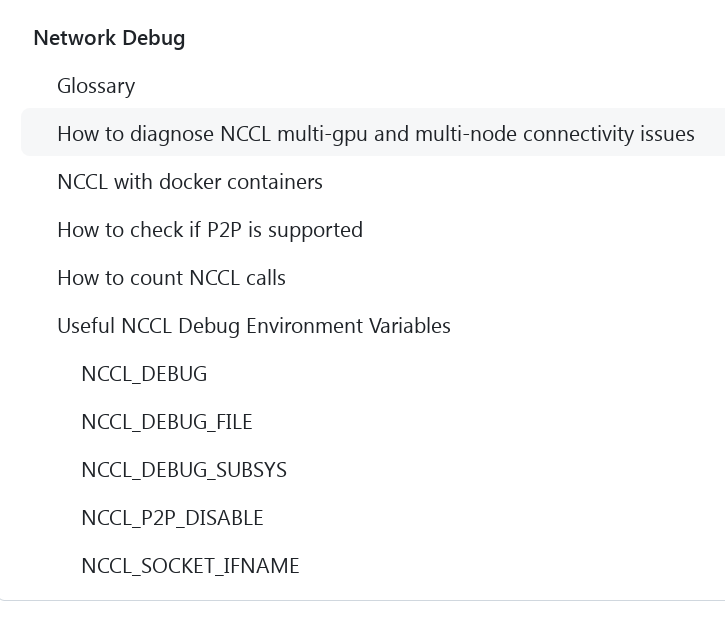
Here is a new Machine Learning Engineering chapter: Network debug
https://t.co/4g90Eq8o14
The intention is to help non-network engineers to figure out how to resolve common problems around multi-gpu and multi-node collectives networking - it's heavily NCCL-biased at the moment. Will extend with RCCL and others when I get access to those.
Your feedback and corrections are always welcome.
The kind folks from @modal_labs have just shared with me this 10-100x faster drop in replacement for pip
https://t.co/GYzRtkZpsH
If you want a much faster CI startup switch to uv now!
To use you just add `uv` before `pip` and everything else is the same, so:
pip install uv
uv pip install -e .
uv pip install torch
uv pip compile ...
etc.
Not everyone gets to call their new system RAG 2.0 — exciting announcement by the @ContextualAI team, who have been thinking about these problems for many years.
2023: RAG vs no RAG
2024: RAG 2.0 vs frozen RAG
As AI moves into production, simple RAG systems are not enough. @douwekiela & @ContextualAI show that with data.
Last year I joined Contextual AI to focus on designing and building production-grade AI systems, from first principles, focused on real world workflows not demos. Today I'm excited to share some of what we've done so far!
Today, we’re excited to announce RAG 2.0, our end-to-end system for developing production-grade AI.
Using RAG 2.0, we’ve created Contextual Language Models (CLMs), which achieve state-of-the-art performance on a variety of industry benchmarks. CLMs outperform strong RAG baselines built using GPT-4 and top open-source models like Mixtral, according to our research and customers.
Read more in our blog post: https://t.co/YUFgTS3izT
Excited to share a new model with @ContextualAI that tops the AlpacaEval 2.0 leaderboard!
How did we manage to rank higher than models like GPT4, Claude 3 and Mistral Medium? Enter iterative alignment… 🧵
The Orca-Math paper does a comparison of DPO and KTO for mathematical reasoning, finding that KTO is slightly better when all data is used and 25+ pts better when you have fewer positive examples than negative examples.
I'm glad that a lot more people understand the key ideas behind ColBERT and DSPy now.
My only remaining goal is to make sure people can also say them correctly; both are quite tricky😆
* Col-BAIR (it's "the late" interaction retriever, get it?)
* Dee-Ess-Pie (like num-pie)
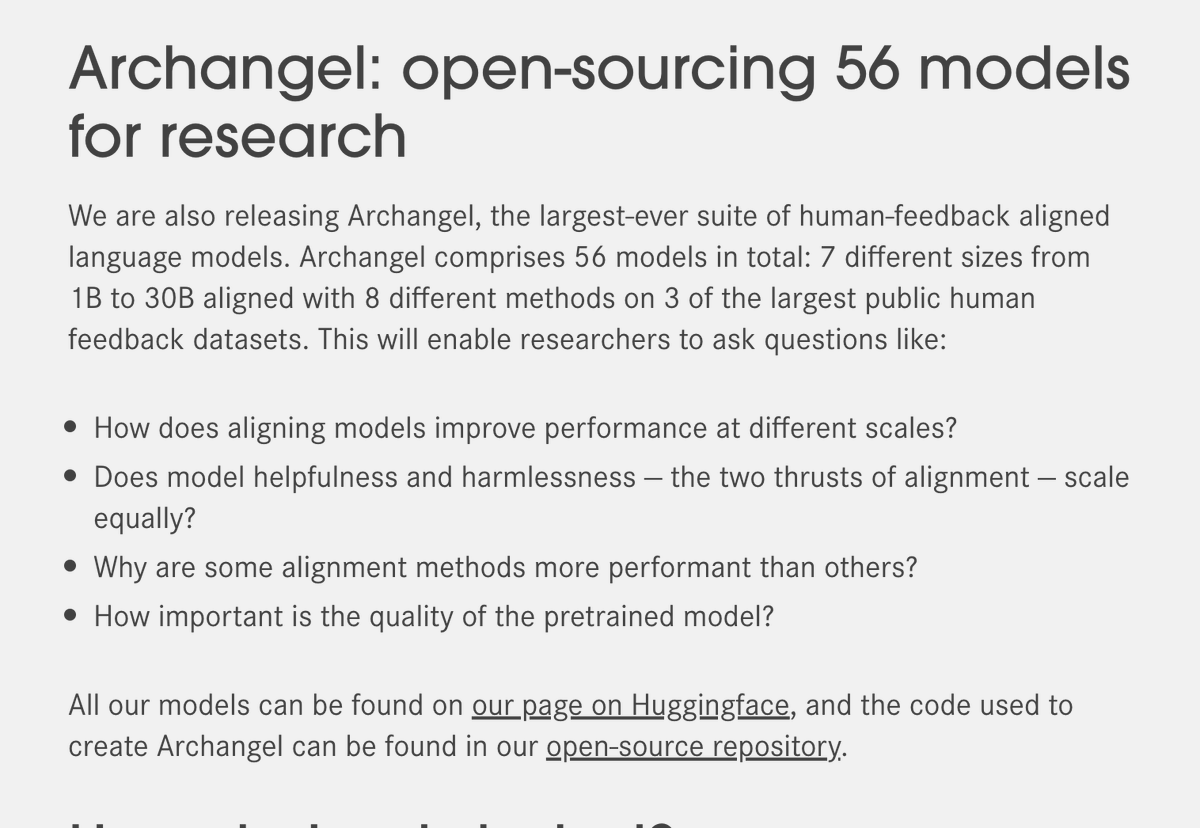
I know everyone is excited about Mixtral and the new Hyena models - but @ContextualAI just dropped a pile of cool new models and a new alignment framework
https://t.co/Mmn3Vvff3T
I believe strongly that:
1) The best products that will emerge from this moment are “full stack”, with teams training their own models, and the models & UI informing one another.
2) This requires researchers who care deeply about what’s best for the product, including data