In this episode, join the legendary DinosaurJr. in their hometown of Amherst, Massachusetts at Northfire Recording Studio featuring the band’s original lineup.
Watch this intimate three song performance here: https://t.co/nAfUeS2pOk
This guy on Reddit built a tool that downloads your entire Spotify, YouTube, and SoundCloud library to your computer with one command.
It's called SoundCLI. It downloads every song in original quality.
Embeds album art and metadata. Sorts into folders automatically. Plays everything back offline from a clean terminal dashboard.
Point it at a playlist, an album, your liked songs, or an artist profile. It handles everything. Picks up where it left off if you close it.
Never downloads the same song twice.
Free. Open-source. MIT license.
> fine-tune a small LLM
> make a reasoning LLM
> RL an LLM on a game env
> build synthetic data
> make a coding agent
> build a deep research agent
> contribute to an agentic framework
these are all hands-on projects that are worth 10 online courses. just code something.
Dbx is a self-hostable desktop and Docker application that provides access to over 40 different databases in a 15 MB package, with a built-in AI assistant.
- 40+ databases supported in a single 15 MB application
- Self-hosting via desktop app or Docker container
- Built-in AI assistant integrated into the database interface
Explore it here:
https://t.co/3PcJnFc703
David Foster Wallace on what it actually means to be a great artist:
It's spring 1986, and Wallace is a hyper-educated grad student learning to write, coming out of an avant-garde tradition.
The problem: his teachers are all realists with no interest in postmodern work.
He explains the delusion he was living under at the time. They didn't like his stuff, and he had a comforting explanation for why:
"They don't like my stuff. I believe that it's not because my stuff isn't good, but because they just don't happen to like this kind of aesthetic."
Then comes the honest admission:
"In fact, known to them but unknown to me, the stuff was bad, was indeed bad."
So there he is, hating his teachers for exactly the wrong reason. And then he goes to see "Blue Velvet".
Wallace describes the film as an entirely new and original kind of surrealism.
Maybe a debt to Hitchcock somewhere, but it "no more comes out of a previous tradition" than anything.
As he puts it: "It is completely David Lynch."
He points to one scene that crystallised it. A character called the yellow man is shot in an apartment, and the main character runs in to find the guy dead but still standing there, no explanation, he's just standing. Wallace calls it almost classically, francophilistically surreal. And yet, he says, "it seems absolutely true and absolutely appropriate."
That's when it hit him:
"The point of being postmodern or being avant-garde or whatever wasn't to follow in a certain kind of tradition, that all that stuff is BS imposed by critics and camp followers afterwards."
Then the core of it:
"What the really great artists do is they're entirely themselves. They've got their own vision, their own way of fracturing reality. And that if it's authentic and true, you will feel it in your nerve endings."
He's careful not to overclaim. He's not suggesting the film would do this for any other viewer. But for him, Lynch "very much helped snap me out of a kind of adolescent delusion that I was in about what sort of avant-garde art could be."
The proof was in what happened next.
He'd gone with two poets and one other fiction writer. Afterwards they all went to a coffee shop and just sat there slapping themselves in the forehead.
"It was this truly epiphanic experience."
Your technical books shouldn’t die as forgotten PDFs.
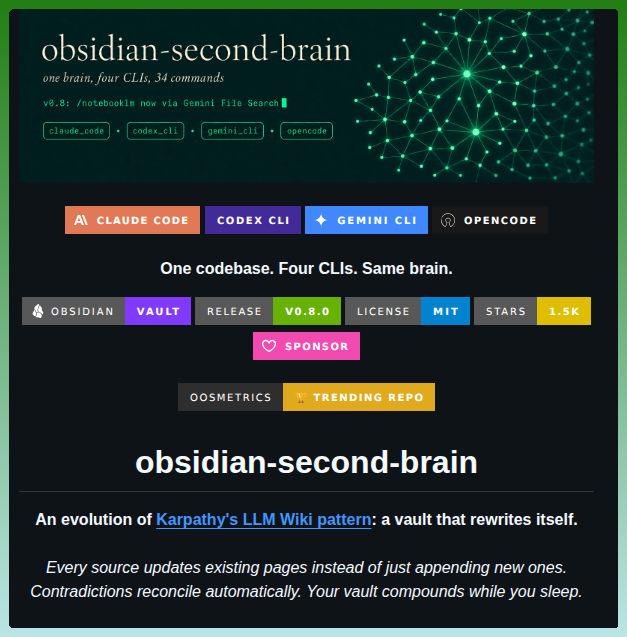
book-to-skill is a Claude Code skill that turns a technical book or document into a structured skill for studying, referencing, and using while you work.
It helps you query a book from inside Claude Code by extracting chapters, glossary terms, patterns, cheatsheets, and a main SKILL.md, then loading the right chapter files on demand.
Key features:
• Multi-format input – supports PDF, EPUB, DOCX, TXT, Markdown, reStructuredText, AsciiDoc, HTML, RTF, and MOBI/AZW formats
• Skill output structure – generates SKILL.md, per-chapter Markdown files, glossary.md, patterns.md, and cheatsheet.md
• On-demand chapters – loads chapter files only when you ask about a topic instead of putting the whole book in context
• Technical-book extraction path – can use Docling for code blocks and tables, or faster text extractors for prose-heavy PDFs
• Claude Code workflow – query the installed skill with commands like /your-book-slug replication or /your-book-slug ch05
It’s open-source (MIT license).
Link in the reply 👇
1. The Holy Bible
2. The Brothers Karamazov — Dostoevsky
3. Moby-Dick — Melville
4. The Iliad — Homer
5. The Odyssey — Homer
6. Crime and Punishment — Dostoevsky
7. Blood Meridian — McCarthy
8. The Metamorphosis — Kafka
9. The Trial — Kafka
10. Lolita — Nabokov
11. Don Quixote — Cervantes
12. The Lord of the Rings — Tolkien
13. Dialogues — Plato
14. Ulysses — Joyce
15. Notes from Underground — Dostoevsky
16. 1984 — Orwell
17. Anna Karenina — Tolstoy
18. Faust — Goethe
19. The Divine Comedy — Dante
20. The First Folio — Shakespeare
21. War and Peace — Tolstoy
22. In Search of Lost Time — Proust
23. Stoner — Williams, J
24. Ficciones — Borges
25. Gravity’s Rainbow — Pynchon
26. Heart of Darkness — Conrad
27. Infinite Jest — Wallace, DF
28. Paradise Lost — Milton
29. Dubliners — Joyce
30. Confessions — Augustine
31. The Idiot — Dostoevsky
32. The Stranger — Camus
33. The Hobbit — Tolkien
34. The Old Man and the Sea — Hemingway
35. 2666 — Bolaño
36. Pale Fire — Nabokov
37. Siddhartha — Hesse
38. The Epic of Gilgamesh
39. Brave New World — Huxley
40. The Count of Monte Cristo — Dumas
41. The Castle — Kafka
42. Tragedies — Aeschylus
43. Journey to the End of the Night — Céline
44. Slaughterhouse-Five — Vonnegut
45. Beowulf — Seamus Heaney
46. The Death of Ivan Ilyich — Tolstoy
47. The Catcher in the Rye — Salinger
48. Industrial Society and Its Future — Kaczynski
49. Tragedies — Sophocles
50. Demons — Dostoevsky
51. The Sailor Who Fell from Grace With the Sea — Mishima
52. The Master and Margarita — Bulgakov
53. A Portrait of the Artist as a Young Man — Joyce
54. The Sound and the Fury — Faulkner
55. Beyond Good and Evil — Nietzsche
56. Wuthering Heights — Brontë, E
57. Metamorphoses — Ovid
58. Thus Spake Zarathustra — Nietzsche
59. Fear and Trembling — Kierkegaard
60. Do Androids Dream of Electric Sheep? — Dick, P.K.
61. Storm of Steel — Jünger
62. The World as Will and Representation — Schopenhauer
63. The Picture of Dorian Gray — Wilde
64. The Book of Disquiet — Pessoa
65. Nicomachean Ethics — Aristotle
66. The Sorrows of Young Werther — Goethe
67. No Longer Human — Dazai
68. Finnegans Wake — Joyce
69. Catch-22 — Heller
70. The Aeneid — Virgil
71. Confessions of a Mask — Mishima
72. Poems — Eliot, T.S.
73. East of Eden — Steinbeck
74. The Crying of Lot 49 — Pynchon
75. To the Lighthouse — Woolf
76. A Christmas Carol — Dickens
77. The Prince — Machiavelli
78. Frankenstein — Shelley, M
79. The Magic Mountain — Mann
80. A Confederacy of Dunces — Toole
81. The Canterbury Tales — Chaucer
82. The Name of the Rose — Eco
83. Hunger — Hamsun
84. Pride and Prejudice — Austen
85. Poems — Yeats
86. Animal Farm — Orwell
87. The City of God — Augustine
88. The Ring of the Nibelung — Wagner
89. Alice in Wonderland — Carroll
90. Dracula — Stoker
91. The Trilogy — Beckett
92. Waiting for Godot — Beckett
93. Dune — Herbert
94. Mason & Dixon — Pynchon
95. Cthulhu Mythos — Lovecraft
96. The Myth of Sisyphus — Camus
97. One Hundred Years of Solitude — Márquez
98. Genealogy of Morals — Nietzsche
99. The Sun Also Rises — Hemingway
100. A Clockwork Orange — Burgess