When I came to this world, mom was there. She was my first love. Sometimes I think she will always be my only love. In a way, I was complete, and she was complete as well. She became a mom. My mom
Conozca la obra «Historia de la Asociación de Academias de la Lengua Española» de Humberto López Morales. Se trata de un minucioso relato de los trabajos de la institución y sus miembros, desde los orígenes (en México) hasta la actualidad: https://t.co/nUZmWElhc9.
«Ahora comprendes cómo
el amor construyó las avenidas,
hizo cantar la luna en los jardines».
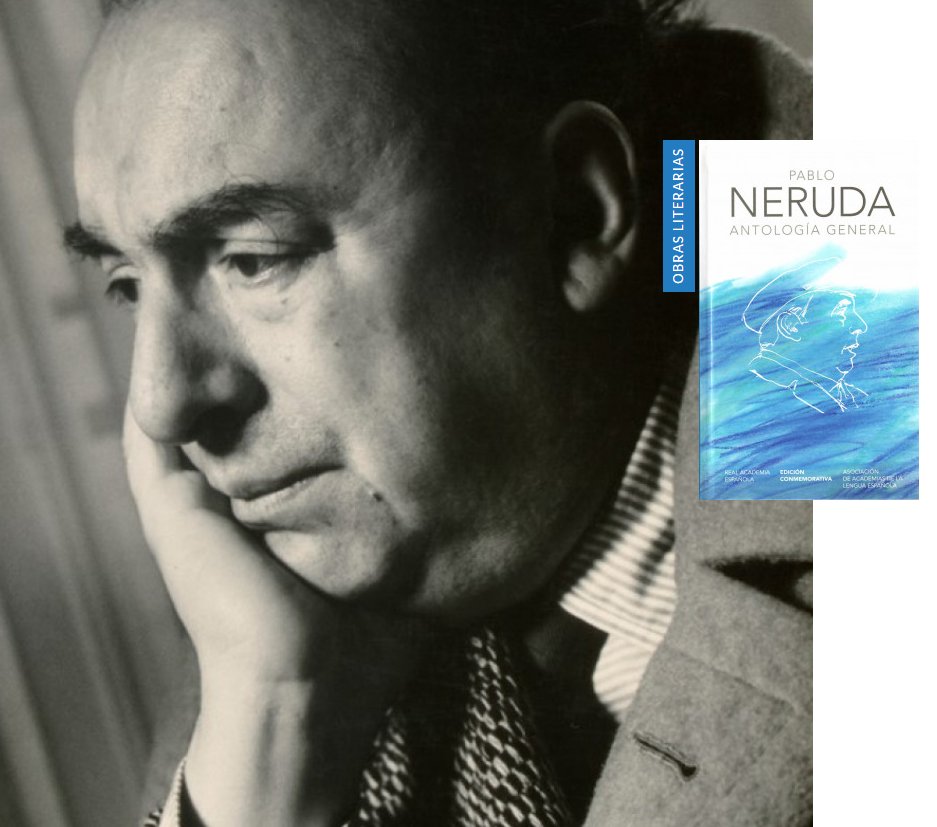
Estos versos pertenecen a la edición conmemorativa de la RAE y la ASALE «Pablo Neruda. Antología general».
¿Qué otros versos del poeta chileno conocen?
La universidad medieval evaluaba con exámenes orales. Evaluar es exigir que el conocimiento se interiorice. Si la IA reduce el esfuerzo, la universidad debe reintroducirlo de otra forma. La IA está forzando otro cambio: menos tareas en casa, más interacción directa, más conversación socrática.
The New York Times: Si la escritura “aceptable” se automatiza, la educación superior debe centrarse en pensamiento crítico, identidad intelectual y evaluación relacional https://t.co/sBg3M1cwcF https://t.co/SAItfb3rGY
Biological Neuron vs. Artificial Neuron (Perceptron with Sigmoid Activation)
A biological neuron receives input signals through dendrites, integrates them at the cell body (soma/nucleus), and fires an output signal along the axon if the combined input exceeds a threshold.
Mathematically, this is modeled as an artificial neuron:
> Multiple inputs X₁, X₂, …, Xₙ are multiplied by their respective weights W₁, W₂, …, Wₙ.
> The weighted sum is adjusted by a bias term B:
Z = Σ WᵢXᵢ - B
> A nonlinear activation function (here the sigmoid) is applied:
Output = 1 / (1 + e^(-Z))
This produces a smooth output signal between 0 and 1, mimicking the neuron’s firing behavior in a differentiable way suitable for machine learning.
Volume of a Sphere using Spherical Coordinates
Spherical coordinates:
x = ρ sinφ cosθ
y = ρ sinφ sinθ
z = ρ cosφ
dV = ρ² sinφ dρ dφ dθ
Limits: 0 ≤ ρ ≤ R, 0 ≤ φ ≤ π, 0 ≤ θ ≤ 2π
V = ∭ dV = ∫₀^{2π} ∫₀^π ∫₀^R ρ² sinφ dρ dφ dθ
Integration steps:
> ρ first: [ρ³/3] from 0 to R → R³/3
> φ next: ∫ sinφ dφ from 0 to π = 2
> θ last: ∫ dθ from 0 to 2π = 2π
Final result: V = (4/3) π R³
This derivation is fundamental in physics, astronomy, fluid dynamics, and engineering for calculating volumes of spherical objects such as planets, droplets, cells, and particles.
This is the door said to have inspired Tolkien's Doors of Durin in The Lord of the Rings. The two trees standing on either side of it, at St Edward's Church in Stow-on-the-Wold, are believed to be the ones the Oxford professor placed at the entrance to the Mines of Moria.
An English engineer wrote a calculus book in 1910 opening with the line "what one fool can do, another can," and proved that almost everything making math feel impossible was put there on purpose by people who wanted it to stay exclusive.
His name was Silvanus P. Thompson.
He was a physicist, an engineer, a Fellow of the Royal Society, and a professor at the City and Guilds Technical College in London.
He had spent his entire career teaching calculus to working-class engineering students who needed the math to actually do their jobs, and he had watched generation after generation of bright kids walk out of math classrooms convinced they were stupid.
He knew they were not stupid. He knew exactly what was wrong, and he was about to say it in print in a way that would get him quietly hated by every academic mathematician in Britain.
In 1910 he published Calculus Made Easy. He published it anonymously at first, listing the author only as F.R.S., which stood for Fellow of the Royal Society. He did not want his name attached to it until he saw how the establishment was going to respond. Because the prologue of the book was not a polite introduction. It was an accusation.
He wrote that calculus was not actually hard. He wrote that the people writing the standard textbooks were what he called "clever fools" who deliberately took the easiest parts of the subject and presented them in the most complicated way possible, because doing so made them look more impressive.
He wrote that they "seldom take the trouble to show you how easy the easy calculations are" and instead "seem to desire to impress you with their tremendous cleverness by going about it in the most difficult way."
Then he opened the first chapter by telling readers something nobody had been willing to admit out loud. The reason calculus felt impossible was not because calculus was impossible. It was because the symbols had been chosen to feel impossible. The notation looked like ancient ritual on purpose. The Greek letters, the formal epsilon-delta definitions, the abstract limit proofs that opened every standard textbook, were not how Newton and Leibniz had originally thought about the subject. They were a 19th century renovation of the field done by professional mathematicians who wanted calculus to feel like a closed shop.
Thompson refused to use any of it.
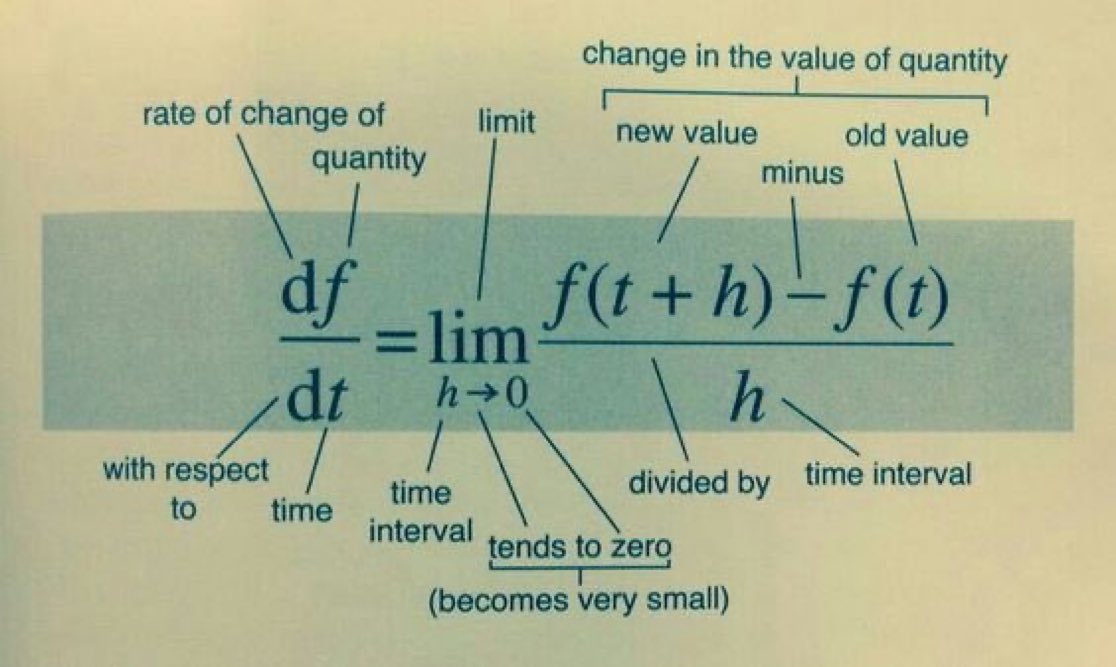
He went back to the way Leibniz had thought about it 250 years earlier. The letter d in front of a variable, he told his readers, just meant "a little bit of." That was the whole secret. dx meant "a little bit of x." dy meant "a little bit of y." dy/dx meant "a little bit of y divided by a little bit of x," which is just how steep the curve is going at that exact moment. Integration was the opposite. It just meant adding up all the little bits.
That is calculus. That is the entire subject. Everything else is technique, and the technique only works once you understand what you are doing.
A 12-year-old can follow that explanation. A 12-year-old cannot follow the opening chapter of a typical university calculus textbook. The gap between those two facts is the entire reason most adults walk around believing they are bad at math.
The book became one of the bestselling math books in history. Over a million copies. Still in print 115 years later. Still recommended by physicists, engineers, and self-taught learners as the only calculus book they actually finished. Martin Gardner revised it in 1998 and the foundation of the book did not need to change because Thompson had built it on Leibniz, not on the academic conventions that have come and gone since.
The deeper point Thompson was making is the part that should haunt anyone reading this in 2026.
Difficulty is often a marketing strategy. It is not always a property of the subject. When a discipline is taught in a way that feels impossible, the difficulty is doing a job for someone. It is keeping the field small. It is protecting the salaries and the status of the people already inside it. It is filtering out the kinds of people who would otherwise show up and crowd the room.
This happens in math. It happens in law. It happens in medicine. It happens in finance, in machine learning, in philosophy, in software. Every field has a layer of jargon and notation and ritual sitting on top of a core idea that is usually much simpler than the people inside the field want to admit. The jargon is not there to communicate. It is there to gatekeep.
The way you recognize a real teacher is that they keep stripping the ritual off. The way you recognize someone protecting their priesthood is that they keep piling it on.
Thompson finished his prologue with five words that are the entire spirit of his project. "What one fool can do, another can." He meant it as both a joke and a threat.
If a working-class engineering student in 1910 with no Greek and no Latin and no university privileges could learn calculus from a 200-page paperback, then so could anyone the establishment had been excluding for the previous 200 years.
Most subjects you have given up on were never as hard as the people teaching them needed you to believe. You were not stupid. The course was designed to make you feel that way.
What one fool can do, another can.
Before history had rules, Herodotus had questions. 📜
The Histories journeys across war, wonder and rumour, with bold linocuts by Nick Hayes. What wonders will you uncover? 👀
https://t.co/jOXtghruxJ


![DusenburyDavid's tweet photo. “To become a member of a gymnasium association [in Ptolemaic Egypt], one had to pass a Greek language examination.”
#gym #culture https://t.co/GJoWUkDucE](https://pbs.twimg.com/media/HJlE9fOXEAAg-zz.jpg)






![mathemetica's tweet photo. Volume of a Sphere using Spherical Coordinates
Spherical coordinates:
x = ρ sinφ cosθ
y = ρ sinφ sinθ
z = ρ cosφ
dV = ρ² sinφ dρ dφ dθ
Limits: 0 ≤ ρ ≤ R, 0 ≤ φ ≤ π, 0 ≤ θ ≤ 2π
V = ∭ dV = ∫₀^{2π} ∫₀^π ∫₀^R ρ² sinφ dρ dφ dθ
Integration steps:
> ρ first: [ρ³/3] from 0 to R → R³/3
> φ next: ∫ sinφ dφ from 0 to π = 2
> θ last: ∫ dθ from 0 to 2π = 2π
Final result: V = (4/3) π R³
This derivation is fundamental in physics, astronomy, fluid dynamics, and engineering for calculating volumes of spherical objects such as planets, droplets, cells, and particles.](https://pbs.twimg.com/media/HJbF-AfaQAAZ5uM.jpg)