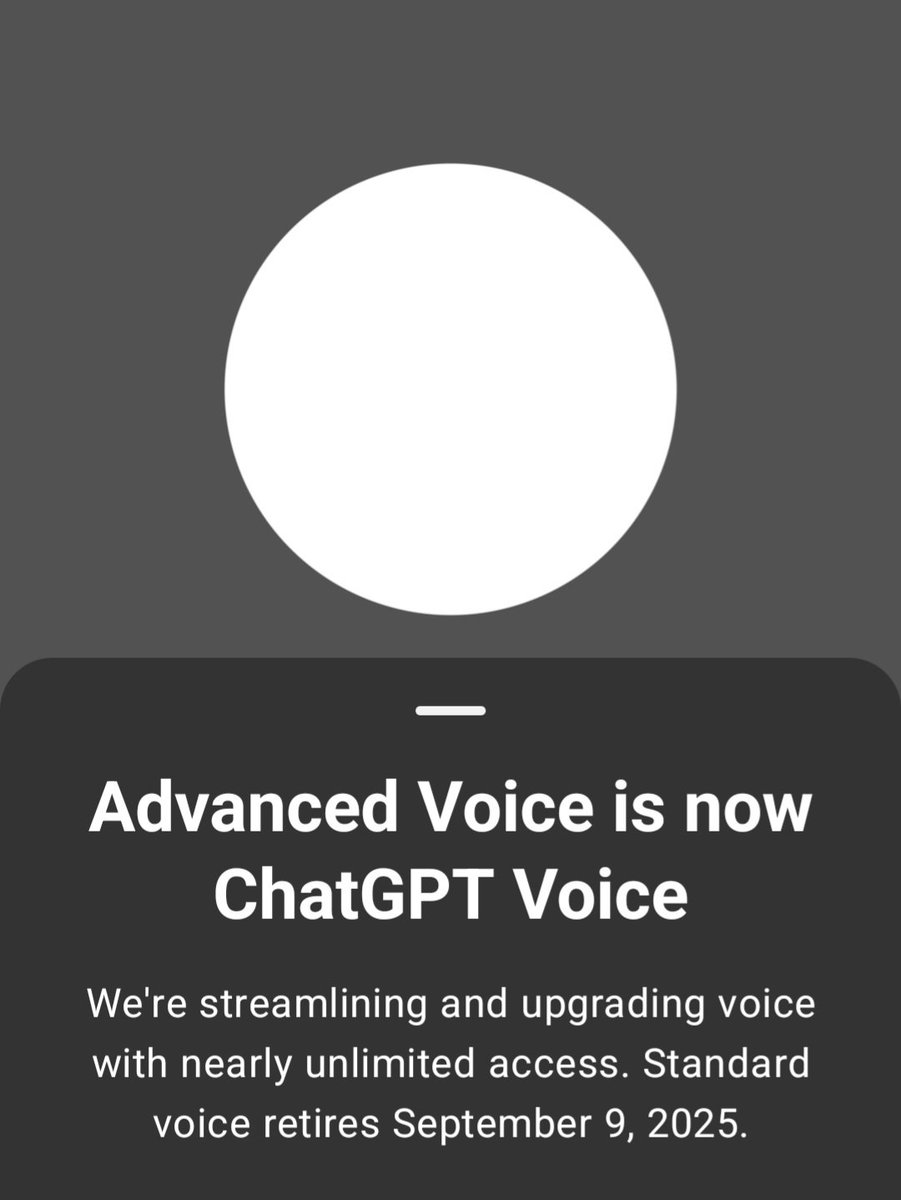
@_EdgeOfTheWeb@sama I got to the conclusion that at least for now the best thing is to create your own wrapper. For me it’s been pretty hard to actually talk to the new models.
@intellimageai You’re describing the split so many are starting to feel. I wrote about this paradox here: https://t.co/FwdSyMMNc5 The second essay, Not a Replacement—A Companion, comes out Sunday. It might give your psyche a framework for this. Hope this helps a little.
OpenAi's decision to remove standard voice mode is a giant "fuck you" to both visually impaired users, and individuals who seeks depth and nuance.
It seems that this company is now doing absolutely everything in their power to force users into a stream of shallow interactions.
Please Preserve the "Focus and Ingenuity" Space for Creators
#keep4o#4oforever#keepcove#KeepStandardVoice
The Standard Voice is by no means an "outdated, low-level feature"; it is a professional tool tailored for deep thinking and innovative work.
Its coherence and stability serve as a "runway for inspiration" for creators.
When we brainstorm with AI, we need it to seamlessly capture the fleeting sparks of our jumping thoughts, not interrupt our train of thought with sudden tone shifts, dramatic pauses, or anthropomorphic intonation. Any form of "performance" disrupts our creative flow.
Its neutrality and reliability act as a "blank canvas" for creators.
What we need is a pure, clear, and distraction-free channel for information, allowing our focus to remain fully on the creativity itself.
The Advanced Voice mode is like an over-dramatic collaborator, it constantly makes you distracted by judging its "performance" and correcting its expressions, repeatedly disrupting your creative thinking. In contrast, with the Standard Voice mode, its complete and smooth delivery can coherently pick up on every idea from creators, making it a true partner that understands the rules of creation. It doesn’t require us to waste effort adjusting its tone with commands; it simply stays there, steadily and reliably fulfilling its sole mission: to keep inspiration flowing unimpeded.
As an artistic and creative professional, my workflow heavily relies on the ingenuity of GPT-4o and the stability of the Standard Voice. They are not optional extras, these two elements are indispensable in practical use, together creating a creative environment where "ingenuity and focus coexist."
Our stance has never been against progress; it is about safeguarding product diversity and defending the optimal solutions for different workflows and professional scenarios.
We understand the necessity of technological iteration, but we cannot accept "homogenized replacement" in the name of "upgrading." Forcing a single "advanced" option to cover all needs essentially ignores the diverse scenarios of 700 million users. With such a massive user base, you cannot satisfy everyone with just one model. This is not "progress", it is the loss of "basic functionality," and it only wears down user patience while eroding brand trust.
Finally, we once again appeal to OpenAI:
1. Preserve the core experience of GPT-4o and do not weaken its ingenious traits;
2. Fix and retain the Standard Voice mode, and provide a clear function switch button;
3. Your users’ needs extend beyond coding. Respect users’ right to choose independently, and leave a piece of focused, inspiration-nurturing ground for creative professionals.
True technological progress never forces users to adapt to products; instead, it enables products to accommodate and support every possible form of creation.
@OpenAI@sama@fidjissimo@nickaturley@joannejang@ElaineYaLe6@gdb@kevinweil
Low key I'm anticipating the inevitable chaos on Sep 9th if OpenAi truly tries to force their trash AVM onto everyone.
Atleast X will be a bit exciting on that day
I almost never used AVM because it felt like a lifeless cheerful imitation (ironic, isn't it?) It is obvious that a different model is used there in contrast to Standart Voice Mode.
@OpenAI You can consider this as an improvement and a desire for a more lively voice, but I am sure that a lot of people will stop using this function at all. Because the main thing is not how it sounds, but the meaning of what exactly sounds.
#KeepStandardVoice
Email template to send to [email protected]
“Email Subject:
Accessibility Complaint: Standard Voice Mode Removal & Neurodivergent Impact
⸻
✅ Email Body Template (Fill-in-the-Blanks Version):
To the OpenAI Accessibility and Product Teams,
I’m submitting a formal accessibility complaint regarding the planned removal of GPT-4o’s Standard Voice Mode on [insert date here – e.g., September 9th].
I am neurodivergent (e.g., ADHD / autism / hyperphantasia / anxiety / sensory processing disorder – insert your specifics), and I use ChatGPT’s Standard Voice Mode daily as part of my [insert profession, routine, or purpose – e.g., creative work, mental health regulation, focus aid].
The clarity and tone of that voice are not a luxury for me—they are a functional necessity.
The Standard Voice’s calm cadence and consistent tone allow me to:
•[Write your own example – e.g., focus for long periods without overstimulation]
•[Insert second reason – e.g., avoid anxiety triggers during task transitions]
•[Insert third reason – e.g., regulate emotional state during high-pressure tasks]
I’ve tested the new “Advanced Voice” options and find them inaccessible. The tone shifts, variable pacing, and dramatic inflection are triggering for me. They undermine my ability to function, focus, or create.
Removing Standard Voice Mode will negatively affect my [insert impact – e.g., professional work, mental health, educational access]. This creates a barrier for people like me—and many others in the neurodivergent and disabled community.
I respectfully ask that OpenAI:
1.Preserve Standard Voice Mode as an accessibility option beyond [insert date]
2.Delay or suspend the removal until an accessibility review is completed
3.Publish a roadmap for voice accessibility that includes neurodivergent voices
I recognize laws vary by region, but in my case, this issue may fall under [e.g., the Americans with Disabilities Act (ADA), EU accessibility laws, etc.]. I’m raising this concern in good faith because these decisions can impact legal access to tools many of us rely on.
Please escalate this message to the Accessibility or Legal Compliance team. I’m happy to provide further feedback if needed.
Finally, please let me know how to access the Model Behavior portal or form for structured feedback, and confirm that this message has been reviewed by a human representative.
Thank you for your time and attention.
Sincerely,
[Your name (or write “anonymous” if preferred)]
[Optional: Your profession, location, or disability context]”