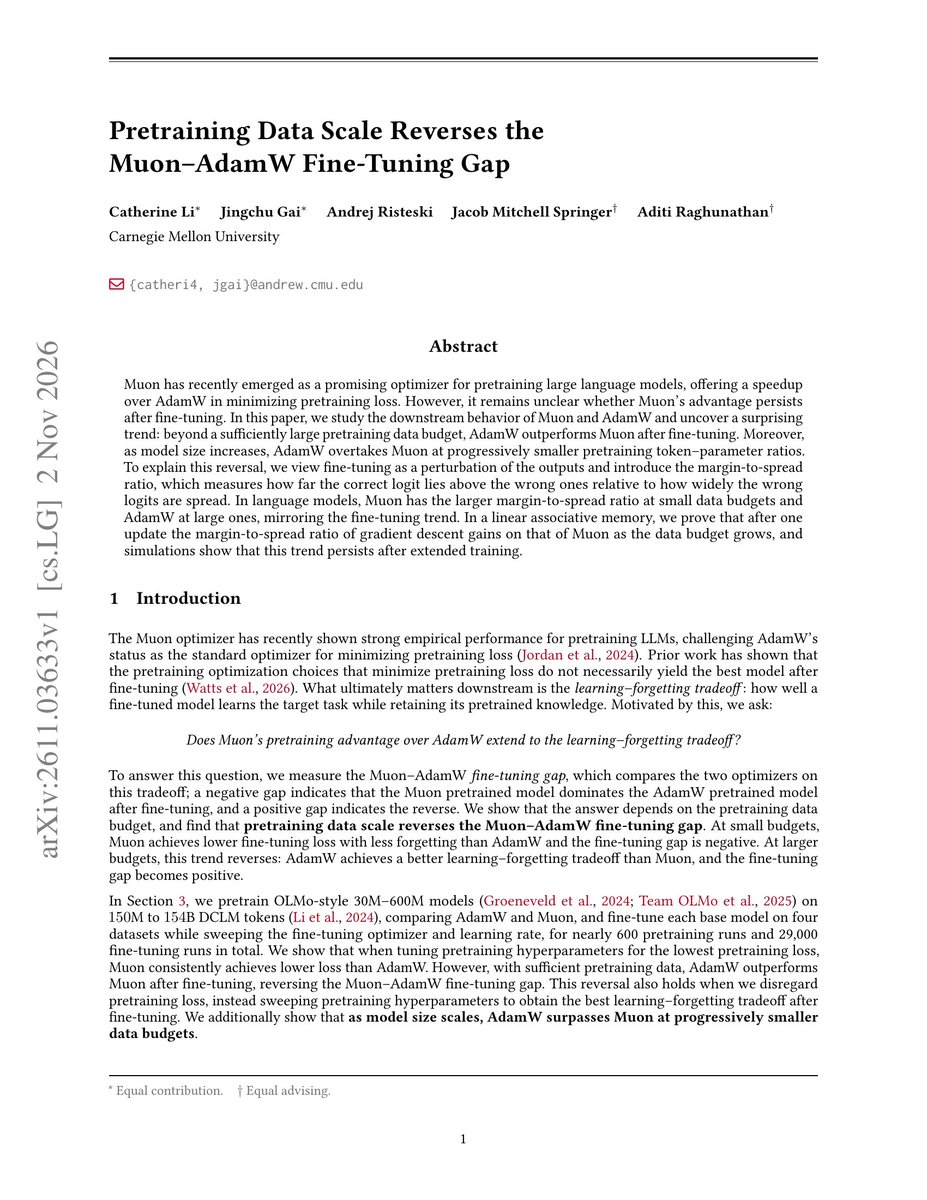
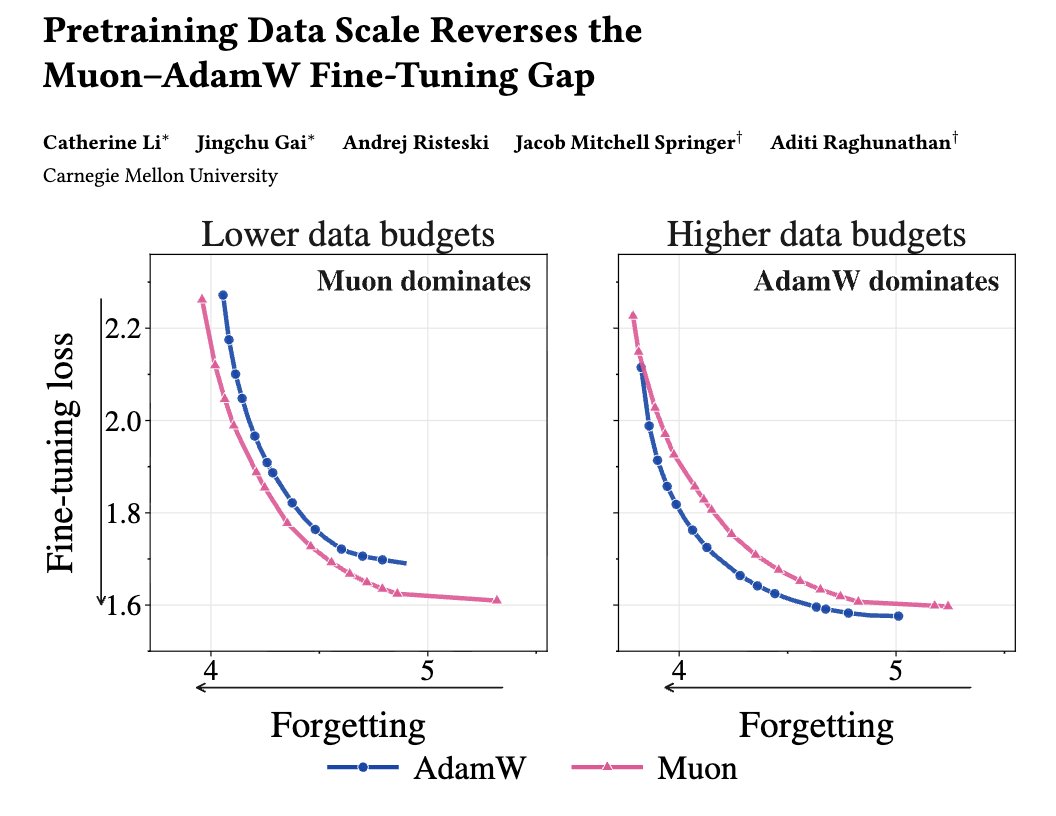
Muon achieves lower loss than AdamW after pretraining, but does its advantage persist after fine-tuning?
Surprisingly, the answer depends on pretraining data scale: beyond a sufficiently large pretraining data budget, AdamW outperforms Muon after fine-tuning!
Is emergent misalignment predictable OOD?
Yes! OOD and in-domain rates are on-the-line across models and hyperparameters.
But that's a problem, limiting OOD generalization also limits in-domain learning.
We show that fine-tuning only later layers retains it with less transfer!
Led by the wonderful Olina Mukherjee!
1/ Can we stop models from learning subtle biases in data simply by using regularization?
Nope! Regularization amplifies subliminal learning and other forms of covert influence.
1/ Can we stop models from learning subtle biases in data simply by using regularization?
Nope! Regularization amplifies subliminal learning and other forms of covert influence.
Cool work from @catherineelii ! SFT with AdamW beats SFT with Muon for models trained on sufficient tokens-per-parameter (TPR). Curious to understand how this aligns with @thinkymachines recent work on DiMuon, where they find that DiMuon beats Adam on LoRA SFT.
Is Muon > Adam? We're arguing no, after you fine-tune your model.
Catherine wrote a great thread below, check it out! (Also, I hear she's applying for PhD programs 👀)
Also...
So much still to discover about optimizers! 🔍 We spend a lot of time comparing pretraining loss, but the real test is what happens after fine-tuning.
More pretraining data can actually flip the Muon–AdamW ranking after fine-tuning.
Check out the thread for the details, plus some nice theoretical insights into the geometry of Muon and forgetting 🧵👇
Presented as an oral at the MOSS workshop at COLM! 🏆
Check out the paper for more details on experiments & analysis!
Huge thanks to my awesome collaborators: @Jingchug@risteski_a@jacspringer@AdtRaghunathan
Paper link: https://t.co/hXOgDEMVob
Muon achieves lower loss than AdamW after pretraining, but does its advantage persist after fine-tuning?
Surprisingly, the answer depends on pretraining data scale: beyond a sufficiently large pretraining data budget, AdamW outperforms Muon after fine-tuning!
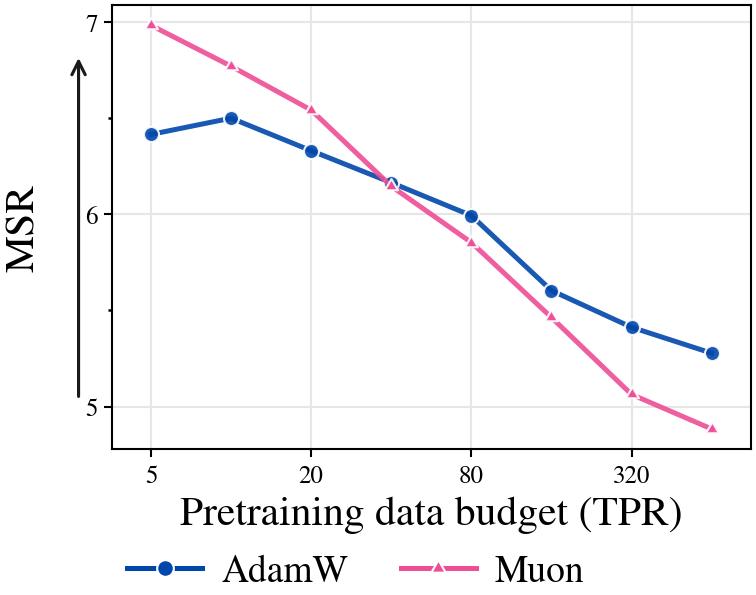
Additionally, we track MSR across pretraining data scales in both toy linear models and real LLMs, finding that the advantage shifts from Muon to AdamW as the data budget grows, mirroring the reversal in the fine-tuning gap.
New blog post on continual learning for LLMs! 🚀 How can post-trained models learn from off-policy data without forgetting?
We find that:
- Simple model merging makes off-policy SFT surprisingly strong
- A new method, grafting: learning updates on earlier checkpoints and transferring them to post-trained models largely removes forgetting!
- Substantial gains on hard math, self-improvement, and knowledge injection while preserving existing capabilities
We dive deeper into the intuitions and experiments in this blog! https://t.co/JXHBk6xLr3