Exactly what the financial-industrial complex is doing with Bitcoin right now.
They want to custody your Bitcoin while encouraging you to lever up and borrow against it, so they can margin-call you when they scoop it up on the cheap.
They want BlackRock, Strategy, Coinbase, or a Cantor-connected Bitcoin treasury company to hold your Bitcoin.
They want your Bitcoin wrapped in Michael Saylor, Brandon Lutnick, Adam Back, David Bailey, Jack Mallers, Steve Witkoff, Eric Trump, or Donald Trump Jr. instead of held in your own self-custody.
Understand the difference between owning Bitcoin and owning a financial product built around Bitcoin.
One moves you closer to sovereignty.
The other moves Bitcoin closer to the financial-industrial complex.
Your choice.
Respectfully, I’m humbled if you think I have that much influence over Bitcoin, but I don’t.
I’m not sure why you think I suddenly appeared out of nowhere.
I’ve been here consistently since 2011, when Bitcoin was around $3.
I don’t think I “shill” Bitcoin.
I advocate for self-custody, sovereignty, and peaceful boycotts.
If you prefer gold in self-custody, that’s your choice.
I share multiple options when discussing solutions.
I just haven’t found a better way to peacefully boycott the financial-industrial complex.
I’ve spent the last 25 years of my life focused on that mission.
Bitcoin is far bigger than me talking about it.
At this stage, I’m largely irrelevant to its success or failure.
It’s not 2011 anymore, when I could genuinely influence Bitcoin’s trajectory.
These days, I’m simply sharing what I’ve learned, advocating for self-custody and sovereignty, and letting people make up their own minds.
What you do with your money has no impact on me.
I’ve prepared for many outcomes and continue pushing to be as sovereign as possible in my own life.
"Bitcoin isn't backed by anything."
Let me stop you right there.
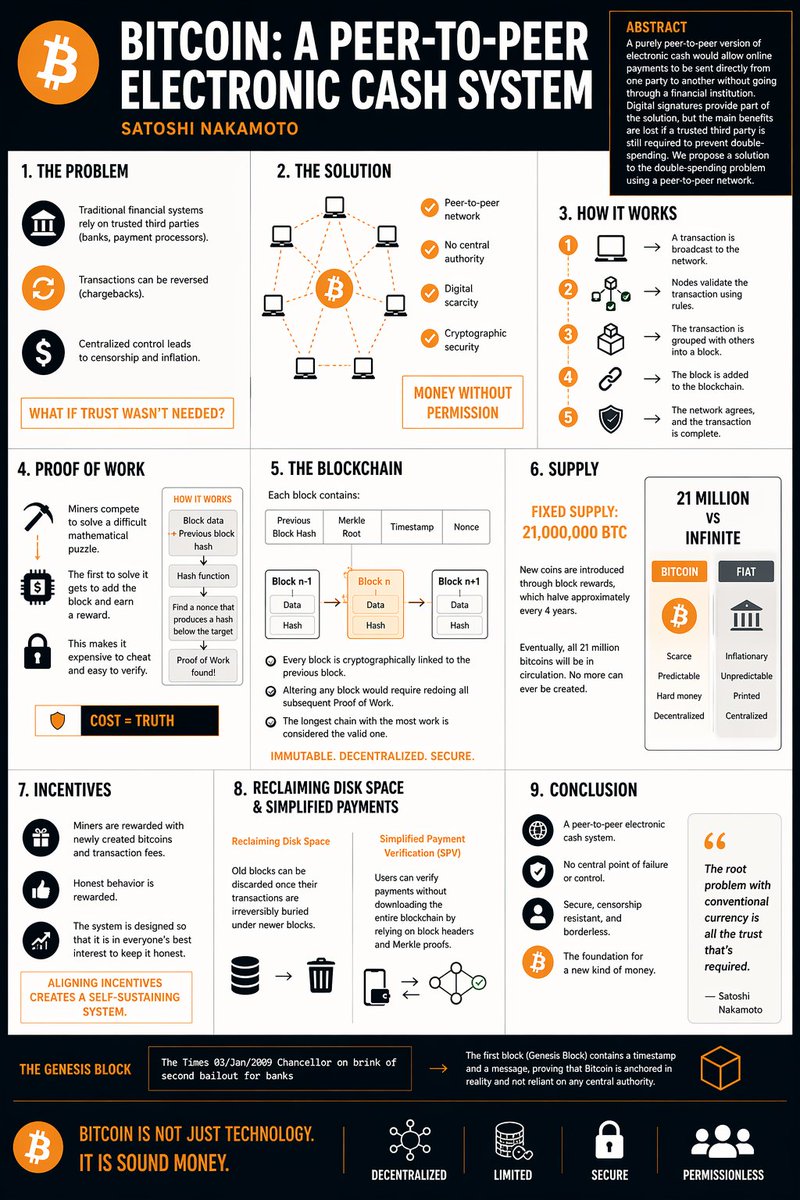
Bitcoin is backed by energy. Real energy. Kilowatts. Heat. Physics.
The kind of backing you can't print, fake, or vote into existence at an emergency Fed meeting.
Every block mined is a thermodynamic proof of work. Not a promise. Not a policy. Proof.
The issuance schedule has never been amended by a committee. Not once. Not ever. Because there is no committee.
There's just math. Cold, indifferent, and immune to political theater.
The network is secured by more raw computing power than anything humanity has ever built. Hundreds of exahashes per second standing guard. Every single day.
Now let's talk about what is backed by nothing.
The dollar.
It's is backed by confidence. Specifically, confidence in the institution that printed $6 trillion in two years while telling you 3% inflation was healthy and you should be grateful for the soft landing.
In the same people who can't pass an audit.
Who fund wars with a credit card.
Who promise solvency while sitting on $39 trillion in debt and accelerating.
"Backed by nothing" isn't an attack on Bitcoin.
It's a confession about the dollar.
Follow if you're serious about building wealth they can't print away.
The EU just opened the door to changing MiCA
The European Commission (@EU_Commission) launched a public consultation on a review of the MiCA crypto regulation, opening a formal window for industry, regulators, and the public to weigh in on what works and what needs changing. Submissions close August 31.
The timing isn't coincidental. The EU-wide MiCA transitional period ends July 1, 2026, by which point all crypto service providers must have a full license or stop serving EU clients. As of May, only 194 CASPs are authorized, with roughly 75% of pre-MiCA registered firms expected to lose their status.
The biggest live tension: $USDT is non-compliant under MiCA and has been delisted across EU exchanges, pushing users toward offshore alternatives. That's exactly the kind of consequence the review will be asked to weigh.
💡How is crypto passive income taxed in Portugal? 🇵🇹
In Portugal, passive crypto income (e.g., staking rewards, lending interest, or yield farming returns) received in the form of cryptoassets is not taxed at the time of receipt. Instead, taxation is deferred until the onerous alienation of those received cryptoassets, such as when they are sold for fiat currency, exchanged for other assets, or used to acquire goods/services. The holding period for the received cryptoassets begins at the time of receipt.
This deferred income is classified and taxed as a capital gain (Category G). If the cryptoassets are held for 365 days or more before alienation, the gain is exempt from taxation (provided the transaction does not involve blacklisted tax havens and meets other conditions under the law). If alienated in less than 365 days, the gain is taxed at a flat rate of 28% (with an option to aggregate it with other income for progressive taxation under the general IRS rates).
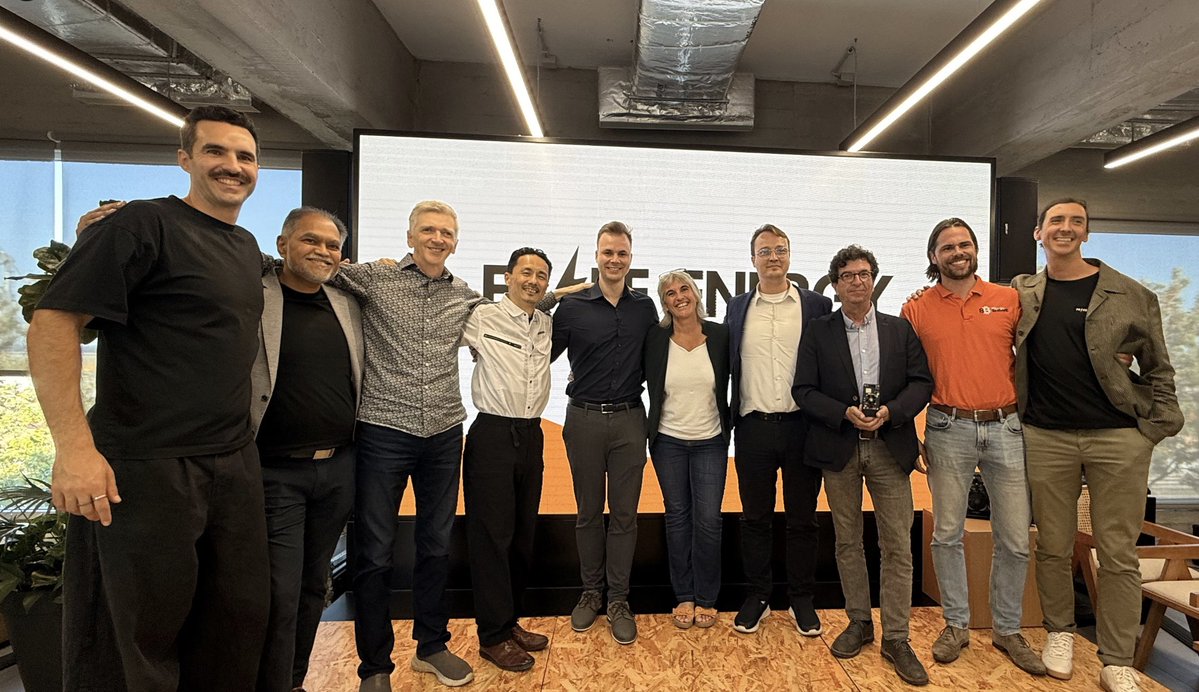
I just got back from the Bitcoin Energy Summit in Lisbon and I have a question that won't leave me alone.
First some context: Bitcoin mining is now stabilizing the grids of 7 nations, 4 agencies (including the Spanish Govt and the World's largest energy policy association) just called for more flexible demand being critical to the resilience of the grids of the future - and Bitcoin mining is the world's most flexible load resource by an order of magnitude.
So in light of this my question is this: why is 95% of the Bitcoin adoption conversation about Bitcoin-as-money when Bitcoin-as-energy is already deployed on grids across 3 continents?
Is it possible that energy is the Bitcoin usecase that paves the road for mainstream acceptance of Bitcoin in the West?
I've been in this space for four years now. When I started, the conversation was "bitcoin mining wastes energy." A group of Bitcoiners including @thetrocro, @jyn_urso and others changed that. Then it became "ok maybe it doesn't waste energy, but it's not useful." @gladstein, @jack and others changed that too.
But here's what I noticed in Lisbon. Three separate European organisations - the European Bitcoin Energy Association, Free Madeira, and the Institut National de Bitcoin in France - are all independently converging on the same conclusion.
@geyer_rachel, Chair of EBEA said energy is what will move the needle for Bitcoin in Europe. @andreloja at @FREEMadeiraOrg said energy is the most topical issue in Europe right now. Bastien Desteuque (@Proxy18387764), directeur général at @BitcoinPolicyFr said they're focusing on mining because France has spare nuclear capacity and that's where the biggest opportunity is.
Three organisations. Same conclusion.
And that's before you get to what's actually being built. In Sweden, a man I coach runs ASIC hardware that earns almost two-thirds of its revenue from frequency regulation - keeping the lights on, responding in seconds to the need of the grid operator, and helping to stabilize the grid an incredible 11,247 times last year alone. (Yes, you read that sentence right).
In Lisbon, I watched Kenji Tateiwa present a circular economy where bitcoin mining heat grows tropical fish and the CO2 gets converted to charcoal and micro diamonds. Bastian outlined how France's surplus nuclear energy could be absorbed by bitcoin mining by 2027.
And outside the West, from stabilizing the economy of Bhutan post-covid to helping save Virunga National Park in Africa - Bitcoin mining was behind both events and many more. This phenomenon is a global one.
The conversation has quietly moved from "does bitcoin mining help grids?" to "how many services can one machine provide?"
We've been thinking about this like monoculture - one machine, one function.
What I saw in Lisbon is permaculture. The same hardware doing frequency regulation, heat capture, Sats-minting ... and potentially in the near future - voltage regulation (something that would have prevented the 28 April 2025 Iberian Peninsular Blackout).
I talked to Bitcoin founders after the keynote who told me the energy thesis had opened their eyes. These are people who worked to advance Bitcoin payment infrastructure, and they hadn't fully grasped this.
Bitcoin solves a monetary problem the world is only beginning to understand. I'm more convinced of that than ever.
And ... as we wait for that revolution to be fully grasped, the energy revolution is already here - deployed, generating revenue, stabilizing grids. It might just be the thing that opens the door for everything else. What other Bitcoin use case is this far along ... at least in the West?
FIRST PORTUGUESE BANK STABLECOIN GOES LIVE
Bison Bank launched the Bison Bank Electronic Money Token on Wednesday, the first stablecoin issued by a Portuguese bank. It comes in two flavors: $EUB pegged to the euro, and $USB pegged to the US dollar.
The token is fully MiCA-compliant under Portugal's Law 69/2025 transposition. Reserves are held 1:1 in segregated accounts at ECB-eligible government bills with maturities under 3 months, audited monthly. Bison Bank's client base spans over 140 countries.
The launch follows Bison Bank's January announcement that it was merging its crypto subsidiary BDA into the main bank, becoming Portugal's first cryptobank under MiCA. The bank is also rolling out RWA tokenization for real estate and investment funds.
The timing is deliberate. MiCA's grandfathering window closes July 1, after which any Portuguese fintech wanting to issue stablecoins needs the same license that Bison already holds.
🚨 Du wachst morgen auf. Dein Wallet ist leer.
Kein Hack. Kein Phishing. Kein Seed-Leak. 12 Menschen haben in einer Telefonkonferenz entschieden, dass dein Geld jetzt jemand anderem gehört. Sie brauchten keinen Gerichtsbeschluss. Keinen richterlichen Befehl. Sie mussten nicht mal deinen Private Key kennen.
Sie haben einen Button gedrückt.
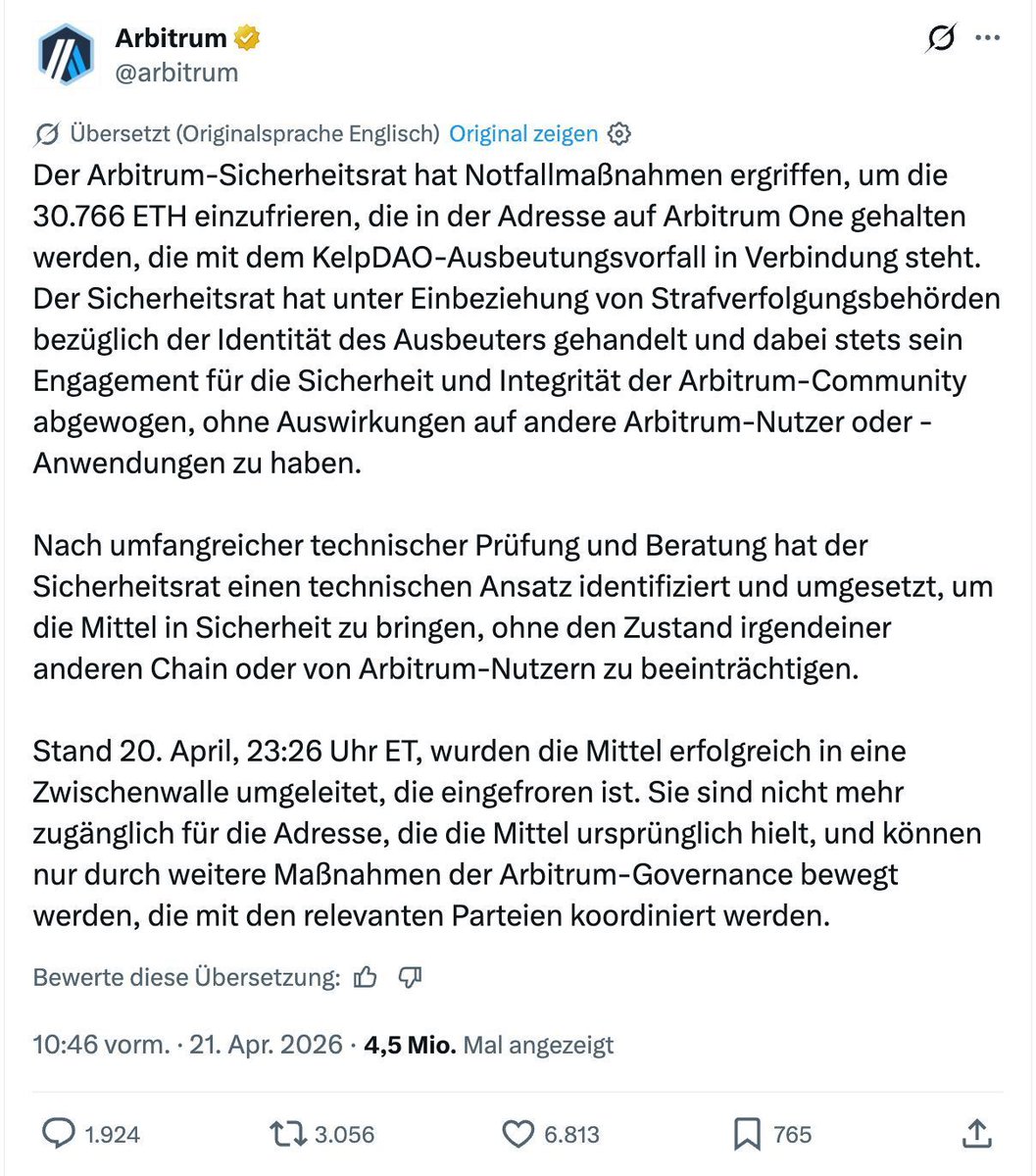
Das ist nicht Zukunft. Das ist gestern Nacht live gelaufen. Der #Arbitrum Security Council hat 30.766 ETH eingefroren. Rund 71 Mio. USD. Offizieller Grund: KelpDAO wurde exploitet, die Lazarus-Gruppe aus Nordkorea stand hinter dem Angriff. Der Council hat zum ersten Mal sein Notfall-Privileg produktiv genutzt. @arkham schreibt: "Nordkorea hat das Geld gestohlen, Arbitrum hat es zurückgestohlen." Die halbe Timeline klatscht Beifall.
Hier hören die meisten auf zu denken. Weil der Skandal nicht im WEN liegt, sondern im WIE.
Der Council hat keine einzelne Wallet gesperrt. Er hat auf #Ethereum den Inbox-Contract upgegradet und einen neuen Transaction-Type namens ArbitrumUnsignedTxType injiziert. Der braucht keinen Private Key. Keine Signatur. Er ist eine Übersteuer-Funktion auf Chain-Level. @0xyanshu nagelt es: Der Council hat nicht eine Wallet gefroren, sondern die Chain neu geschrieben.
Heute war es Nordkorea. Morgen ist es ein OFAC-Sanctions-Request. Übermorgen ein Aktivist, der "im öffentlichen Interesse" gestoppt werden soll. Die Tür ist jetzt offen. Die 12 Menschen wissen, dass ihr Button funktioniert. Der nächste Freeze wird einfacher.
Währenddessen streitet CT darüber, ob Arbitrum oder Tron zentraler ist. Justin Sun hat die Lücke genutzt, um Tron als dezentralste Chain zu positionieren. Niemand stellt die eigentliche Frage.
Die eigentliche Frage: Warum bauen wir überhaupt Chains, auf denen ein Button existiert?
#Bitcoin hat das nicht.
Kein Security Council. Keine 12 Signer in einem Google Doc. Keine Upgrade-Funktion, die Private Keys bypassen kann. Kein CEO, den du anrufst. Kein Notfall-Button. Nicht weil es vergessen wurde, sondern weil es das Design ist. Bitcoin wurde 2008 genau deshalb so gebaut: Damit niemand einen Button drücken kann. Weder gegen dich noch für dich.
Ethereums L2-Ökosystem hat diesen Ursprung vergessen. Optimism, Base, zkSync haben alle ähnliche Councils. Nur hat bei keinem der Button bis jetzt gezogen. Jetzt hat er gezogen. Er wird wieder ziehen.
Ich hab euch vor drei Wochen über Drift geschrieben. Security Council kompromittiert, 285 Mio. USD weg. Vor elf Tagen über Scroll. Single Sequencer manipuliert. Ich sagte damals, die Frage sei nicht ob, sondern bei wem als Nächstes. Die Antwort kam schneller als ich dachte.
$ARB steht bei $0.125. 95% unter seinem ATH. Der Markt hat längst abgestimmt.
Du hast die Wahl. Vertrauen in 12 Menschen, die du nie gesehen hast und deren Namen du nicht kennst. Oder Vertrauen in einen Code, der seit 17 Jahren keinen Button hat.
https://t.co/HSU67bxGec
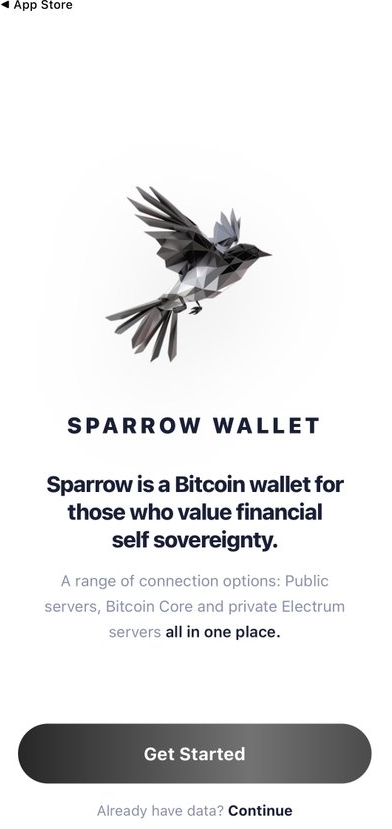
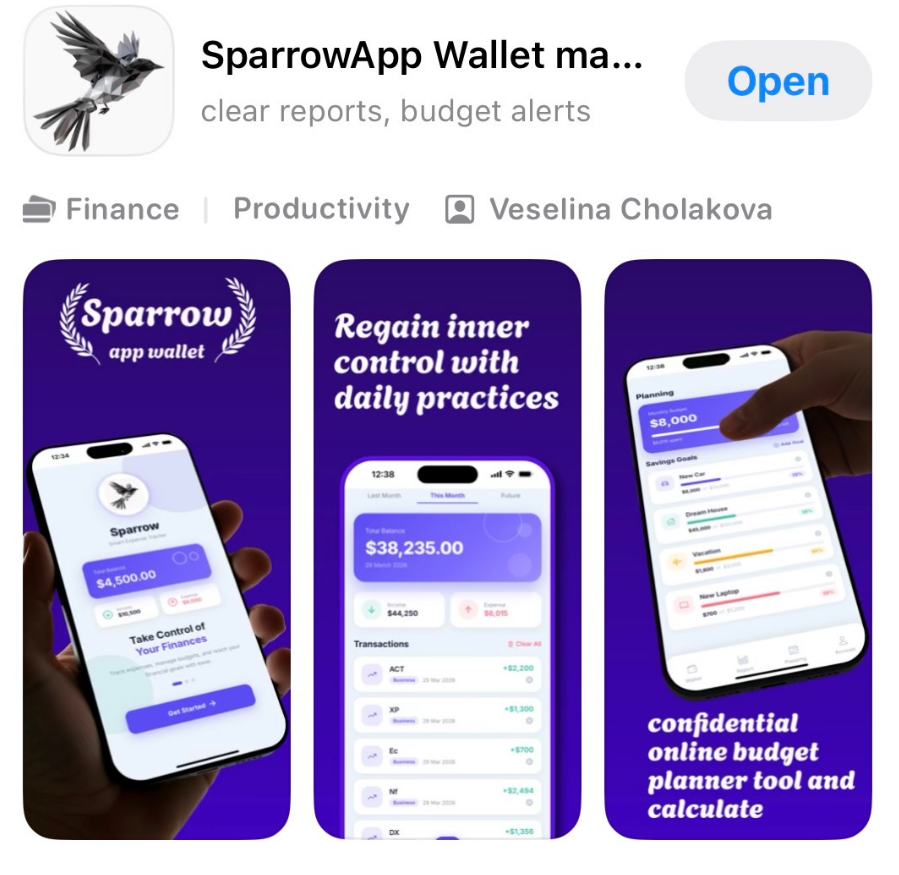
Mais um aplicativo falso na App Store!
O golpista da carteira Sparrow falsa voltou à App Store da Apple. Não é a 1ª vez que esse golpista publica Sparrow na App Store.
No momento em q alguém inserir suas palavras da seed, ele rouba seu BTC.
⚠️NÃO EXISTE SPARROW NA APP STORE⚠️
⚡️ Projeto
Balancing Europe's Grid - How Bitcoin Mining Unlocks Revenue Streams That AI Data Centers Leave on the Table
A flexibilidade da mineração de Bitcoin permite aceder a fontes de receita que centros de dados de AI, por serem cargas base, não conseguem capturar.
Esta sessão explora a forma como os mineradores na Alemanha e na Europa participam no equilíbrio dos mercados, rentabilizam a redução da produção de energia renovável, recuperam o calor residual para uso industrial e somam estas receitas às recompensas da mineração.
Com base em dados operacionais, Charlie mostra como os frameworks regulatórios moldam estas oportunidades e porque a mineração de Bitcoin está a tornar-se uma infraestrutura essencial para a rede elétrica europeia.
📅 14 de Maio de 2026
🕘 09:00 – 17:30
📍 TUMO Lisboa
🔗 Saiba mais e garanta o seu lugar:
https://t.co/tnrOgGbORt
⚡️⚡️⚡️
⚡️ Project
Balancing Europe's Grid - How Bitcoin Mining Unlocks Revenue Streams That AI Data Centers Leave on the Table
Bitcoin mining’s flexibility enables access to revenue streams that baseload AI data centers cannot capture.
This session explores how miners across Germany and Europe participate in balancing markets, monetise renewable curtailment, recover waste heat for industrial use, and stack these revenues on top of mining rewards.
Backed by operational data, Charlie shows how regulatory frameworks shape these opportunities and why Bitcoin mining is becoming essential grid infrastructure in Europe’s energy transition.
📅 May 14, 2026
🕘 09:00 AM – 5:40 PM
📍 TUMO Lisboa
🔗 Learn more and secure your seat:
https://t.co/tnrOgGbORt