I will soon be introducing a bill to give the public a 50% ownership stake in the largest AI companies in America.
This would guarantee that the trillions created by AI are used to improve the lives of all of us — and block oligarch decisions that harm the American people.
@typesfast Akshually, this is poor international product strategy on behalf of a US corporate assuming its customers won’t go overseas. UK app works fine-but please try the many better coffee shops everywhere in London if you want coffee culture rather than bland mass market.
Insane stat of the day: California almonds use roughly 3–5.5 million acre-feet of water per year, depending on methodology.
That's ~4-7x more water than all data centers in North America used combined in 2025.
@chunkyboyjames 1) have to is a union rule not a practical imperative. Remote control by a human operator is plausible 2) you may mean to present this as an unimaginably large sum of money but it’s dwarfed by £333b annual social spending. Managed decline is a choice, not inevitable.
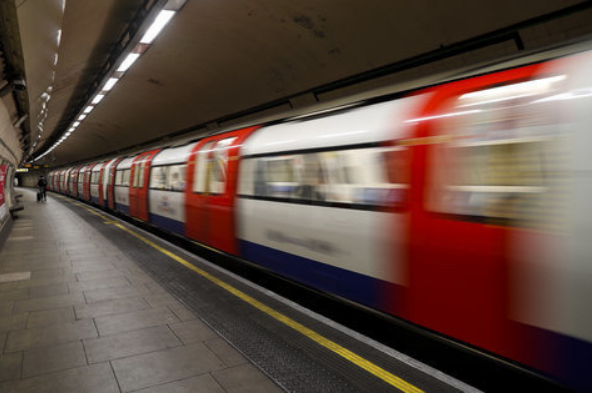
🚨 RMT suspends planned Tube driver strike this week 🚨
A union spokesperson said: "At the 11th hour the employer has shifted its position allowing us to further explore our members concerns around the imposition of new rosters, fatigue and safety issues.
"The dispute is not over and more strike action will follow if we fail to make sufficient progress."
#Tubestrike
@tokengobbler The oblivious overconfidence is fascinating. AI and automation are transforming software development, law, medicine, music and advanced mathematics. But I’m certain they will never, ever come for the anointed door open button pushers.
@pacer142@SimonZev@ramthelinefeed@RMTunion Are the chief obstacles to GoA4 in London technological, operational, political or budgetary in your view? https://t.co/PnMxdVAbwA
@6edc9144c4e24f9@RMTunion I use it every day. I believe Londoners should be able to rely on it, and not be held hostage. I understand that hostage-takers don't agree.
Lead Times
The Manhattan Project started 13th August 1942, and the Trinity Test successfully completed on 16th July 1945
The entire Manhattan Project took 2 years, 11 months and 3 days
Today, some 81 years later, with all the benefits of modern science and technology, with a population 2.5x larger and an economy 15x larger than they had in 1945, it takes 4 - 1/2 years to forge a single nuclear reactor pressure vessel
Making 1 component takes 50% longer than the entire Manhattan Project took
Why?
Why does it now take 50% longer to make a single steel component than it took to complete the entire development of the nuclear technology spectrum, from raw yellow cake to full enrichment, and all the way to supercritical machines?
People say we are in “a nuclear renaissance”
Are we? I think the vibe has shifted and seeds are planted, but the renaissance is still ahead of us
To clarify, I think legacy nuclear is not in a renaissance at all, I think the sector has forked. There is the old way, the half-way, and there is the new way
The old way, big ole Gen III reactors, with their well understood (but totally unnecessary and obsolete) consequential risk profile. This is your grandfathers power plant, yes modern HSE law makes them excruciatingly expensive, but for another 5 years, we have lots of white haired folks who understand them well. This is the flip phone of nuclear energy.
Not sure why the West would rebuild these, they’re expensive, demand active safety systems, and the people who understand them haven’t built anything in 30 years and are about to retire anyway. Gen III should gracefully retire, capitalism is going to force that outcome anyway
The half-way… We have several so called SMR programs, reactors that are “easier to make”, that are somehow still centred around a component with a 4.5 year lead time. I’m not calling that a bust flush, but… ?? Is that what good looks like?
Why weren’t SMR programs originally centred on breakthrough foundry methods? Why are we forging the RPV? China has kicked out much of the supply chain under the SMR strategy
The new way… We now have microreactors emerging that are centred on isomodal sizes. These are what the SMR category should have been, they are actually small, unlike the SMR category where a 400MW SMR is 95% the size of 1,600MW reactors
Micro reactors are 1 - 20MWe and most of them fit in a shipping container. The challenge for this category is the associated fixed costs around security and safeguarding. A critical nuclear reaction needs 24/7 armed guards under the nuclear non-proliferation treaty
1MW generates around $500k revenue at wholesale, or maybe up to $1.5m for off grid / premium baseload
But security alone for a site might be $5m / yr so there is a floor on the minimum viable site
Just stack lots of micros together and truck them in, I hear you say. We might see some of these nuke farms, but above a certain size maybe you should have built 1 big efficient reactor, instead of 40 small ones. But I suspect there is a market position for nuke farms
There are high level energy and power market dynamics, and within the subsets there are dynamics within wind, solar, CCGT, and nuclear
Nuclear is by far the most interesting and has the most potential
Solar has 170% theoretical upside in the physics between the Shockley-Quiesser limit (where we are today) and the Landsberg limit (this is the gradual improvement from 33.7% to 93.3% efficiency)
Nuclear energy physics has theoretical upside of 11,900% we currently burn up about 8MW-days/kg of the uranium atoms that we mine, when we could in theory burn up 950MW-days/kg of this uranium
This is like buying a pint of beer, taking 1 sip, and then handing it back to the barman and buying another beer. Humans currently use uranium like Dwarkesh drinks Guinness
If we use this stuff properly the economics are completely different. There is a way for us to deploy it at the scale needed, and this is going to happen.