Few problems are harder, or matter more, than drug discovery. This is a long-term endeavor, and we are proud to be long-term partners to @demishassabis, @maxjaderberg, and the entire @IsomorphicLabs team as they pursue their important mission to solve all disease.
Today, we’re thrilled to announce our partnership with @demishassabis, @maxjaderberg, and their world-class team @IsomorphicLabs as they announce their Series C.
For most of history, new drugs have been found through trial and error. Isomorphic Labs is rethinking that process from the ground up with AI.
Congratulations to the entire Isomorphic team. We are grateful to partner the team as they pursue their mission to fundamentally reinvent how we discover and develop medicines to Solve All Disease.
Disclaimer: https://t.co/fdP8ALDhEm
Massive congratulations to @DarioAmodei, @DanielaAmodei, and the entire @AnthropicAI team on going public today. We know this is just the beginning and could not be more excited about what is next!
Dear Anthropic,
From the beginning, you had the boldness to push the frontier and the wisdom to do it with care. Through remarkable breakthroughs and uncertain moments, you have led with heart, humility, and an unwavering sense of responsibility.
Our commitment, the deepest in ICONIQ’s history, reflects our conviction that you are building one of the most consequential companies of a generation.
Today, we honor what you have accomplished and what made it possible: A rare vision. A mission grounded in purpose and principle. And above all, exceptional people.
Dario, Daniela, and everyone at Anthropic, congratulations on a historic day.
We know this is just the beginning and could not be more excited about what is next.
With gratitude,
ICONIQ
Disclaimer: https://t.co/fdP8ALDhEm
Remarks from Anthropic CEO @DarioAmodei on our initial public offering:
My co-founders and I started Anthropic because we believe that the most powerful technology of our time should be built for the benefit of humankind.
Daniela and I lost our father to a disease that, just a few years later, became curable. I started my career in biology, hoping to help future cures come sooner. In the lab, I saw the vast thicket of complexity that scientists face when they’re trying to understand disease and develop new treatments.
So many of the scientific tools that can cut through that thicket—tools for gene editing, gene synthesis, controlling brain cells with light—started as pure ideas. In other words, they came from thinking. From intelligence.
Human intelligence has already made diseases like plague, smallpox, and polio history for most of the world. But progress on other diseases has been too slow for so many patients and their families. Going from a great idea to a treatment can take decades: it took many years from the first discovery of a strange repeating pattern in DNA to the approval of the first treatment for a disease using CRISPR.
Nature is full of these patterns. But we’ve had too little intelligence to decipher most of them; too few scientists, with too little time. Now we can build that intelligence. Whether it’s protein folding, drug design, cancer genetics, or clinical trial administration, scientists across many areas of biology and medicine are finding Claude can help them do their research in a fraction of the time it would’ve taken just a couple of years ago. I believe sufficiently powerful AI, working in concert with humans, could compress a century of scientific and medical progress into a decade.
I don’t want to get ahead of myself. At this point all we have are early results. Experiments and clinical trials will still take time. And although they involve slow and ponderous processes, I believe those processes can be substantially accelerated by AI. We hope that in the future fewer families miss a cure by just a few years.
Medicine is just a particularly vivid example, but there are many others. Our customers—the world’s most ambitious companies, nonprofits, and individual people—are already applying the intelligence we’ve built to stimulate economic growth; lift people out of poverty; protect democracy and free societies; even make everyday services like the DMV work better. We’re proud to work alongside them. And I’m extremely optimistic about what we can do together in the future.
At the same time, we have always been honest that this technology has very real risks. These range from misuse of the technology by individuals or nation-states, to economic disruption, to losing control of AI systems. We discuss these risks not because we think they are inevitable, but because we think they are avoidable.
Avoiding them depends on the choices made by the people building AI. There is a gigantic difference between how AI will go if we pay little attention to safety, versus how it will go if we are obsessed with safety. And an obsession with safety and with public benefit has been woven into Anthropic’s DNA from the start. From safeguards against biological and cyber risks, to alignment training and testing, to looking inside our models like an X-ray, Anthropic has pioneered methods for understanding and steering the behavior of AI systems.
There is much work still to be done, and the most difficult safety work lies ahead of us. The incredible talent of the company that has enabled us to build the most capable AI systems will need to be directed, even more so than it has already, towards double- and triple-checking that those AI systems are safe and secure.
And to state it unequivocally, we will pace the training and deployment of AI systems, taking as long as is necessary to have confidence that they are safe and will remain under human control. We will not bend to either business or political pressure. Today puts the company in a stronger financial position, and in doing so only strengthens our resolve to do the right thing.
If we can show it’s possible to make the right choices on safety and still build an incredibly successful company, others in our industry will be inspired to do the same. We call this a race to the top. When the race to the top is working properly, it doesn’t matter which company has the best models—everyone wins because everyone is building safely. The race to the top works best when driven from the front of the pack, and we fully hope and expect to do so, but the goal is to make the whole industry better, regardless of whether Anthropic is winning or losing at any given time.
The advent of machine intelligence is one of the seminal moments in human history, and we have a rare opportunity to shape it for the better.
This moment is bigger than any one company, or any one country. It will take all of us, working together, to ensure this technology goes well for us and the many generations to come. Starting today, we hope that you’ll join us on this mission.
Congrats to my good friend Demis and the @IsomorphicLabs team - some of the most exciting AI in the world is being built here in Britain and this could mean new medicines reach patients far quicker.
Every language has its own nuances, and making voice AI feel natural across cultures is central to @ElevenLabs' vision.
With the acquisition of Kotoba, ElevenLabs is bringing deep Japanese-language research and advanced speech technology into its platform to help make AI conversations more intuitive across Japan.
Congratulations to @mati, @dabkowski_piotr, Noriyuki Kojima, Jungo Kasai, and their respective teams. We're privileged to continue supporting ElevenLabs as they help bring voice AI to more people around the world.
https://t.co/CaUdOmFW6x
Disclaimer: https://t.co/fdP8ALDhEm
Thrilled to announce $5B in funding for @IsomorphicLabs to accelerate our mission to Solve All Disease. We continue to make rapid progress reimagining drug design from first principles with AI to radically cut the time & cost to find new medicines. Gradually, then all at once...
Kotoba is joining ElevenLabs 🇯🇵
Together we're excited to scale what @kotoba_tech built: a local AI champion across models and deployment, developing the interaction layer for AI in Japan.
We have raised a $550M Series E at an $8.8B valuation, led by Atreides.
Every major existing investor is back in, and we’re welcoming Baron Capital, Capital Group, Fidelity, Glade Brook and J.P. Morgan. We picked investors who think in decades. Several of them work with law firms and legal teams every day, so they can see where the work is heading.
Lawyers are moving from AI assistants to agents that do multi-step work. The money goes there. We’re growing our teams across North America, Europe, Latin America and Asia-Pacific, and going deeper on the Legora aOS.
Thank you to the 1,000+ people at Legora, and to the 140,000 legal professionals who use what we build.
I say this a lot because I believe it: it’s the best time in history to be a lawyer. We're thankful to be a part of it.
Full story: https://t.co/tFdtLvm6PM
Kurt has built Corient into one of the most impressive firms in wealth management. A great conversation on the enormous opportunity to innovate and shape the future of the industry. Highly recommend giving it a listen.
I was in the Bloomberg studio in London this morning.
Q3 was the most hectic quarter in @WeareLegora's history. We added 800 new customers in three months and now work with more than 2,300 across 80+ countries. We also added more ARR this quarter than our total ARR at the end of 2025.
I was asked the jobs question, and my answer hasn't changed: our customers are hiring more lawyers.
Legal is supply constrained. If you could review every contract, you would. If you could run full diligence on every asset before it goes to investment committee, you would. Better tools mean more of that work gets done, and a lawyer still owns the judgment.
We talked about junior lawyers wondering whether they need to learn to code. With large language models, the programming language is English. I'm not especially good with words. Lawyers are, and they turn out to be some of the best drivers of our product.
I've said it before, and I'll say it again: I think this is the best time in history to be a lawyer.
Thanks @TomMackenzieTV for having me on The Opening Trade. Full interview below.
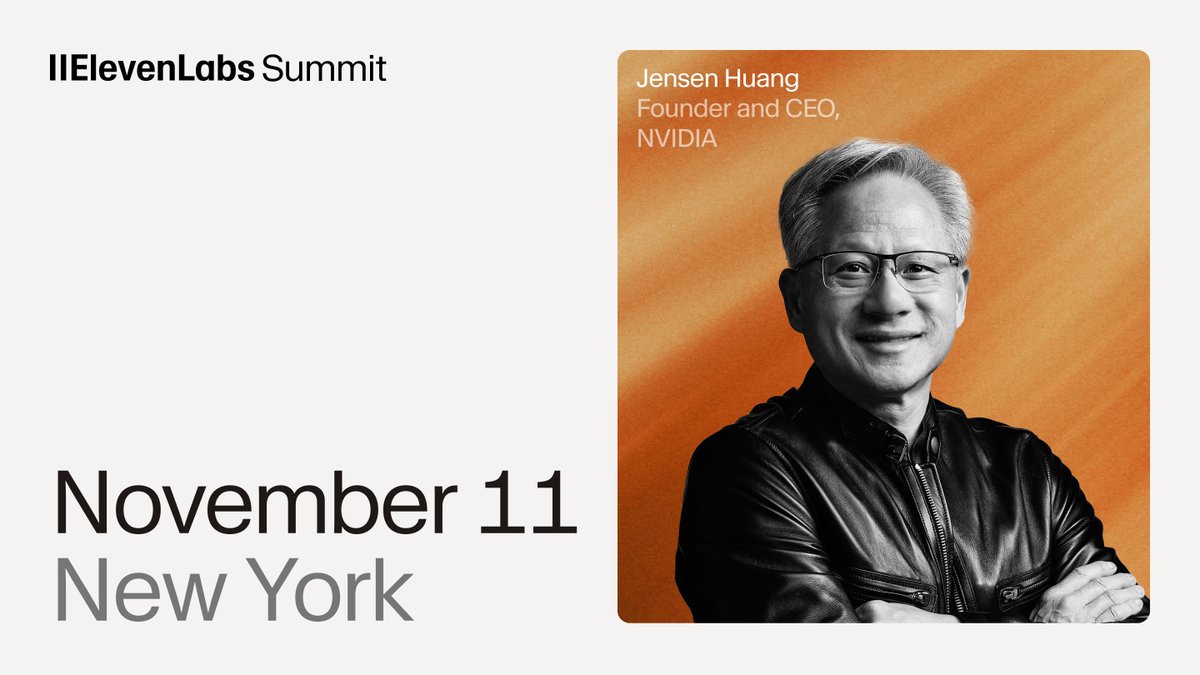
Jensen Huang is coming to ElevenLabs Summit NYC.
NVIDIA has partnered with ElevenLabs since our earliest days, and it's a big part of how we keep pushing what voice and audio AI can do. On November 11, @JensenHuang will join @mati for a conversation on the future of AI.
Legora has crossed $200M ARR.
In our 2026 State of Scaling report, we highlighted the company’s climb from $1M to $100M ARR in just 18 months. The next $100M came in less than six.
Since we partnered with @MaxJunestrand, @siggelabor, and the team a year and a half ago in their Series B, @WeAreLegora has grown to 130,000 monthly users across 2,100 firms and legal teams in 80+ countries, with the US now its largest market by revenue.
It’s been a privilege to watch this team build with such speed and rigor. Congratulations to everyone at Legora on an extraordinary milestone.
Legora is hiring: https://t.co/c9ROnscYdF
Disclaimer: https://t.co/fdP8ALDhEm
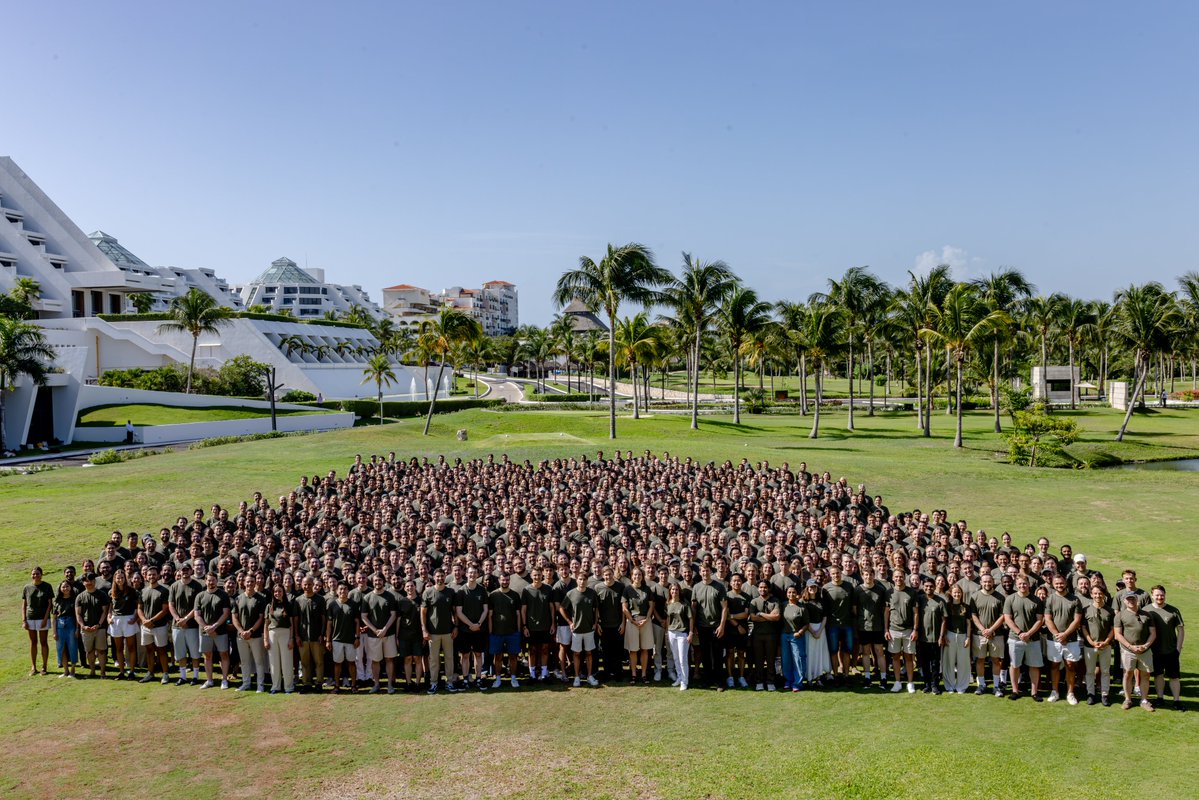
This week, we brought all of @ElevenLabs together. 800 of us, from 50 countries!
Remote-first has been a superpower for us, but there’s nothing like having everyone in one place and feeling the energy across the team. Now onwards - so much more to build!
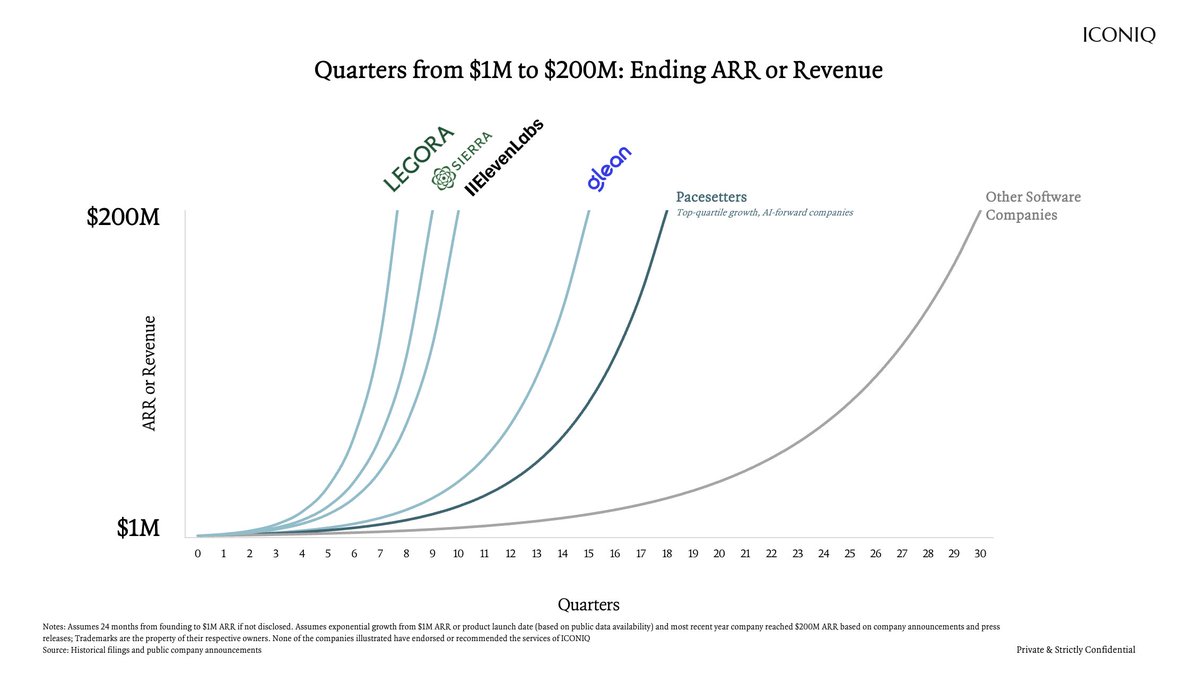
Anthropic, Legora, Sierra, ElevenLabs, OpenAI, and Glean are reaching $100M ARR in one to three years, a milestone that used to take software companies five or more.
The growth curve for AI-native companies looks fundamentally different.
More on what sets the outliers apart: https://t.co/1AokuglkVA
Disclaimer: https://t.co/fdP8ALDhEm
What separates the software companies pulling ahead from the ones falling behind? @alexrkonrad dug into our latest research and put it plainly. His piece highlights some of the key signals we identified in our report: faster paths to $100M ARR, sustained new-logo growth, aggressive investment, and improving burn at scale.
Download our annual Topline Growth and Operational Efficiency Report: https://t.co/1AokuglkVA
@UpstartsMediaCo
Disclaimer: https://t.co/fdP8ALDhEm
There is no best model.
There's a lot of noise about models right now. Who is training them, who owns them, where legal intelligence should live. One question actually matters: what produces the best outcome for the legal task in front of you?
That's how we decide things at @WeareLegora. We optimize for the end-to-end outcome on a legal task. The model is one layer of that system, not the system.
Models are uneven and the frontier changes almost weekly. One model plans a long job well, another runs deep analysis across thousands of documents. Some have to be told exactly what to do, and some are fine with a vague brief. They all break in different ways.
So our lawyers write evals and we test them with the Legora BAR, our benchmark for agentic reasoning. Every model takes every test, and the model that wins gets the work.
We post-train when we know it buys our customers better performance on a specialized task. Training is a tool we reach for when it helps, nothing more than that.
The intelligence that compounds sits in the orchestration layer. Precedents, review standards, client requirements. That knowledge has to stay editable, auditable and portable. In our system, a changed review standard is an edit that takes effect the same day, with no new model training required.
No lawyer should have to worry about which model did the work, any more than they think about which chip is in their laptop. They should only care about the quality of the work. That's what we are focused on.
If you want the engineering version of this argument rather than the CEO version, our CPO, Bryan Tsao, and CTO, @jacsebl, take it apart in the video below.
Who owns the model? Where should a legal team's intelligence live?
These questions are at the center of many conversations in legal AI, but we think the most important question to answer is: what produces the best outcome for every legal task?
As CTO @jacsebl and CPO Bryan Tsao explain, there is no best model. Different models lead on different tasks, and the frontier changes almost weekly.
At Legora, we use the best available model for each task, and invest in the system, where intelligence compounds and remains editable, auditable, and portable. We post-train when we know it delivers our customers better performance on a specialized task. Training is a tool, not a strategy.
No lawyer should have to worry about which model did the work. Just whether the work holds up.
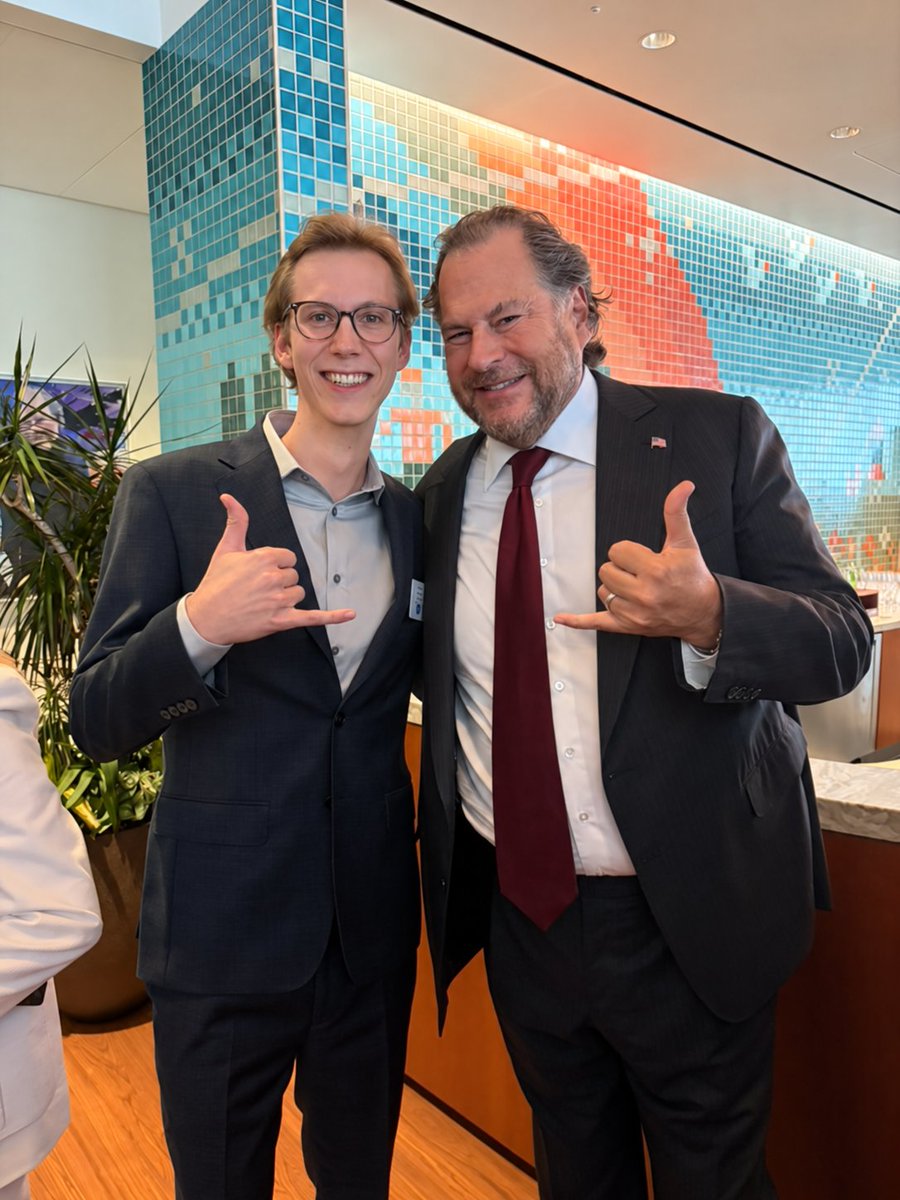
I first came to San Francisco when I was 15, with my dad. He is a programmer. To a teenager from a small island outside of Stockholm, this was the place where the future was being built.
We walked into Salesforce East and stood there watching the enormous digital display of moving water. Outside, Salesforce Tower was starting to rise.
I remember looking up and thinking it would be pretty sweet to have a tower someday. We are not there yet.
What I could not have known is that I would be back years later, having dinner with @Benioff and welcoming @salesforce as a @WeAreLegora customer.
Salesforce's Legal and Corporate Affairs organization will now use Legora across North America, EMEA and APAC. Their lawyers keep the judgment calls. We take care of the work around them. We have run on Slack since day one and became Salesforce customers when our sales team outgrew its first CRM, so it is good to have it run in the other direction too.
Welcome to Legora, Salesforce.
Dad, this one feels special.