💜 ¡Regala vida, comparte esperanza!
Te invitamos a la Segunda Jornada de Donación de Leche Humana en #CUCEI.
📅 19 de mayo, 10:00 h
📍 Auditorio Antonio Rodríguez
🗣️ Charlas, talleres y conocimientos que transforman vidas.
🌱👶🏻 ¡Únete y sé parte del cambio!
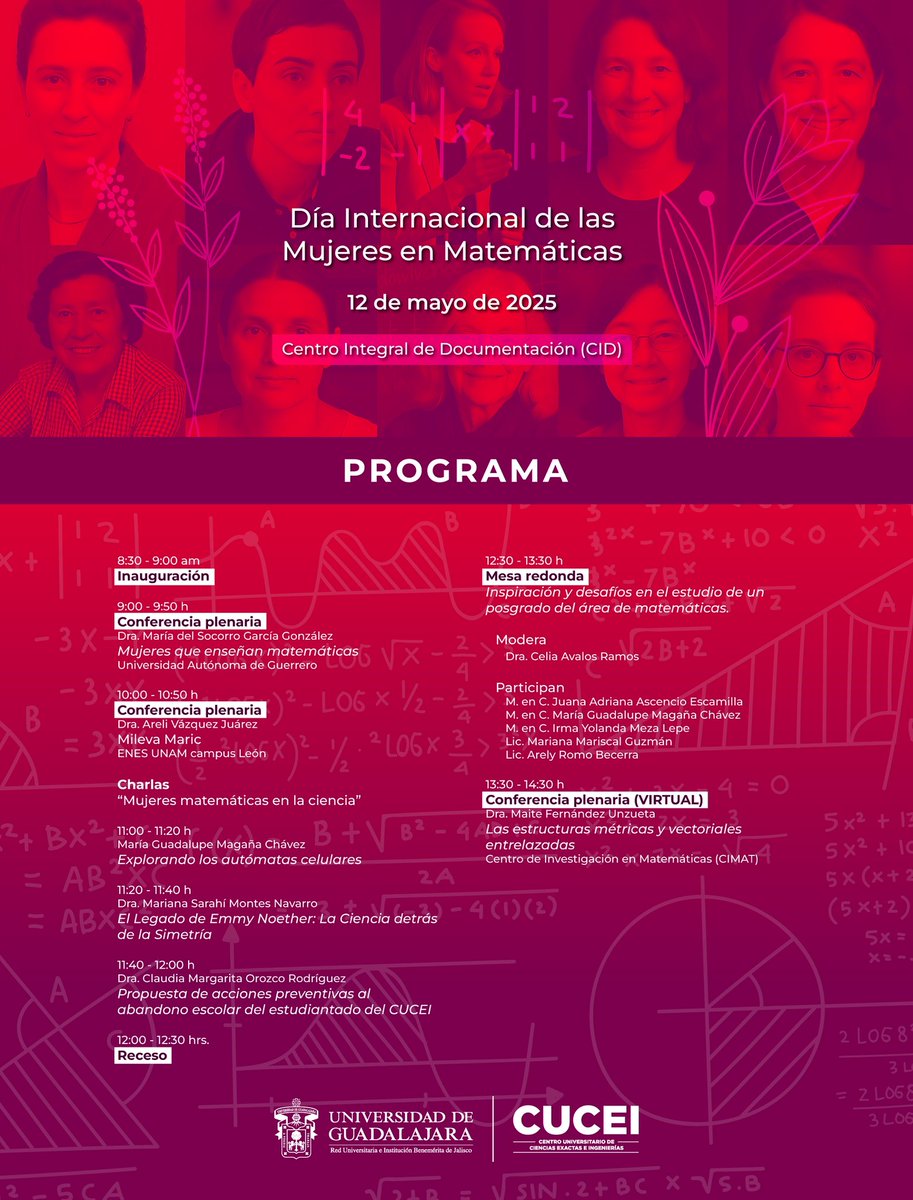
🔢 ¡Celebremos el Día Internacional de las Mujeres en Matemáticas! 💜
📚 Conferencias, charlas y encuentros que nos inspiran a seguir transformando la ciencia con talento y pasión.
✨ ¡Acompáñanos en esta jornada llena de conocimiento! ♀️
#MujeresEnMatemáticas#ComunidadCUCEI
🎓🔬 ¡Inscríbete a la Maestría o Doctorado en Ciencias en Física de CUCEI!
Prepárate para la investigación, docencia y desarrollo científico con un plan de estudios flexible y actualizado.
📌 Más información e inscripciones aquí. 👇
https://t.co/hegfjOTMLQ
¡Día 2 de XXXI Semana Científico Cultural del QFB! 👏🏼
El día de hoy, participamos con el taller: "Innovaciones en Microscopía para la Industria Alimentaria" en @udegcucei
¡Gracias por acompañarnos! 💙
#OrgulloQFB#XXXISemanaQFB#100añosdeQFB#CTRScientific
Inauguración del 2do Simposio en Química, Biotecnología y Tecnologías Ambientales. Felicidades a los posgrados en Ciencias en Química, en Procesos Biotecnológicos del CUCEI, y en Agua y Energía del CUTonalá, les deseamos el mayor de los éxitos!
Con diversas actividades culturales y la proyección gratuita de Casablanca 🎥🍿, recordamos y celebramos el legado del Lic. Raúl Padilla López en su natalicio.
Hoy conmemoramos la vida del Lic. Raúl Padilla López, un gran impulsor de la educación 📚 y la cultura 🎬 en nuestro estado. Su legado seguirá vivo en nuestra universidad y en Jalisco. ¡Por siempre!
#OrgulloUdeG
Listen to chemist Venkatraman Ramakrishnan as he shares some valuable advice to young scientists.
Ramakrishnan was awarded the 2009 chemistry prize “for studies of the structure and function of the ribosome.” This clip is from his participation in Nobel Minds in 2009.
#NobelPrize
Formation of conic sections ✍️
Circle: When the cutting plane is perpendicular to the axis of the cone, the cross-section is a circle.
Ellipse: When the plane is angled, but still cuts through only one cone (without being parallel to the side of the cone), the result is an ellipse.
Parabola: If the plane is parallel to the side (slant) of the cone, it creates a parabola.
Hyperbola: If the plane cuts both halves of the double cone, it forms a hyperbola - two separate curves.
Here we see groups of visitors on a tour of the @CMSexperiment labs.
The groups visited the electromagnetic calorimeter (ECAL) and high-granularity calorimeter (HGCAL) labs, where new pieces of the CMS detector are created to cope with the higher number of collisions at the High-Luminosity #LHC.
ECAL measures the energies of electrons and photons, whereas HGCAL is a major upgrade of CMS, necessary to maintain excellent calorimetric performance in the detector’s endcaps during #HiLumiLHC operations.
⚗️ Chemistry Webinar - Engaging Students in Inorganic Chemistry Courses With Videos
📢 Discover how chemistry videos & quizzes can enhance student engagement and improve learning outcomes.
💾 Reserve your spot! 🔗Choose your region & register now: https://t.co/nE09q343cw
“I felt really alone and isolated at school. This “outsider” feeling drove me to take risks and prove doubters wrong, and later influenced my choices as a scientist.”
- chemistry laureate Jennifer Doudna.
Read her story: https://t.co/PaTtAL6MQY
Stern-Gerlach Experiment (1922) ✍️
Otto Stern and Walther Gerlach demonstrated electron spin by deflecting silver atoms in a magnetic field.
The Stern-Gerlach experiment is one of the foundational experiments in quantum mechanics, conducted by Otto Stern and Walther Gerlach in 1922. It was designed to investigate how atoms behave in a magnetic field, particularly how their magnetic moments interact with an external inhomogeneous magnetic field. The experiment used a beam of silver atoms, which were heated in a furnace and directed through a series of slits to form a narrow, well-collimated beam. This beam was then passed through a region with an inhomogeneous magnetic field, which exerted different forces on the atoms depending on the orientation of their magnetic moments.
According to classical physics, the magnetic moment of an atom—arising from the motion of electrons—should be able to point in any direction. As a result, when subjected to a magnetic field gradient, atoms would be deflected by varying amounts, producing a continuous smear or spread on a detector screen. This expectation was based on the assumption that angular momentum and magnetic moment were continuous classical quantities.
However, the actual result was strikingly different. Instead of a continuous distribution, the silver atoms split into two distinct spots on the detection screen. This indicated that the magnetic moment of the atoms, and hence the spin of the unpaired electron in the silver atoms, could only take on two discrete values. This was one of the first clear demonstrations that angular momentum—and more specifically quantum spin—is quantized, meaning it can only take on certain discrete values. For silver atoms, this corresponds to spin-up or spin-down along the direction of the magnetic field.
The choice of silver atoms was crucial. Each silver atom has a single unpaired electron in its outermost shell, while the inner electrons pair up and cancel each other's magnetic moments. Therefore, the magnetic properties of the silver atom are due entirely to the spin of this one electron, making the system an ideal candidate for observing spin quantization.
The implications of the Stern-Gerlach experiment were profound. It provided concrete evidence that classical ideas could not explain atomic-scale phenomena, and that quantum mechanics—with its probabilistic and quantized framework—was necessary. It not only confirmed the existence of quantised spin but also laid the groundwork for further developments in quantum theory, quantum measurement, and technologies like magnetic resonance imaging (MRI) and quantum computing.
(Image Courtesy: AIP Emilio Segrè Visual Archives, Segrè Collection)
MIT physicists have discovered a way to magnetize materials using only light! This breakthrough could revolutionize memory chip technology, making it faster, smaller, and more energy-efficient. https://t.co/jWDqXnK9aE
🔭✨ En el corazón del Desierto de Atacama, donde los cielos son más prístinos que en cualquier otro lugar, se construye el telescopio más ambicioso de la historia: el Extremely Large Telescope (ELT). 👀
Con un espejo de 39 metros, será el primero con capacidad para detectar signos de vida fuera del Sistema Solar. 🌍🚀
¿Será este el inicio de la búsqueda de una segunda Tierra?👇
Cc: @AnaC_Olvera