I go downtown with my kids (3 & 5) occasionally but I almost always either go for proximity (3 parks nearest to their daycare) or make an adventure out of it (walk -> bus -> park -> muni-> park #2 -> bus -> home) so the travel is part of the adventure. The only thing my 3 year old enjoys more than the bus is taking a MUNI escalator ride!
@jamonholmgren Although the amount of “our CTO/Head of Eng just left to take a career break” I’m seeing in the early stages of company formation is worrying for where things land in 3-5 years
Two very distinct, almost opposite ways to plan a startup:
- 22yo in SF, plans to fundraise and then find a team and idea, has no other plan
- 35yo anywhere, will only build a startup with people they're excited about in a space where they have an advantage. Job otherwise
One enormous advantage of LLMs is they're putting coders in the role of Engineering Managers, which gives them enough detachment to observe behavior and output neutrally, from a detached perspective, without their own ego in the mix.
Which means all of the obvious advice (strong types, lots of tests, clean formatting, single concern function, etc) are becoming obviously true for a lot of people.
They've always been true, it's just now obvious.
@kunchenguid Have you experimented with lowering the effort levels further to extend quota usage?
I’m seeing fairly good results with Fable/Sol on low effort and escalating up to medium in the same way that I was using medium -> xhigh on GPT-5.5.
This is still essentially just the 3 camps I talked about a while back. Camp 1: AI nopers. Camp 2: AI in your SDLC. Camp 3: AI is the SDLC. A lot of very reasonable people in camp 2 are pretty sure camp 3 is hot air. It isn’t.
What are y'all using Haiku for? I'm currently only using it for programmatic data transformation (unstructured -> json)
Every time I push for delegation, I end up with Sonnet subagents.
Good agent prompts are more like emails than chats. Write out a detailed message. Think about it. Think about it again. Hit send.
...realize you didn't think about it long enough
@thosiawa I'm using the json log files from the sessions as a heuristic.
The status line reads the mtime of the session transcript (which Claude Code appends to on every turn) and diffs it against the system clock to estimate whether the prompt cache is still warm.
https://t.co/zvHBFTB2TE
Inspired by @thosiawa - I added a cache freshness warning to my Claude Code status line. It warns at 50min and shows that the cache is stale after an hour.
I added a timestamp to my status line to show the last time I sent a prompt and manually monitor it
It won't protect me against a 5 min cache bust, but it helps for longer ones (I use it more for working with with multiple agents)
After spending a day pairing models to effort levels, Fable ages like a fine wine - still going days after uncorking thanks to low/medium effort usage instead of my prev (Opus, high)
my hot take on how much AI code we should review -
you should review as much code from AI as your engineering director reviewed your code before AI
here’s the chain of thought:
- why do we even use AI to code? it’s to allow us to ship more
- how much more should a single developer be able to ship now, compared to pre-AI? i see us going from 1-10x in the past 3 years, and on a trajectory to hit the 100x magnitude soon
- that means every developer is going to own as much scope as a pre-AI director of engineering
- i haven’t met a single eng director who said their team’s codebases were perfect and exactly how they would like it to be. why? because people who try to achieve that will fail to become a director
- how do directors handle that level of complexity? it’s absolutely not by reviewing and micro-managing every engineer’s code. it’s through managing the culture, workflows, resource allocation, guardrails and measurable outcomes
- when a director sees the team struggle on productivity or quality, they might lean in and try to understand the state of the codebase to develop some intuition for how to improve things systematically. even this is often done with the help from their principal engineers - i believe this is the right balance for how we should manage AI
so, if we want to get a massive boost from AI, we must be prepared to operate in a way that allows us to manage much higher complexity, which requires that we remove ourselves as a bottleneck and manage the outcome at a different level
shape your AI agents’ workflows - are they doing adversarial review? are there good automated tests? are they presenting evidence before shipping? are they doing phased rollout? are there good metrics to catch problems?
survey your agents for feedback - ask them to reflect on their past sessions and report biggest problems causing them to struggle, and allocate enough tokens to get those problems fixed
focus on outcomes - are your agents doing busy work? do you truly understand customer requirements and what work is worth doing? are your agents’ work generating the business outcome you expect?
that’s how we truly scale
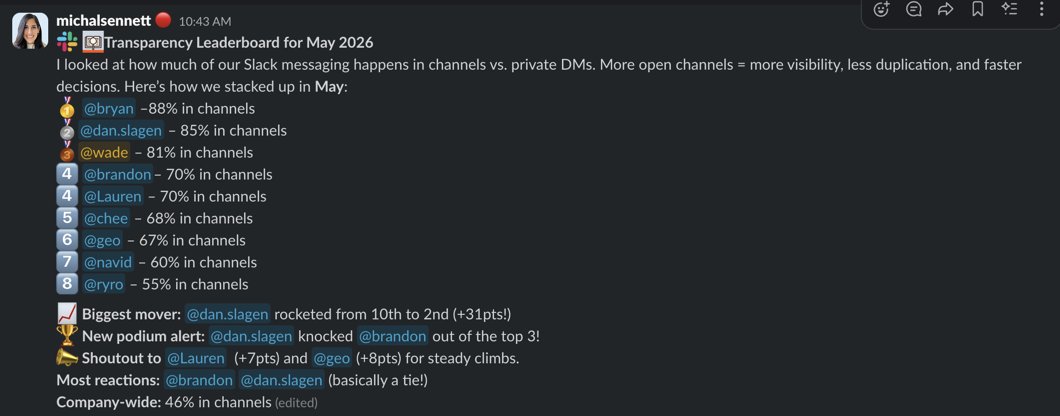
We're killing the DM at @Zapier. Starting with the executive team.
We've long held Default to Transparency as a value. That value has largely encouraged communication in public channels. But as the company grew, DMs are a hard habit to resist and break.
But every DM is a gap in our Shared Brain. It's context that is lost for humans and AIs. As a result the cost of DMs keeps going up.
So earlier this year I posted about our exec transparency leaderboard. The leaderboard has become quite the competition internally…
I'm 3rd today. My co-founder @BryanHelmig has held the top spot as long as I can remember…
It sets a standard for the rest of the company. In fact, since last year we’ve seen the % of Slack messages in public channels go from 33% to 46%.
What the leaderboard measures
Transparency is a team sport, and a disinfectant. Every month we track what percentage of our execs' Slack messages happen in public channels versus private DMs.
When your CEO debates strategy in a DM, that decision is invisible to every agent and every team that needs to know what was decided and why. The decision happens but the reasoning vanishes.
When that conversation happens in a channel, it stays. New hires can search it, agents can read and verify it, etc. Your Shared Brain knows what's true now: ask it a question and the answer reflects the latest reality.
Taking It to the Next Level
Reducing DMs are one way to increase transparency and open up context for humans and AI, but there are other mechanisms that help too. Three things beyond the leaderboard:
1. Meetings get recorded, transcribed, and become queryable
2. We run a shared skills library. Anyone on the team can encode a workflow they've figured out into a skill and share with the team
3. And we keep score. It's a silly scoreboard, but it subtly drives positive behaviors
Raising Your Ambition
In order to get the most of AI in your company, the AIs need context. So making your context queryable is one of the most practical moves you can make to improve the effectiveness of your AI agents.
P.S. I’m coming for #1, Bryan...