@Liz_Cheney Although I don't agree with some of your policies, tanks for supporting democracy, country, and rule of law. And most of all trying to do something about it.
Today, I observed another adult doing something which didn’t materially affect me or anyone else but didn’t align with my personal preferences.
Then, I continued on with my day.
I didn’t even tell them what I thought about it.
I just went right on with my day.
It was wild.
"The Russian army was the second strongest in the world. Now the Russian army is the second strongest in Ukraine," NATO Secretary General Stoltenberg said.
He also harshly responded to the 'experts' that are criticizing the speed of the counter-offensive.
"You can't sit in Brussels and tell the Ukrainians how to fight. They risk their lives, and we only support and praise them for their bravery."
The World Yo-Yo Contest is the culminating yo-yo competition of the worldwide competitive circuit and is considered the most prestigious yo-yo competition in the world.
Mir Kim is the current 1A world champion.
https://t.co/e1s1Kgh6TK
Exceptional thread and profound insights into the counter-offensive in the South by @solonko1648 (Olexandr Solon'ko), servicemember of the Ukrainian Armed Forces. In his analysis, he sheds light on the situation, discussing both the challenges and achievements.
Translation:
Much has been written about the battles in the South. I wouldn't say that this is the case where it's better to see once (or multiple times) than to hear/read about it many times. Especially through the eyes of the frontline units. A thread about battles from the perspective of aerial reconnaissance:
Environment. Steppe. Fields, tree lines. Slight elevations and dips, villages, small rivers. Minefields. Whoever you may be, an armored assault group, evacuation team, aerial or infantry reconnaissance, your movement is visible from afar. The enemy has long been preparing.
Equipment and personnel can be spotted from a distance and targeted. Both sides understand that there are limited places for positions and deployment. Most likely, there's something to shoot at in almost every tree line. Confirmation is needed, of course. Primarily, it's necessary to determine the priority of the target
There's a limited number of access roads, logistical routes. Everything's been calibrated and fired upon repeatedly every day. You certainly can be spotted. Carrying out the mission while maintaining complete concealment from the enemy is mostly impossible
There has been a great deal of talk about fortifications and minefields. Every tree line has been dug up. On one stretch of the Mariupol highway, anti-tank fortifications have been installed. We're not just talking about trenches. There's an entire system of trenches, dugouts, and even undeground tunnels in some places
In each tree line, there's a network of trenches and firing positions for various weapons. AGS, DShK, ATGMs. Anti-tank ditches and mine obstacles stretch across the fields. From regular TM and POM mines to more "sophisticated" ones, all lying in wait for infantry.
Once again, it's crucial to emphasize that we're specifically discussing a system of trenches, interconnected by passageways and pathways. These pathways facilitate the movement of personnel, weaponry, and ammunition. As for what remains unexcavated, it's mined. All of this must be navigated to make progress forward.
For those who are "overly smart" and believe that the Ukrainian Armed Forces took an incredibly long time to drive the Russians out of the village of Robotyne, they must have missed the defense system that needed to be overcome in order to push the russians away from the Mariupol highway and gradually approach the village, encircle it, and finally seize control. Truly, a monumental task has been accomplished.
The russians are establishing firing points (AGS, heavy machine guns), and they mine the routes to them. They themselves move along designated paths. Our positions in the liberated territory are surrounded by mines and tripwires. Paths are cleared for ingress, and sappers gradually clear the area.
Frequently, the hidden "surprises" detonate during shelling, triggered by fires that start due to the shelling (weeds, shrubs, and trees catch fire, setting off tripwires). At times, we ourselves discover and call in sappers to clear specific areas.
There's much talk about armored vehicle losses, but the issue of initial setbacks is overlooked. In the long run, it's impossible to entirely avoid armor losses, even due to the enemy's advantage in the air. However, armor serves a specific purpose that entails risks.
There's much talk about armored vehicle losses, I'll skip the topic of initial setbacks. In the long run, it's impossible to entirely avoid armor losses, especially due to the enemy's advantage in the air. However, armor serves a specific purpose that entails risks.
These actions are justified by the fact that they save lives. I spoke with a soldier who survived two direct hits on a Bradley during shelling. Even the most critically damaged equipment is recovered and taken for repairs. You can replace a piece of metal, even if it's expensive, but you can't repair a human life
Enemy ATGM operators position cameras in advance of their positions. This way, they can spot targets (all types of vehicles) in advance and engage them effectively. If successful, artillery finishes off the targets. Alternatively, they might start with air force, followed by artillery.
They hunt for evacuation teams – both vehicles and stations. Right under our noses, they hit an armored vehicle, and an evacuation vehicle arrived for the guys. They had to maneuver in a tight spot, moving very slowly on a narrow road, avoiding going off-road into a mined field. Taking risks as well. Fortunately, they managed to get them out.
KAB's are one of the biggest fears. The russians use them extensively. I can't speak to their accuracy, but the weaponry is powerful. They attempt to target logistics and command centers, just as we do. They don't hesitate to simply fire on roads. Forward defenses in settlements are constantly under shelling.
The aerial reconnaissance linked system Orlan-Zala-Supercam is effective and causing issues. They identify targets and launch Lances, releasing them in swarms along with KAB's. They attempt to break through and hunt down vehicles.
The recaptured positions are even more calibrated. Bombs are not spared. No lack of mines either. The tree line where one of the crews was operating was simply leveled. Only a palisade remained, and a well-made trench ceased to be usable.
The russians use a standard tactic for their armor. The route to the firing position is determined, usually in a way that keeps the vehicles under visual cover of the tree lines and eventually positions them in an open space for shooting. They quickly expend their ammunition and retreat
Vehicle cannot be completely concealed. Dust clouds are visible during movement, and the vehicles can be seen shifting between tree lines, while drones provide visibility as well. The main task here is to execute the firing mission quickly enough to prevent artillery targeting or counterattacks using FPV or ATGMs.
I understand why the russians are intensively butthurt due to the loss of the village with six streets. They put in significant effort to prevent the Ukrainian Armed Forces from advancing. Defending is easier according to all norms. On the other hand, we're putting in a tremendous effort to break through. And when we succeed, it shows that our efforts are paying off
Thank you for your attention. I might continue sharing in the future. Meanwhile, I invite you to follow on Facebook and TG (Telegram): https://t.co/VFEb0RL5rC
https://t.co/72zY1jFdLW
Postscript: The original thread can be found here: https://t.co/23jW1SyXvz
If you're interested in updates, I highly recommend following him.
Translation by @Tatarigami_UA
OK fine, but it hasn’t stopped him from making any of the very unpopular changes. Don’t get that guy. I love the fact that I am using his platform to post this.
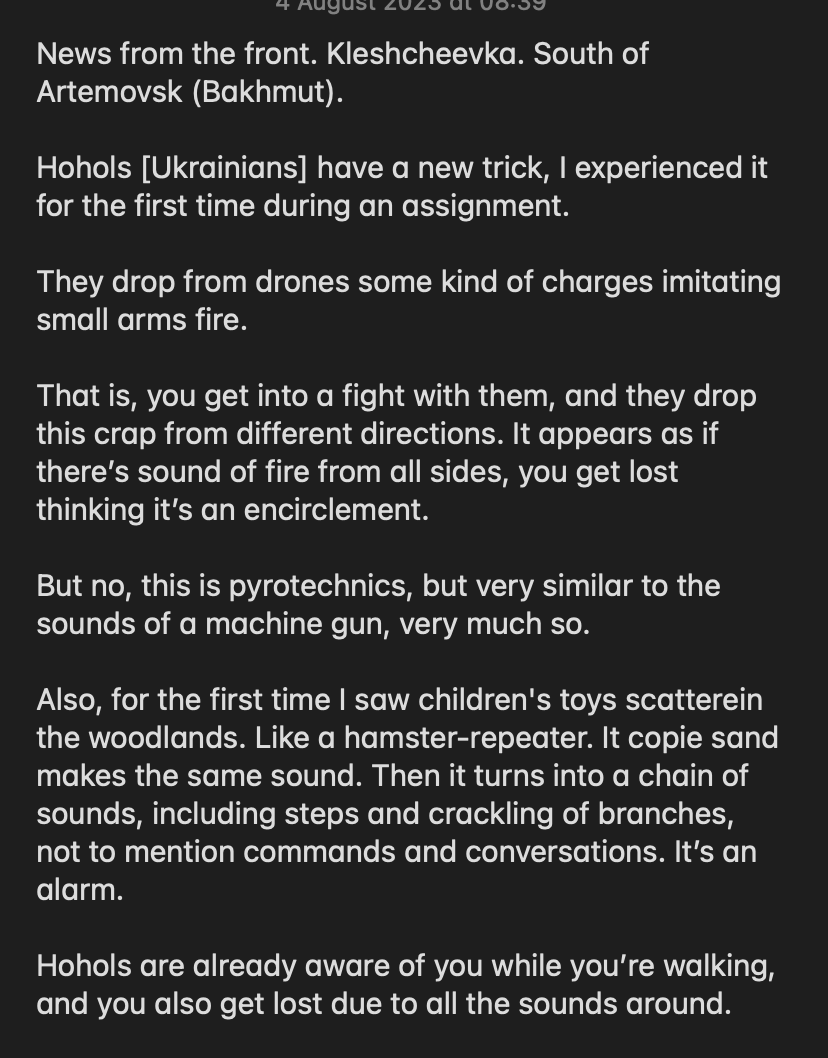
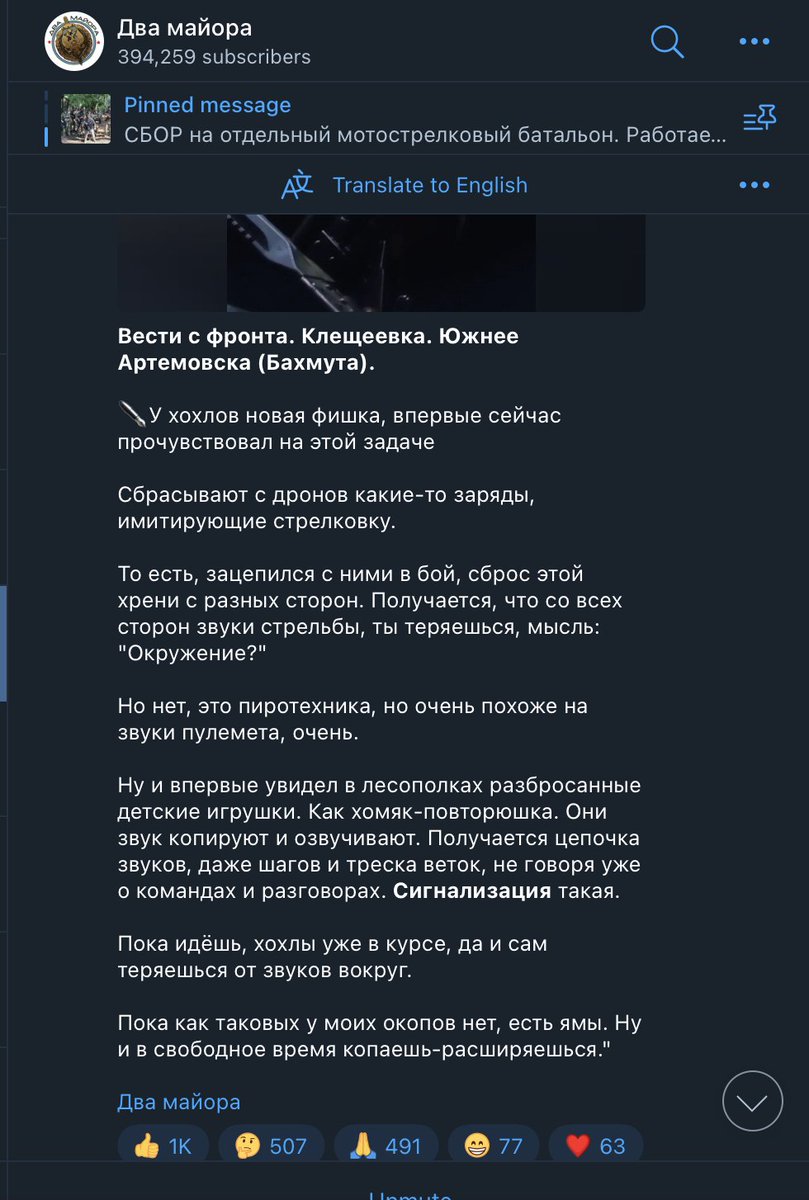
Russians have a new fear unlocked: as Dva Mayora reports, Ukrainians started dropping contraptions that imitate the sound of gunfire on Russian positions during combat, making them think they're encircled 🤣 But even more so, Russians found children's toys that "echo and repeat" any sounds they pick up to confuse the hell out of Russians and warn Ukrainians.
https://t.co/LjWLyLiqXD
New Guinea’s humidity, mountains and thick rainforests made wireless comms problematic for the bulky, delicate wireless sets of the time.
Radio communications could also be intercepted by the enemy.
Communications reverted to 19th Century modes:
human runners and carrier pigeons.