@SemiAnalysis_@atomscale builds and uses domain-specific AI to continuously optimize crystal growth and adaptively adjust materials process on the fly - critical for improving yield in the current photonics stack and getting the next gen of high performance materials to production scale.
Update on this paper from last year on AI in scientific discovery.
MIT put out a press release:
"no confidence in the provenance, reliability or validity of the data...[or] veracity of the research."
"The author is no longer at MIT."
AI agents are poised to transform the commercialization of advanced materials. At Atomscale, we’re driving this transformation with our next-generation AI agents, purpose-built for atomic-scale engineering.
Read on:
The development of new materials and their integration into devices remains one of the most challenging and costly barriers in advancing foundational technologies. Recent advances in both artificial intelligence and state-of-the-art computational resources are creating a transformative era for materials synthesis empowered by AI agents. These digital collaborators will serve as intelligent decision-making layers that help increase engineering precision to accelerate laboratory breakthroughs and enable industrial-scale production of next-generation materials.
From novel semiconductors for next-generation computing to advanced cathode materials for high-performance batteries, progress in advanced materials production is hindered by long development cycles and high costs. As established materials platforms have matured (e.g. silicon, lithium cobalt oxide (LCO), etc…), the gap between successful lab-scale POCs and scalable industrial application has only widened, with commercialization efforts frequently spanning over a decade and costing hundreds of millions to billions of dollars.
The combination of artificial intelligence and state-of-the-art computational resources is laying the groundwork to address challenges at the atomic scale that were previously too complex to consider. The attention on generative models has highlighted the use of AI to model atomic interactions and predict new materials, but an even more massive opportunity exists to leverage AI agents to dynamically control and optimize precision materials synthesis – enabling production of more performant and higher quality materials and devices.
AI agents do not replace human experts; instead, they augment the decision-making process by acting as effective copilots for human-in-the-loop synthesis. They integrate orders of magnitude higher resolution real-time data analysis with expert context, offering actionable insights that would not otherwise be available with human analysis alone. Agents can be tasked to rapidly identify causes of process variances, assess many parallel opportunities for optimization simultaneously and can be employed to dynamically control processing based on real-time metrology and characterization. Natural language interfaces offer an opportunity to embed rich empirical process context that is difficult to document with rigid data models alone. This intelligence can help shorten commercialization timelines and optimize material performance at the atomic scale.
At Atomscale, we are advancing this approach with our next-generation AI agents. Our platform integrates custom AII with real-time in-situ monitoring to streamline the engineering of atomic-scale materials. By analyzing continuously streamed characterization and metrology data on the fly using proprietary models and augmenting these results with agent-driven decision support, our system provides context-aware analysis of materials synthesis. This allows our platform to suggest precise adjustments to growth parameters during or after synthesis, thereby supporting more controlled and efficient material development.
AI agents are positioned to play a significant role in accelerating the commercialization of new materials. Through massively scalable data analysis and context aware decision-making, these tools can help streamline the development process and more effectively transition laboratory innovations to commercial applications.
If you are interested in exploring how AI agents can support and enhance your materials research and development efforts, please contact us.
Exciting news — Atomic Data Sciences is now Atomscale!
Our new name reflects our evolution from automating data analysis in materials science to building a comprehensive intelligence layer for atomic-scale engineering. As we grow, our mission remains clear: to drive breakthroughs in advanced materials synthesis from R&D to production with state-of-the-art AI.
We're more focused than ever — visit us at https://t.co/7wF775qYPj!
@xie_tian@Sergei_Imaging Simulation is nice to have but at the end of the day, physical process design, optimization, scaling, and yield ramp consumes 99% of the lifecycle for a new materials platform.
@xie_tian@Sergei_Imaging Lab-style automation / SDLs in the current framework will never scale to production, but characterization will. Better continuous feedback for existing equipment already unlocks massive efficiency gains.
New post on the impact of real-time feedback with end-to-end AI for atomically engineered materials - making a lot of progress @AtomicDataSci ! Check out our substack at atomicdatasciences dot substack dot com or the link in the replies.
@RehaMathur@draparente General RW ability for models>tools is critical - but the most limiting step is extracting/passing context-rich and physics-rich info between tools. Step 1 is automating ETL pipelines for process and characterization data; building this with closed-loop agents @AtomicDataSci
We’re excited to share this perspective, co-authored by co-founder @ccprice19, on the current state of AI/ML application to accelerate discovery and synthesis of advanced electronic materials.
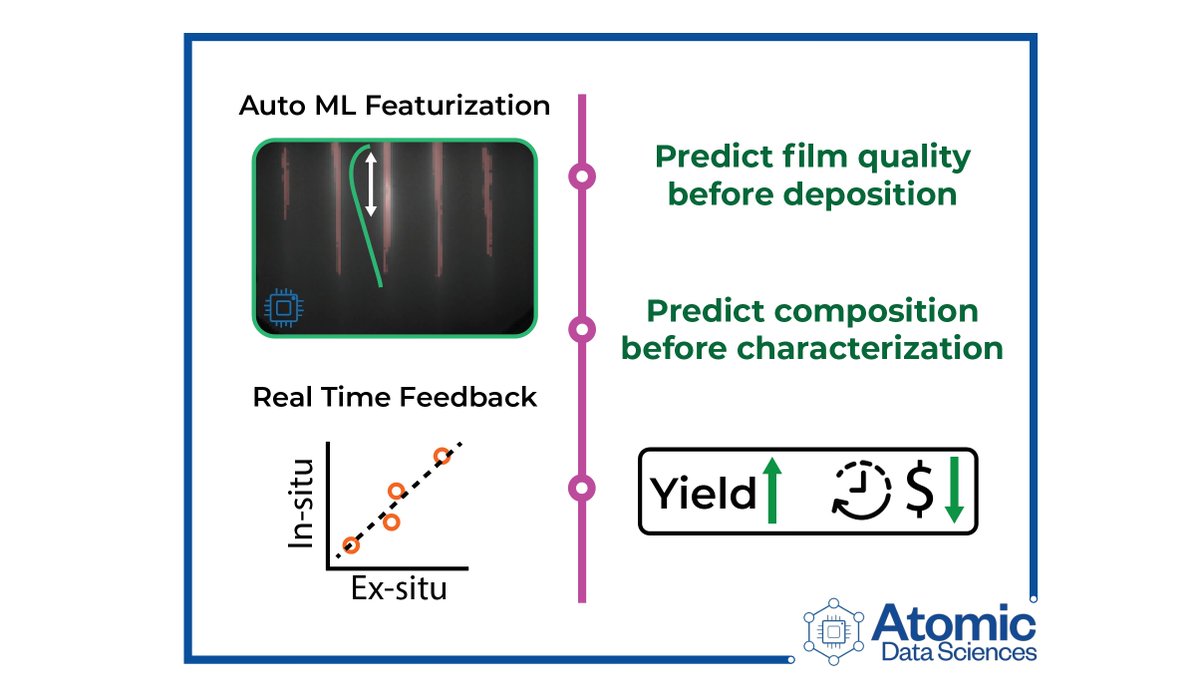
We continue to believe there is substantial value to purpose-built AI/ML tools for advanced materials that scale and automate information extraction, delivering significantly shorter time-to-feedback (including real-time) and previously unattainable high-dimensional analysis results from the fusion of many sources of characterization. https://t.co/ljgiMoD5AR
@XirtamEsrevni@ChurchillMic@Robert_Palgrave Elevating real-world materials characterization data to be trained on at scale is needed (working on this @AtomicDataSci). Even with better theory+more compute, synthesis is tied to the individual equipment and simulation-only digital twins will be extremely difficult.
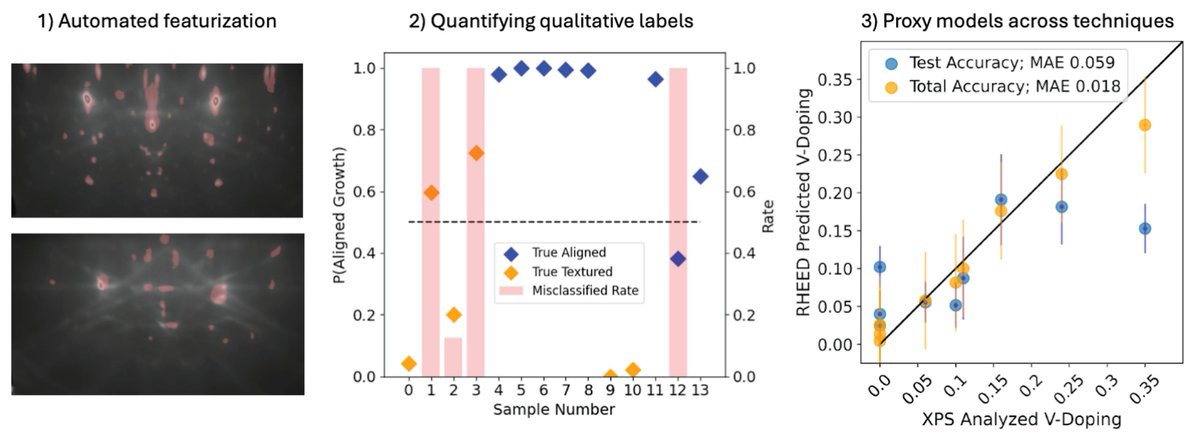
An early demo of major efficiency gains unlocked by making it quick and easy to create datasets and proxy models over real samples of cutting edge materials. Much more to come!
Automated AI accelerates advanced materials workflows!
We are excited to share that Predicting and Accelerating Nanomaterial Synthesis Using Machine Learning Featurization, a collaboration between Atomic DS and the Hinkle Lab at the University of Notre Dame, is published in ACS Nano Letters. We develop workflows to improve the efficiency of materials synthesis and characterization using the tools available in AtomCloud. With just ~10 conventionally labeled synthesis trials, we predict the defect rate of future trials with >80% accuracy. We also predict film composition in-process with similar accuracy to expert practitioners. Even within a lab-scale synthesis campaign, applying these predictive models can save hundreds of hours of expert and equipment time. Our featurization scheme generalizes across materials without customization. Some practical insights we found in this work: https://t.co/fVAJ9bRGjA
Breaking the fourth wall of Founder Mode™ to share our vision to solve decades-old challenges in advanced materials, ultimately shaping the future of computing and energy. Follow along with us:
https://t.co/W235dkXXDa
A great day to discuss AI for advanced materials synthesis at the NEMC Fall Meeting @Mass_Tech - check out our platform to quantify your analytical and microscopy data for fab R&D, scale-up, and SPC faster than an @TomBrady 2 minute drive
Ending the week with a big update from @AtomicDataSci - real automation and AI accelerating advanced materials synthesis. Chat with us about AI for materials and stay tuned for more to come!
We’re excited to share our latest preprint (https://t.co/KKVCeHqQs9) which uses AtomCloud’s AI/ML powered automation to accelerate key steps in the materials synthesis feedback loop, deliver insights faster and earlier, and save time while helping avoid doomed trials.
Great to have Prof. Swastik Kar highlighting @AtomicDataSci work with Northeastern University’s experimental quantum lab at Quantum Massachusetts 2023 - thanks @Mass_Tech@QuantumDaily for putting on a great event!