@seanjagermann@chrislevan24 You don’t need to worry about CAC or LTV or anything else I’ll cover your UE. I’ve been through like 20 brands of protein bars, need non junk for my 5am workouts
Things we got right at gruns #2 - Unit Economics
Everyone thinks they know their unit economics, but they really don’t - not at the level they need to. LTV:CAC is the primary metric, and it has a million inputs
costing SKUs at the PO level, knowing the exact impact on your LTV of that gift with purchase campaign, understanding how retail affects gross margin and CAC tolerance, all of it - down to the literal penny.
This is where data and AI really unlock tremendous value inside brands. when you achieve that level of clarity and understanding around your unit economics, you can scale with open eyes and make decisions that increase the value of the business. Doesn’t hurt having a world class mktg and ops Org like we did that can execute
Blending an average gross margin across your entire assortment and eyeballing LTV:CAC as you grow is ok for the early days, but when you start to scale past 8, 9 figures - eyeballing becomes extremely expensive.
Integrate your product margin and costs of delivery across all of your cohort analytics at the SKU level and be mindful of your LTV:CAC ratio. When that ratio gets to be closer to 2 or 3 than 1, you are ready to scale.
Until that number gets there, you have work to do on your margins and retention - don’t try to scale things that don’t work
Talking about Gruns has driven a ton of new followers. Now that you’re here I want to talk about something I am truly passionate about:
Designated hitter doesn’t belong in the NL
@spencerr110 Get all of the data from all of your systems/sources and then it’s just math. Waaaay easier said than done, but as a data nerd I always default to data Eng as the solution
Things we got right at gruns #1 - Data & The Office of the CFO
Every brand I've worked with eventually has the same argument: who owns data?
They usually pick one way, hire a jr analyst and then contract out the engineering. Then they change who that person reports to 5 times before deciding to build out a proper team and function.
- Finance says it's theirs because the numbers end up in the P&L.
- Operations wants it cuz they’re the “backbone”
- ceo sometimes wants it as a direct report because dashboards feel strategic…
I've now run it all three ways, and I have a strong view👇
Data belongs in the office of the CFO.
Not because finance is smarter, but because the entire point of leveraging data is to build a more valuable company, and when data is integrated into the financial reporting and forecasting systems at a brand, that’s when it really unlocks enterprise value.
My recommendation:
1/ Have the CFO own the data function
2/ Implement the proper infrastructure that gives you as much granularity and flexibility as possible
3/ Build an AI harness around this data in order to unlock speed and insights
4/ Report on results vs plan religiously
5/ Iterate and optimize proactively instead of reactively - pull the levers you need to pull
The most common question I always get around LTV:CAC is:
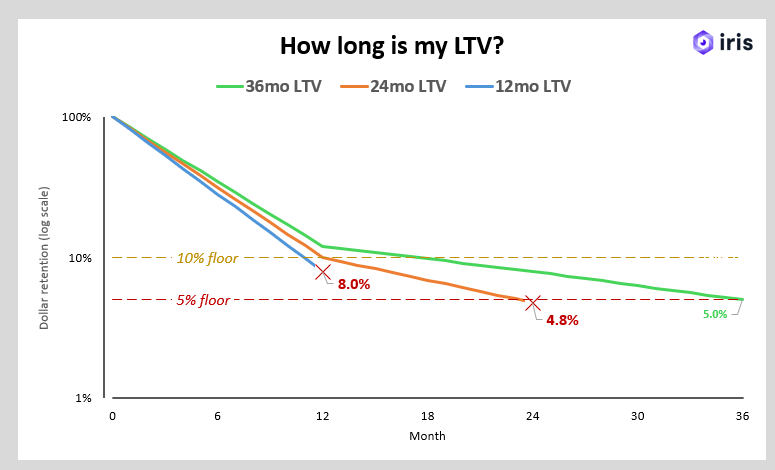
How long is my LTV? 12 months? 36 months? 5 years?
It depends. Let me explain
The longer your customers retain, the longer you can stretch out the LTV duration
I've looked at hundreds of retention curves. My rule of thumb for our brands:
If you have a 10% or higher cohort dollar based retention rate at 12 months, you can move on underwriting 24mo LTV
If you have 5% or higher at 24 months, you can move onto a 36mo LTV
If you see your dollar based retention rate at 5% at month 12, you should very likely not be underwriting your CAC against a 36mo LTV - you are outlaying cash for a payback that is probably not coming
@antipodes123@drewfallon12 I’ve tried to reply to this like 20 times. If you can’t tell I’m new to social media, if this doesn’t go through shoot me a dm and can chat
@antipodes123@drewfallon12 “
after product, fulfillment, shipping, and other variable costs” so Contribution Profit. The “L” (time) is the tough part here. Extreme self promotion for Iris but I think this is a really nice breakdown: https://t.co/lvOJyypzI3
The most common question I always get around LTV:CAC is:
How long is my LTV? 12 months? 36 months? 5 years?
It depends. Let me explain
The longer your customers retain, the longer you can stretch out the LTV duration
I've looked at hundreds of retention curves. My rule of thumb for our brands:
If you have a 10% or higher cohort dollar based retention rate at 12 months, you can move on underwriting 24mo LTV
If you have 5% or higher at 24 months, you can move onto a 36mo LTV
If you see your dollar based retention rate at 5% at month 12, you should very likely not be underwriting your CAC against a 36mo LTV - you are outlaying cash for a payback that is probably not coming
@laurensgeleedst Agree finance likely won’t, lots of long conversations with our cfo explaining Eng at a high level. But we had a high autonomy culture, CFO didn’t need to write code or even understand it to get alignment on the work being done
@couuor IAP on top of a cloud run service. Quick and robust enough for internal tooling, plus makes permissions out to a data warehouse or other tools easy
@codyplof Fivetran + Airflow (Composer since we are GCP at Gruns). If you negotiate pricing this is still the easiest 0 -> 1 out there. Happy to chat through how I’ve done things at a handful of brands