If I was the governor of a state looking to grow their revenues, I would add the ability for anyone to incorporate using an AI agent and stablecoins. And charge a premium for the service
Post the agent in the marketplace/connectors that the big LLMs have, to simplify it for everyone
First to market makes a killing
Two frontier labs. One accelerated computing platform. Congrats to @SpaceX and @AnthropicAI on the new compute partnership, powered by 220,000+ NVIDIA GPUs inside Colossus 1. The future of AI runs on NVIDIA.
A common trend emerging in larger enterprises is token budgeting as a major topic. As agents can do more and more long running tasks, and thus take vastly more compute, allocation of tokens across teams becomes a very real thing in the enterprise.
Companies spend a meaningful amount of time deciding how much to spend on talent, marketing campaigns, events, laptop setups, and even the cost of lunches. Tokens will be no different.
Tokens will similarly need to be excruciatingly well-managed because you’ll need to ensure you don’t blow up your budget, and you’ll need to ensure that the tokens are flowing to the highest and most useful parts of work. You don’t want to find out you burned your monthly budget on something relatively low value and then be blocked on the much higher value task later.
Doing this at large company scale is extremely hard as you have layers of abstraction on data and visibility into the digital work being done by agents in any central way. This is going to mean that agentic spend will increasingly will expand beyond the confines of the IT budget, and end up in organizational budgets like other expenses.
Ultimately team and org leaders will have to be given budgets for this, but even they don’t have adequate visibility and controls in most cases. We’ll need all new software just to solve this problem, and it’s probably an opportunity for startups in its own right.
Going to be an all new era of enterprise resource allocation, especially while we compute constrained.
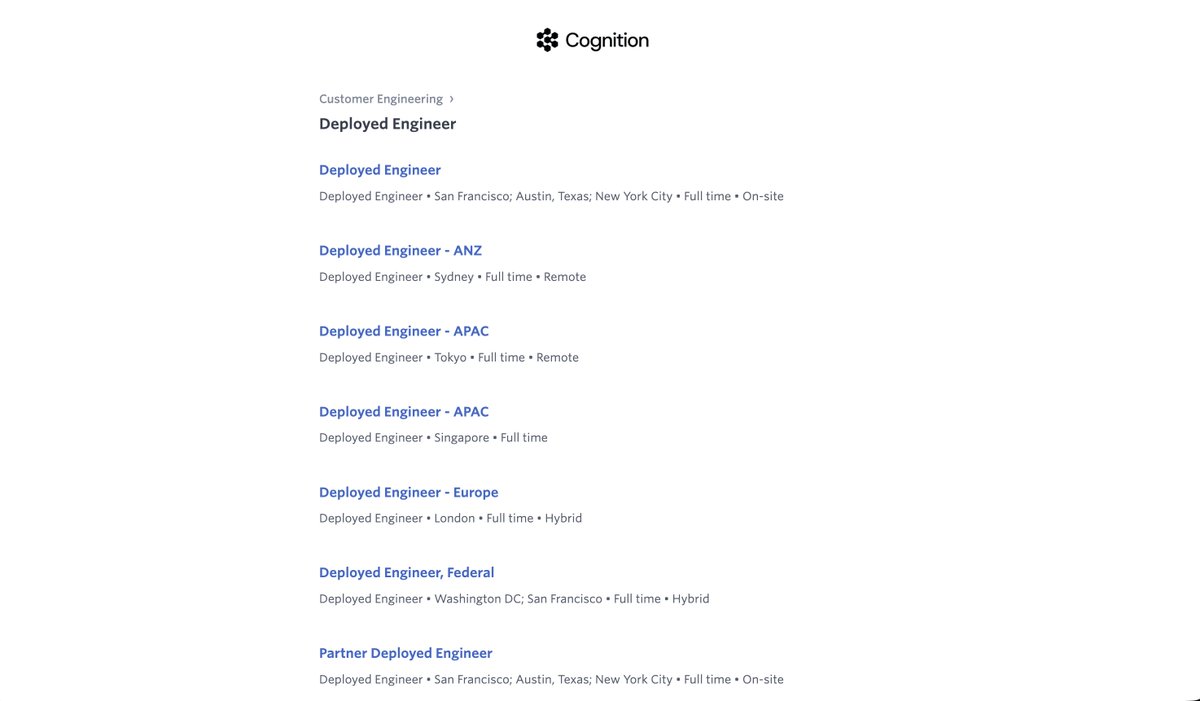
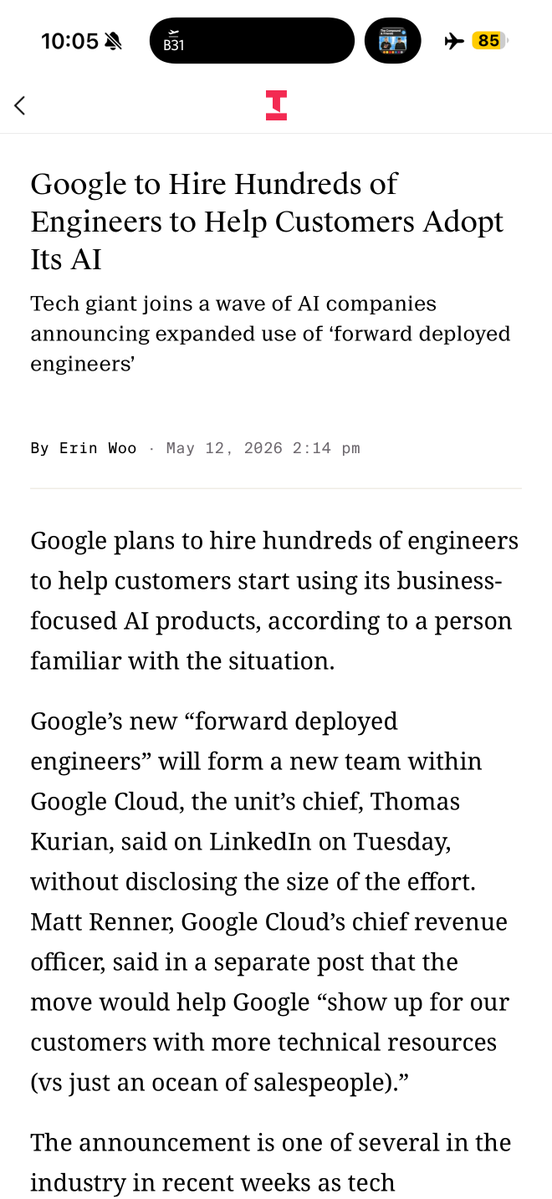
Forward Deployed Engineer is the hottest, and one of the most in-demand, jobs right now.
Every major AI company is hiring including companies like @OpenAI@cognition@AnthropicAI and @Google
If you possess a combination of soft skills (good communication), have an engineering background, and are up to speed on the latest and greatest in agentic coding you're probably able to land one of them.
They pay well and offer a foot in the door to some of the fastest growing companies in the world.
This is a fantastic post about why jobs aren’t going away in the way some predict. We are constantly making the mistake of confusing task completion with AI with being able to eliminate the whole job.
Even as we can automate one or many tasks within a job, the definition of the job almost inevitably just expands to do vastly more of those tasks, do them at a higher quality, or move on to the type of task that hasn’t been automated yet.
And as a result of being able to do more of the tasks or at a higher quality level, the job becomes valuable in a new way. And in many cases for now an entirely new audience as well.
This will be true for coding, legal work, sales, or marketing. The small business or non-tech company that wants to now take on larger software projects finally can, and they’ll hire to do so. The small business that couldn’t afford a full marketing agency can hire or contract out to a marketer that can do as much as an agency did before now with agents. And so on.
Don’t fall into the trap of confusing tasks with jobs.
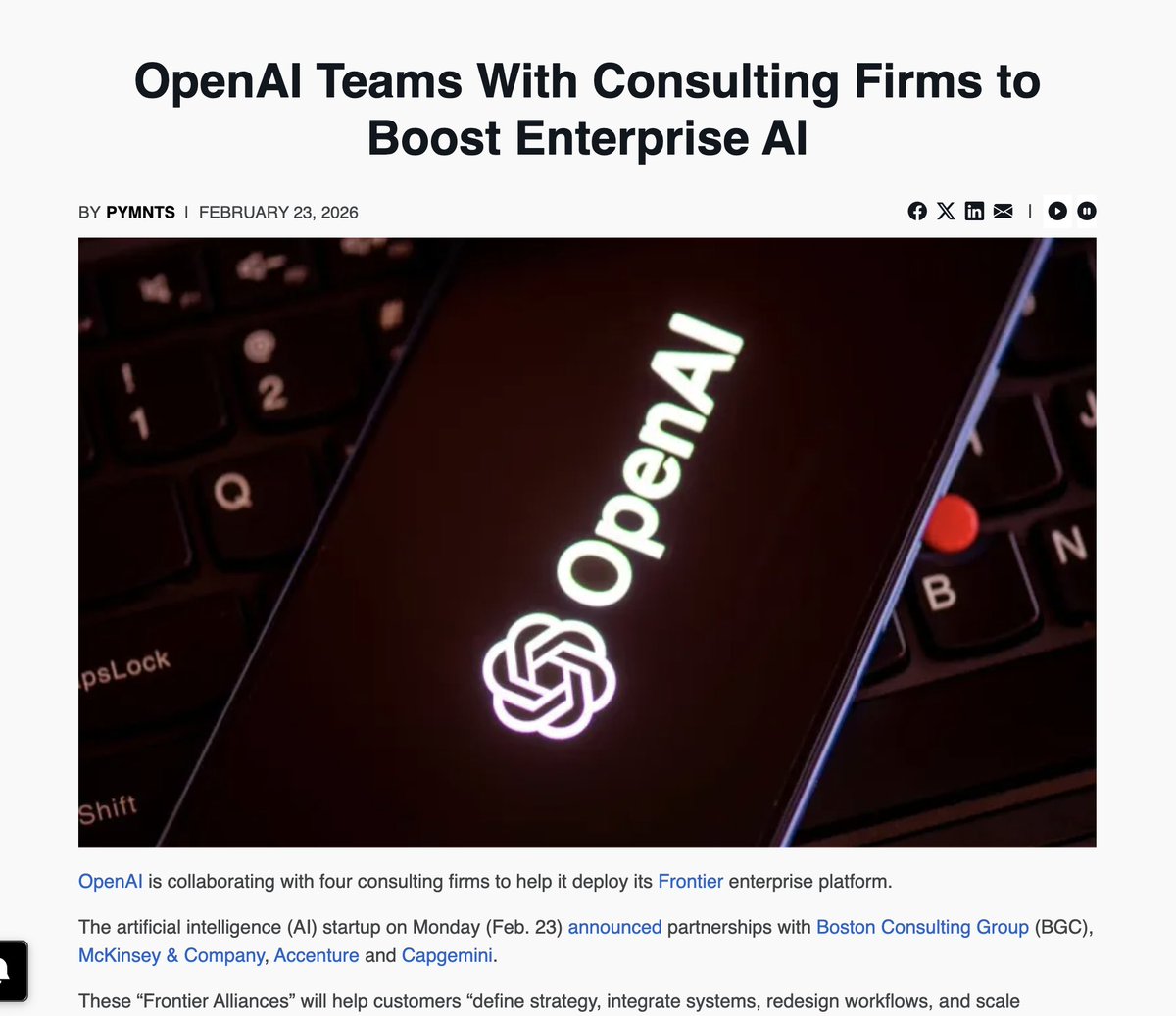
Anthropic and OpenAI are both building PE-backed consulting arms to deploy AI inside companies.
Let that sink in for a second.
The two companies building the most powerful AI on earth looked at the market and said "businesses can't figure out how to use this. We need to go in and do it for them."
They are literally telling you where the gap is.
Companies have access to the best AI models ever built. And most of them are still running on spreadsheets, disconnected tools, and manual processes because nobody showed them how to actually implement it.
That's the whole game right now. Not building better models (obviously) or shipping new features.
IMPLEMENTATION.
Getting AI inside real workflows.
Mapping the processes, building the systems, and making it stick.
I've been doing exactly this for 4 years and have worked with 80+ companies at this point.
It started with automation and naturally flowed into Ai.
And every single engagement starts the same way. Not with AI or automation but with a process map.
Because AI alone won't fix broken operations.
Companies now understand that. They have not yet seen true ROI from Ai.
You have to understand how the business actually runs before you touch a single tool.
Where does the data live? Where are the bottlenecks? What's manual that shouldn't be? What breaks when volume goes up?
That's the work, and that's what Anthropic and OpenAI just told the entire market is worth billions.
Every company is going AI-first over the next 3-5 years.
The demand for people who can actually make that happen is about to be unlike anything we've seen.
The labs told you where the gaps are.
Now go fill them.
There is a huge opportunity for resourceful and entrepreneurial talent within organizations to go in and reimagine workflows for a world of agents.
The way you automate work with agents requires real work. It means setting up unstructured data in a way agents can easily access, learning the workflow and processes and creating skills or plans for agents to leverage, connecting disparate systems together, and likely changing the process itself to support getting the agents the need to do much of the work. Then you have to design where humans will play a role to oversee the workflows, how you validate the work, and so on.
Most of the gains you see from coding don’t take this level of effort because the agent knows more, it gets context more easily, and the users are technically. But for the rest of knowledge work there’s no way around this; there’s really no way to shortcut any of this work. It has to be done by a person or people on the team.
You will see a huge growth of roles within enterprises, and people that specialize in this will be hugely valuable in the economy. Great way for early career folks to make a huge dent quickly as well.
Every entrepreneur that knows how to use AI is trying to find ways to build AI native companies that completely displace incumbents.
For the incumbents, it’s the “Innovator’s AI Dilemma” If those startups get traction, and they can’t buy them, the CEOs will face multiple huge Dilemmas:
1. Do they tear down their companies and reinvent them as native AI ?
2. How do they explain it to public shareholders ?
You will know AI is having a huge impact on public companies when there are two types of lawsuits:
- Shareholders that sue the company for tearing down the company and crushing the stock price
- Shareholders that sue the company for NOT tearing down the company and crushing the stock price
I think most CEOs don’t come close to understanding AI in enough detail to even begin to consider these decisions.
Hint: Asking your AI models the best paths from where you are now, to being an AI native version that can achieve the same economics has to be one of your initial steps.
If asking your models questions doesn’t make sense to you, you are in deep shit
Travis Kalanick: “AGI is not here yet, and it's silly for folks to say it is.”
“When it comes to big companies, I think the big thing about, let's call it the autonomous enterprise, is change management.
And change management is about all the people that already work there, the middle managers, the technocrats, the bureaucrats.
The change management is a human thing.
And it's very tricky with very complex processes, many of which are not even documented.
And in theory, it's just all going to happen real fast.
But in practice, that's hard.
So that's part one.
Part two, what I'm seeing with true tech companies, they are fired up about the development, the productivity, the deployment schedule, and the new features they're able to roll out much, much, much faster because they've pivoted their culture, sort of very pro-AI development.
Now, there are folks selling their book that are like, ‘Oh, we're at AGI,’ and all this.
Anybody who has worked with these agents and done the AI dev stuff, there's a lot of good stuff, but they're not that smart yet.
They're just not that smart.”
There’s $1T up for grabs for agent-first startups and this window is WIDE open. Probably 10,000+ niches.
How it plays out:
1. Every SaaS company follows salesforce and goes headless within 18 months
2. a new category of "agent-native" startups emerges that treat salesforce, HubSpot, workday etc as dumb backends. the startup IS the agent. the SaaS is just the database.
3. the entire consulting/services industry around enterprise SaaS gets compressed into software. the agent replaces the implementation team.
4. outcome-based pricing becomes default. nobody pays per seat when the "seat" is an agent making 10,000 API calls a minute. you pay when revenue hits your account.
5. the winning founders are ex-operators who understand a vertical workflow cold. the code is the easy part. knowing that a property manager spends 14 hours a week on lease renewals? that's the insight worth $100M.
6. distribution becomes the moat. when anyone can wire agents to APIs, the company with the audience and the brand wins. media + agents is the new SaaS. There’s a rush to incubate live/short form shows.
7. Silicon Valley goes all influencer. Roy lee gets this. Pat Walls gets this. Sam Parr gets this.
8. the first $1B agent-native company in each vertical will look nothing like the SaaS it replaced. smaller team, higher margins, no implementation cost, no churn from bad UX because there is no UX.
the fastest path to wealth right now: find an industry that still runs on dashboards, phone calls, and spreadsheets. build the agent-native version. charge per outcome. own the workflow end-to-end.
someone reading this right now is going to build a $100M company off this exact shift. tell me about it on the @startupideaspod when you do. Im rooting for you.
Less reading, less bookmarking, more building.
the last wave rewarded people who built pretty interfaces on top of ugly data.
I think this wave rewards people who build smart agents on top of exposed APIs.
Or who just build the APIs themselves
Here we go
Custom orders of the Tesla Model S & X have come to an end. All that’s left are some in inventory.
We will have an official ceremony to mark the ending of an era. I love those cars.
This was me at production launch 14 years ago:
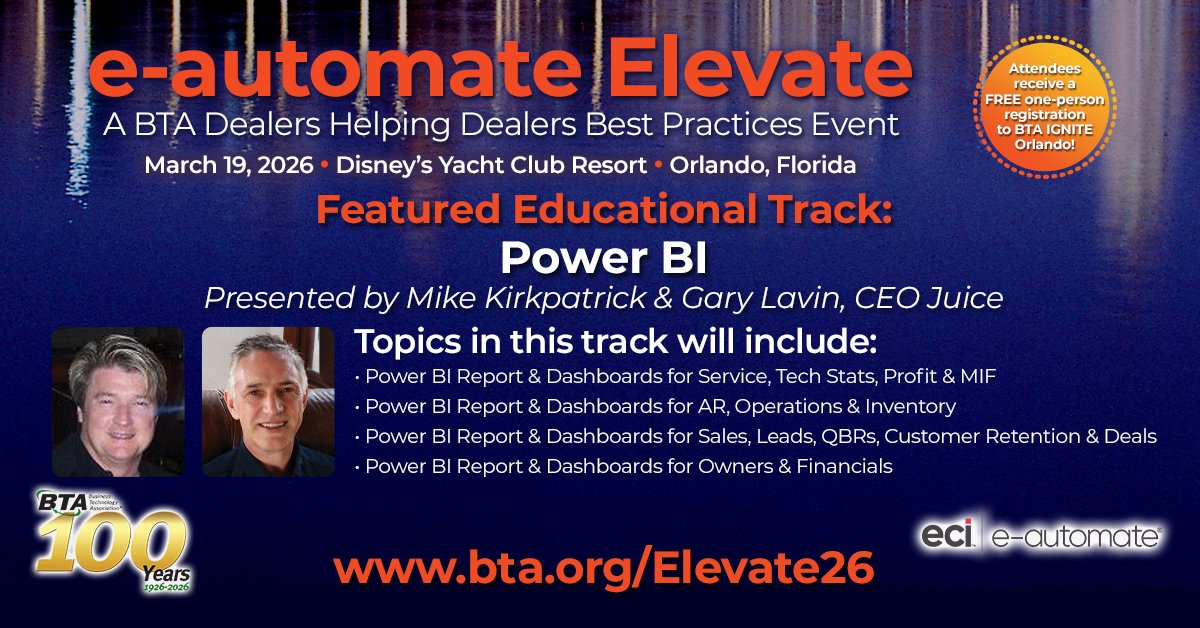
📊 From AR and inventory to sales, QBRs, customer retention and owner-level financials — see how Power BI dashboards can give every department clearer insights and stronger accountability. @ceojuice
Register: https://t.co/912KZx6luM
Macrohard or Digital Optimus is a joint xAI-Tesla project, coming as part of Tesla’s investment agreement with xAI.
Grok is the master conductor/navigator with deep understanding of the world to direct digital Optimus, which is processing and actioning the past 5 secs of real-time computer screen video and keyboard/mouse actions. Grok is like a much more advanced and sophisticated version of turn-by-turn navigation software.
You can think of it as Digital Optimus AI being System 1 (instinctive part of the mind) and Grok being System 2. (thinking part of the mind).
This will run very competitively on the super low cost Tesla AI4 ($650) paired with relatively frugal use of the much more expensive xAI Nvidia hardware. And it will be the only real-time smart AI system. This is a big deal.
In principle, it is capable of emulating the function of entire companies. That is why the program is called MACROHARD, a funny reference to Microsoft.
No other company can yet do this.
Here’s how this plays out. Software used to be too expensive and hard to write to automate most things. Now it’s vastly cheaper and faster to code. Thus, leverage has gone up dramatically, which means we’ll use software for far more. Leasing to more demand for engineering.
SERVICE-AS-A-SOFTWARE. That is the real opportunity for 90% of us.
I keep watching smart people pour months into building beautiful UI applications that Anthropic and OpenAI are going to absorb in a single product update.
It will feel ARCHAIC in two years that we used to click through user interfaces to navigate databases and complete tasks. Agents just do it. One prompt. Done.
90% of the entire application layer is going to get eaten over the next decade. The dashboards. The forms. The CRUD. All of it.
Where does that leave you?
Exactly where the money is.
Service-as-a-software.
E.g. An ad agency that bakes its winning playbooks into AI systems and serves 1,000 clients with the quality they used to give 10.
An IP law firm that encodes decades of expertise into AI skill files and sells legal services at infinite scale with near-zero marginal cost.
A consulting firm. An accounting practice. A creative studio. Pick your vertical.
The backend is AI. The frontend is your expertise packaged as a service. The moat is that YOU actually know what good looks like in your domain.
You're not competing with OpenAI. You're competing with other service providers who are still doing everything manually.
That's not a hard fight to win.
Encode your knowledge. Automate your delivery. Sell the service. Scale infinitely.
The technology gets commoditized. The person who knows how to USE it doesn't.