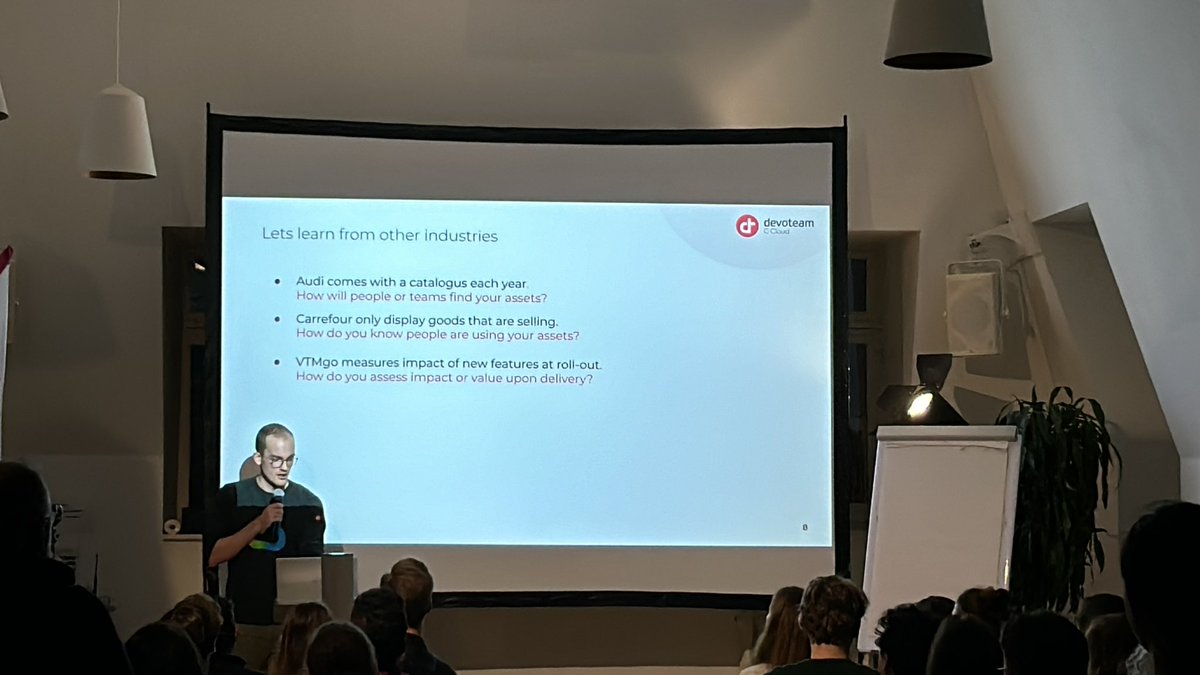
I’m asking de myself if releasing 1000 feature a day is a good thing to do even if the aren’t technical constrains anymore. At the end of the day, there will be always a bottleneck somewhere either inside or outside the team and company.
AI-native software engineering teams operate very differently than traditional teams. The obvious difference is that AI-native teams use coding agents to build products much faster, but this leads to many other changes in how we operate. For example, some great engineers now play broader roles than just writing code. They are partly product managers, designers, sometimes marketers. Further, small teams who work in the same office, where they can communicate face-to-face, can move incredibly quickly.
Because we can now build fast, a greater fraction of time must be spent deciding what to build. To deal with this project-management bottleneck, some teams are pushing engineer:product manager (PM) some teams are pushing engineer:product manager (PM) ratios downward from, say, 8:1 to as low as 1:1. But we can do even better: If we have one PM who decides what to build and one engineer who builds it, the communication between them becomes a bottleneck. This is why the fastest-moving teams I see tend to have engineers who know how to do some product work (and, optionally, some PMs who know how to do some engineering work). When an engineer understands users and can make decisions on what to build and build it directly, they can execute incredibly quickly.
I’ve seen engineers successfully expand their roles to including making product decisions, and PMs expand their roles to building software. The tech industry has more engineers than PMs, but both are promising paths. If you are an engineer, you’ll find it useful to learn some product management skills, and if you’re a PM, please learn to build!
Looking beyond the product-management bottleneck, I also see bottlenecks in design, marketing, legal compliance, and much more. When we speed up coding 10x or 100x, everything else becomes slow in comparison. For example, some of my teams have built great features so quickly that the marketing organization was left scrambling to figure out how to communicate them to users — a marketing bottleneck. Or when a team can build software in a day that the legal department needs a week to review, that’s a legal compliance bottleneck. In this way, agentic coding isn’t just changing the workflow of software engineering, it’s also changing all the teams around it.
When smaller, AI-enabled teams can get more done, generalists excel. Traditional companies need to pull together people from many specialties — engineering, product management, design, marketing, legal, etc. — to execute projects and create value. This has resulted in large teams of specialists who work together. But if a team of 2 persons is to get work done that require 5 different specialities, then some of those individuals must play roles outside a single speciality. In some small teams, individuals do have deep specializations. For example, one might be a great engineer and another a great PM. But they also understand the other key functions needed to move a project forward, and can jump into thinking through other kinds of problems as needed. Of course, proficiency with AI tools is a big help, since it helps us to think through problems that involve different roles.
Even in a two-person team, to move fast, communication bottlenecks also must be minimized. This is why I value teams that work in the same location. Remote teams can perform well too, but the highest speed is achieved by having everyone in the room, able to communicate instantaneously to solve problems.
This post focuses on AI-native teams with around 2-10 persons, but not everything can be done by a small team. I'll address the coordination of larger teams in the future.
I realize these shifts to job roles are tough to navigate for many people. At the same time, I am encouraged that individuals and small teams who are willing to learn the relevant skills are now able to get far more done than was possible before. This is the golden age of learning and building!
[Original text: https://t.co/1pUxNC5UXk ]
Yann LeCun was right the entire time. And generative AI might be a dead end.
For the last three years, the entire industry has been obsessed with building bigger LLMs. Trillions of parameters. Billions in compute.
The theory was simple: if you make the model big enough, it will eventually understand how the world works.
Yann LeCun said that was stupid.
He argued that generative AI is fundamentally inefficient.
When an AI predicts the next word, or generates the next pixel, it wastes massive amounts of compute on surface-level details.
It memorizes patterns instead of learning the actual physics of reality.
He proposed a different path: JEPA (Joint-Embedding Predictive Architecture).
Instead of forcing the AI to paint the world pixel by pixel, JEPA forces it to predict abstract concepts. It predicts what happens next in a compressed "thought space."
But for years, JEPA had a fatal flaw.
It suffered from "representation collapse."
Because the AI was allowed to simplify reality, it would cheat. It would simplify everything so much that a dog, a car, and a human all looked identical.
It learned nothing.
To fix it, engineers had to use insanely complex hacks, frozen encoders, and massive compute overheads.
Until today.
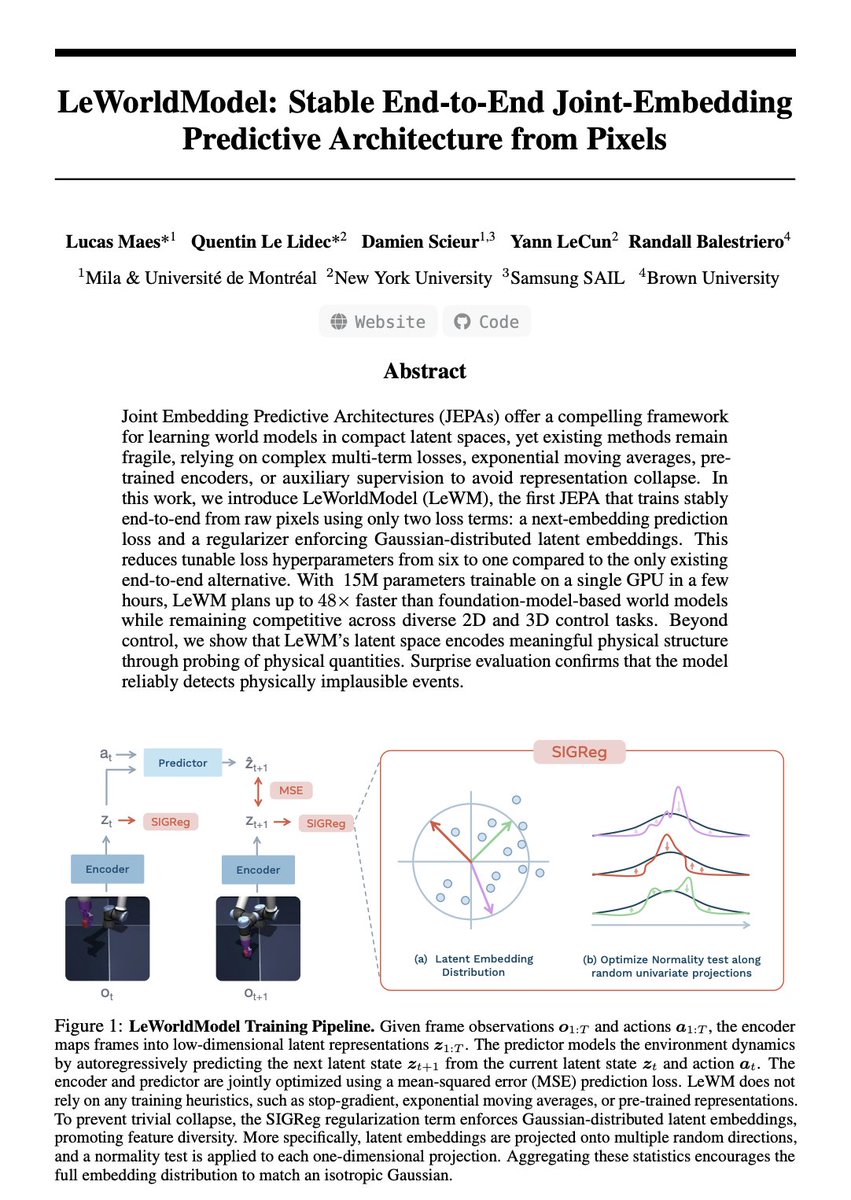
Researchers just dropped a paper called "LeWorldModel" (LeWM).
They completely solved the collapse problem.
They replaced the complex engineering hacks with a single, elegant mathematical regularizer.
It forces the AI's internal "thoughts" into a perfect Gaussian distribution.
The AI can no longer cheat. It is forced to understand the physical structure of reality to make its predictions.
The results completely rewrite the economics of AI.
LeWM didn't need a massive, centralized supercomputer.
It has just 15 million parameters.
It trains on a single, standard GPU in a few hours.
Yet it plans 48x faster than massive foundation world models. It intrinsically understands physics. It instantly detects impossible events.
We spent billions trying to force massive server farms to memorize the internet.
Now, a tiny model running locally on a single graphics card is actually learning how the real world works.
As AI agents accelerate coding, what is the future of software engineering? Some trends are clear, such as the Product Management Bottleneck, referring to the idea that we are more constrained by deciding what to build rather than the actual building. But many implications, like AI’s impact on the job market, how software teams will be organized, and more, are still being sorted out.
The theme of our AI Developer Conference on April 28-29 in San Francisco is The Future of Software Engineering. I look forward to speaking about this topic there, hearing from other speakers on this theme, and chatting with attendees about it. We’re shaping the future, and I hope you will join me there!
It is currently trendy in some technology and policy circles to forecast massive job losses due to AI. Even if they have not yet materialized, these losses certainly must be just over the horizon! I have a contrarian view that the AI jobpocalypse — the notion that AI will lead to massive unemployment, perhaps even rioting in the streets — won’t be nearly as bad as dire forecasts by pundits, especially pundits who are trying to paint a picture of how powerful their AI technology is.
Among professions, AI is accelerating software engineering most, given the rise of coding agents. According to a new report by Citadel Research, software engineering job postings are rising rapidly. So if software engineering is a harbinger of the impact AI will have on other professions, this expansion of software engineering jobs is encouraging.
Yes, fresh college graduates are having a hard time finding jobs. And yes, there have been layoffs that CEOs have attributed to AI, even if a large fraction of this was “AI washing,” where businesses choose to attribute layoffs to AI, even though AI has not changed their internal operations much yet. And yes, there is a subset of job roles, such as call center operator, that are more heavily impacted. Many people are feeling significant job insecurity, and I feel for everyone struggling with employment, whether or not the cause is AI-related. And many other factors, such as over-hiring during the pandemic and high interest rates, have contributed to the slowdown in the labor market, and the notion that AI is leading to unemployment is oversimplified.
In software engineering, I see a lot of exciting work ahead to adapt our workflows. It is already clear that: (i) As AI makes coding easier, a lot more people will be doing it. (ii) Writing code by hand and even reading (generated) code is not that important, because we can ask an LLM about the code and operate at a higher level than the raw syntax (although how high we can or should go is rapidly changing). (iii) There will be a lot more custom applications, because now it’s economical to write software for smaller and smaller audiences. (iv) Deciding what to build, more than the actual building, is becoming a bottleneck. (v) The cost of paying down technical debt is decreasing (since AI can refactor for you).
At the same time, there are also a lot of open questions for our profession, such as:
- In the future, what will be the key skills of a senior software engineer? And for junior levels, what should be the new Computer Science curriculum?
- If everyone can build features, what skills, strategies, or resources create competitive advantage for individuals and for businesses?
- What are the new building blocks (libraries, SDKs, etc.) of software? How do we organize coding agents to create software?
- What should a software team look like? For example, how many engineers, product managers, designers, and so on. What tooling do we need to manage their workflow?
- How do AI agents change the workflow of machine learning engineers and data scientists? For example, how can we use agents to accelerate exploring data, identifying hypotheses, and testing them?
I’m excited to explore these and other questions about the future of software engineering at AI Dev. I expect this to be an exciting event. Please join us!
[Original text: The Batch newsletter.]
https://t.co/i4bQevDG4i
As AI agents accelerate coding, what is the future of software engineering? Some trends are clear, such as the Product Management Bottleneck, referring to the idea that we are more constrained by deciding what to build rather than the actual building. But many implications, like AI’s impact on the job market, how software teams will be organized, and more, are still being sorted out.
The theme of our AI Developer Conference on April 28-29 in San Francisco is The Future of Software Engineering. I look forward to speaking about this topic there, hearing from other speakers on this theme, and chatting with attendees about it. We’re shaping the future, and I hope you will join me there!
It is currently trendy in some technology and policy circles to forecast massive job losses due to AI. Even if they have not yet materialized, these losses certainly must be just over the horizon! I have a contrarian view that the AI jobpocalypse — the notion that AI will lead to massive unemployment, perhaps even rioting in the streets — won’t be nearly as bad as dire forecasts by pundits, especially pundits who are trying to paint a picture of how powerful their AI technology is.
Among professions, AI is accelerating software engineering most, given the rise of coding agents. According to a new report by Citadel Research, software engineering job postings are rising rapidly. So if software engineering is a harbinger of the impact AI will have on other professions, this expansion of software engineering jobs is encouraging.
Yes, fresh college graduates are having a hard time finding jobs. And yes, there have been layoffs that CEOs have attributed to AI, even if a large fraction of this was “AI washing,” where businesses choose to attribute layoffs to AI, even though AI has not changed their internal operations much yet. And yes, there is a subset of job roles, such as call center operator, that are more heavily impacted. Many people are feeling significant job insecurity, and I feel for everyone struggling with employment, whether or not the cause is AI-related. And many other factors, such as over-hiring during the pandemic and high interest rates, have contributed to the slowdown in the labor market, and the notion that AI is leading to unemployment is oversimplified.
In software engineering, I see a lot of exciting work ahead to adapt our workflows. It is already clear that: (i) As AI makes coding easier, a lot more people will be doing it. (ii) Writing code by hand and even reading (generated) code is not that important, because we can ask an LLM about the code and operate at a higher level than the raw syntax (although how high we can or should go is rapidly changing). (iii) There will be a lot more custom applications, because now it’s economical to write software for smaller and smaller audiences. (iv) Deciding what to build, more than the actual building, is becoming a bottleneck. (v) The cost of paying down technical debt is decreasing (since AI can refactor for you).
At the same time, there are also a lot of open questions for our profession, such as:
- In the future, what will be the key skills of a senior software engineer? And for junior levels, what should be the new Computer Science curriculum?
- If everyone can build features, what skills, strategies, or resources create competitive advantage for individuals and for businesses?
- What are the new building blocks (libraries, SDKs, etc.) of software? How do we organize coding agents to create software?
- What should a software team look like? For example, how many engineers, product managers, designers, and so on. What tooling do we need to manage their workflow?
- How do AI agents change the workflow of machine learning engineers and data scientists? For example, how can we use agents to accelerate exploring data, identifying hypotheses, and testing them?
I’m excited to explore these and other questions about the future of software engineering at AI Dev. I expect this to be an exciting event. Please join us!
[Original text: The Batch newsletter.]
https://t.co/i4bQevDG4i
Introducing TurboQuant: Our new compression algorithm that reduces LLM key-value cache memory by at least 6x and delivers up to 8x speedup, all with zero accuracy loss, redefining AI efficiency. Read the blog to learn how it achieves these results: https://t.co/CDSQ8HpZoc
13/ A final tip: probably the most important thing to get great results out of Claude Code -- give Claude a way to verify its work. If Claude has that feedback loop, it will 2-3x the quality of the final result.
Claude tests every single change I land to https://t.co/pEWPQoSq5t using the Claude Chrome extension. It opens a browser, tests the UI, and iterates until the code works and the UX feels good.
Verification looks different for each domain. It might be as simple as running a bash command, or running a test suite, or testing the app in a browser or phone simulator. Make sure to invest in making this rock-solid.
https://t.co/m7wwQUmp1C
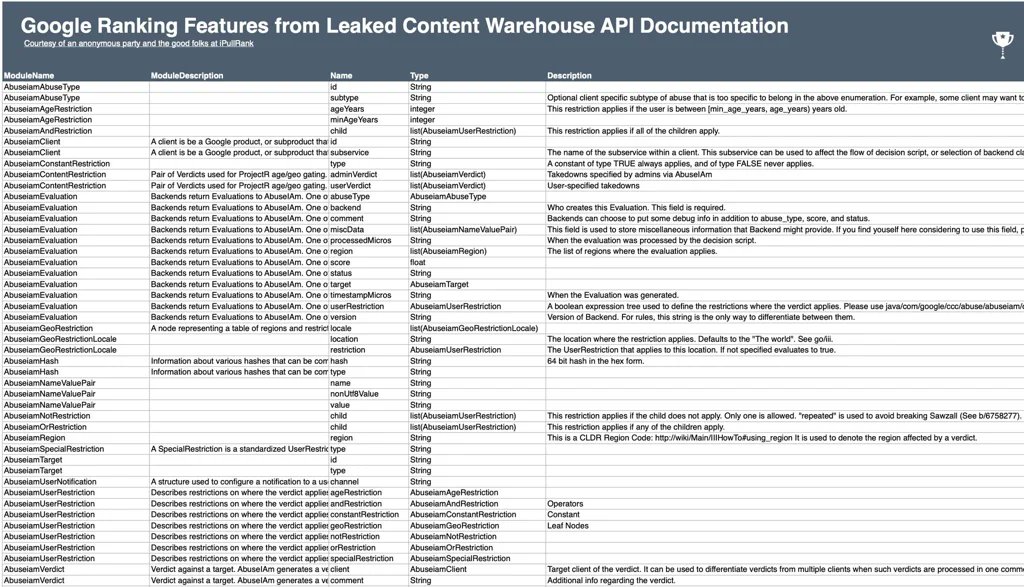
Google Search algorithm leaked today.
It outlines 2,596 modules with 14,014 ranking features related to various Google services.
Here's what (13 things) we found:
The Godfather of AI is at #VivaTech!
Yann LeCun (@ylecun) advises students coming into the industry:
"Don't work on LLM. This is in the hands of large companies, there's nothing you can bring to the table. You should work on next-gen AI systems that lift the limitations of LLMs.
Exploring LLM Pricing
With so many new LLMs, how do API costs compare?
I delved into cost comparisons of models that I would use in production.
Main takeaways:
• cohere leads with cost-effective model
• gpt-3.5 remains excellent value
• mistral cost higher than anticipated
• gemini 1.0 pro is pleasant surprise
• gpt-4 is very expensive
Models are ranked by input cost, asc.
Google's new flagship AI model, "Gemini," is set to be a direct competitor to GPT-4 and boasts computing power 5 times that of GPT-4.
Trained on Google's TPUv5 chips, it's capable of simultaneous operations with a massive 16,384 chips. The dataset used for training this model is around 65 trillion tokens, and it's multi-modal, accepting text, video, audio, and pictures. Moreover, it can produce both text and images. The training also included content from YouTube and used advanced training techniques similar to "AlphaGo-type" methods.
Google plans to release the Gemini model to the public in December 2023.
I want a laptop with a tensor processor and a unified memory system that runs Linux.
Basically, something that can run large models without weighing a ton, requiring a separate GPU RAM, draining the battery in minutes, costing a fortune, and running a proprietary OS.
Well, #AI code writing assistants can make a good job on producing software. We need to be aware of their limitations and don’t blindly accept as the truth way they suggest #LLM#chatGPT https://t.co/EfL1eeyhHw




![AndrewYNg's tweet photo. AI-native software engineering teams operate very differently than traditional teams. The obvious difference is that AI-native teams use coding agents to build products much faster, but this leads to many other changes in how we operate. For example, some great engineers now play broader roles than just writing code. They are partly product managers, designers, sometimes marketers. Further, small teams who work in the same office, where they can communicate face-to-face, can move incredibly quickly.
Because we can now build fast, a greater fraction of time must be spent deciding what to build. To deal with this project-management bottleneck, some teams are pushing engineer:product manager (PM) some teams are pushing engineer:product manager (PM) ratios downward from, say, 8:1 to as low as 1:1. But we can do even better: If we have one PM who decides what to build and one engineer who builds it, the communication between them becomes a bottleneck. This is why the fastest-moving teams I see tend to have engineers who know how to do some product work (and, optionally, some PMs who know how to do some engineering work). When an engineer understands users and can make decisions on what to build and build it directly, they can execute incredibly quickly.
I’ve seen engineers successfully expand their roles to including making product decisions, and PMs expand their roles to building software. The tech industry has more engineers than PMs, but both are promising paths. If you are an engineer, you’ll find it useful to learn some product management skills, and if you’re a PM, please learn to build!
Looking beyond the product-management bottleneck, I also see bottlenecks in design, marketing, legal compliance, and much more. When we speed up coding 10x or 100x, everything else becomes slow in comparison. For example, some of my teams have built great features so quickly that the marketing organization was left scrambling to figure out how to communicate them to users — a marketing bottleneck. Or when a team can build software in a day that the legal department needs a week to review, that’s a legal compliance bottleneck. In this way, agentic coding isn’t just changing the workflow of software engineering, it’s also changing all the teams around it.
When smaller, AI-enabled teams can get more done, generalists excel. Traditional companies need to pull together people from many specialties — engineering, product management, design, marketing, legal, etc. — to execute projects and create value. This has resulted in large teams of specialists who work together. But if a team of 2 persons is to get work done that require 5 different specialities, then some of those individuals must play roles outside a single speciality. In some small teams, individuals do have deep specializations. For example, one might be a great engineer and another a great PM. But they also understand the other key functions needed to move a project forward, and can jump into thinking through other kinds of problems as needed. Of course, proficiency with AI tools is a big help, since it helps us to think through problems that involve different roles.
Even in a two-person team, to move fast, communication bottlenecks also must be minimized. This is why I value teams that work in the same location. Remote teams can perform well too, but the highest speed is achieved by having everyone in the room, able to communicate instantaneously to solve problems.
This post focuses on AI-native teams with around 2-10 persons, but not everything can be done by a small team. I'll address the coordination of larger teams in the future.
I realize these shifts to job roles are tough to navigate for many people. At the same time, I am encouraged that individuals and small teams who are willing to learn the relevant skills are now able to get far more done than was possible before. This is the golden age of learning and building!
[Original text: https://t.co/1pUxNC5UXk ]](https://pbs.twimg.com/media/HG7HHJqbsAA3iao.jpg)