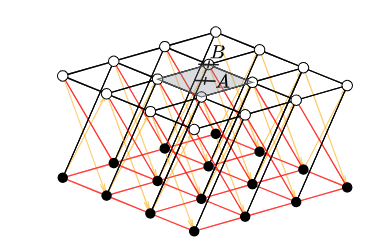
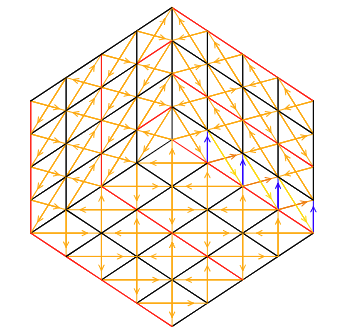
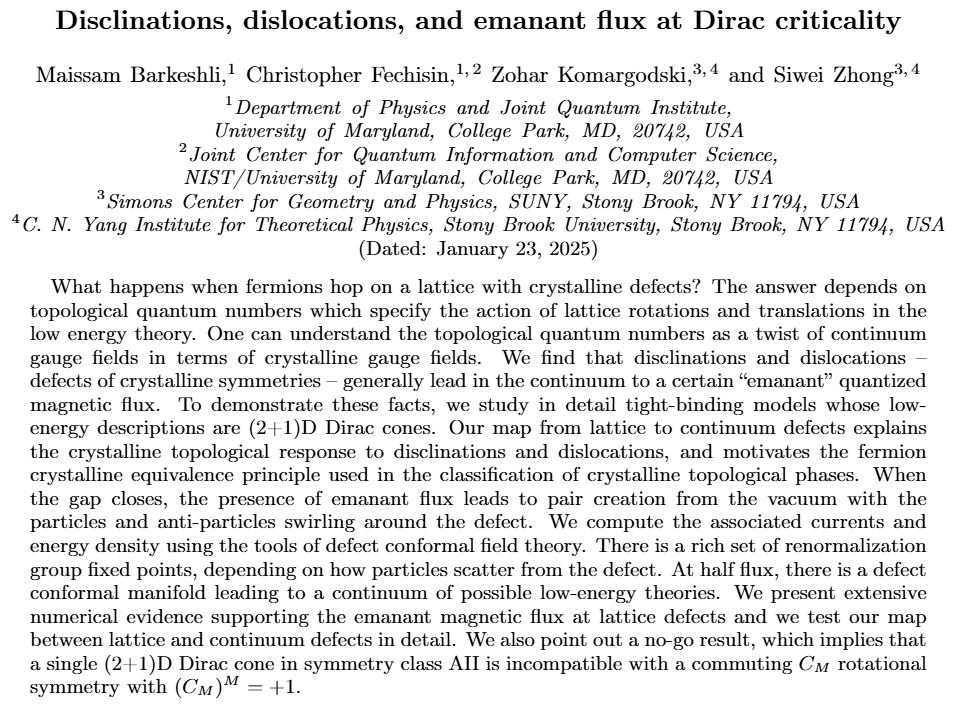
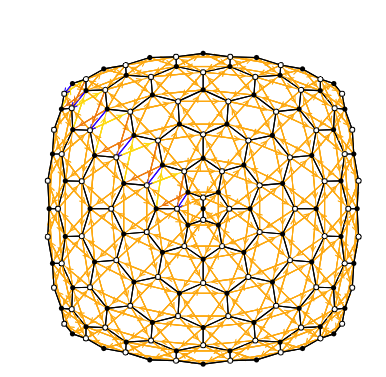
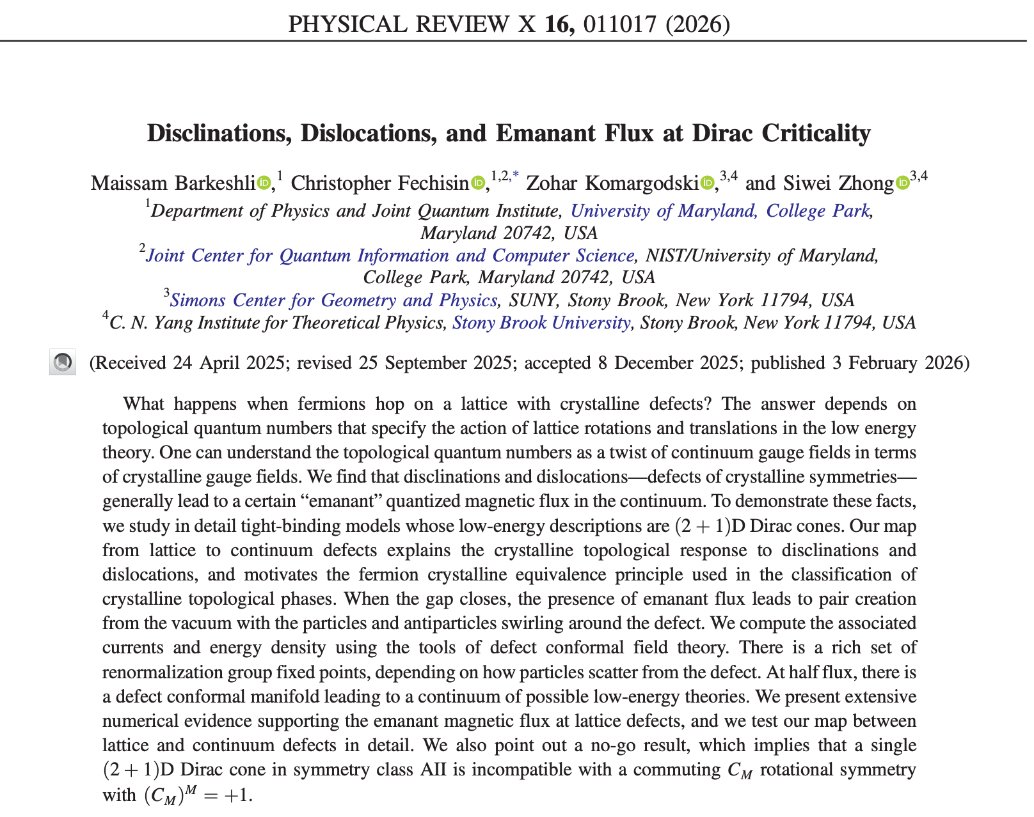
What happens when fermions jump in a crystal with defects? With Chris, @MBarkeshli , and Siwei, we have combined ideas from QFT and Condensed Matter to answer the question and checked it extensively in numerics.
Surely it has the most beautiful figures in any of my papers.
Nice to make some progress on a basic topic in theoretical physics -- universal response of emergent Dirac fermions to crystal defects. Now published in @PhysRevX , with @ZoharKo , @CFechisin , Siwei Zhong. @JQInews@UMDPhysics
[1/2] Our new work is out today on arXiv, studying mixed-state SPT order in steady states of Lindbladians. Unlike for pure states — where the SPT order of a Hamiltonian's ground states is robust to weak symmetric perturbations — we find in our model that
https://t.co/dTHExCJyCo
Editors' Suggestion: Topology and manipulation of scattering singularities in complex non-Hermitian systems: Two-channel case, Jared Erb et al @AnlageLab#NonlinearDynamics#Optics https://t.co/TKz52fPyCL
My new work with @nat_tanti and @victorvalbert is out today on the arXiv! https://t.co/LjrhGB8ltB
We study SPT order protected by *non-invertible* symmetry in a class of group-based cluster states, akin to the relationship between the toric code and quantum double.
🧵 1/6
[2/2] the mixed-state SPT order of a Lindbladian's steady states is 𝗻𝗼𝘁 robust to most symmetric perturbations of the Lindbladian, even if they're arbitrarily weak. Instead, the new steady states exhibit a type of SSB order intrinsic to mixed states.
[1/2] Our new work is out today on arXiv, studying mixed-state SPT order in steady states of Lindbladians. Unlike for pure states — where the SPT order of a Hamiltonian's ground states is robust to weak symmetric perturbations — we find in our model that
https://t.co/dTHExCJyCo
@EricAspling@markwilde @kunalsharmaq I think this one is a good place to start.
https://t.co/wBvghE1K85
The tl;dr is that atoms in Rydberg states have very large electric dipoles which interact very strongly, generating interactions that can be switched on and off by populating and depopulating Rydberg states.
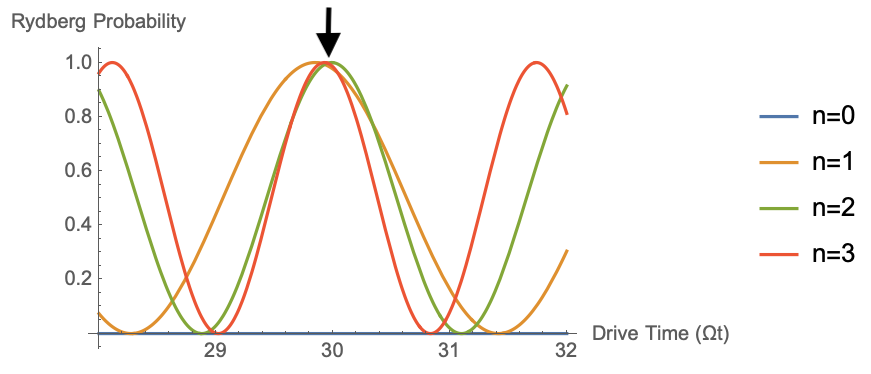
@markwilde @kunalsharmaq Maybe, one way would be to find a drive time where the array would be close to the Rydberg state for any photon number≠0. In this example, if we checked for a Rydberg excitation at Ωt=30, then it would approx. be a QND vacuum or not measurement for one mode of up to 3 photons.
Example model 1D system showing a beyond-group symmetry studied with ITensor DMRG.
"Non-invertible symmetry-protected topological order in a group-based cluster state" Christopher Fechisin, Nathanan Tantivasadakarn, Victor V. Albert.
https://t.co/bzwoYnvswG
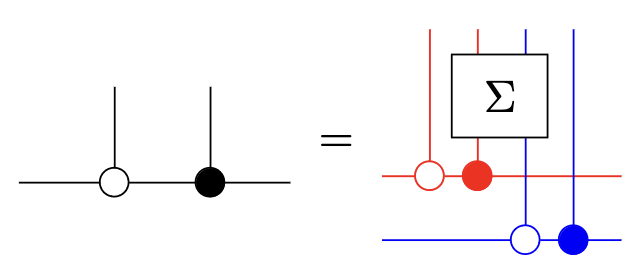
We also show that these cluster states can be used for measurement-based quantum computing. To do so, we use a deep relationship between cluster states and Kramers-Wannier duality as well as the decomposition of certain non-abelian groups into a series of abelian groups.
5/6
I'm very excited to share recent results on preparing topological states by measurement. In our latest collaboration with Quantinuum, we unambiguously provide the first realization of non-Abelian topological order in their latest H2 quantum processor (which launches today!)
Symmetry makes life easier for physicists. New “higher form” symmetries are proving to be mathematically useful within quantum field theory. @KSHartnett reports: https://t.co/O7u2XK20W0
New in Quantum: Classifying phases protected by matrix product operator symmetries using matrix product states by José Garre-Rubio, Laurens Lootens, and András Molnár https://t.co/mJrFH2RIpE