Much more in the draft, including discussions of treatment histories, compound treatments, and the effects-of-causes vs. causes-of-effects distinction. I hope you give it a read and find it useful.
SocArxiv: https://t.co/czAq36WP2V
Dropbox: https://t.co/QFCtbRZdFS
(5/5)
My latest WP, a restructured version of the piece in the quoted thread. Helpful for thinking clearly about social media RCTs and their limits, useful for teaching about spillover in causal inference
SocArxiv: https://t.co/czAq36WP2V
Dropbox: https://t.co/QFCtbRZdFS
(1/5)
The social media hypothesis blames social media for the deterioration of teenagers’ mental health.
However, many randomized controlled trials (RCTs) show that encouraging heavy social media users to quit for a short time has only small effects on mental health in the short term.
This new preprint argues that these studies fail to convincingly show that social media is not to blame.
Why?
3 reasons.
1.) The social media hypothesis concerns the effects of joining social media; RCTs identify the effect of quitting.
2.) The social media hypothesis concerns the cumulative effect of using social media for years; RCTs identify the effect of quitting social media for weeks.
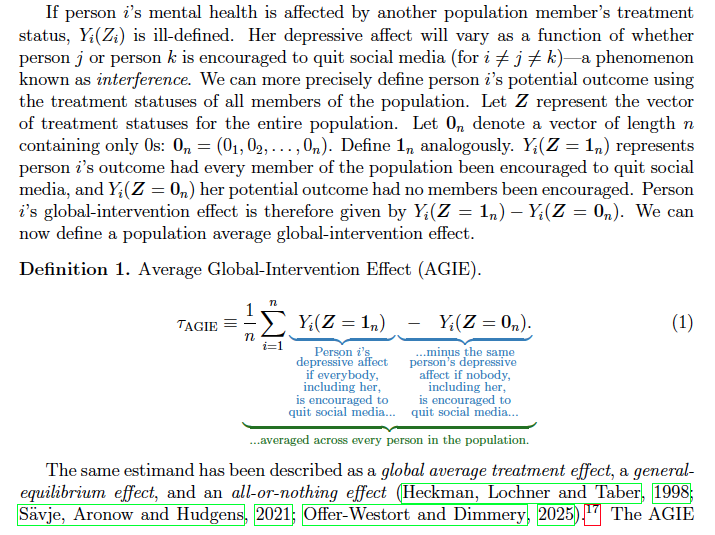
3.) The social media hypothesis concerns a large-scale change—the widespread adoption of social media among teenagers. RCTs, in contrast, test small-scale effects of individuals quitting while most peers remain online. These local experiments may not capture the broader cultural and psychological impact of universal social media use. When social media use is ubiquitous, it can fundamentally alter the broader culture and social milieu, even affecting the mental health of teenagers who abstain from social media entirely.
I also hope that the paper can serve as a (somewhat) gentle introduction to potential outcomes notation under interference to help researchers navigate the more technical articles in this space
(4/5)
The social media hypothesis blames social media for the deterioration of teenagers’ mental health.
However, many randomized controlled trials (RCTs) show that encouraging heavy social media users to quit for a short time has only small effects on mental health in the short term.
This new preprint argues that these studies fail to convincingly show that social media is not to blame.
Why?
3 reasons.
1.) The social media hypothesis concerns the effects of joining social media; RCTs identify the effect of quitting.
2.) The social media hypothesis concerns the cumulative effect of using social media for years; RCTs identify the effect of quitting social media for weeks.
3.) The social media hypothesis concerns a large-scale change—the widespread adoption of social media among teenagers. RCTs, in contrast, test small-scale effects of individuals quitting while most peers remain online. These local experiments may not capture the broader cultural and psychological impact of universal social media use. When social media use is ubiquitous, it can fundamentally alter the broader culture and social milieu, even affecting the mental health of teenagers who abstain from social media entirely.
@carlislerainey I dislike the framing b/c I agree w/ Gelman that there are (virtually) no true nulls. But the "human-in-the-loop estimators" used in most published papers are surely biased and reported CIs are probably too short. Prefer Gelman and Carlin (2014), who implicitly make similar arg
Trends in emergency department visits overstate actual deterioration in child mental health significantly due to changes in screening, definition, and coding of mental illness, from Han Choi, @CorredorWaldron, @PrincetonCHW, and @cfelton https://t.co/rNMWTDLLAo
@singlecrossing @JustinWolfers This is very funny because Eric Tchetgen Tchetgen did, in fact, propose the Nudge Average Treatment Effect (NATE) for IV just a few days ago lol https://t.co/T4ac79cDT0
@RomanFolw@b_m_stewart The section on weakness has probably changed the most. In the 2022 preprint, we talk about weakness as a singular thing w/ 3 consequences. But it's clearer to think of there being 3 diff versions of weakness, each w/ its own distinct consequences. Big picture is the same though
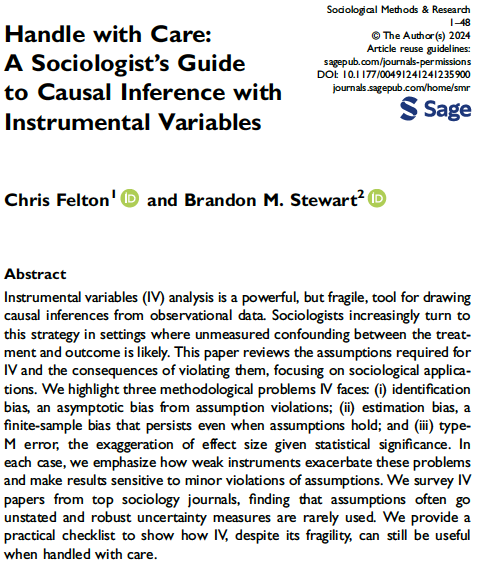
Using instrumental variables in your research? Teaching IV this semester? My paper with @b_m_stewart is available online at SMR: https://t.co/ARegFAJT6p
We have 3 goals:
-clarify IV assumptions
-illustrate the fragility of IV
-help researchers w/ a checklist
(1/12)