America’s global role is more contested and uncertain than at any time since World War II, and the time is ripe for a fundamental reevaluation of the nation’s strategy. To meet this moment, the Council on Foreign Relations is launching the Future of American Strategy Initiative, a multiyear effort that aims to answer one defining question: Where does America go from here?
To kickstart this conversation, CFR scholars, across 27 essays, explore the evolving strategic environment the United States will face over the next decade, spanning American strategy, great power rivalry, global order, geoeconomics, and warfare: https://t.co/yLo63FJNz7
"The global community desperately needs a powerful voice of reason and of justice that would fill the leadership vacuum in a world of widening conflicts, fraying support for human rights and use of force norms, and dizzying developments in the application of AI," writes expert David J. Scheffer.
"Enter Pope Leo XIV."
His encyclical was a welcome warning on the perils of technological change that could trample on human rights, Scheffer argues.
“No algorithm,” Pope Leo wrote in May, “can make a war morally acceptable.”
With the rupee plummeting to historic lows, foreign investors headed for the exits, and India about to slip behind Bangladesh in per capita GDP, it’s time for Modi to rethink his approach to the economy. [My take] v @WSJopinion
https://t.co/DxFAEVMVwm
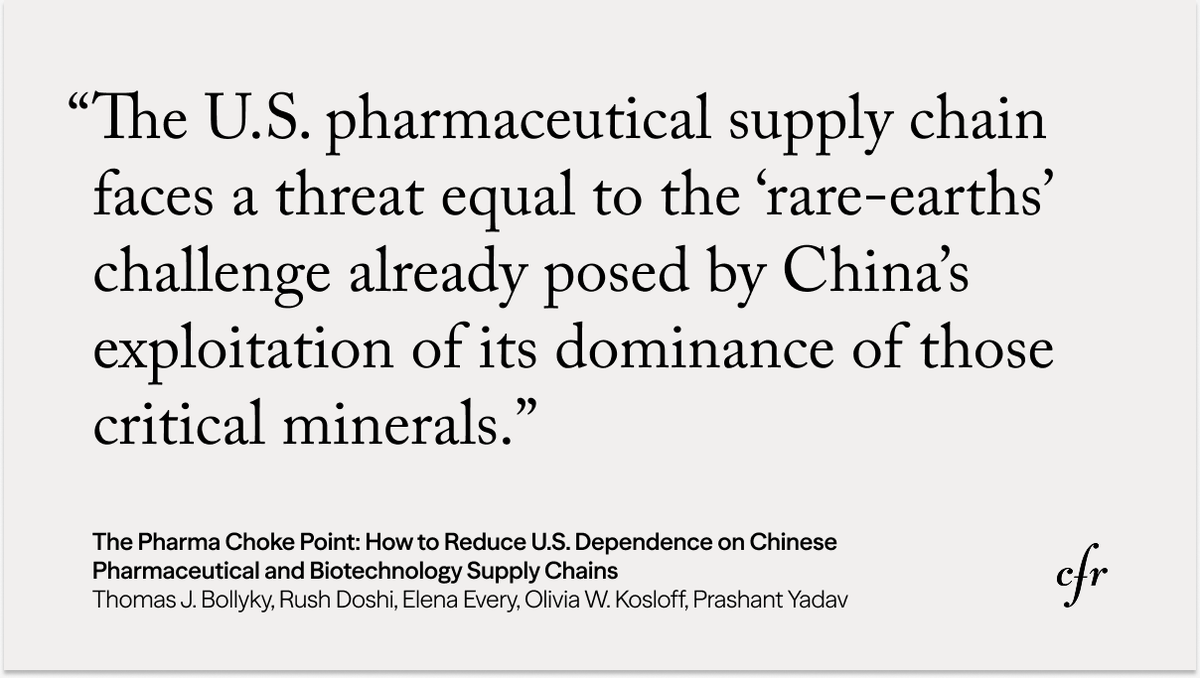
🚨Thrilled to share our new @CFR_China report with CFR Global Health's @TomBollyky, @Prof_Yadav_SCM, @OliviaWKosloff, & Elena Every: "The Pharma Choke Point."
The US is dependent on Chinese production for essential medicines, creating a "rare earths" problem in this sector. Seven hundred medicines approved for use in the United States depend on at least one chemical produced solely in China.
For the last year, our study group of pharma and biotech specialists, China scholars, and industrial policy experts came together to:
1⃣ Use commercial data to map the dependencies
2⃣ Devise a typology of three unique "archetypes" of these dependencies
3⃣ Craft solutions to address these dependencies
A few key points follow below:
➡️China's Leverage is real — Beijing doesn't need a wartime crisis to exploit it. It can slow shipments, delay licenses, or reroute flows through "peacetime weaponization." That's the playbook it has already run on rare earths.
➡️Current dependence is structural — It's the product of decades of Chinese state investment and Western pursuit of the low-cost solution. China controls the raw/starting materials for 94% of US amoxicillin, 74% of heparin, and 70% of acetaminophen. It's dominating preclinical work in biotech. And diversifying downstream offers no real protection from upstream dependence.
➡️Archetype 1: Upstream Dependence — Roughly 700 medicines Americans depend on at least one chemical made only in China, including antibiotics, blood thinners, ER drugs. Solutions include:
- building a strategic reserve of critical medicines
- building "allied scale" to create diversified production
- mix various long-term supply and demand interventions to change economic viability for KSMs, APIs, and other upstream inputs (more in the report)
➡️Archetype 2: Competitive Displacement of U.S. Biomanufacturing and Clinical Trial Capacity — For innovative biologics—medicines made from living cells—such as monoclonal antibodies, the risk is not a single upstream choke point but competitive displacement across every stage of the value chain: discovery, clinical development, contract manufacturing, and market access. The U.S. is losing a critical capability: now, WuXi alone handles nearly half of US clients' development programs. China alone is more than half of all late-stage monoclonal antibody programs. Lock-in deepens at every stage. Solutions include:
- accelerating first-in-human clinical trials in the United States
- funding and incentivizing the adoption of advanced biologics manufacturing technologies (e.g., low-cost capital from the USG)
- building contract research alternatives in allied countries like South Korea
- bolstering the U.S. biomanufacturing workforce
- creating a system to secure artificial intelligence (AI)–ready biodata and digital chemistry, manufacturing, and controls.
➡️Archetype 3: Dependence on PRC Infrastructure — Here, the vulnerability is not disruption in the supply of an existing product, but Chinese control over the research-and-development (R&D) infrastructure underlying future pharmaceutical innovation. Growing reliance on China for DNA synthesis is just one example. Solutions include:
- improving DNA supply chain security
- enhancing transparency and disclosing provenance
- increasing federal investment in next-generation DNA synthesis technologies
- and bolstering allied cooperation on standard-setting and procurement to encourage the adoption of these technologies.
➡️Key Takeaway: China has both the tools and demonstrated willingness to weaponize U.S. pharmaceutical dependence: the structural conditions enabling it run through nearly every tier of the pharmaceutical supply. The question is not whether to act, but if the United States will manage to do so before a crisis makes the cost of decades of inaction unavoidable.
I am so grateful to Tom, Prashant, Elena, Olivia, Chloe, Ben, Aarya, CFR's publications team, and so many others who made this possible. It was tremendously educational to work together on this project.
In a survey, CFR asked members of the Society for Historians of American Foreign Relations what they considered to be the best and worst foreign policy decisions in U.S. history.
They ranked the Marshall Plan as the best U.S. foreign-policy decision.
On June 5, 1947, Secretary of State George C. Marshall proposed the plan in a Harvard commencement address. Less than a year later, President Harry Truman signed it into law, authorizing one of the largest foreign aid programs in history.
From 1948 to 1951, the United States provided 16 countries in Western Europe $13.2 billion in assistance—equivalent to roughly $180 billion today—to buy food and goods and to invest in their infrastructure and industry.
The Marshall Plan revitalized postwar Europe, blunted Soviet influence in Western Europe, encouraged intra-European cooperation, and cemented the United States' leadership of the transatlantic alliance.
Learn more about other foreign policy decisions and how they ranked at the link in our bio.
“The challenge for the United States today is figuring out how to operate in a world that has not evolved in the liberal direction once hoped for, even as large sectors of the American public see few gains from active global engagement,” writes expert Gideon Rose.
Read more from the Future of American Strategy: https://t.co/oHi6fm6ddB
The Trump administration is controlling billions of dollars of Venezuelan oil revenue with almost no transparency or oversight, argues expert Roxanna Vigil.
"The United States has a narrow window to translate its influence in Venezuela into meaningful democratic progress," she writes. In the absence of a clear plan, "the United States risks propping up the same authoritarian regime responsible for the worst peacetime migration and humanitarian crisis in the Western Hemisphere in recent history."
Read more: https://t.co/jZ45lkKj2C
"When current account surpluses are massive, as China's are, that money has to find someplace to go. And so China's buying stuff all over the place,” says expert @scmallaby, examining the purchase of brands like Blue Bottle, Everlane, and Volvo.
Watch the latest episode of The Spillover hosted by Sebastian Mallaby and Rebecca Patterson here: https://t.co/KIBHbJEfBL
China's surplus (unfortunately) isn't going away without big changes in Chinese policy.
The IMF would do the world a service by indicating that this a problem that won't solve itself ...
1/
https://t.co/BpeT1uTBLN
This week on The Spillover podcast, we are joined by @Brad_Setser, famous for tracking China’s global investment flows. It’s a good time to hear from Brad, and not just because trade and investment imbalances are the subject of the forthcoming G7 meeting. Measured as a share of global GDP, or just in absolute terms, China’s current account surplus has hit a record, and this is occurring at a time when the challenge of parking immense foreign currency receipts is arguably harder than ever before. China would rather not accumulate more dollar bonds: these can be frozen, as Russia discovered after invading Ukraine, and what’s more US inflation is eating into returns. Likewise, China would rather not channel more resources into its Belt and Road initiative: as a technique for accumulating friends and influence, this has been a bust. So why does China persist in accumulating foreign currency when it has no good place to put it?
President Trump signed a long-awaited executive order on June 2 that marks a shift by the administration toward federal oversight of AI. But as AI developments rapidly expand, much more work is needed to create an effective cybersecurity network for the country, argue experts Matthew Ferren and Vinh Nguyen.
Read more: https://t.co/CvGdPEgpMW
From common antibiotics to emergency room drugs, the key ingredients for many life-saving medicines in the United States come directly from China, creating a dangerous vulnerability. China can impose export restrictions, delay quality inspections, or simply flood the market to drive out competitors. Over the past year, CFR convened a group of pharmaceutical and biotech specialists, China scholars, and industrial policy experts to address this dependency and recommend policies for the United States to reduce it.
NEW report from @CFR_China and CFR's Global Health program: @TomBollyky, @RushDoshi, @OliviaWKosloff, @Prof_Yadav_SCM and Research Associate Elena Every provide a replicable solution framework for how the U.S. can reduce its pharmaceutical dependence on China.
Today at 2 p.m. ET, watch CFR expert @ZongyuanZoeLiu speak before the House Foreign Affairs Subcommittee on East Asia and the Pacific on China’s role in the fentanyl crisis: https://t.co/3DijmRzAOv
Americans' views on the Iran war continue to break down along partisan lines. Republican support for the war remains high even as Republican congressional candidates see the conflict as a growing political liability when voters head to the polls for midterm elections in the fall, writes expert @JamesMLindsay. Read more: https://t.co/CJtOEQ1tKY
“You have some people who will say, ‘Well, free trade brings peace.’ I just don’t agree with that at all” says U.S. Trade Representative Ambassador @jamiesongreer. “We’re always going to trade. But we do think it needs to be more balanced, and we need to have stronger supply chains here.”
Watch his conversation with CFR President @MikeFroman: https://t.co/vy3AivV0Lv
China controls 90% of global rare earths processing and 70% of mining. The U.S. National Defense Stockpile (NDS) has shrunk from nearly $24 billion in 1990 to $1.3 billion in 2023. A 2023 Congressional Research Service report found that it would cover less than half of defense production needs during a conflict.
"America's stockpiles were built for an earlier era," write CFR expert @HillmanJE and Research Associate @IshaanThakker1. “Building resilience against coercion and preparing for the possibility of conflict will require larger reserves, smarter technology, and deeper coordination with industry and allies.”
The U.S. stockpiling system faces five major challenges: industrial bottlenecks in refining and manufacturing; a mandate that is too narrow to address economic coercion short of war; gaps in coverage for emerging technologies like artificial intelligence and quantum computing; outdated analytics that lag behind commercially available software; and a heavy reliance on foreign sourcing in an era of geopolitical fragmentation.
The Trump administration's $12 billion Project Vault, a public-private initiative to stockpile rare earth elements, is meant "to ensure that American businesses and workers are never harmed by any shortage.” Although the United States has started stocking up, the administration “should expand and modernize the NDS, establish a strategic resilience reserve to meet commercial mineral needs, expand private sector collaboration through Project Vault, and explore plurilateral agreements to scale trusted sources of supply," write Hillman and Thakker.
"Stockpiling is one of history’s oldest responses to scarcity, but accumulating materials is no longer enough. True resilience requires integrating reserves with production capacity, supply chain visibility, and technological upgrades. Done well, an upgraded stockpiling system could identify critical bottlenecks, inform policy responses without overextending its mandate, and prevent economic coercion and shocks from escalating into crises."
Read more in the comments.
In a survey, CFR asked members of the Society for Historians of American Foreign Relations what they considered to be the best and worst foreign policy decisions in U.S. history.
They ranked the U.S. insistence on limiting the number of Jewish refugees in the years before World War II as one of the worst decisions.
Nazi Germany's persecution of so-called non-Aryans in the 1930s pushed Jews, first in Germany and then in the countries that Germany seized, to seek refuge elsewhere. Many refugees hoped to find safety in the United States.
Yet even as Nazi control over Europe expanded, the United States strictly limited immigration. The refusal to address the growing humanitarian crisis reflected antisemitism, nativism, bureaucratic red tape, and unfounded fears that refugees would become a burden on the government or work as German spies.
The United States stuck to its restrictive immigration policy even though President Franklin D. Roosevelt and other leading U.S. officials condemned Germany's treatment of Jews, and U.S. newspapers frequently covered the plight of refugees.
The U.S. refusal to admit more refugees meant that tens of thousands of people who might have been saved instead perished in the Holocaust.
Learn more about other foreign policy decisions and how they ranked at the link below: https://t.co/7cPSmKRhox








![dhume's tweet photo. With the rupee plummeting to historic lows, foreign investors headed for the exits, and India about to slip behind Bangladesh in per capita GDP, it’s time for Modi to rethink his approach to the economy. [My take] v @WSJopinion
https://t.co/DxFAEVMVwm https://t.co/zZzhk297dY](https://pbs.twimg.com/media/HJ7PT2RXoAA_x8p.jpg)