World models are key for developing adaptive agents. In our #ICLR2024 spotlight we present THICK: an algorithm to learn hierarchical world models with versatile temporal abstractions. And we show how they can enhance model-based RL or planning…
📜 https://t.co/9SVk5TEis5
1/🧵
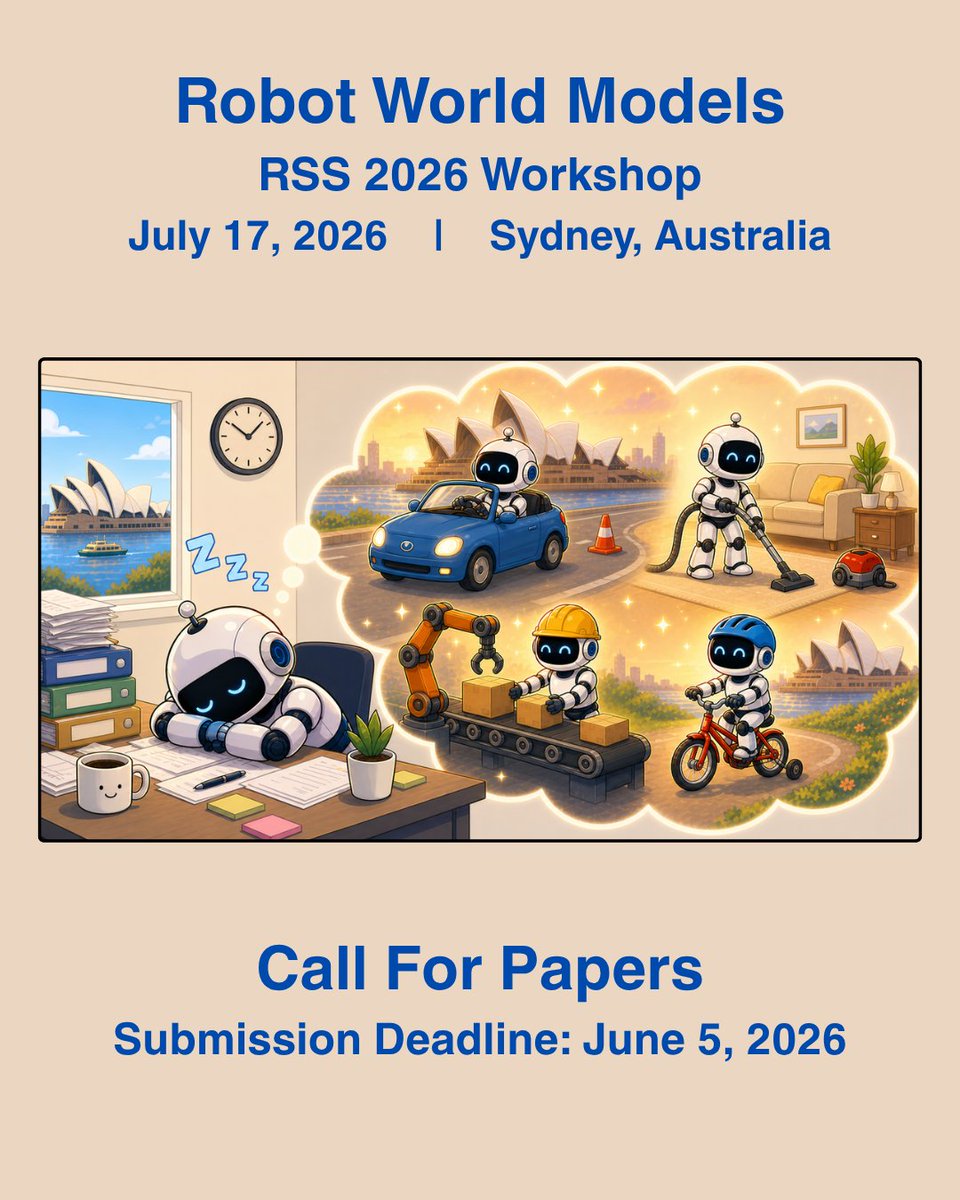
🚀 Announcing #RSS2026 workshop: Robot World Models 🌐🤖🐨🌐 July 17, 2026 in 🇦🇺!
We're bringing together researchers building the next generation of WM for robots — models robots can act in: controllable, long-horizon & grounded in real dynamics. 🔗 https://t.co/wMRyAcPzlP
🤖 🌍 We have extended the submission to our CoRL (@corl_conf) workshop about Robot World Models for one more week! Use your chance to submit! 🌏🤖
❗️Both 1-page abstracts of published works and 4-page novel works in progress are welcome!
📡 Details: https://t.co/XjeFO3YnBn
Introducing DINOv3 🦕🦕🦕
A SotA-enabling vision foundation model, trained with pure self-supervised learning (SSL) at scale.
High quality dense features, combining unprecedented semantic and geometric scene understanding.
Three reasons why this matters…
Are you working on real-to-sim, sim-to-real, learning world models, or using physics-based simulators? There are two weeks left until the submission deadline for our CoRL workshop, Learning to Simulate Robot Worlds. More details here:
🔗https://t.co/XjeFO3YnBn
🚀 We’re excited to announce our #CoRL2025 workshop: Learning to Simulate Robot Worlds
Spanning high-fidelity simulators, digital twins, and learned world models - our goal is to unite communities to push robot learning forward 🤖🌐
🔗 https://t.co/AjKxrN5DId
🧵🧵🧵
@svlevine was just presenting in the Exploration in AI @ #ICML2025 and promoted that exploration needs to be grounded, and that VLMs are a good source ;-) Check our paper below
👇
Zero-shot imitation from just a single sparse demonstration is hard. Goal-conditioned methods tend to “greedily" move from one state to the next and lose the big picture.
We're presenting an alternative approach on Tuesday at #ICML2025.
(1/3)
When multiple tasks need improvements, fine-tuning a generalist policy becomes tricky. How do we allocate a demonstration budget across a set of tasks of varied difficulty and familiarity?
We are presenting a possible solution at ICML on Wednesday!
(1/3)
✨Introducing SENSEI✨ We bring semantically meaningful exploration to model-based RL using VLMs.
With intrinsic rewards for novel yet useful behaviors, SENSEI showcases strong exploration in MiniHack, Pokémon Red & Robodesk.
Accepted at ICML 2025🎉
Joint work with @cgumbsch
🧵
How to represent dynamic real-world data both consistently and efficiently, while reflecting the compositional object-centric structure of the world?
Contrast your slots!
...with our new SlotContrast method(🚀#CVPR2025 Oral🚀)!
🌐website: https://t.co/UXeYp8qyAy
🧵🧵🧵 1/n
#Context plays a critical role not only in interpreting language but many other cognitive processes. In a new paper, we propose that context-sensitivity is a core feature of human memory that enables flexible planning, #generalization, and decision making https://t.co/LigJbVD4Dc
Were you ever wondering why there are little-to-no diverse offline imitation learning algorithms 🤔? Then we've got something 4 you! Our paper, "Offline Diversity Maximization under Imitation Constraints" is being presented today at RLC2024 🎇! 🧵
https://t.co/NTOedhW9vD
🚨We're back!🚨 Excited to announce The 2nd IMOL Workshop at #neurips2024!
Send us your 📜newest work📜on learning & exploration in artificial and biological agents. #CFP at https://t.co/6KDwrtx36b
🔄Please share widely & stay tuned for more programming announcements!
Tired of causally confused agents when learning from offline datasets?
We propose 🚣🏼♀️CAIAC🚣🏼♀️, a method for counterfactual data augmentation to improve the robustness of offline learning agents against extreme distributional shifts at test time. 🧵
🚨Introducing GenRL!
An embodied AI agent that learns multimodal foundation world models 🌍
By connecting the multimodal knowledge of foundation models with the embodied knowledge of world models for RL, GenRL enables turning vision and language prompts into actions!
For more details check out our paper or our code.
Paper 📜: https://t.co/9SVk5TEis5
Code 🐍: https://t.co/UqFIbp48Lt
Many thanks to @nsajidt, @GMartius, and @mvbutz!
8/8
World models are key for developing adaptive agents. In our #ICLR2024 spotlight we present THICK: an algorithm to learn hierarchical world models with versatile temporal abstractions. And we show how they can enhance model-based RL or planning…
📜 https://t.co/9SVk5TEis5
1/🧵
THICK PlaNet 🪐: We can also plan directly with our model. In THICK PlaNet we first plan on the high level with MCTS and then we search for low-level actions to follow this plan. This is useful for long-horizon or hierarchical tasks and sparse rewards.
7/8