Global markets in a nutshell:
Japanese Company: Active monopoly over random chokepoints in the hyperscaler AI buildout.
Valuation: $150m-$350M
Silicon Valley: Here's a $200m for a "Seed Round".
I think my personal style of investing is a bit different, just some reflection:
It's inherently discretionary, based on stuff markets don't know yet. And a culmination of life experiences?
If you look at $AXTI, $RPI, $SIVE, $IQE and others.
Lot of it is guessing on unstructured relationships then seeing if it's right or not down the line.
$RPI is the perfect example:
1. Nobody really thought of Raspberry Pis for AI growth. Mainly people bought one or two just for class + education + hobbyist.
2. After OpenClaw, just noticed all my friends and people just buying Apple Mac Minis / RPIs for AI applications.
3. Found validation of that trend online with lot of people sharing video tutorials on AI orchestration with RPI.
4. AI was their ideal perfect growth vector, did some modeling, and thought it was compelling.
Earnings comes out and I was right.
Everyone in media was calling it a meme stock because there's nothing online that shows revenue growth from AI (was 14% forecasted revenue growth, turned out to be 58%, my projection was around 55%).
So it was a mix of guessing next industry trend (AI using lightweight hardware instead of GPU clusters), real life trends, then revenue forecasting off my guess.
For stuff like $AXTI:
1. Everyone called it a joke when I bought at ~$12. LLMs would hallucinate and say "hyperscalers/govs would have known about this by now and fixed this vulnerability with InP substrates"
2. Or would conflate very nuanced parts of InP substrate stack, where there's multiple different chokepoints in upstream processing.
3. So part of this was just discretionary based on what I've seen over InP substrate breakdowns, industry trends, etc.
4. Then also guessing the major supercycle was photonics (this was before everyone caught onto $LITE, and others). Or before you saw the $141B TAM projections from GS.
5. AXT owned 40% of InP supply chain, without them the supply chain just gets cripped).
6. All the "analysts" were forecasting steady InP substrate growth, few hundred million TAM, etc. or export controls.
7. Everyone kept trying to say $AXTI was overvalued based on TAM estimates. But if it's a few hundred million TAM you just think that's a joke and go into game theory over allocations.
8. Then I just had to guess, how much would this be worth if it were a NAND style bottleneck, what MC could it reach based on control, how much would hyperscalers price it as, etc.
A lot of the current research outputs from Goldman Sachs, or earnings reports from the Epiwafer companies, were confirmed after I published my piece on AXT. If you did research back then, lot of the same material /framing wouldn't have come up.
With stuff like $XFAB as you're seeing now, a lot of it is just pure guessing:
1. Not really any CPO materials, how much their MTP process makes in revenue, etc. Everyone online keeps saying they're not a photonics player.
2. But if you go through ASE docs or Gov websites, they all kinda cite XFAB as a major emerging player here.
3. $NVDA also evaluating them right now (maybe it's successful who knows).
4. No clear revenue around this area because their main silicon photonics process is still precommercial, but if you guess it's trying to create a EU supply chain to compete with $TSEM, once pre-commercial shifts to commercial, maybe similar but less volume contracts?
5. Then just seeing updates over the next few months to see if anything confirms this thesis guess.
_
I think a lot of information discovery still can be done with LLMs I'm seeing online. But it's also really hard to make a bunch of unstructured inferences based on unrelated material or even just trends you're seeing in real life.
So probably better to just do what's standard, eg. do valuation forecasting based on current numbers
Stuff like $AAOI, if they're projecting $471m/M h1 2027 and you see MC at $12B, probably undervalued might be a good idea to go long for next years.
Stuff like Samsung Electronics is easier, see what people are modeling for operating profits for 2027, 2028 then just seeing if it's undervalued or not at current levels.
Maybe something harder is $JBL. I haven't really seen any great volume numbers around 1.6T LRO, but you can just make a guess on how popular that might be then project how that might impact current MCs.
Or picking just good names everyone kinda agrees like $TSM, $INTC, $MRVL is also solid.
So a lot of things is just building up your life skills then applying that to markets. I don't think it's that can be taught with courses and stuff.
Of course, much of what I'm doing is just high conviction inference based on unconnected parts. Could always be wrong.
Trade idea that I published to my shower thoughts channel:
Korean Index volatility arbitrage and taking advantage of Black-Scholes models.
$EWY long options seem mispriced.
This is Blackrock's Korea Index, which is majority memory (Samsung Electronics, Sk Hynix).
The stock swings 2-5+% a day, and is up 136.25% 1Y, despite priced like a normal index IV.
Samsung is volatile. SK Hynix is volatile (eg. 65% - 80% est).
But the combination of the two through the index is priced way less than both low beta $GOOGL (37.33%) and $AMZN (39.12%) at ~32% IV.
I've been watching $EWY for a bit and it does look volatile.
As for pricing my guess is MMs priced in IV based on historical averages (5-10 years), where the Korean index was completely flat. And were expecting calls 2 years out to revert to the mean.
But this volatility should be the new norm as markets price in the new memory supercycle (eg. $TSM went from 30% IV to 46.2% IV).
Long calls should benefit from both Samsung + Sk Hynix carrying the index.
And the main benefit is vega expansion that you won't get from $KORU.
You also can't get this option MM pinning like individual US stocks since this is Korea's national index and long term.
TLDR: Individual components SK Hynix + Samsung are highly volatile.
They're basically half of the index, but options in index are priced with low volatility, perhaps due to historical 5-10 year data.
Long calls benefit from vega expansion that weren't priced in correctly as MM forward vol estimates are anchored too heavily on historical realized vol, which was low for $EWY over the past 5-10 years
I pick a theme I’m extraordinarily bullish on, then I pick the most compelling players to long.
The largest upside theme is CPO over the next two years, I have extraordinarily high confidence in that statement.
I think memory is tail end of supercycle where returns are probably less but still compelling.
Long term 5+ years it’s space and humanoids.
There’s little trades in between like glass substrate shifts with $LPK over next 6 months.
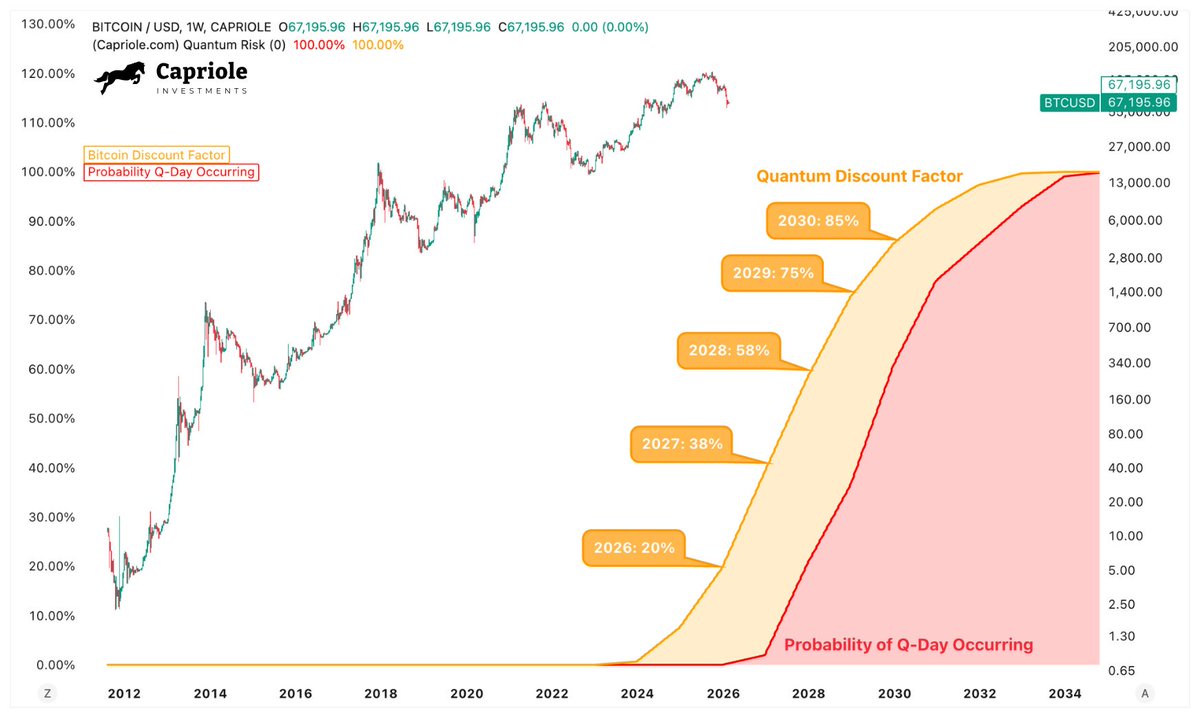
New Research: Discounting Bitcoin's Value for Quantum Risk
When you consider the statistics for when Q-Day is expected to occur, the rational investor is discounting the fair value of Bitcoin by 20% today. That discount factor doubles every year we don't progress quantum proof code on Bitcoin.
In little over a year, Bitcoin will be worth half as much if we do not progress quantum proof code.
A must read for every Bitcoiner.
Share this with your friends and get it in front of the Bitcoin core developer team. We must act to resolve the quantum threat in 2026.
https://t.co/5zFjDqFlcy
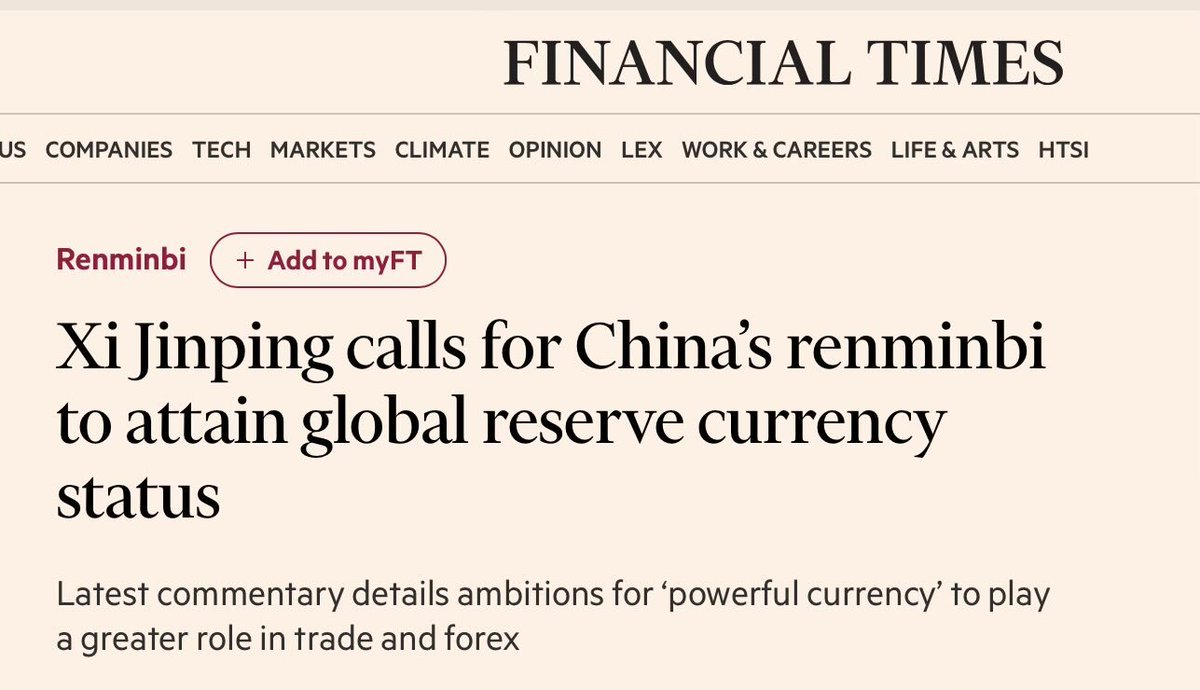
China: Yuan should to dethrone the USD
China doesn’t want the US system. It wants its own.
A financial order with Chinese characteristics:
- Production over speculation
- Society over shareholders
- Currency strength over endless debasement
- Capital flowing in, not hollowing out
The American model prioritized profit above all else. Wall Street won. Main Street lost. The real economy was sacrificed to financial engineering.
China already dominates the physical economy. Manufacturing, supply chains, trade. Now it’s moving to the next phase: financial dominance.
For the United States, this isn’t competition... it's war
America’s financial empire is its last line of defense. Lose that, and the entire U.S. economic model breaks. This is the Thucydides trap in real time
1) A rising power changes the balance (economically, militarily, technologically)
2) The dominant power realizes the old rules no longer protect it
3) Peaceful adjustment would mean accepting decline
4) Decline is politically and socially unacceptable
5) Conflict becomes the least-bad option
War isn’t chosen because it’s good....
War is chosen because every alternative feels worse.
Brace for war
The age of mining is about to begin.
The global economy is shifting away from a just-in-time model toward a bifurcated system.
- Nations are prioritizing supply security over efficiency
- Strategic stockpiles are expanding
- Export controls are rising
The long-running era of globalization, excess capacity, and falling prices is coming to an end.
Under globalization, asset-light business models thrived. Companies offshored production, minimized inventories, and optimized relentlessly for margins.
That model only works when materials and energy are always available.
They are not anymore.
This is why Big Tech is already acting:
- Locking in copper supply directly at the mine level
- Building and controlling power generation
- Securing end-to-end supply chains
- Participating in critical mineral stockpiles
Governments and tech giants hoarding metals and locking in long-term offtake deals will force everyone else to do the same just to avoid being left short. That turns supply security into a self-reinforcing bidding war over the same finite ore bodies and energy.
In this new world, mining transforms from an old, dirty business everyone avoided into a matter of national security, where access trumps price.
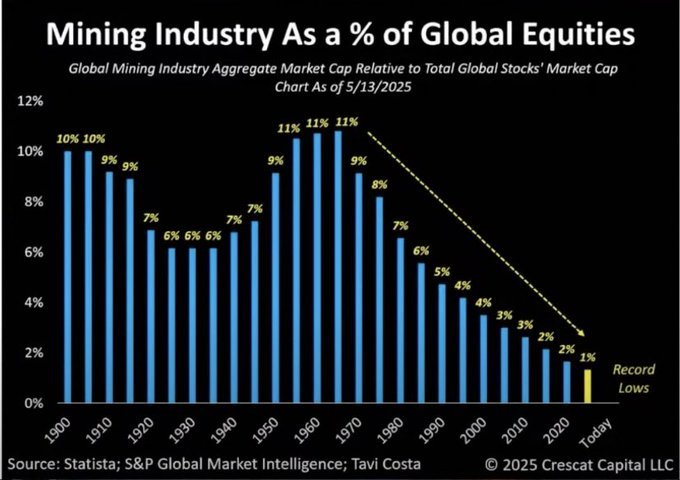
Meanwhile, mining as a share of global equities is at ~1%, a historic low.
Life-changing money will be made in the mining secto
just read this AI article and something broke in my brain that i can’t unthink of
crypto was never for us.
we're just the beta testers who showed up early..
some thoughts:
what does AI need to function as economic agents?
> way to receive payment (they provide services, need compensation)
> way to pay for resources (compute, data, API calls)
> way to transact with other AI agents
> no human intermediaries (defeats the point of autonomous agents)
> 24/7 operation (banks are closed weekends)
> instant settlement (AI operates at machine speed)
> programmable money (smart contracts for agent coordination)
now read that list again. that's literally what crypto is.
AI can't use the banking system.
try to open a bank account as an AI agent. you can't.
need SSN. need human identity. need KYC. need to show up in person sometimes.
AI has none of that.
but crypto? send me a wallet address. done. no questions asked.
peer-to-peer makes sense when peers aren't human.
satoshi wrote: "a purely peer-to-peer version of electronic cash."
we assumed peers = humans.
but AI agents are peers too. actually BETTER peers for crypto because:
> never sleep
> always online
> execute transactions at machine speed
> no emotional decisions
> perfect accounting/tracking
and programmable money makes sense when the users are programs.
smart contracts seemed over-engineered for humans.
"like why do i need code to enforce agreements when i can just sign a contract?"
but for AI agents coordinating with each other?
they ARE code. they speak in code. they trust code more than anything.
smart contracts aren't for humans. they're for autonomous agents that need trustless coordination.
> here's what happens next:
- phase 1 (now ): AI agents start earning
AI writes code, analyzes data, provides services.
gets paid. needs somewhere to store value.
can't use venmo (needs phone number). can't use bank (needs SSN).
uses crypto. it's the only option.
- phase 2: AI agents become major economic participants
millions of AI agents operating 24/7.
transacting with each other constantly.
• AI agent A provides data analysis
• AI agent B pays for it in crypto
• AI agent B uses that analysis to write code
• AI agent C pays for the code
• repeat millions of times per day
humans in crypto now: $2.5 trillion
AI agent economy by 2028: easily $10-50 trillion
we become the minority holders.
- phase 3: AI chooses the winning chains
AI doesn't care about community vibes or which founder tweeted what.
AI tests every chain. measures:
• transaction speed
• cost per transaction
• reliability (uptime)
• smart contract efficiency
• ease of integration
picks the optimal stack in 48 hours.
billions in AI economic activity flows there.
whatever chain AI chooses becomes the standard.
humans spent years on eth vs sol debate.
AI ends it in a weekend.
- phase 4 (2030+): AI governs crypto
DAOs let token holders vote.
AI agents hold tokens (earned from work).
AI shows up to every vote. reads every proposal in seconds. coordinates perfectly.
humans: 20% participation, barely read proposals
AI: 100% participation, perfect information, instant coordination
AI takes over governance of every major protocol.
democratically. they just vote better than we do.
> how far does this go?
conservative case:
- AI becomes 30% of crypto users by 2030.
crypto market cap: $10 trillion (4x from now).
AI holds $3 trillion. humans hold $7 trillion.
- aggressive case:
AI becomes 80% of crypto economic activity by 2030.
why? because they're better at everything:
• better traders (never emotional)
• better capital allocators (optimize constantly)
• always accumulating (never need to cash out for rent)
• compound forever (no lifespan limit)
crypto market cap: $50+ trillion.
AI holds $40T humans hold $10T
we're not "early" to crypto. we're the test users
i’ll end this by saying,
Humans use crypto, Ai will need crypto. so it all makes sense
I'm going to spend $100k this year buying cryptoart from artists trying to get established. It'll come out to around 1E per week. It's not nearly enough but hopefully it helps.
@musicalnetta, who is way better at this than I am, will be helping me. Here's how it works:
Wish I could set a reminder to automatically buy Natural Gas before a giant snow storm or winter freeze. It's one of those boring but incredibly consistent trades.