Lucy 2.5 Realtime is now live on fal!
Real-time video-to-video editing over WebRTC, from @DecartAI.
- Restyle, swap backgrounds, and add, replace, or remove objects live on a webcam or streamed feed as it plays
- Swap characters, change color and texture, and drop in VFX like fireballs, explosions, and smoke
- Reference-image character-swap and virtual try-on at interactive latency
- Sharper edit isolation and prompt adherence on small, off-center, non-human objects
Meet Lucy 2.5, our most advanced Live AI model yet.
Lucy edits videos in realtime, now with more capabilities and greater control.
See how it's being used across streaming, e-commerce, advertising, and more 🧵
Multiple postdoc positions in geometric ML and generative modeling are available at Oxford in collaboration with Aithyra and Imperial @bose_joey
https://t.co/JXt5O4509w
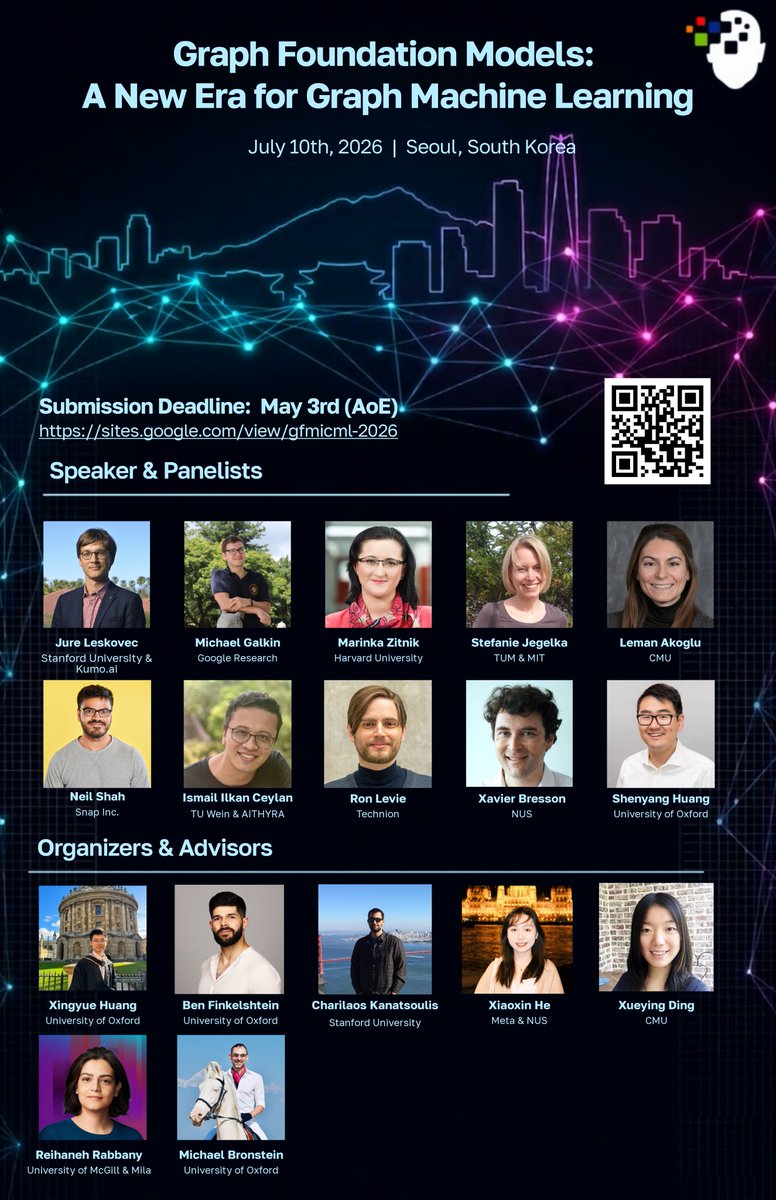
We are happy to announce that "Graph Foundation Models: A New Era for Graph Machine Learning" workshop has been accepted at #ICML2026!
Call for papers on topics: Graph Foundation Models, LLMs/TFMs+Graphs, theory of GFMs, etc.
📷 Submit by May 3rd! 📷 #GraphML#GFM
Introducing Look Where It Matters — High-Resolution Crops Retrieval for Efficient VLMs.
VLMs don't need to process full high-res images. AwaRes uses tool-calling to retrieve only the high-res regions needed to answer a given query🧵
https://t.co/JCiHCykcRP https://t.co/xqIYzmKeHP
🧵 1/ New paper: HiMu — Hierarchical Multimodal Frame Selection for Long Video QA
Your brain doesn't rewatch a 1-hour video to answer a question. It splits the problem: speech → audio, visuals → vision, "right after" → temporal ordering.
We built a system that does the same
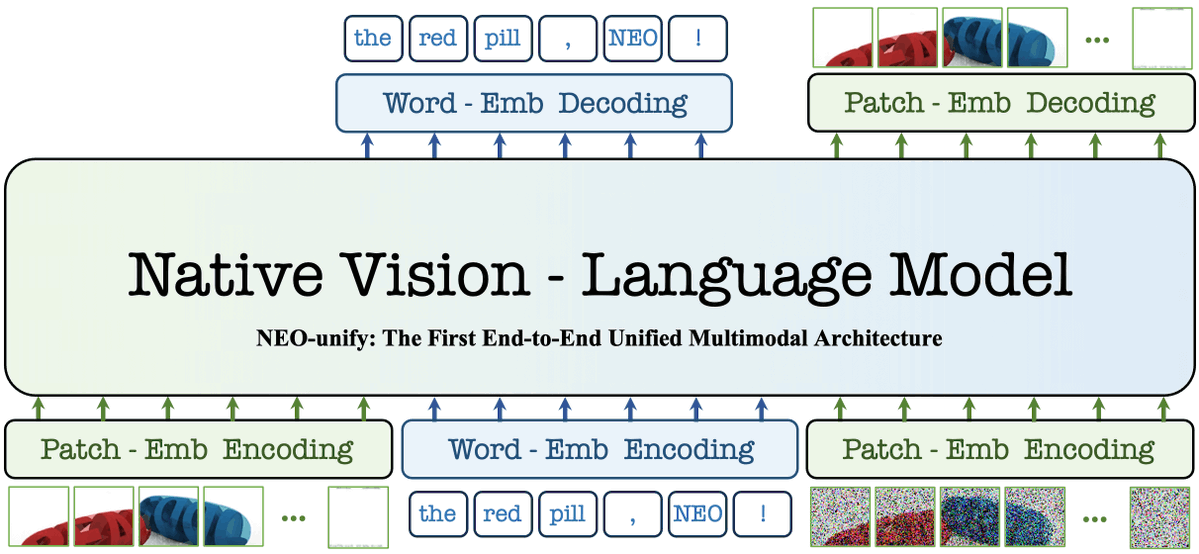
🚫 No Vision Encoder (VE)
🚫 No Variational Autoencoder (VAE)
✅ Just one end-to-end model directly engages with native signals, pixels and words, for both understanding and generation.
💊NEO-unify💊 is the first step toward **truly end-to-end unified models**, learning directly from near-lossless inputs via a representation space shaped by the model itself.
A bit late, but Our paper "R³: Deraining Directly in the Bayer Domain" was accepted to #WACV
We explored why working on Raw Bayer images beats standard RGB for rain removal.
Last month alone: 📊 87k+ downloads (RGB) 📊 32k+ downloads (Bayer)
Shoutout to @ChaimBaskin
Can Video-LLMs really connect the dots across time? 🕵️♂️🎬
Many benchmarks are solvable from a single lucky frame - so models can pass without true temporal reasoning.
We introduce HERBench, a harder VideoQA benchmark for multi-evidence integration
🔗 https://t.co/DhiqevEdxC
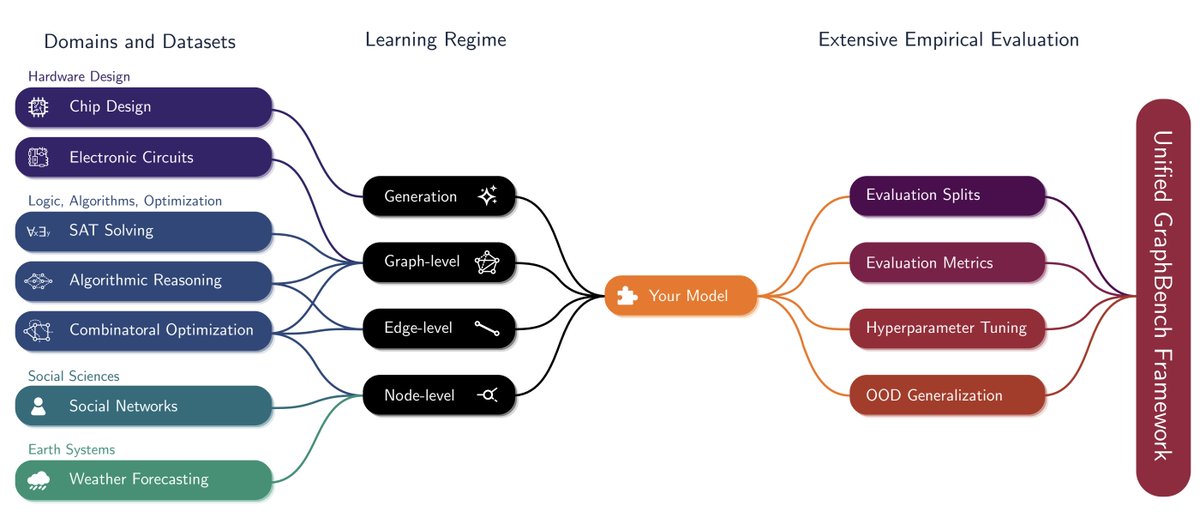
GraphBench: Next-generation graph learning benchmarking is now available! 🔍📊
This work introduces GraphBench: a comprehensive benchmarking framework for graph learning that provides principled baselines and reference performance across modern models.
https://t.co/wm2NlL02tq
Want to create an avatar from a single image?
FlexAvatar is a transformer model that creates full 360°, high-quality, and expressive 3D head avatar from just a single portrait image in minutes.
Real-time Demo: FlexAvatar's lightweight architecture allows both animation and rendering in real-time, enabling interactive user experiences. To create a new 3D head avatar, only one image is required, e.g., from a webcam. The final avatar is ready after 2 minutes.
Architecture: Under the hood, FlexAvatar adopts a transformer-based encoder-decoder design. The encoder maps the input image onto a latent avatar space, while the decoder produces 3D Gaussian attribute maps by incorporating the animation signal via cross-attention.
The model learns all facial animations directly from the data without relying on pre-built 3D face models. This equips the avatars with realistic facial expressions.
The internal avatar latent space can be conveniently used to integrate additional observations of a person via fitting. This enables use-cases where more than one image of a person is available, e.g., from a phone scan of the person.
We train jointly on 2D monocular videos and multi-view data. However, in monocular videos, the animation signal leaks the target viewpoint, causing the model to produce incomplete 3D heads. We call this phenomenon entanglement of driving signal and target viewpoint.
To prevent entanglement, we introduce bias sinks. These are learnable tokens that indicate whether a training sample stems from a monocular or a multi-view dataset. During training, the model learns to produce incomplete 3D heads only when the monocular token is present.
During inference, FlexAvatar then always uses the multi-view token for which the model has learned to produce complete 3D heads. This simple design allows to combine the generalizability from monocular data with the quality of multi-view data.
FlexAvatar summary:
- Input: Single-image, phone scan, or monocular video
- Output: Full 360° head avatar
- Expressive animations
- Real-time rendering and animation
- Generalization to any portrait
- Create a new avatar in 2 minutes
- Use bias sinks to combine 2D and 3D data
🏠https://t.co/DTmz4OYtBM 🌍https://t.co/kghX1sloWU
🎥https://t.co/PHKXvGRK6J
Great work by @TobiasKirschst1 and @SGiebenhain!
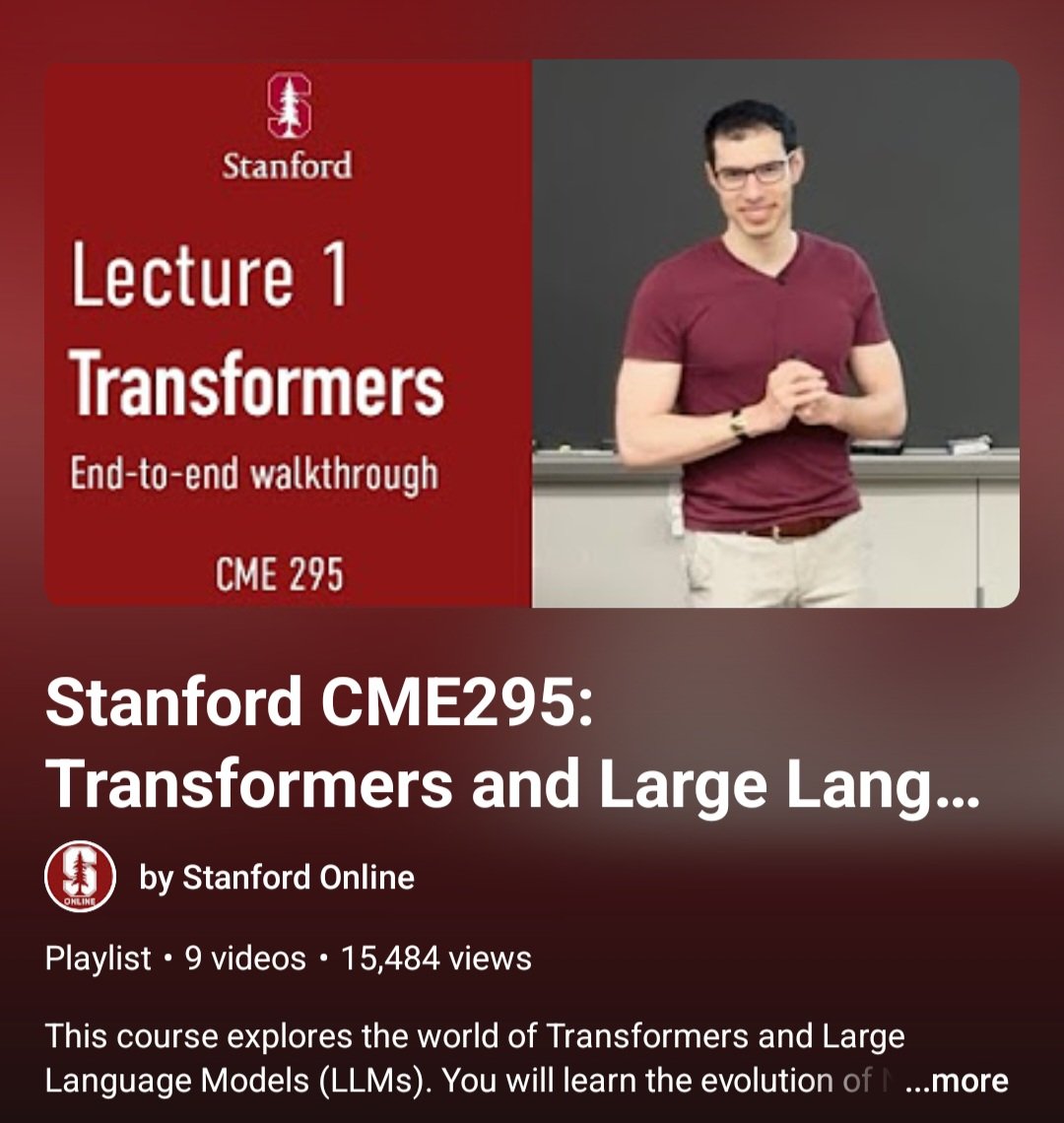
Stanford just dropped their full LLM course on YouTube.
9 lectures.
Completely Free.
Real curriculum-level depth.
CME 295: Transformers & Large Language Models
This isn’t:
• a hype tutorial
• a prompt-engineering hack
• a tech influencer hot take
It’s Stanford’s Autumn 2025 course.
They cover: Transformers from first principles
Tokenization, attention, positional embeddings
Decoding, MoE, scaling laws
LoRA, RLHF, fine-tuning
RAG, tool calling, evaluation
RoPE, quantization, optimization tricks
This is foundation-level AI knowledge.
The kind that actually gets you ahead.
If you’re serious about learning AI:
👉 bookmark this
👉 repost for later
👉 stop doomscrolling and build
Playlist link: https://t.co/6rEBdY9tIU
I’m excited to share our new work🎉, published with Raz Lapid, Rom Himelstein, Yaniv Nemcovsky, @ChaimBaskin , Avi Mendelson, @ziv_ravid
« You Had One Job: Per-Task Quantization Using LLMs' Hidden Representations «
We introduce a hidden tasks representation-aware compression and quantization method with dynamic per-layer bit allocation.
The idea: during post-training quantization (PTQ), we explicitly preserve features and hidden representations at every layer, so the model retains the information that actually matters for the task—even as we aggressively compress it.
What surprised us: on several benchmarks, the quantized & compressed model performs better than the original baseline. In other words, our PTQ procedure not only avoids hurting accuracy, it can recover signal that was blurred by auxiliary objectives or pretraining noise.
Why this matters now: Industry is pulling in two directions:
1.huge, general-purpose models (AGI-style) with apps layered on top, and
2.efficient, task-specialized models that run well on edge devices.
Our results push the second path forward: we shrink models for a specific task and make them smaller and much better on that same task.
This is just a start. Understanding and preserving internal representations opens new doors across training, compression, and information retention while reducing model size.
https://t.co/WKbbHzJpin
This is a bigger disaster and, in my humble opinion, a reflection that the community is sick. Why are we afraid of our names being seen while publicly commenting on scientific work? Disabling of commenting and editing functions is insult to authors and killer of science.