Most people's mental model of Chainlink $LINK is completely wrong
Here's why👇
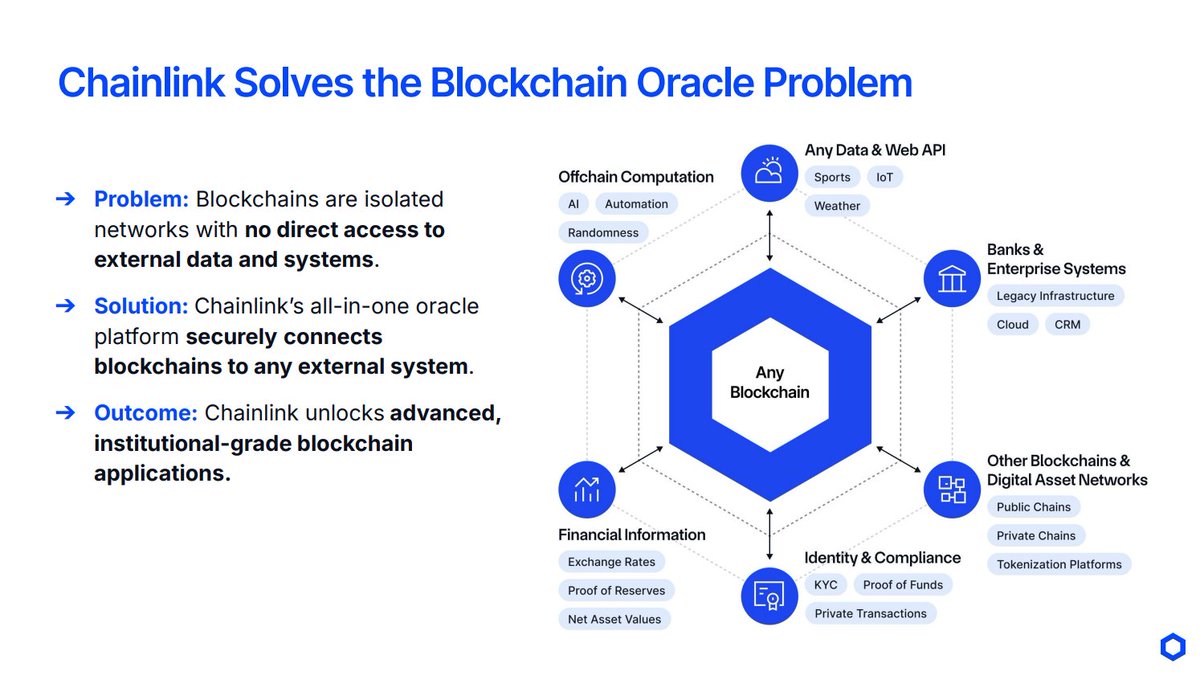
People often think of oracles as simple middleware bolted to the side of a blockchain, simply injecting price data
In their mind, Chainlink is "just an oracle" so who cares right?
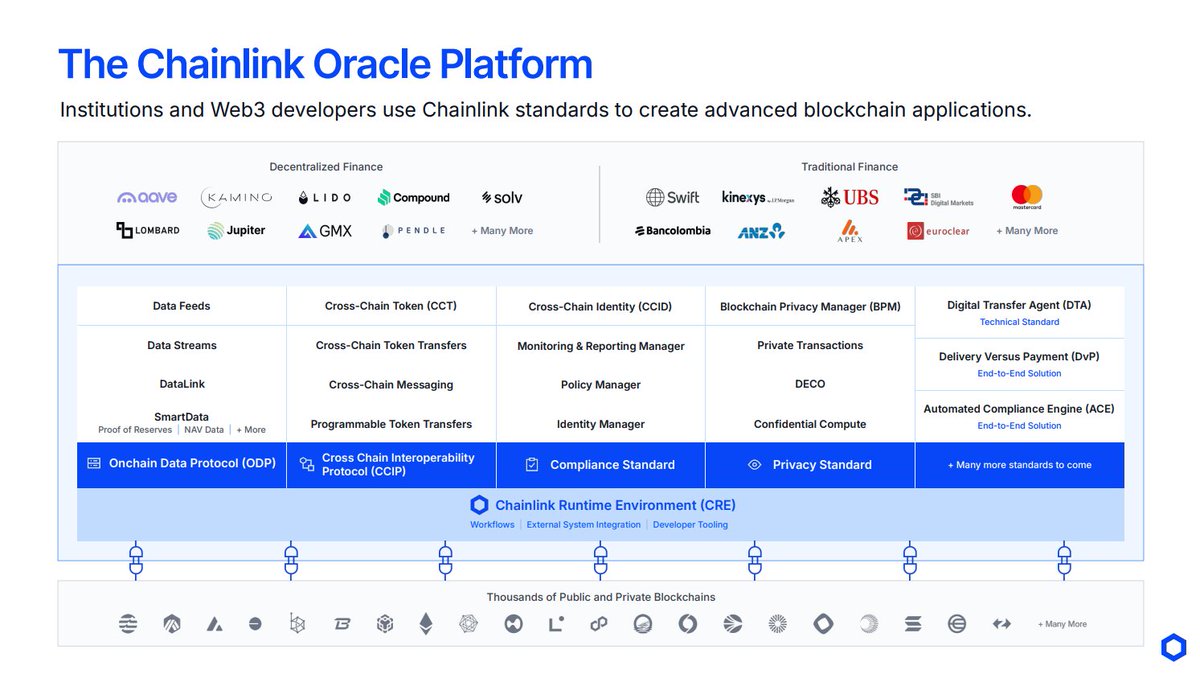
A more complete mental model is that Chainlink is the global orchestration layer that sits above and across all blockchains and external systems
A unified platform that enables organizations to create advanced business workflows spanning any number of blockchains, legacy systems, and oracle services, all powered by a decentralized runtime environment
This matters now more than ever because we are entering a Cambrian explosion of blockchains of all kinds (public & private, L1 & L2, DeFi & TradFi, EVM & non-EVM)
The cost and friction of launching a new blockchain network has never been lower
And what we have seen historically is that in order for a blockchain to be successful, it needs critical oracle services:
- Data oracles: DeFi needs market data to secure lending and derivatives, while TradFi needs NAV data for tokenized funds and corporate actions data for tokenized equities. Proof of Reserve provides public visibility into the reserves backing tokenized assets
- Cross-chain oracles: Digital assets in both DeFi and TradFi need to be securely transferable across any public or private blockchain to access a greater pool of buyers, minimizing liquidity fragmentation and enabling advanced settlement workflows
- Compliance oracles: Regulated tokenized assets need to comply with various regulations and internal business logic rules around identity verification and risk management to become adopted by institutions
- Privacy oracles: Sensitive information needs to be made accessible to blockchain apps without revealing the underlying data, while private chains need to connect to public chains while only selectively revealing what is needed to complete transactions
- Legacy-system oracles: Institutions want to access public and private blockchains using their existing infrastructure and messaging standards (Swift, FIX, DTCC) through a single integration gateway rather than manually integrating with thousands of chains individually
- Orchestration oracles: Institutions need to be able to coordinate complex business workflows that span multiple blockchains, legacy systems, and oracle services through a simple API gateway
Chainlink is the only unified platform that provides all of these solutions in a single offering, minimizing trust-assumptions and eliminating the complexity of using a patchwork of service providers
This is how institutions adopt blockchains, not by betting on specific chains, but integrating with a unified platform that provides them access to any public or private chain
While blockchains fiercely compete amongst each other to become the transactional database layer, Chainlink wins regardless of which chains are used
For Chainlink, every new blockchain introduced to market is all the more justification for why organizations need a global orchestration layer to manage the complexity
Financial market infrastructures like Swift, DTCC, and Euroclear understand this, which is why they have adopted Chainlink alongside J.P. Morgan, Mastercard, Central Bank of Brazil, UBS, SBI, Fidelity International, ANZ, and many others
In addition to powering the DeFi economy (70%+ marketshare globally, 80%+ on Ethereum, and 90%+ on L2s), Chainlink directly monetizes the integration and deployment of its services on blockchains via the Scale program and enterprise deals
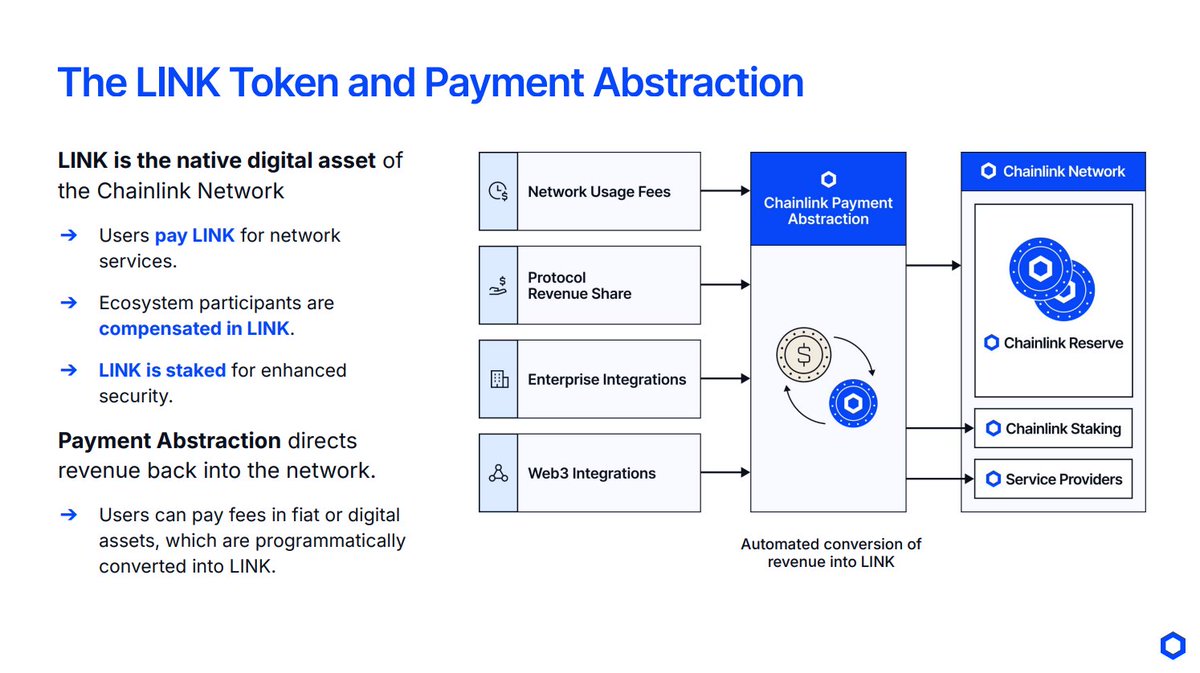
Onchain revenue from the usage of Chainlink services, as well as offchain revenue from Scale and enterprise deals, directly fuel $LINK token buybacks which grow the Chainlink Reserve
Chainlink services have already enabled $28+ trillion in transaction value across 77+ blockchain networks via 2,000+ oracle networks used by 500+ applications, with more public and private blockchains regularly integrated all the time
Today, developers build on blockchains and plug into Chainlink
In the future, developers will build on Chainlink and plug into blockchains
The result is straight forward:
More blockchains
↓
More Chainlink adoption
↓
More onchain & offchain revenue
↓
More $LINK token buybacks
↓
Chainlink's dominance compounds
The US government, citing national security authorities, has issued an export control directive to suspend all access to Fable 5 and Mythos 5 by any foreign national, whether inside or outside the United States, including foreign national Anthropic employees.
The net effect of this order is that we must abruptly disable Fable 5 and Mythos 5 for all our customers to ensure compliance.
Access to all other Claude models is not affected.
We apologize for this disruption to our customers. We believe this is a misunderstanding and are working to restore access as soon as possible.
Read our full statement: https://t.co/bwn0sximKZ
4 days.
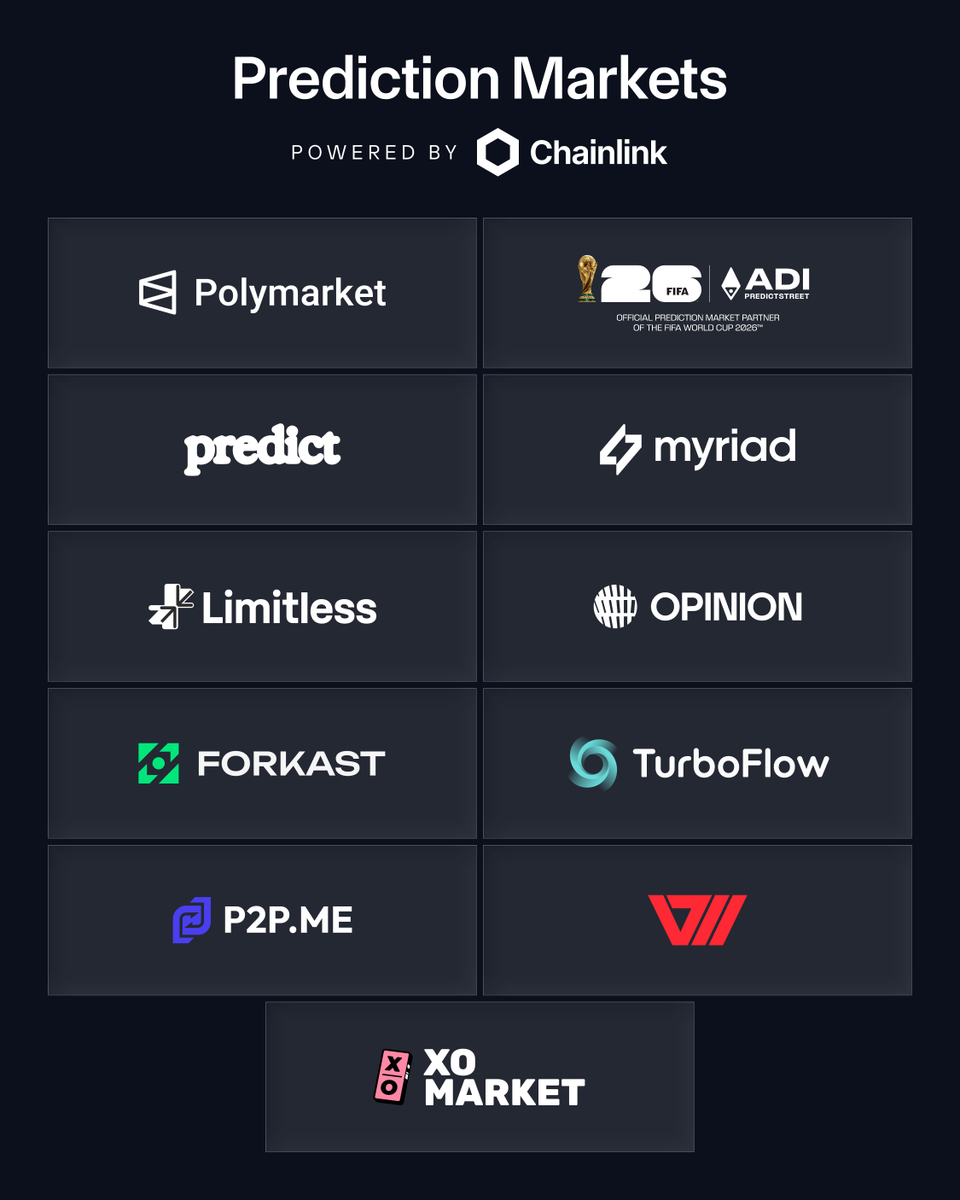
8 new prediction market integrations.
100s of new markets.
The DeFi moment for prediction markets is here, and it’s powered by Chainlink.
Explore the ecosystem 🧵👇
$LINK is the exclusive asset for direct exposure to the success of @Chainlink
Unlike other projects that have sold both tokens and equity to investors (creating conflicting economic interests), Chainlink is not driving value to any equity and there is no IPO—there is only $LINK
Any claim or perception that the goal is to maximize the value of Chainlink Labs at the expense of, or in isolation of, LINK holders (e.g, Ripple stock vs XRP) is dead wrong
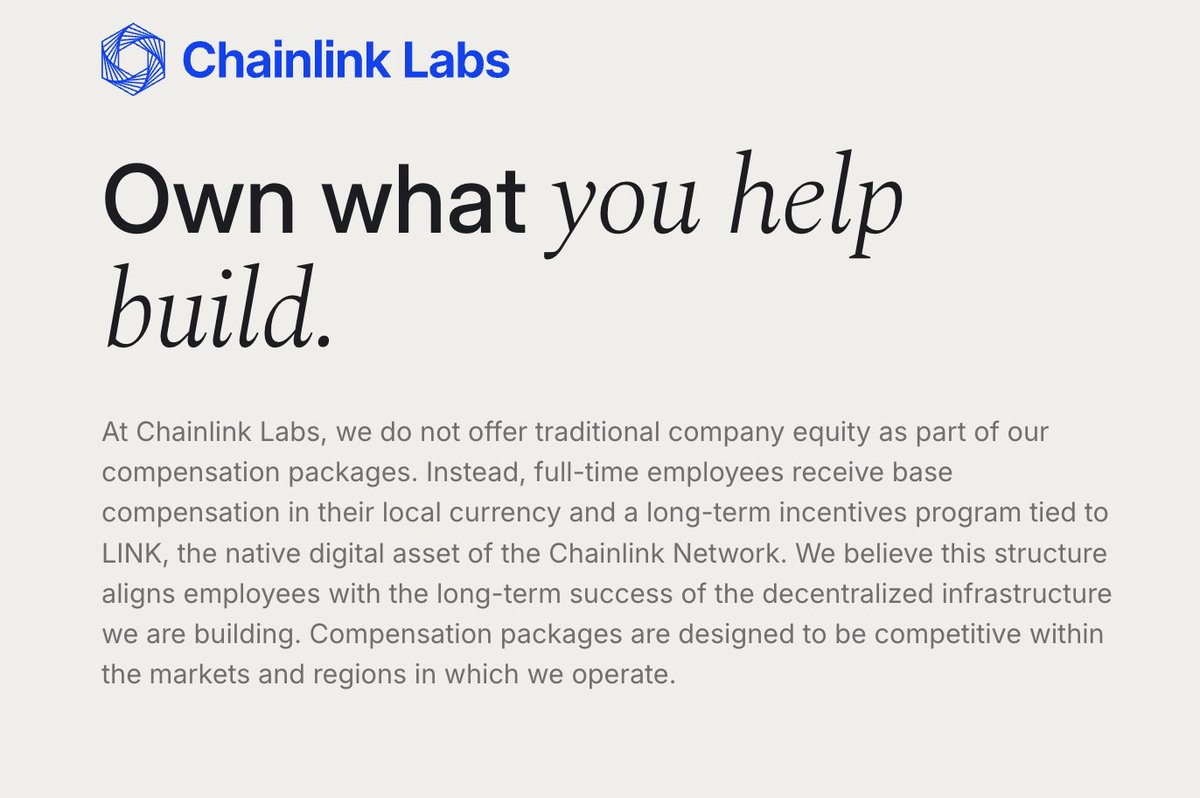
There's no better proof in this than how Chainlink Labs employee compensation works
Employees do not receive equity, they receive base comp in local currency and a long-term incentives program tied to $LINK
Interests are fully aligned via direct skin in the game
Think about it, any detrimental action toward LINK holders would directly impact the CLL employees building the protocol as well, makes no sense
Some of the largest $LINK whales I personally know work for CLL, there is an shared interest in seeing the token do well
Fundamentally, we are all in this together
NEW: @trylimitless, the largest prediction market on @base, adopts Chainlink Data Streams as its oracle infra to power high-speed resolution for short-term, high-volume crypto markets with instant payouts.
Predict outcomes across BTC, ETH, SOL, and more leading assets today.
NOW: Chainlink is powering new @FIFAWorldCup prediction markets for @MyriadMarkets.
The opening round of the 2026 FIFA World Cup™ kicks off in just 2 days, predict match outcomes for the world’s largest sporting event today.
Over the past several weeks, Aave has been developing a new risk framework that includes Asset Risk, Bridging Risk, Chain Risk, and advanced automation capabilities for risk management.
This framework establishes a new standard for how Aave assesses, monitors, and manages risk across the protocol.
After passing the proposal, the risk framework will be applied across all markets and assets. Assets that do not qualify for the new standard will be off-boarded from Aave over the coming weeks.
NEW: The Official Prediction Market Partner of the @FIFAWorldCup is now powered by Chainlink.
@Predictstreet has adopted Chainlink as its exclusive oracle infra to enable accurate market resolutions & unlock instant payouts for the world's largest sporting event with 6B+ fans.
NEW RESEARCH: IC3 just published one of the most comprehensive surveys on AI & crypto.
As AI & agents scale, model-level guardrails aren’t enough. AI needs:
• Trusted data
• Authenticated workflows
• Verified execution
• System-level security
Chainlink solves this.
Still blows my mind that the former @ChainlinkLabs Deputy General Counsel of 5+ years is now Chief Counsel for the U.S. @SECGov Crypto Task Force
From the infra powering DeFi to the regulator overseeing it..
Quite obvious the real tech that’s been built over the past decade+ in this industry will inevitably underpin US capital markets
Just watched Taylor Lindman, Chief Legal Counsel for its Crypto Task Force.
I wish I could share the full talk because it’s unfucking real we have such pro-DeFi experts in these positions of power in the government.
Optimistic on access to real DeFi in the USA and abroad 👊
In the past week, Chainlink SVR generated $3.57M in revenue by recapturing non-toxic liquidation MEV for lending protocols like Aave, Compound, Venus, and Morpho
This revenue was split $2.3M to integrated DeFi protocols and $1.27M to Chainlink, supporting the economic sustainability of DeFi and the oracles that underpin it
Year-to-date SVR revenue now totals over $12.43M, with all-time SVR revenue exceeding $22.35M
Offchain and onchain revenue in the Chainlink ecosystem support weekly Reserve ethereum:0x514910771af9ca656af840dff83e8264ecf986ca buybacks, with $49.5M in inflows to date
Since launch, @Chainlink SVR has grown to become the most widely adopted oracle MEV recapture solution with ~99% market share
• Adopted by the largest DeFi lending markets including Aave, Compound, Venus, and various Morpho markets
• Exclusively recaptures the non-toxic liquidation MEV that would have leaked to L1 validators and searchers during DeFi loan liquidations
• Has generated $18.7M in revenue, split $12M to integrated DeFi protocols and $6.7M to Chainlink (supporting $LINK buybacks)
• Achieves a consistent 85% recapture rate (i.e., SVR recaptures ~$85 for every $100 in liquidation bonus made available)
• Has successfully processed over $700M in liquidation value for Aave alone, with zero bad debt accrual even during extreme market volatility like Oct 10
• Features the largest, most decentralized ecosystem of independent searchers, with over 115 independent liquidators (competition ensures solvency + drives up recapture rates)
• Enabled Chainlink to directly monetize its DeFi app total value secured, in addition to monetizing the integration, usage, and maintenance of oracle services by blockchains via the Scale program
Chainlink SVR = literal money printing machine
It can’t be onchain enforced, by definition, because it involves offchain enterprise revenues
Weekly Reserve inflows follow a programmatic schedule that smooths out revenue, hence similar amounts each week, considering such deals are often laid on quarterly or milestone basis etc
I’m not saying what you describe is a bad idea, I’m saying it’s not a great use of resources considering there’s a tokenization market to win, which is first priority
Since launch, @Chainlink SVR has grown to become the most widely adopted oracle MEV recapture solution with ~99% market share
• Adopted by the largest DeFi lending markets including Aave, Compound, Venus, and various Morpho markets
• Exclusively recaptures the non-toxic liquidation MEV that would have leaked to L1 validators and searchers during DeFi loan liquidations
• Has generated $18.7M in revenue, split $12M to integrated DeFi protocols and $6.7M to Chainlink (supporting $LINK buybacks)
• Achieves a consistent 85% recapture rate (i.e., SVR recaptures ~$85 for every $100 in liquidation bonus made available)
• Has successfully processed over $700M in liquidation value for Aave alone, with zero bad debt accrual even during extreme market volatility like Oct 10
• Features the largest, most decentralized ecosystem of independent searchers, with over 115 independent liquidators (competition ensures solvency + drives up recapture rates)
• Enabled Chainlink to directly monetize its DeFi app total value secured, in addition to monetizing the integration, usage, and maintenance of oracle services by blockchains via the Scale program
Chainlink SVR = literal money printing machine
I understand and recognize the community value of more Econ info being shared, many considerations in that ultimately not my call
But do you believe spending months/years building, testing, and auditing such a novel ZK system would be the best use of the team’s limited product/eng resources?
That the team should actively take resources away from building monetized end-to-end solutions for banks/institutions, and instead do this?
If Chainlink doesn’t win institutional tokenization, because it’s distracted building unrelated non-monetized solutions, then it won’t matter such a system exists because there will be no economics/revenue to prove