@LATAM_BRA Grato. Estou tentando comprar POA-MIA-POA. Dia 8/8: LA 3219 - LA 8190. Retorno em 21/8: LÁ 8191 - LA 3771 tarifa econômica Stsndard e upgrade p/ LATAM +
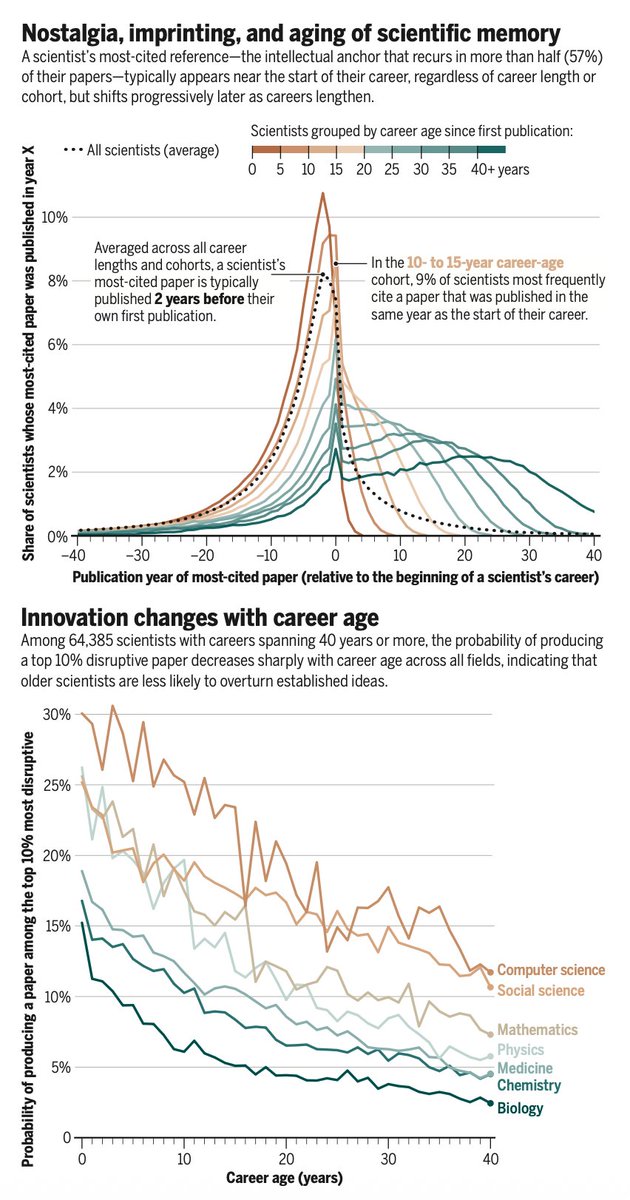
How is innovation in science impacted by aging researchers? @ScienceMagazine
"Aging enhances combinatorial innovation but limits disruptive breakthroughs"
@ScienceVisuals Figure showing anchor publication of a scientist typically early in career (top) and declining innovation over length of career (bottom)
https://t.co/E2Q6Zzdf4s
The cardiology community mourns the loss of Dr. Eugene Braunwald, a towering figure whose work shaped modern cardiovascular medicine.
From foundational discoveries in heart failure to Braunwald’s Heart Disease, his legacy will guide generations to come.
A true giant in our field.
2/
The Inverted Pyramid
What is happening in contemporary Spanish healthcare is a phenomenon worthy of anthropological study: the pyramid of authority has been inverted while the pyramid of responsibility remains intact.
Doctors are required to answer to the judge, to the professional college, to hospital management, to the patient, and to society for every clinical decision. When something goes wrong — and in medicine, things go wrong with a measured and inevitable statistical frequency — the doctor stands alone facing the disciplinary file, alone facing the lawsuit, alone facing the newspaper headline.
Yet, that same professional has been systematically stripped of the corresponding authority. A nurse questions an order in a prosecutorial tone. An orderly decides that a transfer can wait and walks away. A technician refuses to take an X-ray because “the indication is not clear.” And the doctor, who has just weighed fifteen differential diagnoses, must justify themselves to someone who lacks the training to understand the complexity of what is being decided.
The most egregious example comes from the administrative level. The manager who prohibits the use of a certain implant because there is a cheaper one, without understanding that the cheaper one has a failure rate three times higher. The protocol that limits monthly MRIs, as if pathology should adapt to the budget. It happened with shoulder arthroscopy in its early days, banned because “the instruments and implants were very expensive”: the decision on which surgical technique to use was left in the hands of someone who could not distinguish an arthroscope from an otoscope.
The message is devastating: your clinical judgment is subordinate to my economic judgment. Your knowledge is worth less than my Excel spreadsheet.
And there is the degradation of the medical signature. Everything is signed: reports, requests, reports, consents, invoices. This leads to a loss of value in the signature; it banalizes it. But it is a selective banalization: when the signature implies responsibility, it is demanded rigorously; when it should imply authority, it is ignored. The doctor signs a surgical indication and the manager postpones it. Signs a material request and the administrator rejects it. The signature serves to condemn you, not to make them obey you.
The pattern is invariable: the doctor signs, answers, bears the consequences. But does not decide, does not command, does not have the final word in.
Next installment: “The Perverse Framework”
Subscribe to continue reading
(Original source: https://t.co/ZTUKs0aGaA)
@drjohnm@Sensible__Med Of course @drjohnm is easier to ordem a test that ChatGPT will help me to decide.
Touch the patient? No way!!
How can we break this paridigm?