Fascinating paper in @NeuroConsc, experimentally altering dreams by sound stimulation during sleep 😴 leads to creative problem solving 💡 after waking. Researchers Karen Konkoly, Ken Paller & team @NorthwesternU. @kap101@NeuroConsc
https://t.co/XnZXmQ1fzq
Happy to share new preprint on wake slow waves in older adults with subjective cognitive decline (INSIGHT-preAD cohort), with my awesome postdoc mentors Thomas Andrillon & @OudietteD at @InstitutCerveau!
Thanks @Alzh_Fondation for support!
https://t.co/W4bTEYTv47
Evolutionary insights into sleep infraslow rhythmicity! Excited to see research investigating such rhythms beyond humans and rodent models, including pigeons 🐦 and 7 lizard species 🦎
Our paper on CSF, BOLD, pupil, and physiological measures in sleep deprivation and recovery sleep is finally out! 🎉 Congrats Zinong!
https://t.co/0joyYnsSh6
Amazing new study combining functional PET(fPET)-FDG and EEG-fMRI simultaneously during wakefulness and sleep, providing both temporal and spatial insights into metabolic and hemodynamic activities at infraslow scale (~0.02 Hz) during NREM sleep. Wow 🤯
https://t.co/R2ERXfBkbZ
Join Prof. Dr Marcello Massimini at #eSleepEurope2025 as he explores “Local sleep and the emergence of sleep-like activity in specific states such as brain damage.”
➡️ 9 October, 13:00–13:45 CEST
🔗 Register here: https://t.co/opHG8gAzq5
#eSleepEurope2025#ESRS
Fresh results in bioRxiv! We know about the function of NREM sleep for overnight memory consolidation. But what about REM sleep?
In aging, slow delta waves can intrude phasic REM periods, and this, is associated with worse overnight consolidation (1/5) https://t.co/PVcOOgbwpi
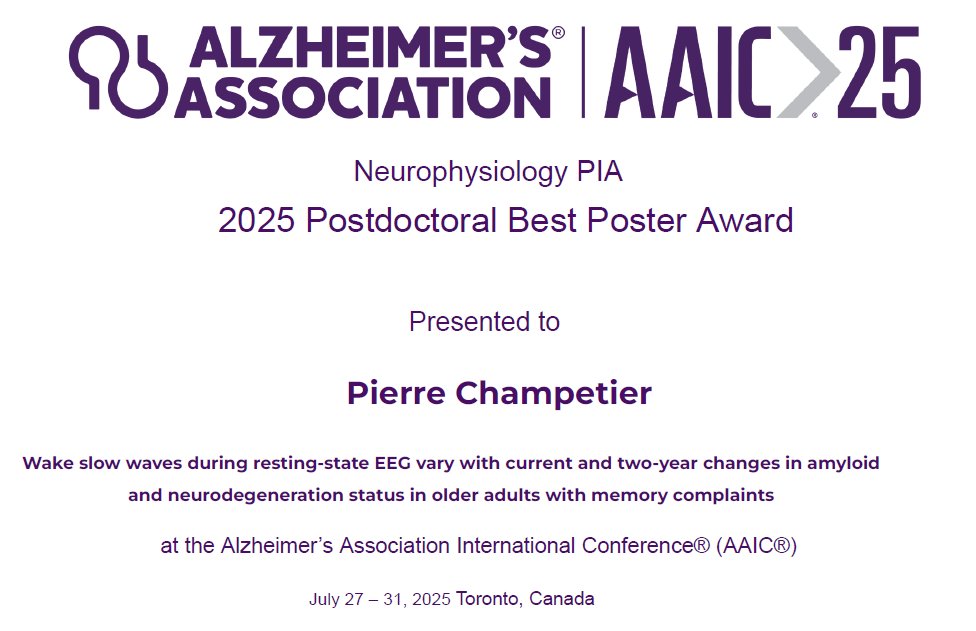
🙏 Honored and grateful to the Neurophysiology PIA for awarding me the ‘𝐏𝐨𝐬𝐭𝐝𝐨𝐜𝐭𝐨𝐫𝐚𝐥 𝐁𝐞𝐬𝐭 ��𝐨𝐬𝐭𝐞𝐫’ prize at AAIC (world’s largest research conference on Alzheimer’s disease and dementia) for my work on EEG wake slow waves in older adults 🧠
@alzassociation
📜 Just out in J. of Sleep Research!
Thrilled to share the last paper of my PhD, in which we delved into wake and sleep of expert meditators (>10,000 lifetime hours 🧘♂️), notably assessing EEG power, complexity, SW and spindles
#SleepResearch@ESRS_Sleep
https://t.co/tM1h4SIORx
Happy to present an online poster at the #AAIC25, entitled "Wake slow waves during resting-state EEG vary with current and two-year changes in amyloid and neurodegeneration status in older adults with memory complaints". Don't hesitate to contact me on the AAIC platform 😊
Nice paper on a new kind of brain rhythm in wake and REM sleep: iota oscillations (25–35 Hz) 🤯Interesting insight into fast activity beyond traditional bands, eager to know what is the cognitive relevance of this rhythm!
Many thanks to @FENSorg for awarding me a travel grant to attend the conference in Oslo and present my algorithm for automatic removal of cardiac artefacts 🫀 from EEG signals 🧠 without requiring an ECG 🤯! It will soon be implemented in SASICA toolbox (M.Chaumon). Stay tuned!
Happy to have contributed to this new study where we combined multiple approaches (hypnodensities, aperiodic activity, infraslow rhythms, spindle clustering, machine learning models...) to dive deeper into idiopathic hypersomnia with long sleep duration💤
https://t.co/6W97c4VYMw
If you’re curious about the feasibility of modulating sleep in humans, you might find our new perspective "stimulating".
https://t.co/mloX9KPVQG
Written with my wonderful colleagues @inesviolante@val_jaramillo and Michael Song.
Check out our new paper in SLEEP, linking resting-state fMRI connectivity and memory consolidation during sleep in older adults👵💤 Length of spindle trains modulated this relationship
Congrats to 1st author Anaïs Hamel! @ChetelatLab@ResearchSleep
https://t.co/fcpubxW768
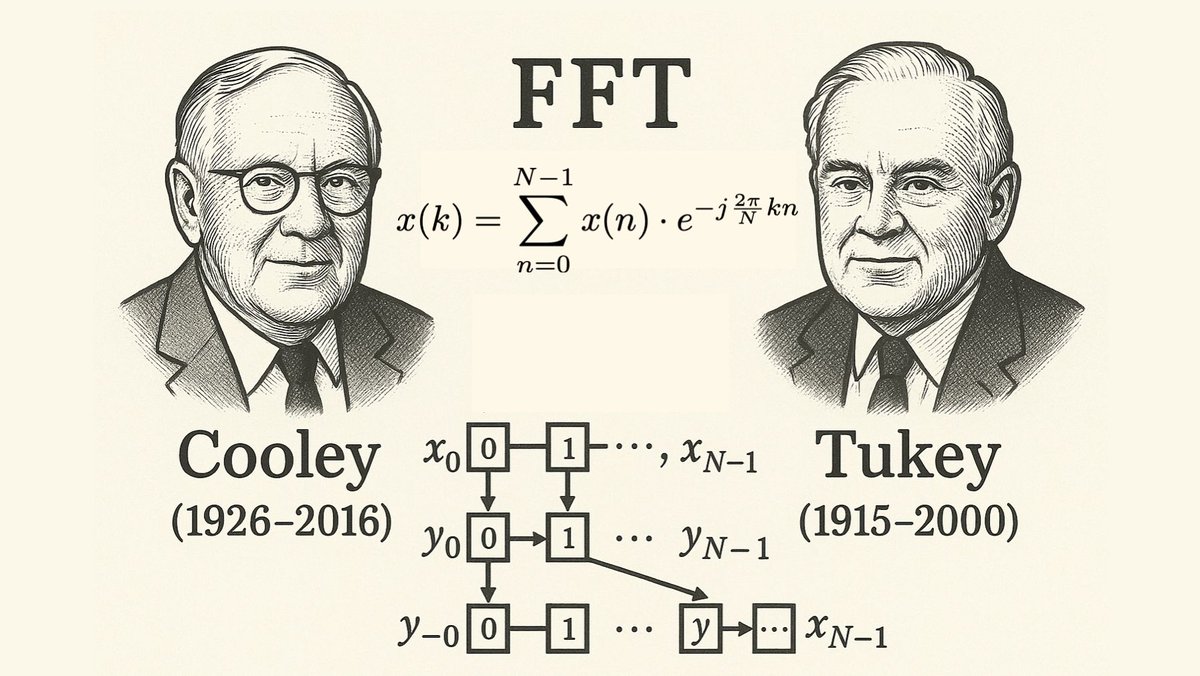
60 years ago this month, the Fast Fourier Transform (FFT) was introduced by Cooley & Tukey (1965) - one of the most important algorithms in signal processing and data analysis.
In 1805, Gauss - studying the orbits of asteroids Pallas and Juno - came up with a method to interpolate their trajectories from discrete samples. What he came up with was mathematically very close to the modern FFT but Gauss never published that work, and didn’t analyze its computational complexity. It predated even Fourier’s 1822 work on heat diffusion - but without the framing or generalization that Cooley & Tukey would bring 160 years later.
In 1965, Cooley & Tukey published their now-famous algorithm that reduced the cost of computing a Discrete Fourier Transform from 𝑂(𝑛²) to 𝑂(𝑛 log𝑛). This leap made real-time signal processing and digital media compression feasible.
From radio telescopes to JPEGs, from audio codecs to quantum mechanics - the FFT is everywhere. It’s one of the most important (and elegant) algorithms of the 20th century - rooted in the genius of Gauss, but brought to life in the computer age.