Why did #Vijay win? The easy answer is that Tamil voters were captivated by his film persona. What is harder is to understand the objective conditions that led to his rise. Cinema remains a powerful force in Tamil politics—there is no doubt about that. But look at what happened to Rajini, who announced his political entry and then immediately took a U-turn. Rajini, who was the biggest star in TN, never articulated his political framework. Vijayakanth formed a party in the Dravidian spectrum and made an impact, but eventually faded. AS for Kamal, the primary beneficiary of his political entry was Kamal himself. Even though Vijay formed his political party only in 2024, he had been preparing the ground for for years--not just through his movies but also by building a network of supporters and social welfare activities.
He carefully positioned himself within Tamil identity politics, casting himself as a critic of both mainstream fronts. In 2019, during final phase of the Sri Lankan civil war, when Tamil were being butchered by the army, he observed a fast in Chennai in solidarity with Sri Lankan Tamils. He supported the protest against the ban of Jallikkattu, opposed NEET and the three-language formula. In 2018, he visited the families of those killed by police in Thoothukudi during the anti-Sterlite protests (which was really a dark chapter of the AIADMK government). After he formed the #TVK, he called the #DMK its political rival and the BJP ideological rival. None of this offers a solid ideological commitment. But this provides a framework — Tamil identity politics, social justice message, anti-corruption crusade and a new contract, particularly for the youth — which, along with his star power (he is the biggest star in TN) made him especially appealing to the public. But that's not everything.
TN politics was also in a transformational phase, after Karunanidhi and Jayalalithaa, who dominated the state for decades, departed. DMK managed the transition well with #Stalin taking the reins of the party and leading it to victory in 2021, whereas the AIADK fell into disarray. Edappadi eventually emerged as the leader of the party, but the split between him and OPS, and the split of Dhinakaran and then the continued presence of Sasikala all weakened the party. The AIADMK's decline left a vacuum in the state, which was what the BJP tried to fill. Many here say the BJP, which won just one seat, was effectively running the AIADMK alliance. Vijay seemed to have exploited both the decline of the AIADMK and the anti-incumbency sentiments towards the DMK (there is genuine anger towards corruption and the family rule) with his populist, anti-establishment message. Actually the space the BJP wants to occupy is gone. I think the DMK will stay and fight back, the AIADMK will have to fight for survival.
This doesn't mean Vijay is going to be a saviour. The party is not constituted with clear ideological moorings. He remains a larger-than-life figure, a cult, something that’s not good for a healthy democracy. He is politically and administratively inexperienced, and it’s unclear what checks and balances will operate around him. It also remains to be seen whether he will give substantive shape to the political framework he has articulated, or evolve into a political shape-shifter.
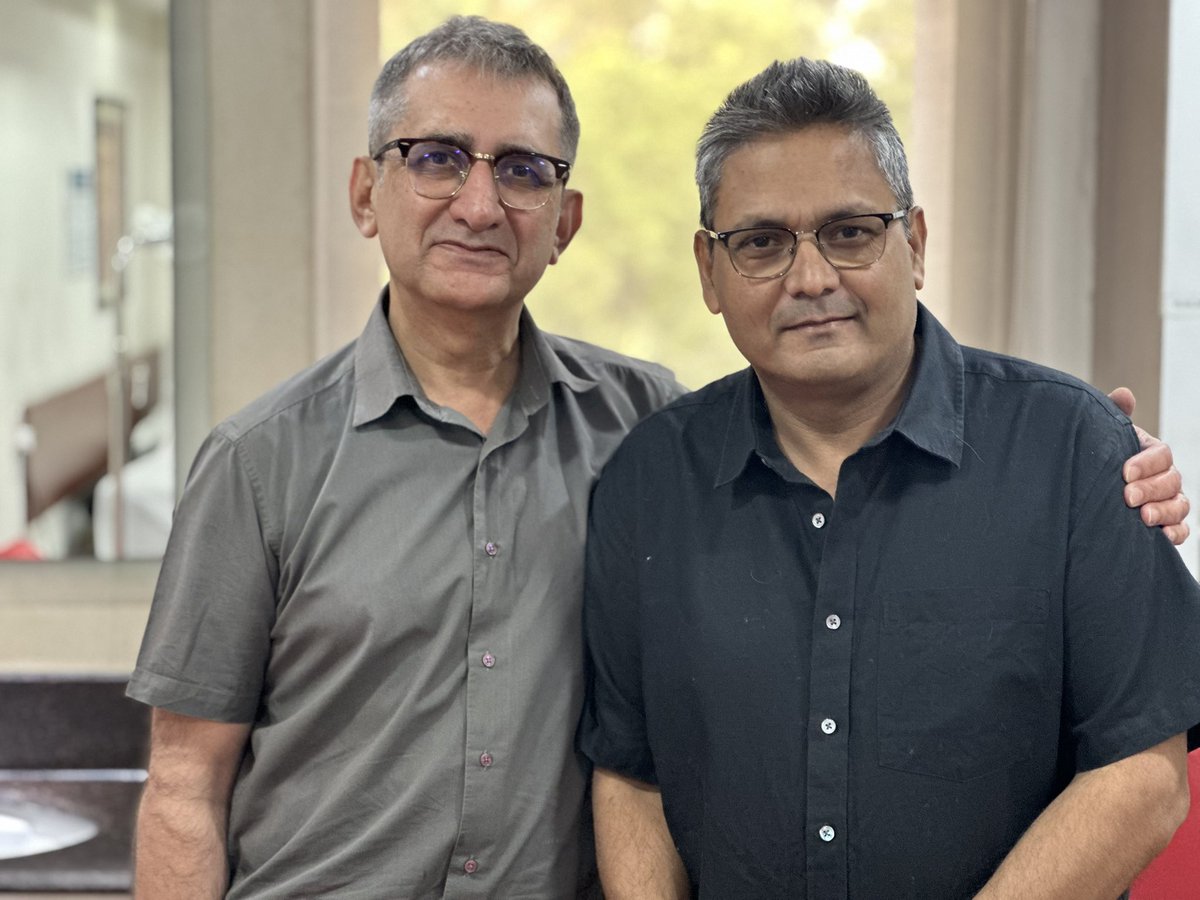
आह से आहा तक मोमेंट 🤞
किसी शल्य क्रिया के लिए डॉक्टर का सधा हाथ जितना ज़रूरी है उतना ही ज़रूरी होता है आपकी स्वास्थ्य संबंधी शंकाओं का शांत चित्त से समाधान… और इसमें इंद्रप्रस्थ अपोलो हॉस्पिटल, दिल्ली के डॉक्टर फ़ैसल मुमताज़ का कोई सानी नहीं…
आपका बहुत शुक्रिया डॉ फ़ैसल मुमताज़…
Make no mistake: trump backing down, 36 hours after issuing a massive threat, is a sign of weakness. Just two days ago, he had said he did not want to talk to anyone because he had won the war--everything, Iran's navy, air force, missile capability, was being destroyed. But now, he says he had "very good and productive conversations" with the "country of Iran" (note, not the 'terrorist regime of Iran'). I had written it here: the regime change window was closed on Feb 28 itself. trump gravely miscalculated Iran's response. The assassination of Khamenei was a grave strategic mistake (Indian sources tell me that their assessment was that Khamenei, whose health was failing, refused to move out of his office despite Israeli threats).
Since Feb 28, Iran has repeatedly rejected trump's ultimatums and social media threats and out-escalated him at every move. trump threatened to hit Iran 20 times harder if the Strait of Hormuz is shut–it remains shut; trump attacked Kharg Island, Iran attacked American bases in the Persian Gulf; Israel attacked South Pars; Iran attacked Qatar's Ras Laffan and refineries in Kuwait, Saudi Arabia, the UAE and Israel; Israel attacked Natanz; Tehran hit Dimona; trump threatened to obliterate Iran's power plants; Iran threatened to hit power plants and vital American financial interests across region. trump blinks. This is the third time trump shows weakness. The first was when he distanced himself from Israel’s strike on South Pars, following Iran’s region-wide retaliation; the second was when he eased sanctions on Iranian oil; and now, this U-turn.
One has to understand that trump's options are limited. One, he can back down, declaring victory. he tried to declare victory several times over the past week--but the problem is that the Strait of Hormuz remains shut. So he will have to talk to the Iranians. Else, he will have to send Marines for an operation at least along Iran's coast. It would be extremely risky, if not disastrous. On the other side, contrary to what trump and Netanyahu have claimed, Iran still has cards to play. They have attack capabilities in a target-rich environment; the Strait is under their control. Ansar Allah (the Houthis) still haven't joined the war. I guess trump realises that he can't attack Iranian power plants without triggering a massive retaliation from Tehran, which would change the course of the war. I know many people think this is a move aimed at manipulating markets. Could be. But I think trump has begun to realise that he is losing the war and he has to adapt.
Egyptian President Gamal Abdel Nasser’s nationalization of the Suez Canal, Britain, France, and Israel launched a coordinated military operation to seize control of the waterway.
On the battlefield, Britain was winning decisively. However, the real contest was unfolding in global financial market.
The United States, led by President Dwight Eisenhower, strongly opposed the invasion, fearing it would destabilize the Middle East and push Arab nations toward the Soviet Union.
Instead of intervening militarily, Washington deployed a far more effective weapon: the dollar.
The U.S. Treasury and Federal Reserve began exerting pressure on the British pound by encouraging its sell-off in global markets.
This triggered a sharp currency crisis, forcing the Bank of England to burn through its limited gold and dollar reserves to defend sterling.
Simultaneously, the United States blocked Britain’s access to emergency funding from the International Monetary Fund and threatened to dump U.S. holdings of British government bonds, which would have caused a sovereign default.
Within days, Britain faced the prospect of economic collapse unable to finance imports, stabilize its currency, or sustain the war effort.
Britain was compelled to accept a ceasefire and withdraw.
Now it’s returning to America with interest in Hormuz with London backing out while Tehran backed by Russia & China imposing petro yuan at the Toll Gate in Strait ! 😎
Medical Update :
The pacemaker implantation procedure for Sri. Kharge was successfully completed earlier today. It was a short and minor procedure and he has been stable after the procedure.
He is expected to resume his work from October 3 and attend all his scheduled engagements.
Our gratitude for the concern, support and affection extended by all.
❤️
सूचना
मित्रों
मैं एनडीटीवी से इस्तीफ़ा दे चुका हूँ। इस्तीफ़े के तुरंत बाद लिथुआनिया के दौरे पर चला गया था। अपनी तरफ़ से औपचारिक ऐलान के लिए देश लौटने का इंतज़ार कर रहा था। बीती रात लौटा हूँ और आज आप सभी को ये जानकारी दे रहा हूँ।
स्वतंत्र रूप से अपना काम शुरू कर दिया है। इसमें आप सभी का सहयोग चाहूँगा।
कारण और निवारण जैसे मुद्दों पर फिर कभी बात होगी… फ़िलहाल तो बस तन मन धन से मेरा साथ दीजिए।
अंत में बशीर बद्र साहब का ये शेर जो हौसला देता है
“हम भी दरिया हैं हमें अपना हुनर मालूम है
जिस तरफ़ भी चल पड़ेंगे रास्ता हो जाएगा”
मिलते हैं 🙏
Concluding thoughts
India demonstrated both its offensive and defensive capabilities during the four-day aerial engagement with Pakistan. On May 7, India hit deep inside Pakistan, including its heartland Punjab. It has sought to establish a new normal between the two countries--one where India responds to sub-conventional warfare with conventional military force. Pakistan's defences seemed porous, on May 7 and the morning of May 10th, when India launched significant attacks. Satellite imagery supports India's claims of hitting Pakistan's strategic sites, including the Nur Khan airbase in Rawalpindi, near Islamabad. So far, I haven’t not seen any credible evidence substantiating Pakistan's claims of having inflicted serious damage on India's strategic locations.
But there are still unanswered questions. This time, Pakistan, under Gen Munir, was prepared for India’s attacks. When India carried out the first strike, in response to the Pahalgam massacre, it had also offered an offramp. India said it had hit only terror infrastructure, not Pakistan's military facilities, and signalled that it did not want to escalate the situation. But Pakistan chose to widen the conflict by intensifying cross-border shelling and launching drones across the border (It's not difficult to understand the reason. If India wanted to set a new normal, Pakistan wanted to restore the status quo). What was interesting was that on May 8 and 9, Pakistan continued to deny that it was launching drones (it means Pakistan was preparing for its retaliation). And it launched its publicly acknowledged counterattack on May 10. Later in the day, Pakistan's DGMO reached out to India and both sides agreed to pull back from the brink, for now.
So the question is what led to the ceasefire. We know that JD Vance talked to Modi on May 9. Marco Rubio was in touch with both India and Pakistan. So were the Saudis. According to American media, the US stepped in after it got 'alarming intel'. What was the alarming intel? Trump said on May 12 that his government stopped “a nuclear war” between India and Pakistan. So the alarming intel was a Pakistani threat of nuclear attack? Or, as both sides started firing missiles into each other, did the Americans sense a dramatic escalation (which could spiral out of control and go nuclear) and decide to step in? We don't know. I don't buy into the theory that India hit Pakistan's nuclear storage facility which triggered the chain of events leading to the ceasefire--as there is no evidence to suggest this is credible.
So why did India accept the ceasefire, after Pakistan launched a massive missile and drone attack? Did we do that because of nuclear threats? The Prime Minister said on May 12 that India would not bend to nuclear blackmail. If one takes him seriously, there was only one explanation left. Pressure from Uncle Sam. If that is the case, Pakistan can send more gunmen across the border a few months, or years, down the line to kill more Indians, testing India's new doctrine and resolve. And if India responds militarily, Pakistan’s nuclear sabre rattling could bring in the Americans again. This will be a circular exercise without strategic results.
One area where India could really have done better was in messaging. The Indians would not be happy that it was Trump who announced the ceasefire. Pakistan quickly thanked Trump ‘for brokering the ceasefire’, fully aware that it would make India's position more difficult. What was particularly damaging was Trump's tweet on May 11th, in which he took credit for the ceasefire, re-hyphenated India and Pakistan, created a false equivalence between the two countries (despite Pakistan’s long ties with terror groups, including al-Qaeda) and offered third party mediation--all against India's standard, historical, national position on Pakistan–it took two days for India to respond to Trump’s remarks. Even domestically India could have done better in messaging. While Pakistanis were celebrating what they portrayed as "victory", despite suffering strikes on more than two dozen locations–in India, trolls were viciously attacking the diplomat who announced the ceasefire, and his family.
Today, Union Bank of India, Regional office,Patna has organised Mega MSME Outreach Programme at Patna, where Hon'ble Dy CM Sri Samrat Chaudhary Ji was Guest of Honor and in all total loans sanction/in principle sanctions to a tune of 50 Crores were accorded under various schemes.
पप्पू यादव जी के मां बीमार हैं 🥹
बस एक मां ही तो है, इसके बाद किसके सहारे जिएंगे। भगवान ने पहले ही बहुत कुछ इनसे ले लिया है,
आप सभी लोग प्रार्थना करिए जल्द ठीक हों जाए।
लंग कैंसर की बीमारी से लंबे समय से जूझ रहे बीबीसी के सहयोगी पत्रकार रवि प्रकाश का शुक्रवार को मुंबई में निधन हो गया. उन्हें इसी महीने की शुरुआत में अमेरिका में वर्ल्ड कैंसर कॉन्फ्रेंस में पेशेंट एडवोकेसी एडुकेशनल अवॉर्ड से सम्मानित किया गया था.
पूरी स्टोरी- https://t.co/uixVObNGYH