Ever wondered how the cognitive map is read out? Check out our paper just out in @NatureNeuro : "Hippocampal theta sweeps indicate goal direction during navigation" (https://t.co/885CmAyQgi).
Huge thanks to my collaborator and mentor Máté Lengyel. Interested in hearing more? Come talk to me during poster session 3 (9.30am on July 8th at HALL A #203). And as a bonus, I can give you some spoilers on our ongoing work of modelling hippocampal place cell with HSR. 4/4
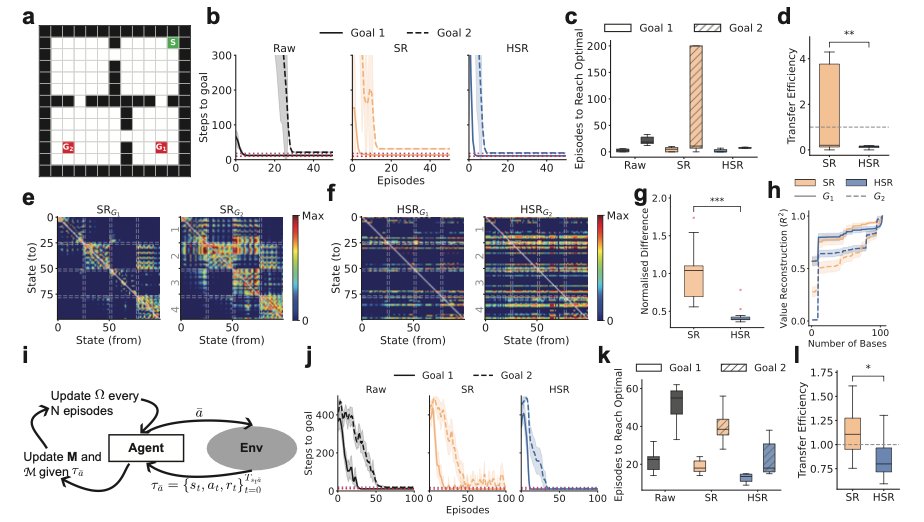
Excited to share our #ICML2026 spotlight✨: Hierarchical successor representation for robust transfer. https://t.co/oGgdkzgzU3... We ask a simple question: can RL agents generalise efficiently under changing goals given its existing knowledge about the environment structure? 1/
Empirically, these hierarchical predictive maps support stronger sample efficiency of learning, transfer efficiency to new goals, and stability. These improvements persist even when options are not provided a priori and need to be constructed online. 3/
Huge thanks to my amazing collaborators: @zilong_ji , Jake Ormond, John O'Keefe, and especially @NeilBurgess10 for constantly pushing me to move beyond trivial questions and think deeper.
Ever wondered how the cognitive map is read out? Check out our paper just out in @NatureNeuro : "Hippocampal theta sweeps indicate goal direction during navigation" (https://t.co/885CmAyQgi).
A hierarchical CAN reproduces goal-directed theta sweeps, and predicts further results on goal-dependent phase coding and goal-directed egocentric directional tuning in place cells.
A critical initialization for biological neural networks
Spontaneous brain activity is often treated as noise: the background hum of a nervous system waiting for a task. But large-scale recordings in mice have shown something more structured. Even in darkness, without explicit stimuli, thousands of neurons display coordinated activity patterns that extend across the brain and persist far longer than the fast biophysical timescales of individual neurons.
Marius Pachitariu and coauthors ask a simple question: could this macroscopic structure emerge from a simple kind of network initialization?
Their answer connects neuroscience, random matrix theory and machine learning. They model spontaneous neural activity as linear dynamics governed by a random connectivity matrix, stabilized by a global inhibitory-like normalization. When this matrix is symmetric and critically normalized, with its largest eigenvalue very close to one, the network naturally produces high-dimensional activity modes with a power-law covariance spectrum.
This is not just a mathematical curiosity. The same spectral structure appears in large-scale mouse recordings from cortex and brainwide Neuropixels data, with power-law exponents around 0.7–0.85. Hippocampal CA1 is the striking exception: its activity looks less correlated, closer to an efficient, high-capacity code for information storage.
The ML perspective is especially interesting. In artificial neural networks, initialization is often treated as a technical detail: Xavier, He, orthogonal schemes, and so on. But this paper reframes initialization as a computational substrate. A critically initialized recurrent system can generate slow, global, high-dimensional modes before task-specific learning. In simulations, these dynamics support time-dependent computations, including zero-shot working memory tasks.
The biological implication is powerful: spontaneous activity may not be random noise, but a preconfigured dynamical scaffold on which learning and computation can operate. The brain may start from an initialization already close to useful temporal memory, with learning then shaping readouts or task-specific pathways.
For R&D teams building ML systems in drug discovery, materials development, energy research or biotechnology, the lesson is broader than neuroscience. Initialization, architecture and dynamics define what kinds of scientific signals a model can preserve, combine and retrieve before training. In applied research pipelines where data are scarce, noisy and time-dependent, designing the right dynamical substrate may be as important as choosing the loss function.
Source: Pachitariu et al., Nature (2026) — CC BY 4.0 | https://t.co/oE37FfYmKc
Interested in the latest advances in neuroscience (neural dynamics and internal models) and how they can be leveraged to build smarter, adaptive AI?
➡️ My first real solo piece 🖤🫶 @NatureNeuro
https://t.co/oa0Ky1qDZN
✨🥰 check out our article - and cover 🤩- about Decoding the Brain in @CellCellPress
https://t.co/HWBquErj0f
We review the mathematics, current approaches, and muse about the future…
#BCI#neuraldecoding#neuroAI
Thanks to my awesome co-authors Adriana Perez Rotondo, Edward Chang, @AToliasLab & @TrackingPlumes
Time-compressed theta sequences, representational drift, and flickering between alternate representations are fascinating network phenomena. Now we reveal what they have in common and how and when they emerge and express via generative processes:
https://t.co/INfpKbD36J 1/5
AI that can improve itself: A deep dive into self-improving AI and the Darwin-Gödel Machine.
https://t.co/EZOVg43PyT
Excellent blog post by @richardcsuwandi reviewing the Darwin Gödel Machine (DGM) and future implications.
I wish to thank my co-authors, @replayprof and Brad Pfeiffer for providing the neural data for our analysis, @KrisTorpJensen for helping with the Bayesian GPFA implementation. Please come to the poster session 1 (#545) tomorrow (starting 10am) if you are interested! (10/10)
Ever wondered how could neural activity may vary substantially even when experimentally controlled or observed variables do not change? Checkout our #ICLR2025 Spotlight paper w/ Maneesh Sahani and @lengyel_m: https://t.co/e8YJxw1xmt (1/n)
Latent 0 exhibits spatial selectivity for the home location. The fact that it is not only activated upon reaching the home well (red star), but also over the late, stationary periods of foraging trials suggests the rediscovery of goal-oriented hippocampal (p)replay. (9/n)